Telegram Tap to Earn Game Development: Features, Cost & Launch Process
Key Takeaways:
- Strategic Value: Tap-to-earn games convert simple user actions into ongoing engagement and community growth within telegram.
- Development Stack: They are built using telegram bots, mini apps, secure backend logic, reward systems, analytics, and anti-bot protection.
- Growth Benefits: These games help drive fast user acquisition, improve retention, encourage referrals, and support multiple monetization models.
- Industry Applications: Commonly used for Web3 onboarding, token launches, loyalty programs, and digital marketing campaigns.
- Market Direction: The model is evolving toward sustainable rewards, stronger security measures, deeper token utility, and scalable infrastructure.
Introduction
The development of telegram tap to earn games has evolved from the basic tapping principles. These were born as simple click games and have expanded into full engagement systems with telegram mini applications, bots, reward logic, referrals, token-driven economies, anti-bot security, wallets, analytics and community-led growth. Success now is not so much about how fast you can tap, but how well the whole ecosystem is built to hold people and keep rewarding them over time.
You’ll get a breakdown about telegram tap to earn game development in this blog, including key features, cost structure, development methodology, integration of bots and mini apps, monetization strategies, launch schedule, and how to choose the best development partner. The goal is to provide a clear, useful understanding of how these technologies actually work in real deployments.
What Is a Telegram Tap to Earn Game?
A Telegram tap-to-earn game is a simple interactive game that runs directly within telegram. Players can earn rewards for completing tasks, adding friends, tapping and moving through stages. All this is done through a telegram bot, a mini software interface or sometimes a Web3-enabled layer connected to wallets and tokens instead of installing a separate software.
The tap-based income is core to the experience but it’s only the beginning. Most games also have leaderboards to add a competitive element, daily chores to keep players busy, and referral bonuses to encourage growth. Engagement is often driven by adding boosters that let users accelerate their earning rate or unlock faster progress.
Depending on whether the game is Web2- or Web3-focused, rewards typically come in the form of points or tokens. The idea behind these systems is to encourage a decent amount of community involvement over time . Players don ‘t just play alone , they also help grow the ecosystem by interacting and inviting others.
The design simplicity of these games makes them scalable and easy to use, especially for Web3 projects and businesses who want to quickly build up lively telegram communities.
If you want to understand how blockchain powers reward systems and token distribution in games, check out our detailed guide on What Are Smart Contracts in Blockchain to see how secure logic and smart contracts support in-game rewards.
Why Telegram Is Ideal for Tap-to-Earn Game Development?
Telegram removes all the usual friction that slows down user growth, which is why it works so well for tap-to-earn games. No lengthy registration process, no software to download, no waiting. Retention is immediately improved because people can join via a link and start interacting in seconds.
The onboarding process is mostly done by bots and it feels more conversational and seamless than technical. Sharing is now almost trivially easy once inside. Telegram has groups and channels that are very good for organic content promotion and can lead to game proliferation at no great marketing expense.
But the real advantage is that everything is already being driven by the community. Users are already used to being part of active communities and so referral based growth feels like a natural extension rather than forced. And then you add prizes on top of that, people will inevitably invite others.
Mini apps are a step further, allowing a full gaming experience within telegram without sending users away. On top of that, you have a crypto-savvy audience already familiar with wallets and tokens, creating a natural condition for Web3-style interaction. Telegram is an amazing space for these games because of the combination of rapidity, community conduct and virality built-in.
Core Features of a Successful Telegram Tap-to-Earn Game
At first glance, a good telegram tap-to-earn game seems simple. And behind the scenes, there’s a combination of engagement loops, incentive logic and backend mechanics that keep user activity up, without breaking the economy.
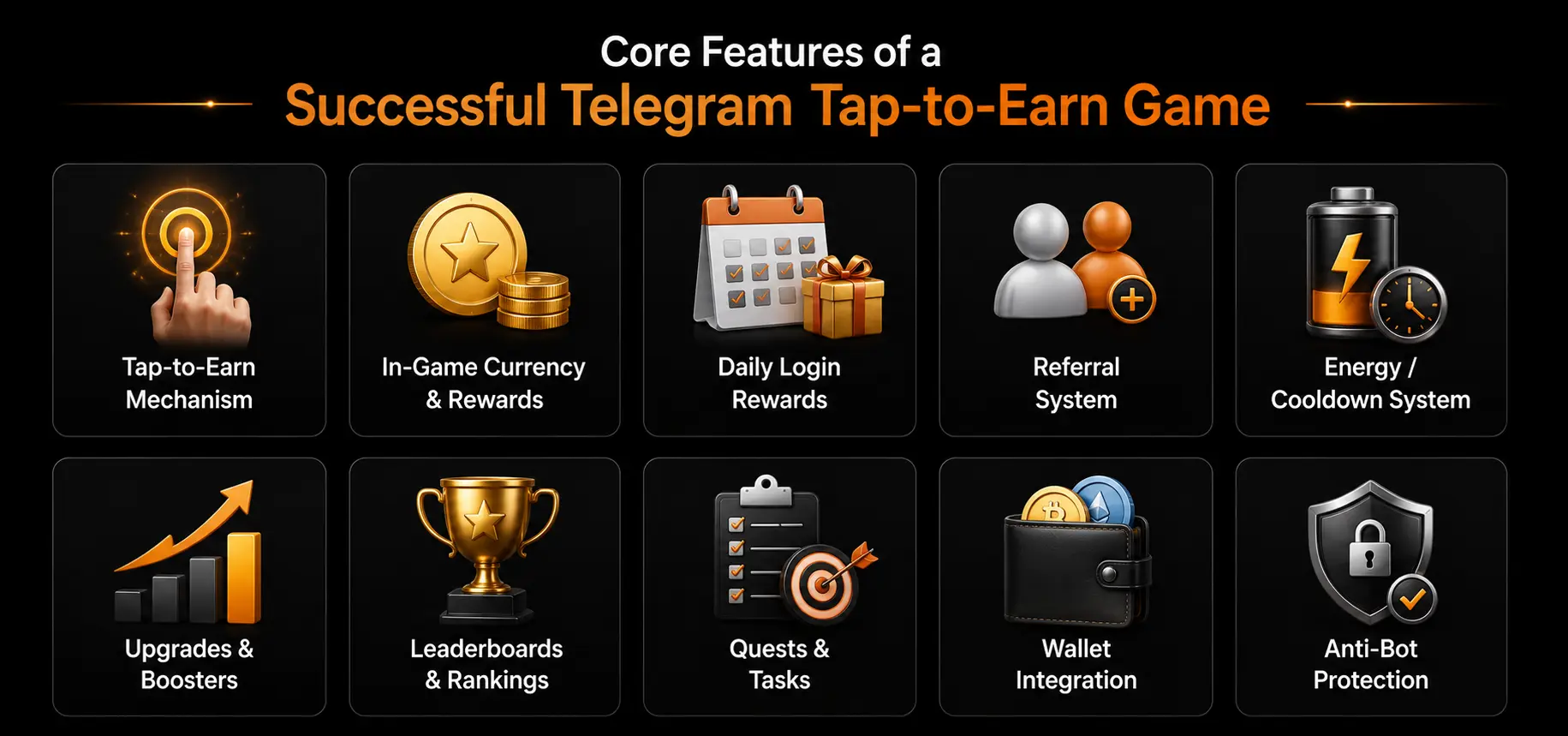
Here’s a clear breakdown of the core features and what they actually do:
| Feature |
Purpose |
| Tap-Based Earning System |
Allows users to earn coins, points, or rewards through repeated actions |
| Telegram Bot Integration |
Handles onboarding, commands, notifications, and game access |
| Telegram Mini App Interface |
Provides the visual game experience inside Telegram |
| Daily Login Rewards |
Encourages users to return every day |
| Referral System |
Helps the game grow through invite-based rewards |
| Energy / Cooldown System |
Prevents unlimited tapping and balances the economy |
| Boosters and Upgrades |
Allows users to improve earning speed or unlock progress |
| Leaderboards |
Builds competition and community engagement |
| Quest and Task System |
Rewards users for social tasks, missions, and campaigns |
| Wallet Integration |
Connects user rewards with crypto wallets or token claims |
| Anti-Bot Protection |
Prevents fake activity and reward farming |
| Admin Dashboard |
Helps the business manage users, rewards, campaigns, and analytics |
What matters most is the connections between all of things. Users actively play in the mini app; the bot is generally the first point of contact; and the backend discreetly ensures fairness by verifying actions and handling incentives.
If any one of these components is weak, the system as a whole quickly becomes unstable. Strong anti-bot logic, proper reward design, and real time tracking are thus as important as the game interface itself.
Tracking user engagement and optimizing game retention is critical; learn more about analytics-driven game insights in our blog on AI and Its Presence in the Gaming Industry
Telegram Tap to Earn Bot Game Development: How It Works
In telegram tap to earn bot game development, everything works as a connected flow between telegram bot, mini App, backend system and admin dashboard. Each layer serves a specific purpose, from bringing users aboard to monitoring actions and validating rewards. You want to have total control and accuracy behind the scenes, but have a seamless user experience. This is how the system normally works as a whole in real life.
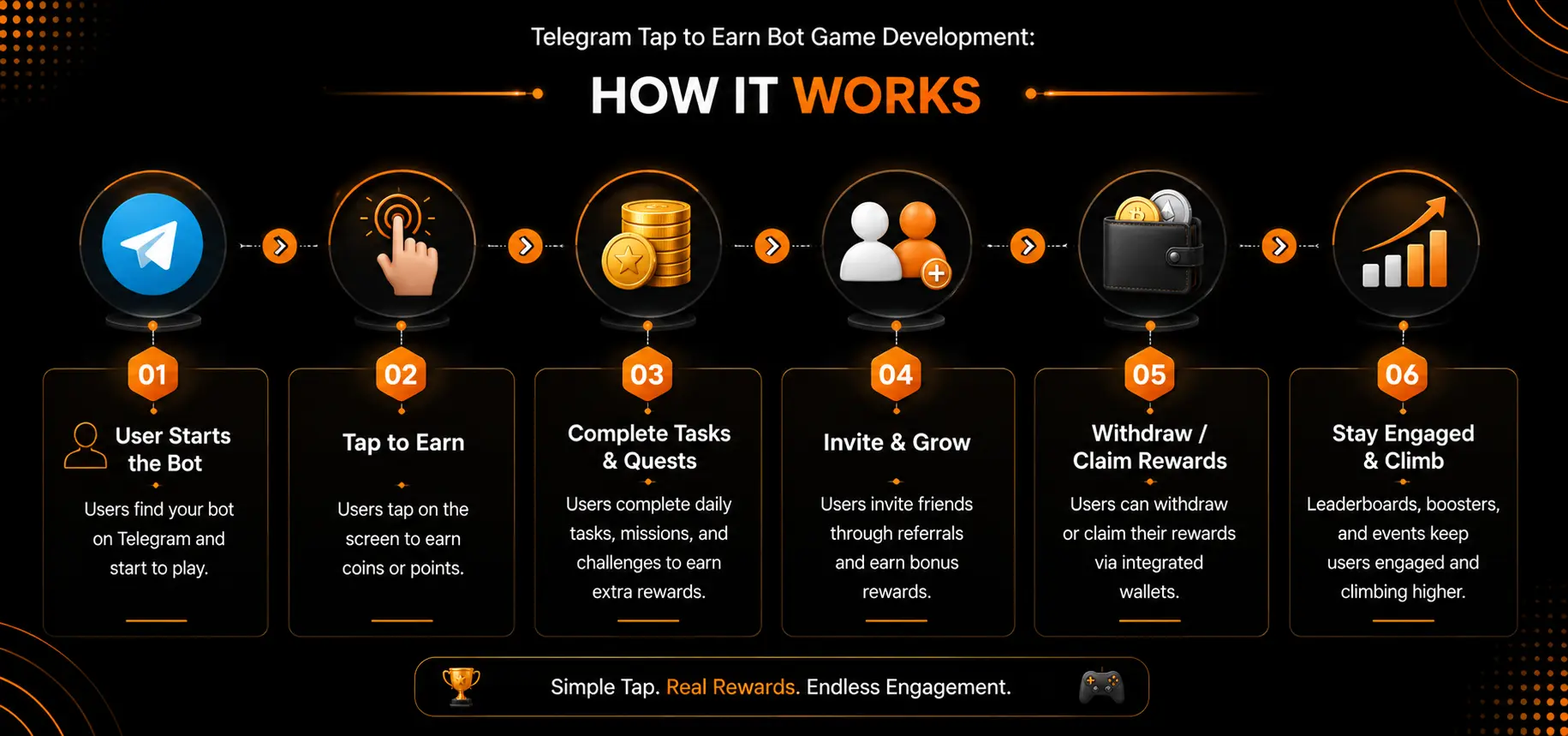
- Bot Entry Flow
To get to the mini app experience, the user has to open the telegram bot that acts as an entry point.
- Mini App Launch
The bot redirects the user to the mini app, where the gaming, tapping actions, tasks and engagement elements are fully presented and available.
- User Actions Logged
Every tap, completed task and interaction is logged and sent to backend systems to measure activity and track engagement.
- Backend Validation Check
The backend validates each user activity to avoid false taps, and only real engagement is counted before the incentive is distributed.
- Reward Allocation System
Upon validation, coins or tokens are credited to the user’s account depending on participation, referrals and task completion.
- Referral Tracking Logic
The system tracks invites, link shares and friend joins to make sure proper attribution can be given and users are rewarded for organic growth.
- Wallet Integration Flow
If Web3 is enabled, users connect wallets to claim tokens or NFTs through a secure backend and smart contract flow. Integrating wallets securely is a key part of Web3 games; our detailed walkthrough in Solana DeFi Development: Complete Guide explains how blockchain-backed wallets work.
- Admin Monitoring System
The Admin dashboard tracks user activity, searches for fraud trends, monitors campaigns and ensures seamless gameplay in real time. Strong backend validation is critical for any reward-based game that relies on real user activity. According to Gartner, continuous threat and fraud management can reduce abuse impact by over 40 percent, making it essential for preventing fake activity and reward manipulation.
Tap to Earn Game Development Process
Building the code for your features is only part of building a tap-to-earn game. Another is designing a system that can scale, retain players, and manage prizes without breaking down. A good game development process keeps everything aligned from idea to launch and past it.
- Define the Game Objective
Every project begins with a specific goal. This could be the development of a community, the introduction of a token, brand interaction, loyalty benefits, or a whole Web3 gaming environment. It charts the path for all that comes after. Designing an MVP with smooth onboarding and interactive features is essential; check our step-by-step guide on How to Build a Standout MVP for Gitex Global for best practices in game development
- Plan Game Economy and Rewards
Next comes the reward system. This covers points, tokens, boosters, referral caps, energy systems and how users claim/withdraw rewards. Game sustainability is based on a balanced economy. Designing a balanced in-game economy is crucial; check Top Real Estate Tokenization Platforms in Dubai to understand structured token distribution models.
- Design UI/UX and Game Flow
At this stage, the user experience is more important. We have designed several screens like tap interface, dashboard, quests, leaderboard, referral area, wallet page and admin views to make navigation easy and interesting.
- Develop Telegram Bot and Mini App
The bot handles communication and onboarding, and the mini app is where the actual gameplay happens. Together they give users a smooth flow of entry and interaction.
- Build Backend and Reward Validation
This is the main engine. This is where all this is handled to keep the system fair. Secure databases, referral tracking, cooldown logic, fraud detection, score validation.
- Add Blockchain and Wallet Integration
If the game has Web3 features, in-game awards are tied to real assets through smart contracts, token rewards, staking options, NFTs, or wallet links.
- Test, Launch, and Monitor
Load testing, anti-bot verification and quality assurance tests are all carried out before going online. After the launch, the performance and behavior of the users are continuously tracked to improve the system. This systematic approach helps in converting an easy idea into a scalable and sustainable engagement platform rather than a mere fad game.
Cost to Develop Telegram Tap to Earn Game in 2026
The cost of creating a telegram tap-to-earn game in 2026 will largely depend on the complexity of the system and the desired user experience. More complex ecosystems will require deeper backend infrastructure, blockchain connection, and long-term scaling planning, but a basic MVP can be built for idea testing and early community building. You generally spend more as you add more security, more automation, and more complex rewards.
Here is a clear breakdown of typical development costs:
| Game Type |
Estimated Cost |
Best For |
| Basic MVP Tap-to-Earn Game |
$10,000–$25,000 |
Testing idea, simple reward game, early community |
| Growth-Ready Telegram Web3 Game |
$25,000–$70,000 |
Token campaigns, wallet integration, referrals, quests |
| Advanced Tap-to-Earn Game Ecosystem |
$70,000–$120,000+ |
Scalable Web3 game, tokenomics, anti-bot, analytics, LiveOps |
Industry benchmarks say MVP builds start around $12,000, which include models like Cipher9. Depending upon breadth and complexity, complex ecosystems can cost in excess of $100,000. The total cost is determined by the construction of telegram bots and mini apps, backend architecture, blockchain integration (if smart contracts are involved) and UI and UX design.
Costs increase further when blockchain features are added. Smart contracts, wallet integration, and tokenomics design require careful engineering, especially when security and abuse prevention are priorities. Anti-bot systems, analytics dashboards, admin panels, cloud hosting, and security testing all contribute to building a stable and scalable platform.
In simple terms, the more future-ready and secure the system is, the higher the upfront investment, but the stronger the long-term performance and trust.
IBM highlights that smart contracts improve transparency and security but require careful engineering to avoid long-term vulnerabilities.
Key Factors That Affect Tap-to-Earn Game Development Cost
It’s not just frontend or design but a lot of technical and strategic decisions that affect the pricing of a tap-to-earn game. As new features are added to the system, the complexity of the backend, the way awards are administered, and the security of user activity tracking all change. Each layer has a direct impact on overall development effort and cash flow, from blockchain integration to gameplay mechanics.
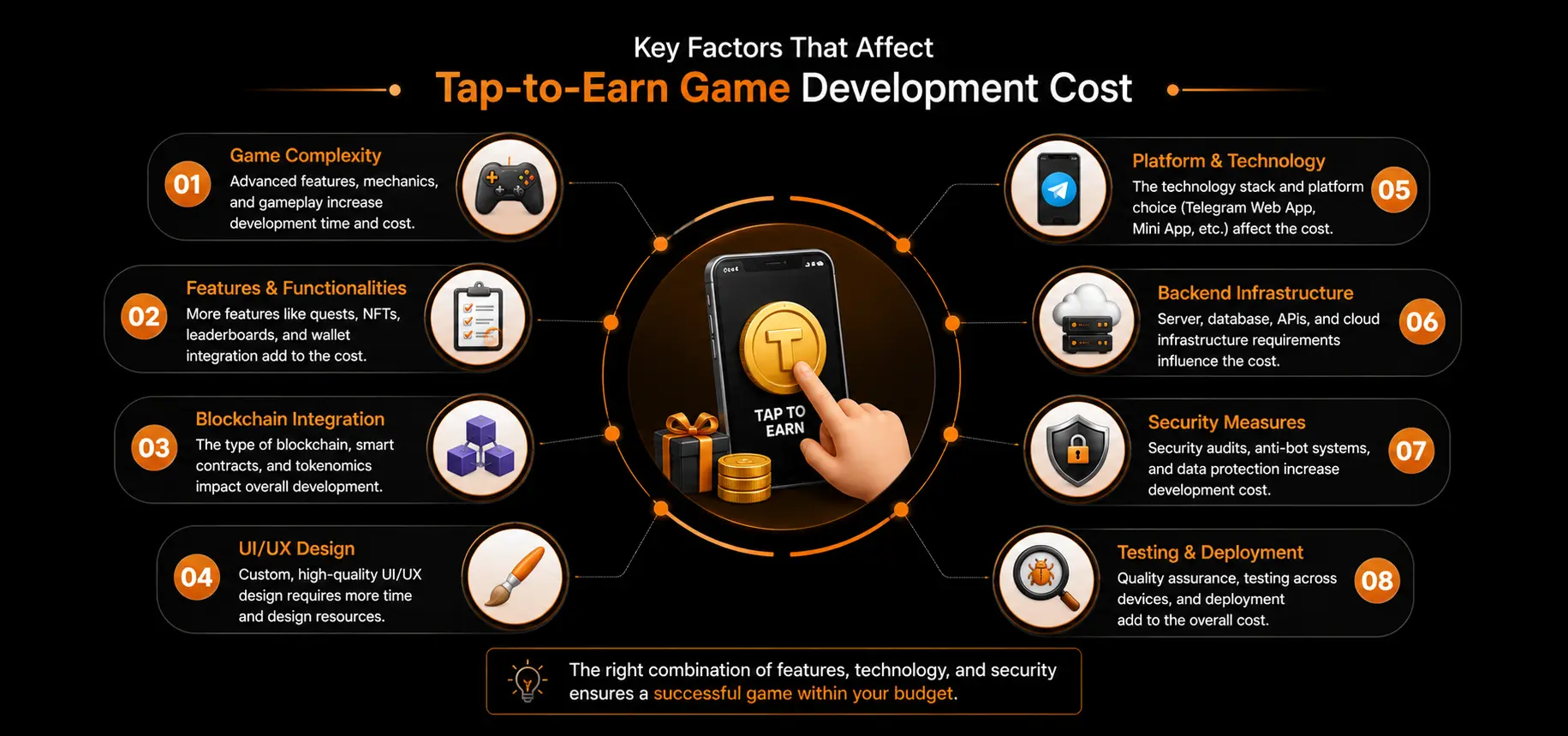
- Game Mechanics Complexity
More complex gameplay requires additional logic, animations, balancing, and backend coordination, which greatly increases development time, effort, and planning of system architecture.
- Reward System Types
Different types of rewards, like coins, tokens, NFTs, or bonuses, need tracking systems and organized logic and careful balance to prevent inflation problems.
- Referral Quest Systems
The need to track user behaviors, verify validity, and prevent misuse greatly increases the backend complexity and development burden of referral and quest modules.
- Token Model Choice
Non-token models are simpler, and they have a direct impact on the architecture, compliance, and long-term scaling requirements, while token-based systems require connection to a blockchain.
- Smart Contract Needs
For incentives, transfers, and ownership, smart contracts leverage blockchain logic, requiring secure coding, audits, and additional development expertise for reliability.
- Anti Bot Protection
Fraud prevention solutions complicate the backend and system reliability requirements significantly by detecting fraudulent users, automating behavior checks and protecting the integrity of incentives.
- Backend Scalability Setup
Cloud infrastructure, load balancing, and stable database design are essential for a scalable backend to ensure smooth performance when traffic spikes.
- Admin Dashboard Complexity
Advanced dashboards include user monitoring, reward control, campaign management, and analytics tools. They require additional frontend and backend development resources.
- Analytics LiveOps Tools
Analytics and live operations systems track performance, engagement and retention, which help optimize the gaming experience and require ongoing data processing and monitoring systems.
- Launch Marketing Support
Marketing integration includes campaign tracking, referral bonuses, and user acquisition tools and increases collaboration between the development, growth, and analytics teams.
Monetization Models for Telegram Tap-to-Earn Games
There are different ways to earn money from the telegram tap-to-earn games. Most effective systems are built with multiple earning tiers that balance user engagement and long-term economic viability. These approaches make money from attention, activity, and community engagement rather than just games.
- In-Game Boosters and Upgrades
Players often buy boosters that improve the speed of earning, energy restrictions, or unlock faster progression. This technique is effective as it directly improves the user experience and drives revenue growth.
- Sponsored Quests
Tasks within the game may be sponsored by brands or cryptocurrency initiatives. Generally, these quests include activities such as tracking pages, participating in communities, or completing simple engagement tasks.
- Token Utility
Tokens have tangible uses in Web3-based applications beyond incentives. They can be used to access premium areas of the ecosystem, stake, collect perks and unlock features.
- NFT Rewards
NFTs add a layer of exclusivity and ownership. They could represent rare achievements, special privileges or rare in-game goods that increase player motivation. Effective monetization relies on boosters, sponsored quests, and token utility; explore Cryptocurrency Exchange Development for monetization models in token-driven platforms
- Advertising and Partnerships
Campaign placements and partnerships are often ways to monetize attention for games with sizable telegram communities. This is very effective when user engagement is constantly strong.
Launch Process for a Telegram Tap-to-Earn Game
Getting a telegram tap-to-earn game up and running takes time. It’s more like a phased rollout, where every phase is an opportunity to test, stabilize, and then eventually scale the system. An organized launch process helps avert early issues, gaming and a poor user experience as traffic begins to increase.
- Pre-Launch
This stage focuses on building early momentum. Waitlist opens, game premise is revealed, and a telegram community is created. Teams also develop referral campaigns and review the bot flow to make onboarding smooth.
- Soft Launch
The game is released first to a select group of people. This helps you find issues, check reward balance, look for bot abuse and test the server functionality under real use.
- Public Launch
It will be released for everyone once it is stable. Here mass engagement is driven by leaderboard competitions, quests, influencer marketing, referral campaigns and community events.
- Post Launch LiveOps
Once it’s launched, the main goal is retention. Seasonal events, new boosters, reward upgrades, wallet claims, NFT decreases and constant anti-bot monitoring all keep the ecosystem lively. Continuous monitoring and live operations improve retention; learn strategies from The Business Advantages of AI-Driven Mobile App Development to optimize post-launch performance
- Token or Airdrop Launch
This phase specifies the criteria for eligibility, vesting plans, wallet claim procedures, and anti-farming measures to ensure fair distribution and long-term trust, should the game contain Web3 prizes.
A well-planned launch like this is what separates short-term hype from a sustainable tap-to-earn ecosystem.
Common Mistakes to Avoid in Tap-to-Earn Game Development
Most tap-to-earn games fail not because the premise is bad but because the underlying mechanics are not built to scale. If a project rushes to get to market and overlooks the fundamentals like balance, security and long-term engagement, it often stumbles once the real consumers start using the site. When it comes to reward-based systems, especially, strong foundations are more important than flashy features because even the smallest vulnerabilities can be exploited.
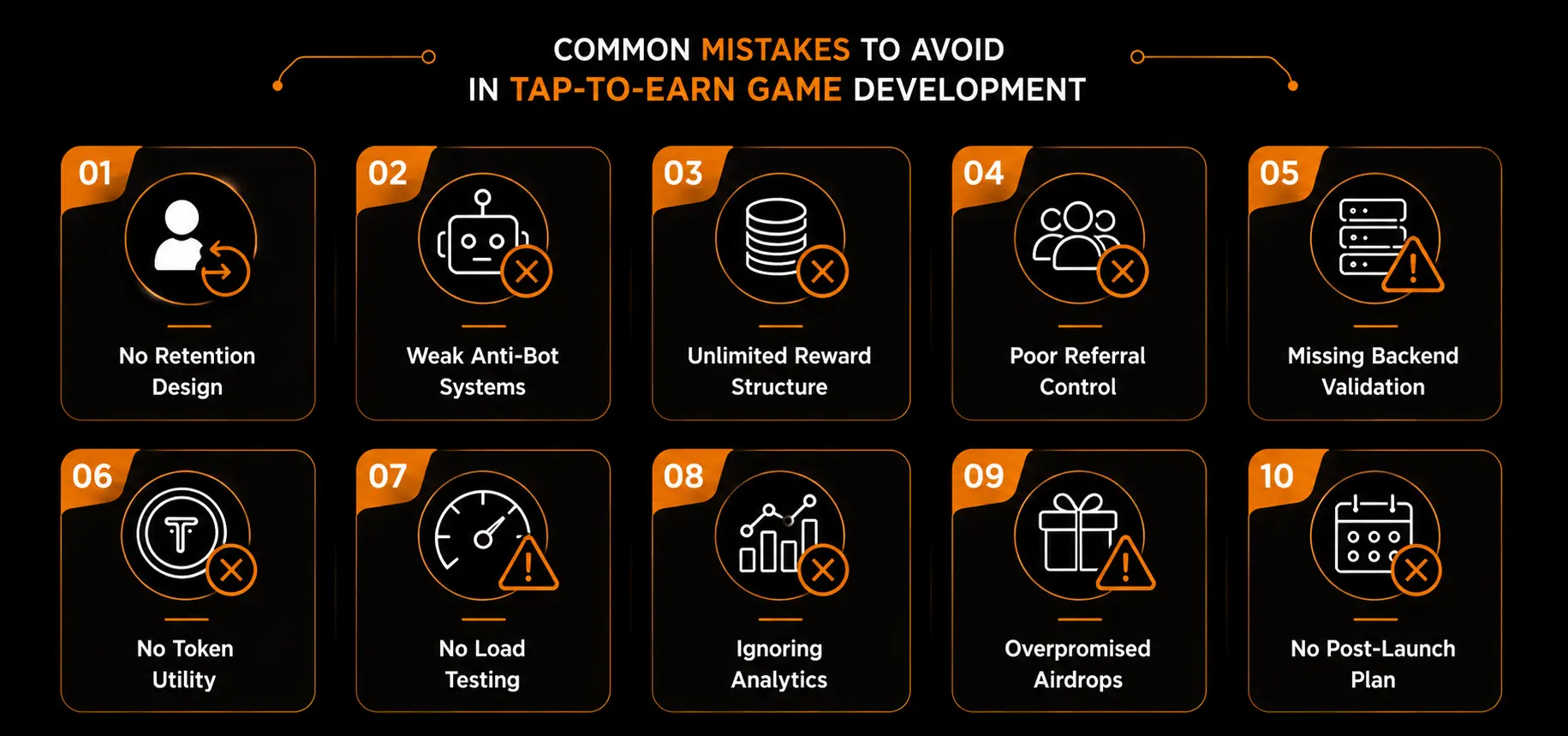
- No Retention Design
Games without daily prizes, objectives or progression loops where the only action is tapping quickly lose users’ interest after the initial thrill.
- Weak Anti Bot Systems
Poor fraud detection allows automated scripts and fake players to take advantage of the prizes as well, damaging the long-term sustainability and economic balance of the game.
- Unlimited Reward Structure
The game economy inflates , decreasing the value of awards and removing incentives for real user involvement and participation .
- Poor Referral Control
Fake accounts are leveraged to exploit referral networks because of the lack of good regulations on tracking, decreasing fairness and completely disrupting the organic growth patterns.
- Missing Backend Validation
Users may also manipulate taps, referrals and prizes, which may lead to incorrect system behavior if activities are not validated on the server side.
- No Token Utility
Tokens that are not actually used within the ecosystem quickly depreciate, which decreases user interest, and significantly weakens long-term engagement and retention levels.
- No Load Testing
If you go live without stress testing you’ll have a bad user experience and you’ll lose the early momentum of growth. This causes problems during times of high traffic.
- Ignoring Analytics
Without tracking data, teams have no insight into how users behave, how many users are retained, or how to optimize gaming enhancements based on real performance insight.
- Overpromised Airdrops
Unrealistic promises of incentives lead to bad emotion, community discontent and trust issues, when distribution does not meet early expectations or claims.
- No Post Launch Plan
Users will get bored quickly and the game cannot maintain long-term engagement cycles without updates, events or new content.
How to Choose the Right Tap to Earn Game Development Company?
The success or failure of your tap-to-earn game depends on who you choose as your partner in the development process. A cohesive team does a lot more than just write code. They understand the long term scalability, security threats, reward balance and user behavior. This section helps you assess a tap-to-earn game development company that is able to not only build a basic game but also help you scale from launch to scale.
Teams with proven blockchain development services are better equipped to handle smart contracts, token security, and long-term reward integrity.
- Telegram Platform Experience
Look for demonstrated expertise in telegram bots and mini apps that can support large volumes of traffic without compromising user experience or reward logic.
- Web3 Game Expertise
The team should understand the basics of Web3 gaming such as wallet onboarding, on-chain logic, offchain balances and actual user incentive structures.
- Tokenomics Planning Skills
Many tokenomics plans are aimed at reducing inflation, farmer abuse and economic collapse, while maintaining sustainable incentives and long-term user motivation.
- Smart Contract Development
If your business uses blockchain, then you must secure smart contracts to protect your money, prizes and game logic from being exploited.
- Scalable Backend Architecture
We require a robust backend for processing referrals, quests, traffic spikes, real-time validation and distributing prizes efficiently.
- Anti Bot and Fraud Control
Observe how they regulate farming, detect abuse, identify bots and verify genuine player activity throughout the system.
- UI and UX Design Quality
The straightforward design makes fast, fun and simple gameplay for Web2 and Web3 users around the world.
- Analytics and Admin Dashboards
Integrated analytics assist in monitoring expansion, economic conditions, abuse trends and post-launch decision optimization.
- Deployment and Post-Deployment Support
The perfect partner doesn’t disappear after deployment, but allows for updates, fixes, optimizations, and long-term scaling.
Conclusion
Telegram’s tap-to-earn games are very effective. They leverage the massive reach of the telegram community, referral-driven growth, and cutting-edge Web3 incentives with simple gameplay. Tapping is where users begin, but it’s the right features, scalable backend, secure reward logic, anti-bot protection, wallet integration, insightful analytics and a solid launch plan that leads to real success. Without one, even the biggest idea can quickly lose momentum.
The execution is just as important as the concept if you want to make something that actually sticks and grows. Talk to the experts at ChicMic Studios to develop a secure, scalable and launch-ready telegram tap-to-earn game for your Web3 community or gaming company! Bring your idea to life with a thrilling live experience.
Frequently Asked Questions
1. What is telegram tap to earn game development?
Telegram tap to earn game development is the process of creating a game inside telegram where users earn points, coins, or tokens by tapping, completing tasks, joining quests, and inviting friends. These games are designed to grow communities quickly while keeping gameplay simple and addictive.
2. How much does it cost to develop a telegram tap-to-earn game?
The cost usually ranges from 10000 dollars to 120000 dollars or more. Pricing depends on game complexity, telegram bot and mini app setup, backend infrastructure, wallet integration, blockchain features, anti bot systems, and analytics depth.
3. How long does it take to build a telegram tap-to-earn game?
A basic MVP can be built in three to five weeks. A growth ready version usually takes six to ten weeks. Large Web3 ecosystems may take twelve to sixteen weeks or longer.
4. What features should a tap-to-earn game include?
Core features include tap based earning, telegram bot flow, mini app interface, daily rewards, referrals, quests, boosters, leaderboards, analytics, admin controls, and strong anti bot protection.
5. Can a telegram tap-to-earn game include crypto rewards?
Yes. Games can offer tokens, NFTs, wallet claims, staking, or point based rewards. The economy must be planned carefully to prevent abuse and ensure long term sustainability.
6. How do I choose a tap to earn game development company?
Look for proven experience in telegram mini apps, bot development, Web3 gaming, smart contracts, tokenomics, scalable backend systems, anti bot protection, and post launch support.