Enterprise AI Agent Development: How to Automate Complex Business Workflows
Key Takeaways
- Core Value: Enterprise AI agents automate complex workflows, reduce manual effort, and help teams make faster, more informed business decisions.
- Key Capabilities: They understand requests, connect multiple business systems, make context-aware decisions, and execute end-to-end workflows with minimal human intervention.
- Business Impact: Organizations improve productivity, reduce operational delays, increase accuracy, and scale business processes without significantly increasing manual work.
- Use Cases: Enterprise AI agents support customer service, HR, finance, sales, operations, procurement, and other departments with intelligent workflow automation.
- Getting Started: Start with one high-impact workflow, prepare quality data, integrate existing systems, and expand automation based on measurable business results.
Introduction
Businesses are generating more data than ever before, but many teams still spend hours on repetitive work. They switch between systems, seek approvals, update records, and repeat the same questions daily. Enterprise AI agent development is helping businesses to go beyond basic automation. Instead of carrying out one task at a time, AI agents understand context, make decisions based on business rules, integrate with various apps to perform complete workflows with minimal human intervention.
That’s why organizations are finding smarter ways to work across customer support, finance, HR, operations and sales. AI agents handle routine tasks, so employees have more time to solve problems and work on things that generate real value. In this blog, you’ll learn what enterprise AI agents are, how they work, where they make the biggest impact, and what to consider before bringing them into your business. Businesses looking to adopt AI often begin by exploring AI development services that align with their long term automation goals.
Why Traditional Automation Isn’t Enough Anymore?
Traditional automation has helped reduce repetitive tasks and has also helped businesses save time, but it is limited. Automation tends to glitch when a procedure changes or something unexpected happens, and someone has to jump in. That’s because most automation solutions are built to follow hard rules and not take changing conditions into account.
Now think about a typical workday. The client asks a question that’s not in the script. A supplier submits incomplete documentation. A sales contract needs legal approval before it can move forward. Or the finance team sees some unusual expense. AI agents really help in these circumstances which call for context and judgment. They can comprehend what is going on, assess the information that is available, and take the next appropriate step within the guidelines you have laid out, instead of just following directions.
What Is Enterprise AI Agent Development?
The goal of enterprise AI agent development is to develop AI agents that can perform business tasks with minimal human intervention. Many enterprise AI solutions also combine machine learning to improve predictions and continuously optimize business workflows. Unlike traditional systems that only respond to questions or follow a predefined set of instructions, these AI agents understand requests, gather data across multiple systems, make decisions based on business rules, and execute complete workflows from start to finish.
Now consider a simple leave of absence request. An AI agent can instead check an employee’s available leave balance, review corporate policies, submit the request, notify the manager, track approvals, update HR records, and even inform payroll if needed, rather than directing employees to the leave application form. The worker doesn’t need to keep checking on the request or be going back and forth across different systems. Everyone involved benefits from one seamless approach that speeds up and simplifies their work.
How Enterprise AI Agents Work?
Enterprise AI agents follow a specific procedure to perform corporate activities effectively. They understand user demands, gather data from associated systems, decide according to business rules, and perform the required tasks with minimal human help.
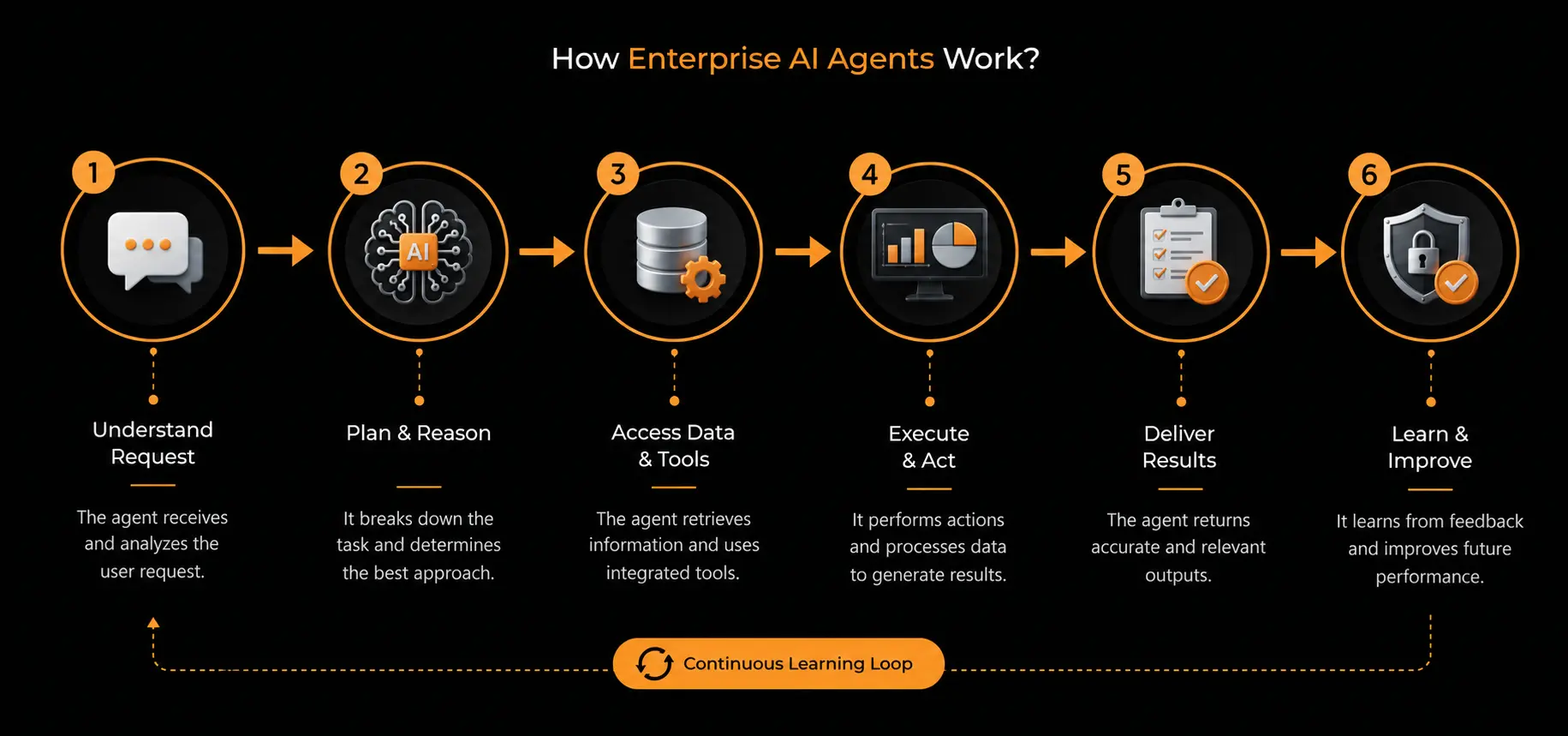
1. They Understand Requests
AI agents understand requests in natural language, not relying on exact commands. This enables workers to have organic conversations without having to understand complex routines or systems.
2. They Gather Information
AI agents pull relevant information from connected programs, such as internal databases, business documents, CRM, ERP and HR software. Reliable database development helps AI agents access accurate information and keep workflows running smoothly. So, you don’t have to look around on different platforms.
3. They Make Decisions
Once the necessary data has been collected, AI agents evaluate the situation using predefined business rules. They automatically escalate requests that need human approval or violate company policies.
4. They Execute Workflows
Once a decision is taken, the relevant tasks are performed by AI agents. They can issue tickets, send notifications, execute approvals, change information and maintain workflows without human assistance.
What Makes Enterprise AI Agents Different?
Many businesses feel that chatbots, AI agents, and traditional automation tools all do the same thing. Both want to help you improve efficiency, but they do it in very different ways. Traditional automation is based on rules. AI agents are able to adapt to changing circumstances and perform more complex tasks.
| Traditional Automation Tools |
Enterprise AI Agents |
| Rule-based workflows |
Goal-oriented workflows |
| Fixed sequences |
Dynamic decision-making |
| Limited flexibility |
Adapts to changing situations |
| Single-system automation |
Cross-platform execution |
| Requires manual intervention |
Handles many exceptions independently |
| Task automation |
End-to-end workflow automation |
The key difference is flexibility. Enterprise AI agents can span across systems, adapt to changing business conditions, and complete end-to-end workflows rather than discrete tasks. A practical comparison of agentic AI vs generative AI can help teams choose the right approach.
Where Businesses Are Using Enterprise AI Agents
Enterprise AI agents are not dedicated to a specific department. Businesses often integrate them into existing web development projects to create connected digital ecosystems. They can accelerate response times, automate repetitive work and help staff focus on jobs that require human judgment and knowledge and can help teams across the business.
1. Customer Support
Customer service teams handle hundreds of questions daily, many of which are repetitive. AI agents could also extract customer info, categorize support cases, reply to FAQs, and forward complicated cases to the right team. Customers get faster responses and support personnel get to spend more time on complex case resolutions. Teams planning this use case can review how an AI chatbot for customer support improves response workflows.
2. Human Resources
HR departments are frequently responsible for a variety of tasks from onboarding new employees to processing leave requests and answering questions about policies. AI agents can automate these repetitive procedures to reduce administrative load and smooth access to information. Solutions like Maica can answer routine employee queries through natural voice conversations and direct more complex requests to the appropriate HR team. This allows HR specialists to focus more on talent development and employee engagement.
3. Finance
Finance departments need fast, accurate processes. With financial reporting, purchase approvals, expense verification and invoice processing, AI agents can assist while maintaining set business standards. It builds consistency, reduces manual effort and helps teams to process financial tasks more efficiently. Many organizations also combine workflow automation with generative AI to improve reporting and document creation.
4. Sales
AI agents can schedule follow-ups, generate meeting summaries, qualify leads, update CRM records, and organize customer data. For example, Maica helps businesses engage with inbound callers, qualify sales opportunities, schedule appointments, and route prospects to the appropriate sales representative. This reduces repetitive administrative work and allows sales teams to focus on building customer relationships and closing deals.
5. Operations
Operations teams are responsible for the efficient running of company processes across a number of departments. AI agents can send notifications, assign tasks, monitor workflows and detect delays before they become larger problems. This helps businesses retain efficiency and improve coordination as they expand. Reliable deployments also benefit from structured DevOps services.
The Main Benefits of Enterprise AI Agent Development
AI agents are used by businesses for more than automation. The real value is in making the day-to-day work better, taking away physical work, and helping teams work more effectively with their time. These are some of the amazing benefits organizations experience after adopting enterprise AI agents. Leaders can also study why AI is shaping enterprise app development.
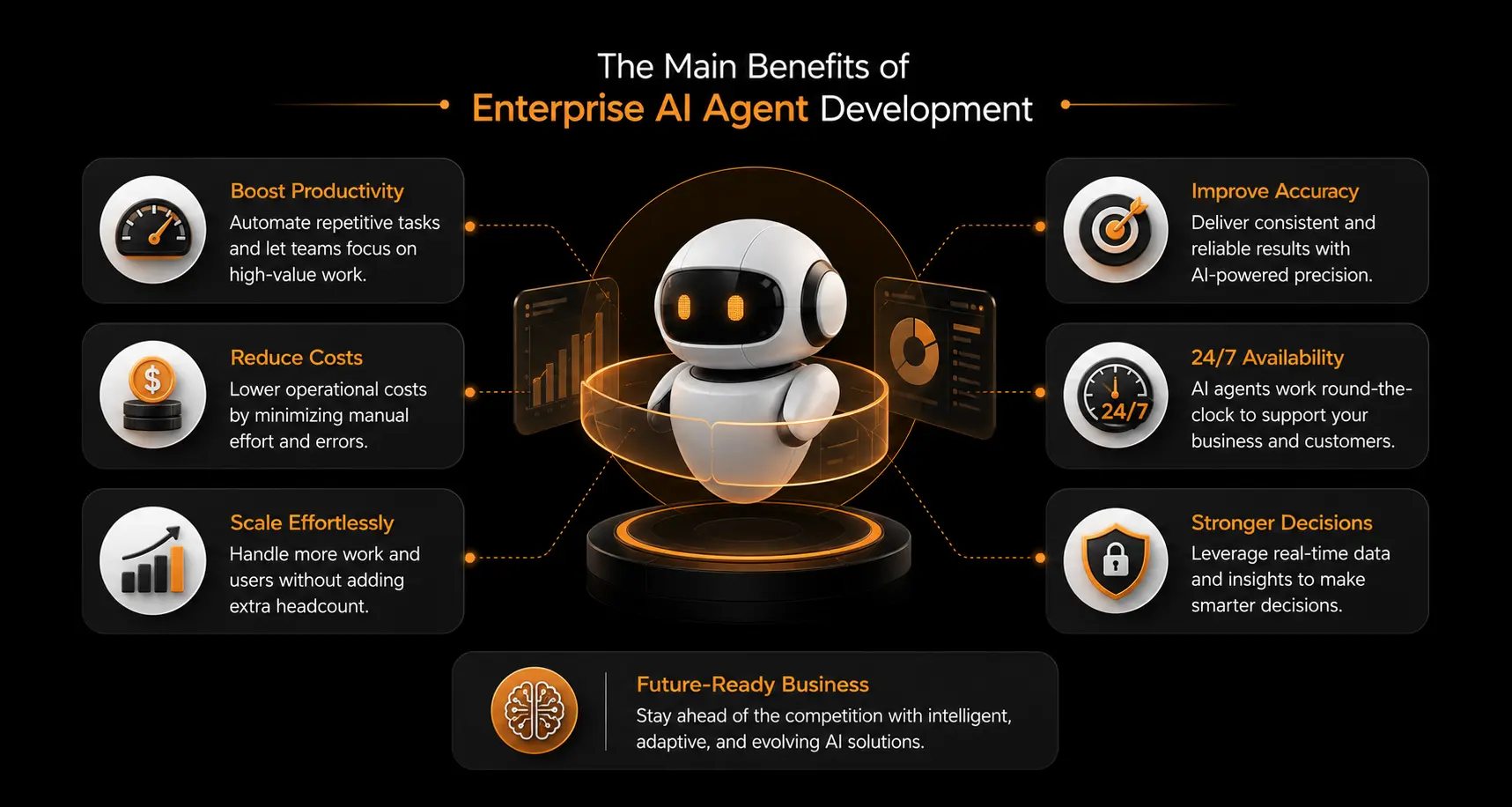
1. Faster Workflows
AI agents enable organizations to accelerate processes significantly by automatically routing jobs through teams, systems and approvals.
2. Higher Team Productivity
AI agents take care of boring admin work, freeing up staff time to focus on core projects, innovation and customer engagement.
3. Better Accuracy and Consistency
AI agents constantly follow defined business standards and help companies to keep consistent operations across multiple departments and reduce human error.
4. Smarter Decision Making
Where human judgment or approval is required, they will assess the information available, select the best option and escalate where situations are challenging.
5. Easier Business Growth
AI agents enable businesses to efficiently cope with the increasing workload and facilitate expansion without a significant administrative burden.
Real-World Examples of AI Agents in Action
Many businesses already have enterprise AI agents that automate routine procedures in their business. You can also explore real implementation examples in an AI portfolio to understand how enterprise AI is applied across industries. Here are some real world examples of how they increase productivity, and reduce manual labor. For broader project planning, review what to look for in AI agent development services.
1. Customer Support
AI agents help the team provide faster, more reliable service by answering frequently asked questions, routing support tickets, retrieving customer data, and escalating complex issues.
2. Employee Onboarding
They speed up onboarding by providing paperwork, setting up accounts, scheduling training and tracking progress, and they reduce the administrative burden on HR staff.
3. Procurement Approvals
AI agents speed up procurement processes and make sure of compliance by checking budgets, going through company rules, routing approvals and alerting stakeholders.
4. Sales Lead Qualification
They analyze customer data, help qualify leads, suggest next steps and update CRM records all of which help sales teams focus on the highest-value opportunities.
Enterprise AI Agents vs Traditional Automation
Legacy automation and enterprise AI agents are often thought to work in the same way by many companies. Both help automate processes, but they differ in the way they perform activities, make decisions and adapt to changing business needs.
| Comparison |
Enterprise AI Agents |
Traditional Automation (RPA) |
| Purpose |
Automates complete business workflows |
Automates repetitive rule-based tasks |
| Decision-Making |
Makes context-aware decisions using business rules |
Follows predefined instructions only |
| Flexibility |
Adapts to changing situations |
Works best with fixed workflows |
| Workflow Coverage |
Manages end-to-end business processes |
Automates individual tasks or steps |
| System Integration |
Connects multiple business applications |
Integrates with selected systems |
| Human Involvement |
Handles routine decisions and escalates exceptions |
Requires manual intervention when processes change |
Traditional automation works best for repetitive tasks, whereas enterprise AI agents are built for complex workflows that require context, flexibility, and intelligent decision making.
Common Challenges Businesses Face
There are many advantages, but implementing AI agents is not simply a matter of installing new software. Success is only for those who plan carefully and set realistic expectations. Thorough quality assurance helps identify workflow issues before AI agents are deployed into production. A clear responsible AI strategy also reduces governance and compliance risks.
1. Poor Data Quality
Before deploying enterprise AI agents, businesses need reliable data management. If business data is out-of-date or inconsistent, it can lower AI accuracy. Strong models often begin with a dependable custom LLM development plan.
2. Disconnected Business Systems
Without good communication between business systems, AI agents have a hard time getting all the information needed to automate workflows successfully. API orchestration can be supported by scalable Node.js development.
3. Automating Too Much Too Soon
If you start all workflows at once, the complexity increases. Automate the easy stuff and the repetitive tasks that have the greatest impact. Teams can start faster with a focused no-code or low-code development approach for simpler workflows.
4. Limited Human Oversight
Humans still control sensitive decisions and AI agents do regular tasks properly with clear approval procedures and human supervision.
Best Practices for Successful Enterprise AI Agent Development
The organizations that get the best results usually adopt a methodical rather than a “jump right in” approach to implementation.
- Focus on one business problem: Before rolling out AI across multiple functions, focus on a measurable issue.
- Know how you work today: Before you automate, know how work happens today.
- Establish clear success metrics: Track results such as cost savings, productivity, accuracy, and response time.
- Keep people in the loop: If necessary, leave important decisions and approvals up to staff.
- Monitor and improve continuously: Check the performance of AI regularly and improve workflows as the needs of the company evolve.
Enterprise AI agents are still in development. Continuous improvement helps businesses optimize long term value and adapt to changing operational requirements.
Common Myths About Enterprise AI Agents
As enterprise AI grows, so does the misconception. By separating myths from reality, businesses can make intelligent decisions about deploying AI agents.
Myth: AI Agents Will Replace Employees
Reality: AI agents take over tedious tasks, freeing up staff to focus on strategy, innovative problem solving and building closer relationships with clients.
Myth: Enterprise AI Agents Are Only for Large Businesses
Reality: AI agents are available for businesses of any size. Many companies start with one workflow and add more workflows as their needs change.
Myth: AI Agents Operate Without Human Control
Reality: Enterprise AI agents follow specific business rules, approval procedures and governance policies, so critical decisions are transparent and accountable.
Conclusion
Enterprise AI agents are changing the way businesses handle everyday work. Instead of spending hours on repetitive tasks, teams can focus on solving problems, serving customers, and making better business decisions. The result is a workplace that runs more efficiently without adding unnecessary complexity.
The key to success is starting with the right process instead of trying to automate everything at once. Identify one workflow where AI can create a real impact, measure the results, and improve from there. A thoughtful approach makes it easier to scale automation over time and achieve lasting business value.
Frequently Asked Questions
1. What is Enterprise AI Agent Development?
Enterprise AI agent development is the process of building AI agents that can understand business requests, connect with enterprise systems, make decisions based on predefined rules, and automate complete workflows with minimal human intervention.
2.How are enterprise AI agents different from traditional automation?
Traditional automation follows fixed rules and works best for repetitive tasks. Enterprise AI agents can understand context, adapt to changing situations, and manage end to end workflows across multiple business systems.
3. Which business processes can be automated using enterprise AI agents?
Enterprise AI agents can automate customer support, employee onboarding, invoice processing, procurement approvals, lead qualification, document management, reporting, and many other repetitive business workflows.
4. Which industries benefit the most from enterprise AI agent development?
Industries such as healthcare, finance, retail, manufacturing, logistics, education, insurance, and professional services benefit significantly because they manage large volumes of repetitive operational processes.
5. Are enterprise AI agents secure for business use?
Yes, enterprise AI agents can be deployed with role based access controls, encryption, authentication, audit logs, and governance policies to help protect business data and meet compliance requirements.
6. Can enterprise AI agents work with existing business software?
Yes, most enterprise AI agents can integrate with CRM platforms, ERP systems, HR software, customer support tools, databases, and other business applications through APIs and connectors.
7. Will enterprise AI agents replace employees?
No, enterprise AI agents are designed to automate repetitive work and support employees, allowing them to focus on strategic thinking, customer relationships, and higher value responsibilities.
8. How long does enterprise AI agent development take?
Implementation timelines depend on workflow complexity, system integrations, and business requirements. Small projects may take a few weeks, while larger enterprise deployments are usually completed in phases.
9. How do businesses get started with enterprise AI agent development?
The best approach is to begin with one repetitive, high impact workflow. Once the AI agent delivers measurable results, businesses can gradually expand automation across other departments.
10. What should businesses consider before implementing enterprise AI agents?
Businesses should evaluate their existing workflows, data quality, system integrations, security requirements, and business goals before implementing AI agents to ensure successful adoption and long term value.