Key Takeaways
- Development Cost: Building an extraction shooter involves much more than graphics. Multiplayer systems, AI, backend infrastructure, and live-service features account for most of the development budget.
- Core Features: Successful extraction shooters rely on dedicated servers, persistent inventories, matchmaking, loot systems, intelligent AI, and seamless multiplayer experiences.
- Cost Factors: Project scope, game complexity, backend architecture, networking, and post-launch support all influence the overall development cost.
- Best Practices: Starting with a vertical slice, prioritizing core systems, using proven technologies, and planning live operations early help reduce costs and development risks.
- Future Growth: Live-service updates, scalable infrastructure, cross-platform support, and continuous content are essential for long-term player engagement and commercial success.
Introduction
The successful development of an extraction shooter no longer depends solely on the development of exceptional gunplay. Now, players want solid progression, high-stakes loot systems, smart AI enemies, and seamless multiplayer experiences that make sure that every raid is interesting. That is why the extraction shooter game development cost is much higher than that of many traditional multiplayer games. Building these systems requires expertise in game development that goes far beyond traditional multiplayer titles. That means every system from player progression to networking has to work flawlessly for the genre’s infamous high-risk, high-reward gameplay to be delivered.
ARC Raiders, Escape from Tarkov, Hunt: Showdown and Dark and Darker are some examples of just how deep and interesting this genre can get and the bar is now higher than ever. At the same time, they have highlighted the technical complexity of creating these experiences. Dedicated servers, persistent inventories, live-service updates, and anti-cheat protection all take continuous investment and expertise. In this blog, we’ll discuss the main factors affecting development costs, what the studios spend most of their money on and how to make a realistic budget for developing an extraction shooter.
Why Extraction Shooters Are More Expensive Than Traditional Multiplayer Games?
The extraction shooter genre has become one of the most technologically complex genres in the modern game development world. Extraction games are a hybrid of AI-driven PvE content, persistent progression, and player economies with competitive PvP, as opposed to traditional PvP shooters that are reset with each match. You’re not building a game that resets after every game, you’re building a connected ecosystem where every decision has long-term consequences.
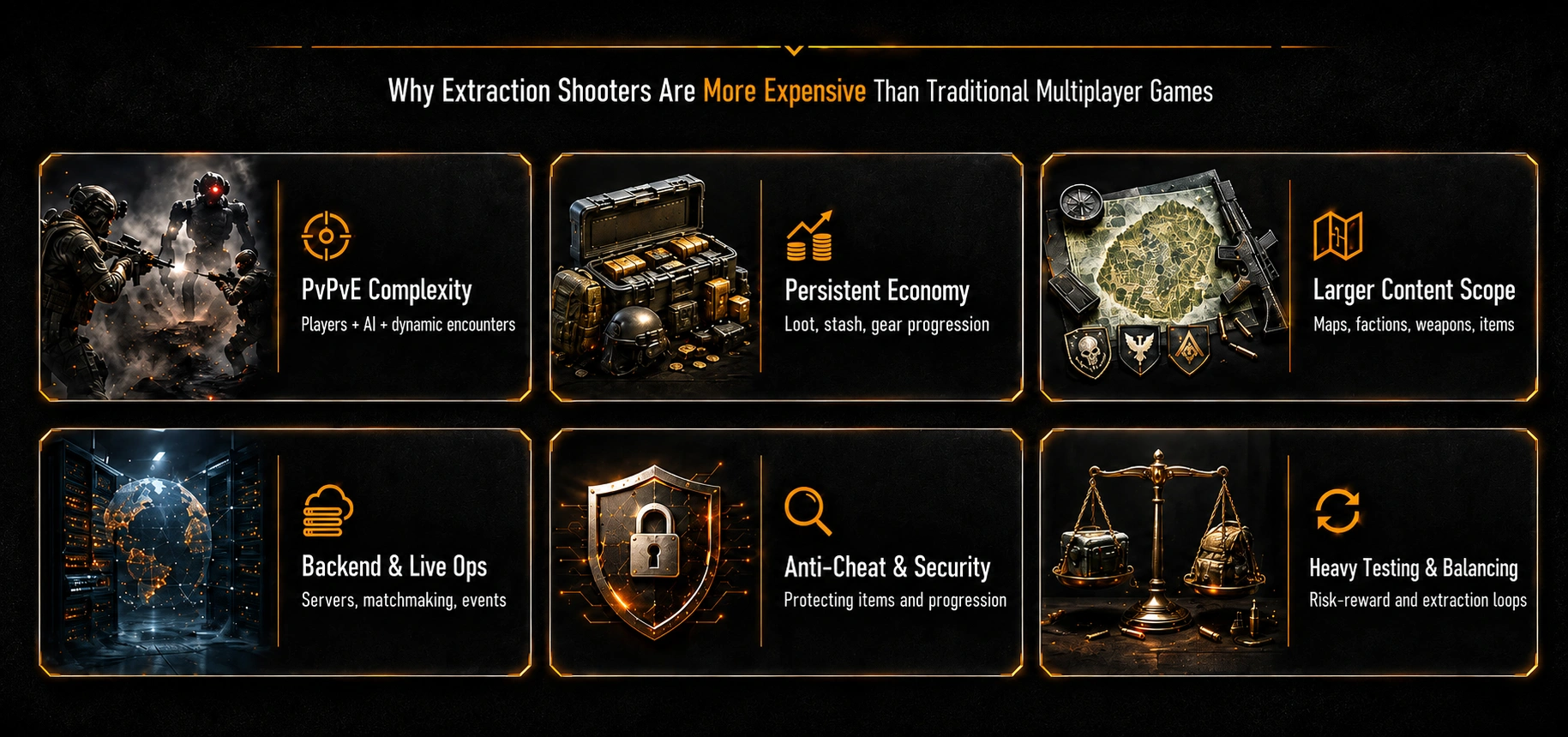
Every raid impacts player progression. Each successful extraction will add to a player’s inventory and each defeat will have real consequences. The interconnected design makes the PvPvE game development much more complex than traditional multiplayer games. This complexity is one reason modern 3D game development projects demand larger teams and longer production cycles.
| System |
Why It Increases Development Cost |
| Persistent Player Inventory |
Every item, weapon, and resource must be securely stored and synchronized across sessions without data loss. |
| Loot Spawning System |
Dynamic loot generation needs careful balancing to keep every raid rewarding while maintaining a healthy in-game economy. |
| AI Enemy Development |
Intelligent AI requires advanced behaviors such as patrolling, flanking, reacting to sound, and coordinating attacks. |
| Dynamic Extraction Zones |
Extraction points must adapt to gameplay conditions while creating strategic risk-versus-reward decisions. |
| Multiplayer Matchmaking |
Matching players based on skill, latency, squad size, and region requires advanced backend systems. |
| Economy Balancing |
Developers must constantly monitor item values, crafting, trading, and progression to prevent inflation or exploitation. |
| Cross-Session Progression |
Player progression must persist accurately across every match, platform, and update. |
| Live Content Updates |
Seasonal events, new maps, weapons, and balance patches require ongoing development long after launch. |
Building each of these systems isn’t just about writing code once. Extraction shooters are one of the most resource-intensive multiplayer categories to build, requiring an enormous amount of testing, balancing, backend infrastructure and ongoing maintenance over the lifetime of the game.
What Actually Drives Extraction Shooter Game Development Cost?
There is a belief that graphics make up the bulk of a game ‘s budget. This is just one part of the equation. The real investment is in the development of the complex systems that make a scalable, secure and seamless multiplayer experience possible. Every element of the extraction shooter game development cost, from networking and backend infrastructure to AI, progression, and live operations, adds up to the overall cost. Supporting these systems also requires a scalable DevOps strategy to keep online services running efficiently. Extraction shooters today are mostly driven by 10 main cost variables.
1. Multiplayer Infrastructure
Dedicated servers can provide consistent performance for large player loads, validate player actions, synchronize matches, reduce cheating and run gameplay securely.
2. Dedicated Server Architecture
Dedicated servers securely manage gameplay, reduce cheating, validate player actions, synchronize matches, and deliver consistent performance under heavy player loads.
3. Persistent Inventory System
Secure inventory systems need continuous data synchronization, item tracking, progression management and protection from duplication or loss of inventory.
4. Loot & Extraction Mechanics
The combination of fair loot drops, safe extract checks and satisfying risk-reward gameplay keeps players coming back while maintaining a healthy in-game economy.
5. AI Enemy Development
Intelligent combat encounters, patrol systems, tactical decision-making, and advanced AI behaviors are facilitated by PvPvE experiences that are engaging and encourage long-term replayability.
6. Multiplayer Matchmaking
Smart matchmaking employs skill, region, latency, and squad size to generate balanced matches with shorter wait times.
7. Shooter Netcode
Optimized shooter netcode improves hit registration, lag compensation, client prediction and synchronization to ensure that firefights are always competitive and responsive.
8. Anti-Cheat Integration
To ensure the integrity of competitive gameplay and fairness, automated security updates, server-side validation, cheat detection, and continuous anti-cheat monitoring are implemented.
9. Multiplayer Backend Development
During each gaming session, backend infrastructure powers authentication, cloud saves, inventories, leaderboards, analytics, content delivery, and player progression. Secure database development is equally important for storing and managing player data without performance issues.
10. Live Operations Infrastructure
The live-service infrastructure allows for the deployment of seasonal updates, battle passes, events, analytics, community engagement, and continuous content that encourages players to return.
What Does It Actually Cost to Build an Extraction Shooter?
The answer depends on the long-term vision, feature set and scope of your game. The cost of just building a prototype to test core mechanics is a lot cheaper than a full live-service game with persistent progression, dedicated servers, and regular content updates. Every project is different, but the following estimates provide a realistic benchmark for the cost to develop a game like ARC Raiders.
| Project Scope |
Estimated Development Cost |
What’s Typically Included |
| Prototype / Vertical Slice |
$250K–$750K |
Core gameplay loop, basic multiplayer, one playable map, and feature validation. |
| Indie Extraction Shooter |
$1M–$3M |
Multiplayer systems, AI enemies, progression, inventory, and essential backend infrastructure. |
| Mid-Sized Commercial Game |
$3M–$10M |
Multiple maps, polished visuals, advanced networking, live-service features, and cross-platform support. |
| AAA Live-Service Extraction Shooter |
$20M–$80M+ |
Large development team, custom backend, seasonal content, live operations, anti-cheat, and continuous post-launch updates. |
Ready to Build Your Extraction Shooter Game?
Note: These estimates generally include quality assurance, production, backend development, art, animation, multiplayer systems and gameplay programming. Marketing, community management, user acquisition, and long-term live operations are usually budgeted separately and can add substantially to the total investment.
The Gameplay Loop That Makes Extraction Shooters So Addictive
The constant balancing act between risk and reward is the main reason players keep coming back to extraction shooters. Unlike traditional multiplayer games where every game ends over and over again, every decision you make in an extraction shooter can affect the future. Players must choose between pursuing better loot and extracting safely. That tension makes every raid meaningful. This is why the extraction shooter gameplay loop is so captivating. It is also one of the most difficult systems to design and calibrate.
The gameplay loop of an extraction shooter usually goes like this:
-
- Enter the map with the weapons, armor and equipment you have chosen.
- Find valuable loot at different locations.
- Fight AI enemies whose purpose is to guard resources and key points.
- Encounter other players pursuing the same objectives.
- Before risking everything, decide if to keep looting or to extract safely.
- Successfully extract and keep everything you have gathered, including weapons, resources, and rewards.
- Use the loot you have extracted to improve your inventory and get ready for upcoming assaults
This is not the only difficulty in designing this cycle. What’s more, developers need to make sure that the game is balanced, fair, resistant to exploits, and sufficiently rewarding to keep players engaged for a long period of time.
Why Do Players Compare Every New Extraction Shooter to ARC Raiders?
ARC Raiders has raised the bar for modern extraction shooters with intelligent AI, stunning visuals, refined gameplay, and long-term progression all rolled into one. The result is that players expect every new game in the genre to be just as good and complex as the previous one. Meeting these expectations requires advanced technology, experienced development teams, and ongoing post-launch support, all of which significantly increase the cost to develop a game like ARC Raiders.
1. AAA Visual Quality
Players expect advanced illumination, detailed character models, realistic environments and smooth animations, all of which are expected to create an immersive next-generation gaming experience.
2. Responsive Gunplay Mechanics
Every weapon should feel accurate, balanced, and satisfying, with reliable hit detection, recoil, and low-latency combat across all matches.
3. Immersive World Design
Huge maps with strategic locations, the potential for exploration and dynamic environments incentivize players to take risks for valuable rewards.
4. Intelligent Enemy AI
Make the AI enemies more realistic, work together to attack, patrol wisely and give you a challenge in battle to improve the PvP experience.
5. Seamless Multiplayer Experience
Fast matchmaking, stable servers, synchronized gameplay and low latency are essential for a fair and enjoyable experience in competitive matches.
6. Meaningful Player Progression
There are crafting systems, persistent inventories, unlockable equipment, and balanced economies. These things keep players interested for hundreds of gameplay sessions.
7. Regular Content Updates
New maps, seasonal events, weapons, missions, and gameplay improvements help keep players engaged, which is key for long-term game retention.
Why Unreal Engine Is the Preferred Choice?
Unreal Engine has become the platform of choice for a lot of studios working on modern extraction shooters due to its ability to deliver the performance, scalability, and visual quality necessary for large-scale PvPvE experiences. Built-in tools support the complex gameplay systems players expect, and help simplify development. Unreal Engine shooter game development can speed up production, but studios still have to build custom backend and live-service infrastructure to be successful with an extraction shooter.
Key advantages of Unreal Engine include:
- AAA visual rendering
- Powerful multiplayer framework
- Advanced animation system
- High-quality physics simulation
- Performance optimization tools
- Cross-platform deployment
- Scalable world-building capabilities
- Blueprint visual scripting
- Robust developer ecosystem
- Strong C++ customization support
How to Reduce Development Costs Without Compromising Quality?
An extraction shooter does not require a huge budget. Intelligent planning, phased development and the implementation of appropriate technical decisions can significantly cut costs without sacrificing gameplay quality. By focusing on core systems and planning for scalability, studios can produce compelling experiences that remain manageable in terms of development risk and cost.
1. Start with a Vertical Slice
Build a refined prototype showcasing the core gameplay loop to validate concepts, attract investors, mitigate risks, and guide future development.
2. Prioritize Core Systems
Before moving on to more features, prioritize combat, multiplayer, extraction, AI, and progression to ensure that the game’s most basic experiences are backed by the resources available.
3. Leverage Proven Technologies
Use proven game engines, networking libraries, cloud services and development tools to de-risk, speed up production, and reduce engineering effort.
4. Plan for Live Operations Early
Build scalable infrastructure systems that can handle seasonal updates, analytics, community features, and future content, without expensive architecture changes after the launch.
Why Choosing the Right Development Partner Matters?
Developing an extraction shooter requires a broad set of skills: multiplayer engineering, backend architecture, gameplay programming, AI systems, economy balancing, optimization in Unreal Engine, live-service operations, and cross-platform deployment. Experience with Unity game development can also benefit studios building cross-platform multiplayer experiences. The integration of these systems requires careful planning, technical expertise, and a development process that promotes long-term scalability and performance.
A seasoned extraction shooter game development company can avoid costly rework during the production, prescribe the right architecture and spot technical challenges early. It is worth mentioning that the custom extraction shooter development is not only about developing game features. It’s all about creating a sustainable ecosystem that ensures regular content updates, seasonal expansions and a growing player base for a long time after the game’s release. Reviewing a studio’s game portfolio can provide valuable insight into its experience with complex multiplayer projects.
Launch a Scalable PvPvE Game with ChicMic Studios
Final Thoughts
Extraction shooters are growing in popularity and player expectations have been raised to a point where seamless networking, responsive combat, intelligent AI, persistent progression and regular content updates are becoming more necessary than nice to have features. So the PvPvE game development cost is much more comprehensive than just graphics and gameplay mechanics. You have to invest a lot of money into backend infrastructure, multiplayer, live ops and scalability over the long-term. Get the solid technical foundation down first. Then bolt on the extra features to make a game that can stand shoulder to shoulder with current releases such as ARC Raiders. Success in this genre comes from studios that mix strategic planning, game design and technical expertise to deliver multiplayer experiences that outlast the initial launch.
Frequently Asked Questions
1. How much does extraction shooter game development cost?
The extraction shooter game development cost depends on your project’s scope, features, and technical requirements. A prototype may cost between $250,000 and $750,000, while a commercial PvPvE title with multiplayer, AI, and live-service infrastructure can range from $1 million to over $20 million.
2. What factors have the biggest impact on PvPvE game development cost?
The biggest cost drivers include multiplayer infrastructure, dedicated servers, persistent inventory systems, AI enemy development, matchmaking, backend architecture, anti-cheat integration, and ongoing live-service support. These systems require significant engineering, testing, and post-launch maintenance.
3. Why are dedicated servers important for extraction shooters?
Dedicated servers provide stable multiplayer performance, synchronize player actions, reduce latency, validate game data, and help prevent cheating. They also ensure persistent progression and inventory systems remain secure across every gaming session.
4. Is Unreal Engine the best choice for extraction shooter game development?
Yes, Unreal Engine is widely used because it offers high-quality graphics, advanced networking tools, realistic physics, and cross-platform support. However, studios still need to build custom backend systems, matchmaking, and live-service features for a complete extraction shooter experience.
5. What features should every extraction shooter include?
A successful extraction shooter typically includes persistent inventories, loot and extraction mechanics, AI enemies, multiplayer matchmaking, dedicated servers, progression systems, anti-cheat protection, and live-service content updates to keep players engaged.
6. How long does it take to develop an extraction shooter game?
Development timelines vary depending on the game’s complexity. A prototype can take 6 to 12 months, while a commercial extraction shooter with advanced multiplayer systems and live operations may require 2 to 4 years or more.
7. Why is backend development so important for multiplayer extraction shooters?
Backend systems manage player authentication, cloud saves, inventories, matchmaking, analytics, leaderboards, and progression. Without reliable backend infrastructure, players can experience data loss, synchronization issues, and poor online performance.
8. Can a startup build a game similar to ARC Raiders?
Yes, but it’s often more practical to begin with a vertical slice or minimum viable product instead of developing every feature at once. This approach validates the gameplay concept, reduces development risks, and helps secure additional funding before full production.
9. How do live-service features affect long-term development costs?
Live-service games require ongoing investment after launch. Seasonal updates, new maps, balance patches, events, community management, server maintenance, and analytics all contribute to long-term development and operational costs.
10. Why should I work with an experienced extraction shooter game development company?
An experienced extraction shooter game development company can help design scalable architecture, optimize multiplayer systems, reduce technical risks, and build a reliable PvPvE experience that supports future updates, player growth, and long-term success.
Turn Your Extraction Shooter Concept Into a Production Plan