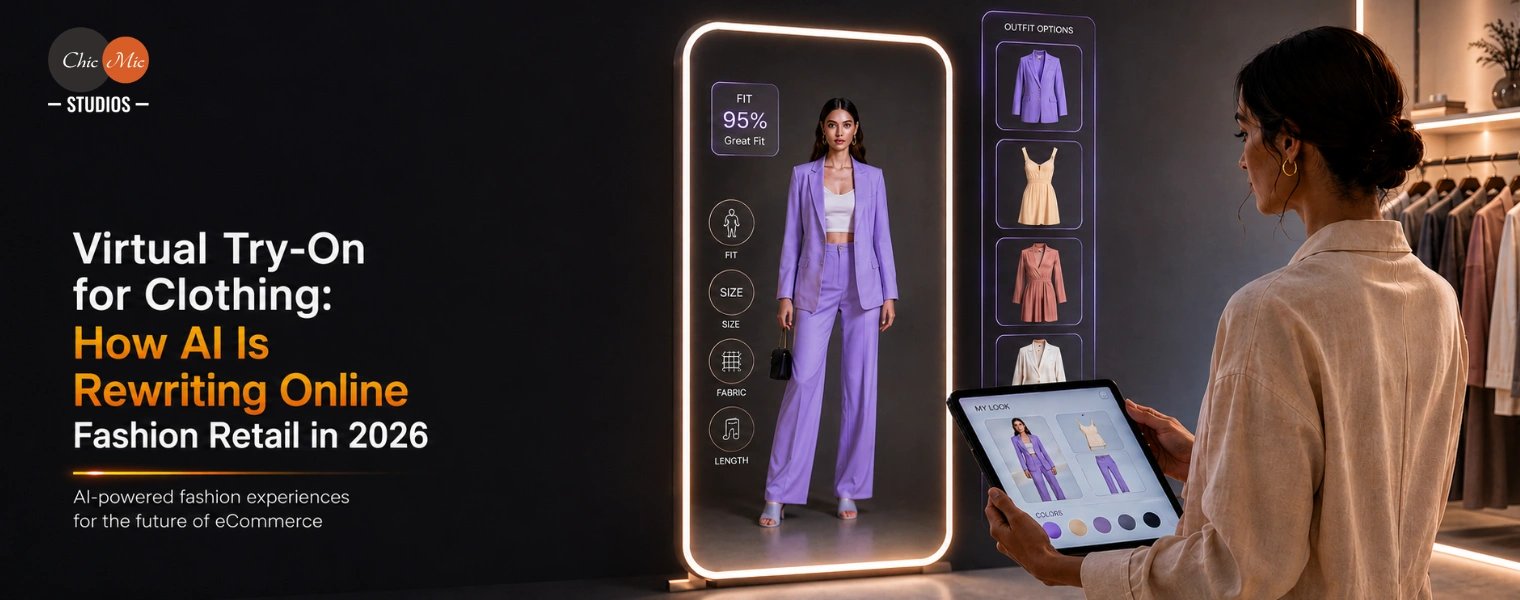
Virtual Try-On for Clothing: How AI Is Rewriting Online Fashion Retail in 2026
Key Takeaways
- Market Shift: AI virtual try-on is changing online fashion retail by making shopping more interactive, personalized, and confidence-driven for modern consumers.
- Core Technology: Computer vision, artificial intelligence, machine learning, and augmented reality work together to deliver realistic virtual fitting experiences.
- Business Benefits: Fashion brands can improve conversions, reduce return rates, increase customer engagement, and deliver more personalized shopping experiences.
- Industry Adoption: From apparel and luxury fashion to footwear and online marketplaces, businesses are adopting AI virtual try-on to enhance the customer journey.
- Future Outlook: As AI technology continues to evolve, virtual try-on is expected to become a standard feature that shapes the future of fashion ecommerce.
Introduction: The Evolution of Online Fashion Shopping
Online fashion has made buying a lot more convenient, but there is one stumbling block that has remained. Customers cannot try on the clothing before purchasing. Product photos, size charts, and customer reviews are useful, to be sure, but they don’t always answer the biggest question of all: “Will this look good on me?” And this is where AI virtual try-on clothing is transforming the online shopping experience. Instead of only imagining how they might look in a piece of clothing, shoppers can see realistic previews of themselves wearing a garment before they buy it. This once futuristic technology is now a practical solution for fashion retailers who want to improve customer experience, boost sales and build buyer confidence.
Furthermore, the growing demand for personalized shopping has motivated firms to incorporate AI fashion technology. Businesses looking to implement these capabilities often invest in AI development services to build scalable retail solutions. Virtual try-on solutions can analyze body proportions, recommend the correct size and render realistic apparel visualizations in a few seconds, thanks to the assistance of artificial intelligence in fashion retail, computer vision, augmented reality and machine learning. In addition to improving the customer experience, these solutions help brands reduce cart abandonment, reduce return rates, and deliver a more engaging digital fashion experience. In this blog we will look at how AI virtual try-on works, why fashion brands are using it and what businesses should think about before creating their own virtual fitting solution.
For another practical perspective, see how ChicMic Studios builds AI-powered mobile apps for modern businesses.
What Is AI Virtual Try-On Technology?
AI virtual try on clothing is a technology that allows consumers to see how an outfit might look on them before they buy it. Customers can upload a photo, use their smartphone camera or create a digital avatar to get a realistic preview of clothing, rather than just product photos or size charts. Today’s solutions are not the old virtual fitting tools that took a picture of a garment and overlaid it on a person’s photo. They use artificial intelligence to understand body shape, body posture and apparel dimensions. This yields a digital clothing try-on experience that is much more accurate and natural.
Every virtual try-on solution is based on a combination of computer vision fashion technology, AI body measurement technology, machine learning fashion solutions and augmented reality fashion shopping. Businesses also rely on advanced machine learning solutions to continuously improve fitting accuracy. These technologies take measurements of body landmarks, estimate body measurements and adapt garments to the user’s proportions in real-time. Many platforms also use generative AI fashion applications to personalize the shopping experience, recommend styling, suggest outfits. Depending on the platform, customers can try on clothing with a photo, live camera, personalized avatar, or fast body scan. As these technologies continue to evolve, AI virtual try-on is transforming from a nice-to-have feature to an essential element of fashion e-commerce.
How AI Virtual Try-On Works Behind the Scenes?
The AI virtual try-on process may appear simple to consumers, but it is a complex process that involves integrating multiple technologies to accurately position garments, analyse body shape and produce realistic previews in mere seconds.
Step 1: Body Scan
AI applies computer vision fashion technology to identify body landmarks like shoulders, limbs, waist, hips, knees and ankles to get the user’s posture.
Step 2: Body Measurement Analysis
AI body measurement technology uses images that customers upload to estimate their body measurements so they can get more accurate size recommendations without having to take their measurements manually.
Step 3: Garment Mapping
The garment selected by the user is digitally fitted on the user’s body by changing the garment size, posture, body contour and viewing angle.
Step 4: Fabric Simulation
AI simulates the way different fabrics stretch, fold and drape, making the virtual outfit more realistic for various clothing materials.
Step 5: Real-Time Rendering
Realistic lighting, shadows and depth are added to the final image, giving consumers the ability to view a natural-looking preview almost immediately. These immersive experiences are commonly built using AR app development technologies.
The Kind of AI Solutions We Build
At ChicMic Studios, we build intelligent retail solutions that combine AI, computer vision and augmented reality to provide a seamless virtual buying experience. Our expertise in providing interactive digital fitting experiences, personalized recommendations, AI-powered body measurement and realistic virtual try-ons is shown through solutions like Virtufy AI. Whether you’re creating a new AI fashion app or enhancing an existing e-commerce platform, we possess the knowledge to transform your ideas into a scalable solution.
Ready to Launch an AI Virtual Fitting Room for Your Fashion Brand?
Why Are Fashion Brands Adopting AI Virtual Fitting Rooms?
AI virtual fitting rooms have matured beyond novelty. They have become an attractive investment for fashion brands to enhance customer experience, reduce returns and increase online sales. Here are some of the top reasons why retailers are implementing this technology.
1. Increase Customer Confidence
Often shoppers are reluctant to purchase clothing online due to concerns about fit or overall appearance. With AI virtual try-on, customers can see the products before payment, which increases the confidence of customers in their purchase decisions.
2. Deliver Personalized Shopping Experiences
Today’s consumers want recommendations that match their taste and style. Many retailers also combine this with an AI chatbot to deliver personalized shopping assistance. Ecommerce is also adopting AI personalization and virtual try-on to help brands recommend products based on body shape, size preferences, shopping history, and favorite styles.
3. Boost Customer Engagement
Interactive buying experiences encourage consumers to spend more time exploring products. Features like virtual wardrobe solutions allow users to more easily compare outfits, save their preferences, and explore new styles.
4. Improve Conversion Rates
When they are informed of how the product is expected to look on them, shoppers are considerably more likely to complete their purchases. It is also reducing the hesitation in the buying process along with improving the overall conversion rates.
5. Stand Out in a Competitive Market
With competition fierce among fashion retailers, the customer experience is becoming more and more important. Brands need to create a frictionless digital fashion experience to stand out and build long-term customer loyalty.
How AI Virtual Try-On Is Reducing Ecommerce Returns?
Product returns continue to be one of the biggest headaches for online fashion retailers. AI virtual try-on clothing increases consumer confidence and reduces uncertainty by offering realistic previews of clothing before checkout, allowing for more informed purchase decisions.
Some of the biggest benefits include:
- Fewer size-related returns
- Reduced “buy multiple sizes” behavior
- Better customer satisfaction
- Lower reverse logistics costs
- Improved inventory management
Many retailers are now combining AI body measurement technology with virtual try-on to improve the accuracy of sizing, reduce the need for unnecessary returns and create a more reliable shopping experience.
Key Features of an AI Virtual Try-On Fashion App
A modern AI virtual try-on app combines computer vision, artificial intelligence, and AR to provide a personalized experience of purchase. Fashion companies can use these features to increase customer engagement, improve conversions and reduce product returns.
1. AI-Powered Body Scan
The system is able to detect body posture, proportions and key body points by means of computer vision fashion technology, thus accurately positioning garments on each user.
2. Real-Time Virtual Try-On
Develop an interactive AR fashion shopping experience that allows customers to instantly see outfits through their smartphone camera or webcam before buying.
3. AI Body Measurement
AI body measurement technology uses photos to estimate a person’s measurements so consumers can choose the right size without having to take their own measurements.
4. Personalized Product Recommendations
The AI product recommendation system recommends clothes based on browsing history, buying behavior, style preference and previous virtual try-on activity.
5. Mix-and-Match Outfit Suggestions
The platform recommends complementary footwear, apparel and accessories to create complete ensembles using generative AI fashion applications.
6. Multi-Platform Compatibility
The solution should be able to allow customers to try it on from any device, and should offer a consistent experience across ecommerce websites, mobile apps, tablets, smart mirrors and in-store kiosks. Businesses often achieve this through cross-platform app development.
Native rollouts can also benefit from dedicated Android app development and iOS app development.
7. Analytics Dashboard
Retailers can leverage insights like virtual try-on usage, conversion rates, customer engagement, popular products, and return trends to optimize their e-commerce strategy.
AI Virtual Try-On Use Cases Across the Fashion Industry
AI virtual try-on is transforming the fashion retail industry by allowing companies to offer tailored shopping experiences, improve consumer confidence, and decrease purchase uncertainty throughout different fashion segments.
1. Retail clothing
AI virtual try-on clothes are used by fashion retailers to visualize garments, select the right size and make more informed purchasing decisions.
Brands planning a broader commerce product can also review our guide to building a profitable retail mobile app.
2. Luxury Fashion
Luxury brands are giving their customers premium digital experiences before they buy, letting them virtually try on designer clothes and explore exclusive collections.
3. Footwear Brands
Some footwear manufacturers are using AI with sizing technology to give consumers accurate fit recommendations, and to allow them to try shoes on before they buy.
4. Accessories
Retailers give customers the chance to virtually try on sunglasses, handbags, hats, scarves and jewelry, to instill confidence in the completion of their ensembles.
5. Fashion Marketplaces
Virtual fitting room technology is now available to multi-brand marketplaces to help consumers compare products between different fashion retailers and create uniform buying experiences. A scalable web development foundation helps support these large ecommerce platforms.
6. Fashion Rental and Subscription Services
Consumers can make an informed decision on what to wear to weddings, parties and other special occasions before placing an order with the help of rental platforms’ AI-powered virtual try-on.
Challenges in Building AI Virtual Try-On Solutions
Building an AI virtual try-on solution is more than just advanced technology. To offer a shopping experience that is seamless and accurate, businesses must overcome technical, operational and data-related challenges.
1. Accurate Body Measurement
To build reliable AI body measurement technology, you need to have a wide range of training data that covers diverse shapes, sizes and poses for accurate estimation of body dimensions.
2. Realistic Garment Simulation
To generate realistic apparel previews, AI must simulate the way different fabrics stretch, fold and drape in response to a variety of body movements and lighting conditions.
3. High-Quality Product Data
Virtual try-on accuracy depends on the accuracy of detailed product images, garment dimensions and 3D models. Many brands also invest in 3D animation services to create more realistic digital garments. Insufficient data can affect the fitting results.
4. Device Compatibility
The solution needs to offer a consistent user experience and fast loading times on desktops, tablets and smartphones.
5. Privacy and Security
Virtual try-on applications, which process client photos and measurements, require robust data security, clear privacy policies, and regulatory compliance.
Release readiness should also include structured quality assurance services across devices and customer journeys.
Planning an AI Fashion MVP? Validate It Before Development Starts
Future of AI Fashion Retail in 2026 and Beyond
AI is changing the future of fashion retail, making the shopping experience more interactive, personalized and data-driven. As technology evolves, virtual try-on solutions will become more widespread, faster and smart.
Some of the biggest trends shaping the future include:
- More accurate AI body measurement technology using smartphone cameras.
- Smarter AI product recommendation systems that understand individual style preferences.
- Growth of virtual wardrobe solutions for organizing and planning outfits digitally.
- Wider adoption of generative AI fashion applications for personalized styling and content creation.
- Better integration between online stores and physical retail through omnichannel shopping experiences.
As these innovations mature, AI virtual try-on will become an expected feature, enabling brands to provide seamless shopping experiences and enhanced consumer engagement.
How Businesses Can Build an AI Virtual Try-On Solution
Building a successful AI virtual try-on solution requires the right strategy, technologies, and ecommerce integration for the successful creation of an AI virtual try-on solution. A structured development process helps businesses build virtual fitting experiences that are user-friendly, accurate and scalable.
You can review selected intelligent products in our AI development portfolio.
1. Define Business Goals
Increase customer engagement, decrease return rate, increase conversions or provide more personalized shopping experiences. Set distinct goals.
2. Choose the Right AI Technologies
Select technologies such as computer vision development, AI body measurement, machine learning, AR capabilities, and 3D garment visualization depending on your business requirements.
3. Prepare Product Data
Create realistic and credible virtual try-on experiences using 3D assets, accurate garment measurements, fabric information and quality product images.
4. Integrate With Your Ecommerce Platform
Integrate the solution with your product catalog, inventory, checkout, customer accounts and analytics tools for a frictionless buying experience. Businesses looking to accelerate development can also explore platforms like Virtufy AI, which combines AI-powered virtual try-on, body measurement, and wardrobe experiences into a single solution
Conclusion
AI virtual try-on clothing is interactive, personalized and reliable, revolutionizing the online fashion shopping experience. Customers can imagine how the apparel will look before buying it, instead of depending on size charts and product images, leading to more confident purchase decisions. Fashion retailers will gain from improved customer engagement, lower return rates, higher conversions and an improved competitive edge. AI fashion tech, computer vision and augmented reality will all evolve to make virtual try-ons a must-have part of modern ecommerce, not just an optional feature. The businesses that adopt these solutions today will be much better positioned to meet changing consumer expectations and deliver the frictionless digital buying experiences that will determine the future of fashion retail.
Frequently Asked Questions
1. What is AI virtual try-on clothing technology?
AI virtual try-on clothing technology allows shoppers to see how garments look on their body before making a purchase. It combines artificial intelligence, computer vision, and augmented reality to create realistic clothing previews, helping customers shop with greater confidence.
2. How does AI virtual try-on work?
AI virtual try-on analyzes a user’s body shape, posture, and measurements using computer vision and machine learning. It then maps a digital garment onto the user’s image or live camera feed, creating a realistic preview in seconds.
3. How can virtual try-on help fashion ecommerce businesses?
Virtual try-on improves customer confidence, increases conversion rates, reduces cart abandonment, and creates more personalized shopping experiences. It also helps businesses reduce costly product returns and improve customer satisfaction.
4. Does an AI virtual fitting room reduce clothing returns?
Yes, while it cannot eliminate returns completely, an AI virtual fitting room helps shoppers choose the right size and style before purchasing. This reduces size-related returns and minimizes unnecessary exchanges.
5. How much does it cost to develop an AI virtual try-on app?
The development cost depends on the app’s features, AI capabilities, platform compatibility, and integration requirements. Basic solutions cost significantly less than enterprise-grade platforms that include 3D garment visualization, AI body measurement, and real-time AR experiences.
6. What technologies are used in AI virtual try-on solutions?
AI virtual try-on solutions typically use computer vision, machine learning, artificial intelligence, augmented reality (AR), AI body measurement technology, 3D garment visualization, and AI product recommendation systems to deliver realistic virtual fitting experiences.
7. Can AI virtual try-on integrate with ecommerce platforms?
Yes, AI virtual try-on solutions can integrate with popular ecommerce platforms, product catalogs, inventory systems, customer accounts, checkout processes, and analytics tools to create a seamless shopping experience.
8. Is virtual try-on the future of fashion ecommerce?
Virtual try-on is quickly becoming a standard feature in fashion ecommerce. As AI technology continues to improve, more brands are adopting virtual fitting experiences to increase customer confidence, improve personalization, and reduce return rates.
9. What are the benefits of AI body measurement technology?
AI body measurement technology estimates body dimensions using photos or smartphone cameras. This helps shoppers find better-fitting clothes while reducing manual measurements and sizing errors.
10. Can small fashion brands use AI virtual try-on?
Yes, cloud-based AI platforms and third-party virtual try-on solutions have made this technology more accessible, allowing startups and small fashion businesses to offer interactive shopping experiences without building everything from scratch.
Turn Your AI Fashion Idea Into a Live Platform in 4 Weeks