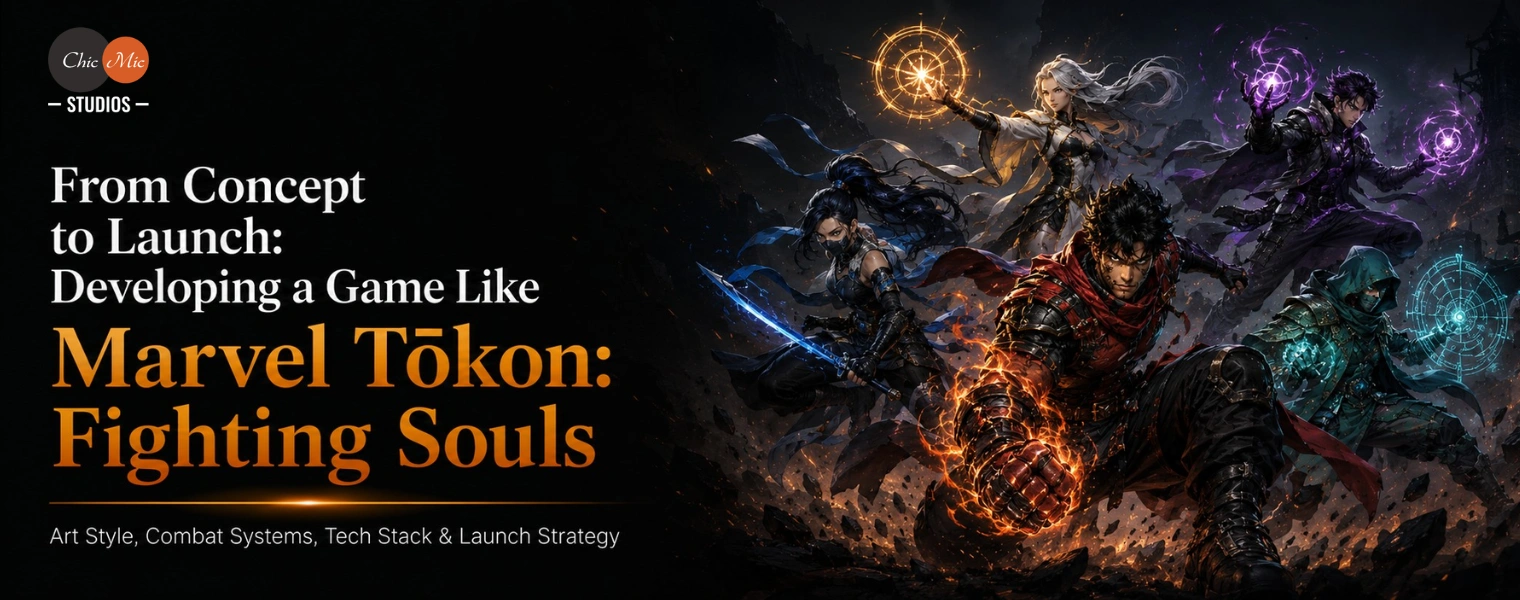
From Concept to Launch: Developing a Game Like Marvel Tōkon: Fighting Souls
Key Takeaways
- Growing Demand: Marvel Tōkon: Fighting Souls inspires studios with accessible, team-based, and visually engaging combat.
- Core Features: Strong character identities, 4v4 mechanics, assists, strategic combat, and smooth online play are central to the experience.
- Cost Factors: Team size, roster size, animation quality, multiplayer infrastructure, quality assurance, and post-launch support affect the development budget.
- Development Partner: An experienced fighting game development company can support competitive depth, cross-platform play, community feedback, and live-service growth.
Introduction
The fighting game genre is evolving with a stronger focus on artificial intelligence, cinematic presentation, and competitive depth. The anime-inspired Marvel Tōkon: Fighting Souls reflects this evolution. It combines fast-paced 4v4 team battles, simplified controls, and visually striking combat in one cohesive experience.
Building a game like Marvel Tōkon: Fighting Souls requires more than recreating flashy visuals or combo mechanics. A structured production process must balance combat design, character identity, multiplayer infrastructure, animation quality, and long-term player engagement.
This guide explains the essential stages of Marvel Tōkon: Fighting Souls game development. It covers concept planning, combat design, technical production, launch strategy, and post-release support.
Why Marvel Tōkon: Fighting Souls Stands Out
Marvel Tōkon: Fighting Souls shows how modern fighting games can combine accessibility, strategic gameplay, and cinematic presentation. By July 2026, the title had reached 51K+ peak viewers with 25.7K streaming hours.
Public insights from the game developers hired for the project also highlight team coordination, distinctive character design, and beginner-friendly mechanics. These choices offer valuable lessons for studios planning accessible and competitive fighting experiences.
- 4v4 Team Combat: Encourages strategic team formation through assists, character swaps, and coordinated attacks.
- User-Friendly Controls: Helps new players learn quickly while preserving advanced mechanics.
- Team Coordination: Gives characters complementary abilities that reward teamwork.
- Individual Character Identity: Gives every fighter distinct moves, animations, playstyles, and personality.
- Anime-Like Graphics: Uses polished animation, cinematic special moves, and readable effects.
- Balanced Gameplay: Rewards skill, strategy, timing, and team composition.
- Development Lesson: Prioritizes accessibility, strategic depth, visual quality, and player feedback.
Bring Your Fighting Game Vision to Life
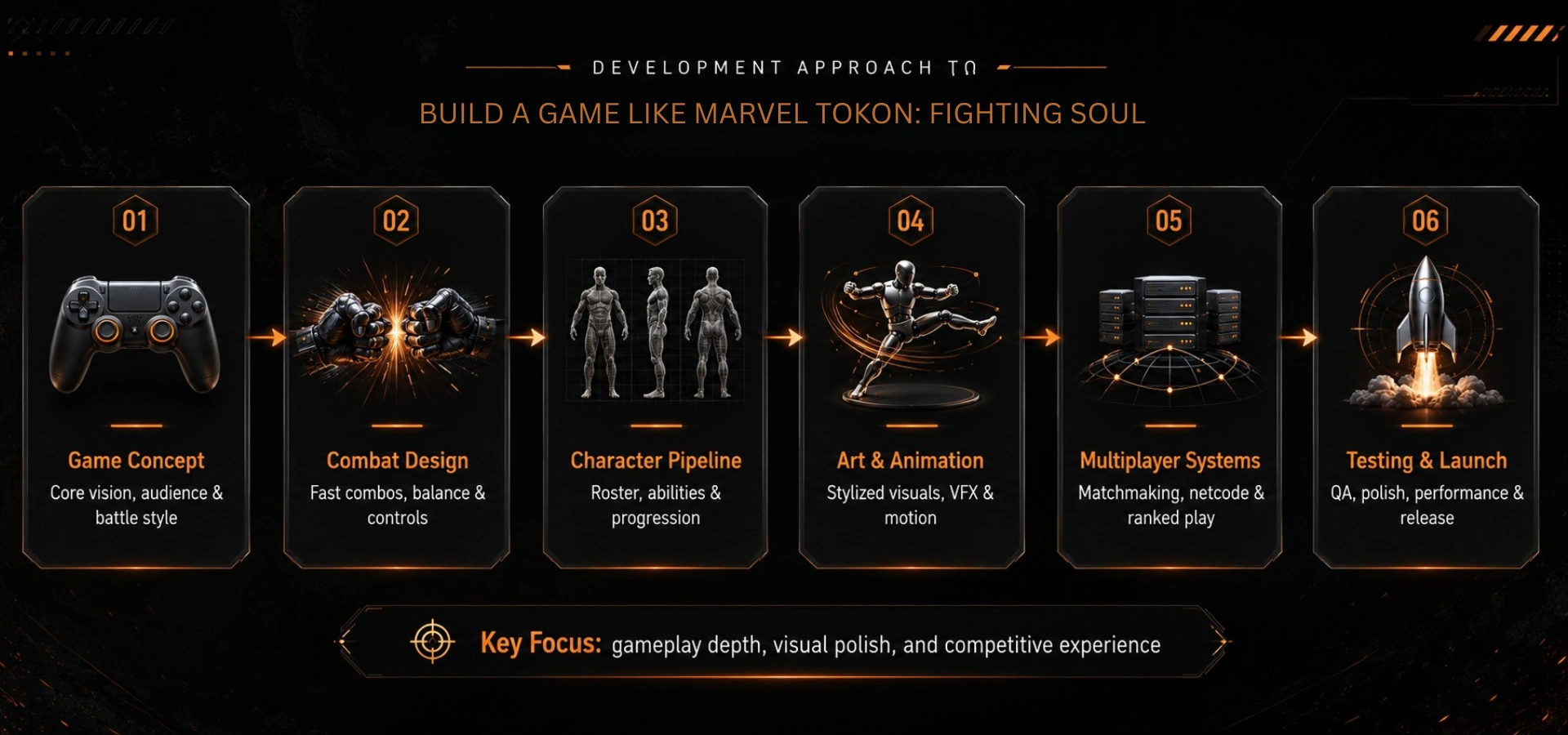
Development Approach to Build a Game Like Marvel Tōkon: Fighting Souls
Marvel Tōkon: Fighting Souls game development requires strong combat design, character-focused gameplay, advanced multiplayer systems, and an engaging visual presentation. Each production stage contributes to a competitive and polished experience.
Step 1 – Define Your Core Fighting Game Vision
A successful fighting game begins with a clear vision. Define the intended player experience, target audience, competitive goals, match pace, team size, and character direction. These decisions guide gameplay mechanics, balancing, animation, and production planning.
Choose Your Combat Philosophy
- Define your target audience.
- Choose casual, competitive, or hybrid gameplay.
- Select solo, tag, or team-based combat.
- Set the speed and pacing of each match.
- Create balanced archetypes such as rushdown, zoner, grappler, and support.
Step 2 – Design an Accessible Combat System
The combat system must welcome beginners without limiting competitive players. Clear inputs, flexible combos, and meaningful risk-and-reward decisions improve retention and player satisfaction.
- Simplify core inputs without removing depth.
- Create flexible combo systems.
- Add unique mechanics for every fighter.
- Balance risk and reward for each move.
- Reward strategy alongside execution.
Step 3 – Character Design and Roster Planning
Roster planning is essential for long-term engagement. Every fighter needs a recognizable identity that extends beyond appearance. Distinct abilities, animations, and playstyles encourage experimentation and improve replay value.
Professional 3D character design helps each fighter maintain a clear silhouette, costume language, and personality.
- Define clear fighter roles.
- Create distinctive animations.
- Develop recognizable visual identities.
- Balance offensive and defensive characters.
- Design varied playstyles for different audiences.
Step 4 – Build the Right Technical Foundation
The technical foundation determines how smoothly a fighting game performs across platforms. Choose a technology stack that supports responsive gameplay, stable online matches, consistent frame rates, and scalable updates.
Unreal game development is well suited to high-fidelity visuals and advanced rendering. Unity game development offers flexible workflows and broad platform support.
Studios targeting desktop audiences should define PC game development requirements early. This helps teams plan performance targets, input systems, graphics settings, and hardware compatibility.
- Choose an engine that fits the project scope.
- Implement rollback netcode for online play.
- Optimize performance for consistent frame rates.
- Plan for cross-platform compatibility.
- Include robust training and replay systems.
Step 5 – Multiplayer and Competitive Infrastructure
Competitive fighting games depend on reliable online experiences. Ranked matchmaking, community lobbies, spectator tools, and replay systems help create an active player ecosystem.
- Offer ranked and casual game modes.
- Build intuitive lobby systems.
- Implement skill-based matchmaking.
- Add spectator and replay features.
- Encourage community interaction through social tools.
Step 6 – Art Direction and Animation Pipeline
Visual presentation defines a fighting game’s identity. A consistent art style, smooth animation, readable attacks, and controlled camera movement make the action engaging without reducing gameplay clarity.
Early 2D concept art helps teams finalize costumes, color language, stages, and visual effects before full production.
Professional 3D animation services support fluid attacks, hit reactions, movement, and cinematic special moves. A structured 3D game development pipeline also keeps characters, environments, lighting, and VFX consistent.
- Develop a consistent visual style.
- Create high-quality character animations.
- Design readable visual effects.
- Use dynamic but controlled camera movement.
- Highlight super moves without reducing gameplay clarity.
Step 7 – Testing, Balancing, and Community Feedback
No fighting game begins with perfectly balanced gameplay. Consistent testing and quality assurance services reveal bugs, balance issues, unclear mechanics, and performance barriers before launch.
- Conduct internal QA throughout development.
- Organize closed and open beta tests.
- Collect structured player feedback.
- Release balance updates regularly.
- Maintain a long-term patch and support strategy.
Ready to Build Your Next Fighting Game?
Marvel Tōkon: Fighting Souls Game Cost: What Should You Budget?
The Marvel Tōkon: Fighting Souls game cost can refer to both the retail price and the investment required to produce a comparable fighting game. The standard edition is priced at $59.99, while Digital Deluxe and Ultimate Editions are available at higher price points with additional content.
There is no fixed cost to build an anime fighting game like Marvel Tōkon: Fighting Souls. Game design, roster size, character production, animation, multiplayer infrastructure, testing, and post-launch support all affect the final budget.
Clear UI/UX design also affects production effort. Menus, HUDs, training tools, accessibility options, and onboarding flows require careful iteration.
| Development Area |
Cost Impact |
Why It Matters |
| Pre-production |
Medium |
Covers concept development, game design documentation, prototyping, and production planning. |
| Game Design |
High |
Includes combat mechanics, balancing systems, progression, UI/UX, and gameplay iteration. |
| Character Animation |
High |
Requires high-quality animation, visual effects, unique movesets, and cinematic special attacks for every fighter. |
| Multiplayer Systems |
High |
Involves online matchmaking, rollback netcode, lobby systems, cross-platform support, and server infrastructure. |
| QA & Balancing |
High |
Requires extensive testing to refine gameplay, remove bugs, and balance every character and team combination. |
| Live Operations |
Medium |
Supports post-launch patches, seasonal updates, new content, community management, and ongoing technical maintenance. |
Why ChicMic Studios Is the Right Fighting Game Development Company for Your Business
Choosing the right fighting game development company is essential for building a scalable and competitive multiplayer experience.
At ChicMic Studios, a game development company, our team combines technical expertise with player-focused design. We build high-performance multiplayer games and support projects from combat mechanics to post-launch operations.
- Multiplayer Architecture: Develop stable online systems with seamless matchmaking and low-latency gameplay.
- Advanced Animation Systems: Create fluid character movement, impactful combat animation, and cinematic special moves.
- Rollback Networking Expertise: Implement responsive online play using modern rollback netcode practices.
- Competitive Balancing: Refine combat systems for fairness, strategic depth, and long-term engagement.
- Live-Service Support: Deliver post-launch updates, balance patches, seasonal content, and ongoing maintenance.
- Cross-Platform Development: Build games that perform consistently across PC, console, and mobile platforms.
Frequently Asked Questions
1. How long does it take to build a game like Marvel Tōkon: Fighting Souls?
The timeline depends on the game’s scope, team size, roster, art quality, and feature set. An indie fighting game may take 12 to 24 months. A large multiplayer title with advanced animation and online infrastructure may require more than 24 months.
2. What engine is best for Marvel Tōkon: Fighting Souls game development?
The right engine depends on technical requirements, target platforms, visual goals, and team expertise. Unreal Engine 5/Unity can support high-fidelity 2D and 3D hybrid anime visuals.
3. What affects Marvel Tōkon: Fighting Souls game development cost?
Major cost drivers include project scope, roster size, combat complexity, animation quality, multiplayer infrastructure, art production, testing, and post-launch support.
4. Why is rollback netcode important?
Rollback netcode reduces perceived input delay and helps online matches remain responsive under changing network conditions. It predicts player inputs and quickly corrects differences when needed.
5. How many characters should a fighting game launch with?
There is no fixed number. The launch roster should support varied playstyles and team strategies. A balanced mix of offensive, defensive, grappler, zoning, and support fighters creates depth while leaving room for post-launch roster expansions.
Planning Your Fighting Game Development?