Best 3D Game Development Studios for Art Outsourcing in 2026
Key Takeaways
- The best 3D game development studios for art outsourcing should be evaluated on more than portfolio quality. Technical expertise, scalability, communication, QA, and engine compatibility are equally important.
- 3D game art outsourcing cost varies according to asset complexity, art style, production volume, animation requirements, technical art, and project timelines.
- 3D game art outsourcing companies can handle individual requirements such as character modeling and environment art or support the complete asset-production pipeline.
- Unity and Unreal game art requires more than creating attractive 3D models. Assets need appropriate topology, UVs, materials, LODs, optimization, rigging, and engine integration.
- The best 3D game development studios for art outsourcing should be evaluated on more than portfolio quality. Technical expertise, scalability, communication, QA, and engine compatibility are equally important.
- 3D game art outsourcing cost varies according to asset complexity, art style, production volume, animation requirements, technical art, and project timelines.
- 3D game art outsourcing companies can handle individual requirements such as character modeling and environment art or support the complete asset-production pipeline.
- Unity and Unreal game art requires more than creating attractive 3D models. Assets need appropriate topology, UVs, materials, LODs, optimization, rigging, and engine integration.
Introduction
Building a 3D game requires more than programming. Character models, environments, props, weapons, animation, materials, and technical assets all need to work together inside the game engine. For many studios, handling the complete art pipeline internally can increase production time and require a larger permanent team.
This is where 3D game art outsourcing companies can help. A capable outsourcing partner can support specific production tasks or manage an entire art pipeline, from modeling and texturing to rigging, animation, and engine integration.
This guide looks at some of the best 3D game development studios for art outsourcing in 2026, with a focus on their capabilities, technical specialization, production models, and the types of projects they can support.
What to Look for in the Best 3D Game Art Outsourcing Companies
Choosing a studio should involve more than comparing portfolios. A visually impressive asset still needs to meet polygon, texture, UV, animation, and engine requirements before it can be used in a production game.
When evaluating 3D game development studios, consider these areas:
- 3D character modeling: Check whether the studio can handle sculpting, retopology, UV mapping, texturing, rigging, and optimization.
- 3D environment art: Look for experience with modular environments, architecture, terrain, vegetation, props, and level-ready assets.
- Game asset creation: A production team should understand technical restrictions such as polygon budgets, texture memory, LODs, and collision.
- Unity and Unreal game art: Assets should be delivered in formats and structures that integrate cleanly into your engine pipeline.
- Animation: For characters and creatures, check capabilities in rigging, skinning, locomotion, combat animation, facial animation, and cinematics.
- Scalability: A good outsourcing model should work whether you need a handful of assets or a larger production team.
Looking for a Reliable 3D Game Art Outsourcing Partner?
10 Best 3D Game Development Studios for Art Outsourcing in 2026
1. ChicMic Studios
ChicMic Studios provides 3D game development across art, animation, programming, testing, and deployment. Its 3D game development offering includes concept and art asset creation, Unity and Unreal development, multiplayer programming, and live-game support. The company also describes dedicated 3D artists, developers, designers, and QA capabilities.
For teams looking to outsource 3D game art while keeping development and art workflows coordinated, a full-service model can reduce the need to manage multiple vendors. ChicMic Studios also provides 3D modeling, texturing, rigging, and animation as part of its game development services.
Suitable for: 3D games, mobile and PC projects, Unity and Unreal development, custom game production, and teams looking to hire 3D game developers alongside artists. (For more understanding of our expertise; check out our Game portfolio.)
2. Virtuos
Virtuos operates a large international game-production network and provides dedicated art-production services. Its official art-production offering covers 2D and 3D assets, animation, lighting, VFX, characters, environments, and cinematics. It also describes workflows extending from ideation through in-engine integration.
This makes Virtuos particularly relevant to projects requiring substantial production capacity or support across multiple stages of game development.
Suitable for: Large productions, AAA-oriented pipelines, character and environment production, animation, VFX, and multi-platform development.
3. Room 8 Group
Room 8 Group’s art services cover the pipeline from concept development to technical art. Its character services include 3D modeling, texturing, rigging, animation, VFX, and technical art, while its environment services cover modeling, level art, lighting, animation, and technical implementation.
The studio also lists Unity and Unreal Engine among its production tools and supports platforms including PC, console, and mobile. Its technical-art offering includes rendering, shaders, lighting, materials, weather, water, and other real-time systems.
Suitable for: AAA-style production, environments, characters, technical art, and projects requiring deeper engine integration.
4. Kevuru Games
Kevuru Games specializes in 3D game art outsourcing, covering characters, environments, weapons, and other game assets. Its portfolio includes both photorealistic and stylized work, while its production toolkit includes Maya, Blender, ZBrush, Substance tools, Marmoset Toolbag, and other 3D production software.
The company also offers different engagement models, including outstaffing, dedicated teams, and managed outsourcing.
Suitable for: Character modeling, environment art, weapons, stylized projects, realistic assets, and teams that need flexible outsourcing arrangements.
5. Asterman
Asterman is another name that appears frequently in discussions of 3D game art outsourcing companies. Its positioning includes game art production across different visual styles, with particular relevance to stylized and game-focused asset production.
For projects where visual consistency is important across characters, environments, props, and promotional content, an external art team can help maintain a defined art direction while increasing production capacity.
Suitable for: Stylized game assets, mobile and casual projects, characters, environments, and projects requiring external art-production capacity.
6. N-iX Games
N-iX combines game development, engineering, and art production capabilities. This type of structure can be useful when art needs to interact closely with programming and technical implementation.
For example, a project may require more than a finished 3D model. Materials, shaders, optimization, engine configuration, animation systems, and gameplay integration can all affect the final result.
Suitable for: Co-development, technical art, Unity and Unreal projects, and productions where art and engineering need close coordination.
7. RetroStyle Games
RetroStyle Games is associated with game art production across stylized and mobile-oriented projects. Its type of production work can be relevant for teams creating large collections of visually consistent assets.
For mobile and casual games, optimization is particularly important because detailed assets still need to operate within memory, rendering, and device-performance constraints.
Suitable for: Stylized games, mobile projects, casual games, environments, characters, and ongoing asset production.
8. Magic Media
Magic Media provides game development and art-production capabilities for projects requiring external development resources. Its services cover areas such as 3D production, game development, animation, and other interactive content.
For studios outsourcing several disciplines at once, a broader development partner can simplify coordination between art and engineering.
Suitable for: 3D game production, animation, environment work, character assets, and broader game-development projects.
9. Devoted Studios
Devoted Studios focuses on game development and co-development services, making it relevant for teams that need additional production capacity rather than only individual art assets.
A co-development approach can be useful when the internal team retains creative direction while an external team handles specific production streams such as environments, characters, technical art, or other game-development tasks.
Suitable for: Co-development, team augmentation, game art production, and larger projects requiring external development capacity.
10. Game-Ace
Game-Ace works with real-time 3D development and interactive experiences. Its capabilities make it relevant to projects where 3D assets need to move beyond standalone artwork and become part of a functioning interactive application.
This distinction matters because game art outsourcing services increasingly involve engine-ready production rather than simply delivering models and textures.
Suitable for: Real-time 3D, Unity and Unreal projects, interactive experiences, game assets, and technical implementation.
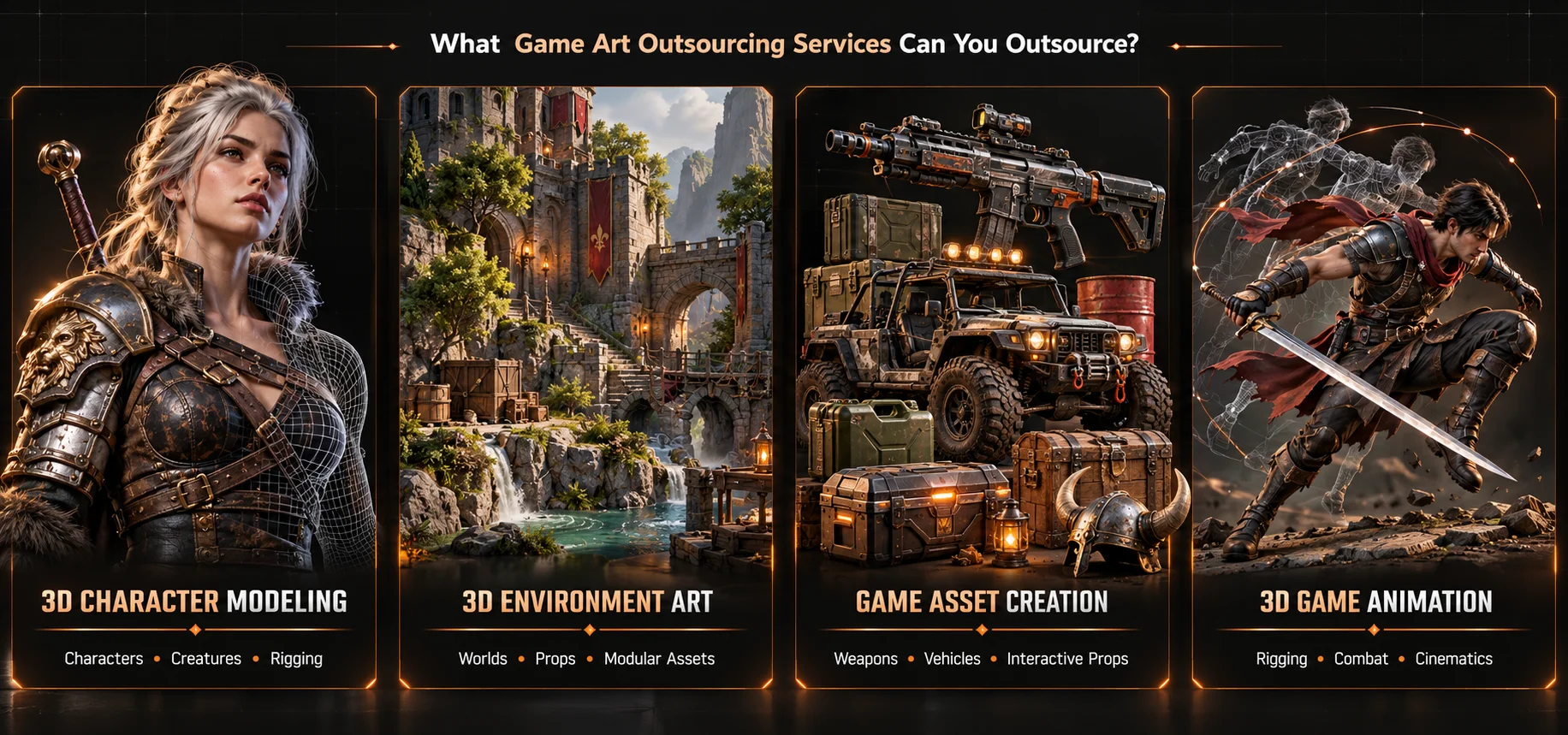
What Game Art Outsourcing Services Can You Outsource?
Modern 3D game art outsourcing companies can support individual stages of production or deliver complete asset pipelines.
1. 3D Character Modeling
Character production typically starts with concept references and moves through high-poly sculpting, retopology, UV mapping, texturing, rigging, and optimization. For game-ready characters, the model also needs appropriate topology and deformation so that it performs correctly during animation.
Typical deliverables include:
- Player characters
- NPCs
- Creatures
- Enemies
- Clothing
- Accessories
- Character variations
2. 3D Environment Art
3D environment art can include everything from individual props to complete modular environments.
Artists may create:
- 3D character modeling: Check whether the studio can handle sculpting, retopology, UV mapping, texturing, rigging, and optimization.
- 3D environment art: Look for experience with modular environments, architecture, terrain, vegetation, props, and level-ready assets.
- Game asset creation: A production team should understand technical restrictions such as polygon budgets, texture memory, LODs, and collision.
- Unity and Unreal game art: Assets should be delivered in formats and structures that integrate cleanly into your engine pipeline.
- Animation: For characters and creatures, check capabilities in rigging, skinning, locomotion, combat animation, facial animation, and cinematics.
- Scalability: A good outsourcing model should work whether you need a handful of assets or a larger production team.
3. Game Asset Creation
A game may require hundreds or thousands of smaller assets. These can include weapons, vehicles, furniture, tools, collectibles, interactive objects, and environmental props. A consistent naming, material, UV, texture, and LOD pipeline becomes important when asset volume increases.
4. 3D Game Animation Services
Animation outsourcing can include:
- Character rigging
- Skinning
- Locomotion
- Combat animation
- Creature animation
- Facial animation
- Cinematics
- NPC animation
The final animation pipeline should be compatible with the project’s gameplay systems and target engine.
How Much Does 3D Game Art Outsourcing Cost in 2026?
The 3D game art outsourcing cost depends heavily on what is being produced. A simple prop and a fully rigged, animated character can have dramatically different production requirements.
Important pricing factors include:
- Asset complexity
- Art style
- Polygon density
- Texture resolution
- Number of assets
- Rigging requirements
- Animation requirements
- Technical art
- Engine integration
- Revision cycles
- Delivery schedule
- Team size
Therefore, there is no single 3D game development cost that applies to every project.
1. 3D Game Art Outsourcing Rates
Studios commonly structure projects through different commercial models:
- Hourly production
- Per-asset pricing
- Fixed-scope projects
- Dedicated teams
- Monthly engagements
- Managed outsourcing
The best model depends on how clearly the scope can be defined. For a fixed collection of assets, per-asset or fixed-scope pricing can be easier to budget. For an evolving game with continuous content production, a dedicated team may provide greater flexibility.
2. 3D Game Development Cost Breakdown
| Cost Area |
Typical Work |
| Modeling |
Characters, props, weapons, environments |
| Texturing |
PBR materials and surface details |
| Rigging |
Character and creature rigs |
| Animation |
Gameplay, NPC and cinematic animation |
| Technical Art |
Shaders, LODs and optimization |
| Integration |
Unity or Unreal implementation |
| QA |
Asset and technical validation |
| Management |
Planning, reviews and communication |
When calculating a game art outsourcing budget, don’t compare vendors purely on hourly rates. Compare the complete deliverables, revision policy, QA process, technical requirements, and project-management support. For example, a lower hourly rate may not result in lower 3D game asset development cost if additional revisions or engine integration are billed separately.
Need a Custom 3D Game Art Development Estimate?
How to Choose a 3D Game Art Development Company
Start with the portfolio, but don’t stop there. A strong portfolio should contain work relevant to your project’s genre, art style, platform, and asset complexity.
Next, examine the technical pipeline. Ask whether the studio handles PBR materials, UVs, LODs, optimization, rigging, animation, and Unity or Unreal integration. It is also important to understand the production model. Determine who manages the artists, how feedback is collected, how revisions work, and how the team handles changes in scope.
Finally, compare 3D game development company pricing based on the complete scope rather than one headline rate.
Outsource 3D Game Art or Build an In-House Team?
| Factor |
In-House |
Outsourcing |
| Hiring |
Requires recruitment |
Existing specialists |
| Scalability |
Depends on internal team |
Can scale by project |
| Specialist Skills |
Requires hiring/training |
Available through vendor |
| Management |
Direct |
Shared |
| Cost Structure |
Salaries and overhead |
Project/team-based |
| Production Capacity |
Relatively fixed |
More flexible |
Final Checklist Before You Hire 3D Game Developers
Before signing an outsourcing agreement, check:
- Portfolio matches your art direction
- Relevant game genre experience
- 3D character modeling capabilities
- 3D environment art experience
- Game-ready asset pipeline
- Unity/Unreal experience
- Rigging and animation capabilities
- Technical-art expertise
- Defined QA process
- Clear communication process
- Transparent pricing
- IP ownership terms
- Revision policy
- Scalability
Conclusion
The best 3D game development studios for art outsourcing are not defined by portfolio size alone. The right partner depends on your game’s visual direction, asset complexity, target platform, engine, production volume, timeline, and budget.
For teams looking for a combination of 3D game art, animation, Unity and Unreal development, and broader game-production support, ChicMic Studios offers an end-to-end development model. Its stated services cover 3D art asset creation, programming, quality assurance and testing, deployment, and ongoing game support.
If your objective is to outsource 3D game art, the best asset is ChicMic Studios, art references, target platform, engine requirements, expected quality level, and delivery schedule.
Frequently Asked Questions
1. How much does it cost to outsource 3D game art?
There is no universal price. Cost to outsource 3D game art depends on asset complexity, style, polygon requirements, texturing, animation, revisions, and production volume.
2. What affects 3D game art outsourcing rates?
Major factors include artist specialization, asset complexity, project duration, technical requirements, animation, engine integration, and the outsourcing model.
3. How much does it cost to hire 3D game artists?
The hire 3D game artists cost depends on whether you hire individuals, use a dedicated team, or outsource complete asset production. Project scope should be assessed before comparing rates.
4. What services do 3D game art outsourcing companies provide?
Services can include 3D character modeling, environment art, props, weapons, texturing, rigging, animation, technical art, and engine-ready asset production.
5. Can studios create Unity and Unreal game art?
Yes. Many modern 3D game development companies support engine-ready workflows for Unity and Unreal, including asset preparation, materials, optimization, and integration.
6. Is outsourcing cheaper than building an in-house art team?
Not necessarily in every situation. Outsourcing can reduce recruitment and fixed-team overhead, but the total cost depends on project duration, asset volume, management requirements, and production complexity.
Ready to Outsource Your 3D Game Art Production?