How to Build a Telegram Tap-to-Earn Game in 2026
Key Takeaways
- Telegram tap-to-earn games still offer massive reach in 2026, but sustainable success requires stronger gameplay and retention strategies.
- Successful tap-to-earn economies treat tokens as reward layers, balancing emissions, utility, upgrades, referrals, and meaningful player engagement.
- A scalable Telegram game architecture needs server-authoritative gameplay, TON wallet integration, anti-cheat controls, Telegram Stars, and monitoring.
- Tap-to-earn development costs range from 15K–40K for MVPs to $150K+ for full-featured blockchain gaming platforms.
- Retention, community engagement, live events, analytics, and transparent tokenomics matter more than launch hype when building lasting Telegram games.
Introduction
By 2024, tap-to-earn had moved from curiosity to phenomenon. Notcoin and Hamster Kombat attracted tens of millions of players, and Telegram became the most discussed distribution method in Web3 gaming. Then the correction: disappointing airdrops, falling token values, and users leaving as fast as they had arrived. Hamster Kombat alone was thought to have lost the majority of its monthly players within months of the token becoming available.
Telegram tap-to-earn game development 2026 is a separate field from the 2024 land grab. The idea still works, but only for teams building meaningful games, honest tokenomics and retention loops beyond the airdrop. And studios who use the mechanism as a hook, instead of the whole game, continue to attract audiences among Telegram’s over a billion monthly users. You will learn in this guide what has changed, what mechanisms still matter, the stack and expenses involved. Also, a practical build procedure which you can use to analyze or design your own project.
What Is a Telegram Tap-to-Earn Game?
A tap-to-earn telegram game is a lightweight game which runs in telegram as a Mini App. Players tap the screen to earn points that can be used to upgrade or exchange for tokens. No need to install anything and players may login in using their current Telegram account.
1. Two Models of Tap Games
Designing tap games is not the same and the distinction is important. Notcoin and Hamster Kombat popularized the “tap to accumulate points” concept, where tapping becomes a way to earn currency rather than a game mechanic in and of itself. Upgrades, recommendations and quests provide actual interaction, while the tap is the access point. A second model is that tapping is actual gameplay and success is a matter of timing, precision, or pattern recognition. Both can work, but they require different retention strategies: the former is reliant on economy design, the latter on level design and skill expression to keep things fresh.
Standard framework for Telegram small app development. The front end is a web app running on the official Telegram Mini Apps platform, and the backend records balances, energy and referrals, with TON managing wallets and token distribution. Telegram crypto game development is the last layer on top of a standard game stack. Done well it gives a studio quick distribution, done poorly it becomes a point farm with no motivation to come back.
2. Why Telegram Is Different
People are attracted to Telegram’s reach. Mini Apps need a chat, Stars let you pay directly and TON Connect makes it easier to manage wallets, so your whole journey from first tap to first purchase is faster than in a regular app-store game. That shorter path is exactly the challenge in retention and economy design, which we dive deep into in our Telegram tap-to-earn feature and cost breakdown.
Ready to Launch Your Telegram Tap-to-Earn Game?
The 2026 Reality Check: What Changed After 2024
The honest picture is mixed. Hamster Kombat had around 300 million players before its token launch in September 2024, but Decrypt reported that monthly players fell from over 100 million to less than 44 million within weeks as the token declined further. Other sites, citing Protos figures, say the fall from the high is almost 86 per cent. A number of the Telegram Mini App games followed a similar pattern: initial sign-ups driven by airdrop speculation, then quick exits.
1. What Broke After the Airdrop
This doesn’t mean the format is dead. This means the tap-to-earn strategy has been tweaked. Projects that are enduring tie rewards to real engagement, keep communities engaged between token events and monetize crypto games based on utility instead of speculation. Consider the token a reward layer, not a product. If you are a studio considering the clone script path, then our Hamster Kombat clone script cost analysis is for you before you part with your cash.
Notcoin, the hit of the past, is said to have attracted more than 35 million players before its token launch in May 2024, and both Notcoin and Hamster Kombat are still included in compilations of popular Telegram games in 2026. Thus, survival is possible. Simply copying a template and waiting for an airdrop to market just doesn’t work anymore.
2. How Notcoin Adapted
Notcoin’s pivot represents one path. The developers have moved away from trying to keep the original tap concept going and have repositioned it as a curator and discovery platform for other Telegram games, using its existing audience to help distribute new releases. That move turned a floundering game into a platformer, showing that the asset worth maintaining is the community, not the mechanic. Our step-by-step build guide fully breaks down the Hamster Kombat model.
Core Mechanics of a Tap-to-Earn Game
1. The Five Loops That Drive Engagement
Every tap game rests on five loops. Get them wrong and no marketing budget will rescue the economy.
- Tap
- Energy
- Upgrades
- Referrals
- Quests
2. Where Balance Breaks
Most teams have a tough time balancing. If the energy refills are too slow, casual players leave, and if upgrades are too cheap, progression takes days. Test pacing on real cohorts, tweak reward rates weekly in beta, and don’t make the first session rewarding longer than a minute.
These loops feed into one reward cycle where players tap, spend on upgrades, invite friends, and complete objectives to earn tokens. If tap-to-earn tokenomics allow emissions to run wild and don’t give tokens a use other than selling, then supply will quickly outstrip demand. Reward not only invitees who register but also those who stay active through viral referral mechanics. Designing the economy of a Telegram game is basically a matter of balancing sinks and faucets, and market data from an analytics business. Helika shows the stakes: Telegram games’ Q4 2024 retention ranged from 5% to 20%, below the 20-30% of traditional games, but still competitive with the broader free-to-play industry, where Day-30 retention is often between 2% and 5%.
Tech Stack and Architecture
1. Client, Backend, and Wallet Layers
Four pieces are part of a manufacturing stack. The client is a web app usually React or a lightweight engine that talks to Telegram via the Telegram Web App SDK for identity, theming, and haptics. Taps on the client side can’t be trusted. The backend validates every request, saves balances and does anti-cheat checks.
Third component is the integration of the TON wallet. The TON documentation describes the connection flow with the use of the TON Connect and transaction signing. Players connect their wallets and claim tokens via intelligent contracts which will be designed, tested and audited by your team before any claim window opens as on-chain errors are difficult to reverse. If you are a team that wants to develop games on the TON blockchain, you should look for partners who specialize in blockchain game development. The fourth component is in-app payments, which Telegram Stars manages.
2. Planning for Scale Before Launch
Plan to scale from the beginning of your launch. If your game goes viral, it can get tens of thousands of users at once, so use queues, caching and rate limits, and keep authoritative game state on the server. Add monitoring and anti-bot controls before launch and farmers will be harvesting the benefits in days.
Monetization That Survives the Post-Hype Phase
1. Telegram Stars as the Primary Revenue Path
The simplest way to make money is Telegram Stars monetization. Players buy Stars through Telegram and use them for boosts, cosmetics or energy refills, and the Telegram Stars documentation details how Mini Apps can accept those purchases. Since checkout is native, conversions might be easier than in web games.
The economic conditions are also great. Telegram takes a small cut for Stars transactions, unlike other app stores that take 15-30% of in-app purchase profits. For studios whose business models depend on small, repeated transactions rather than one big sale, this difference can be the difference between a profitable game and an unprofitable game.
2. What Worked and What Didn’t
Other streams had mixed fortunes. In game purchases are best when they help you progress faster but don’t break the balance. Ad revenue is variable because people leaving means lower quality traffic. Token utility, such as access or premium content, only works if the token has real use cases. The most prevalent failure was to monetize on token hype only.
Here budget matters, because Telegram game development cost increases with every additional income tier you want to add. Crypto game development service studios should show how each stream was modeled even before a line of code was written.
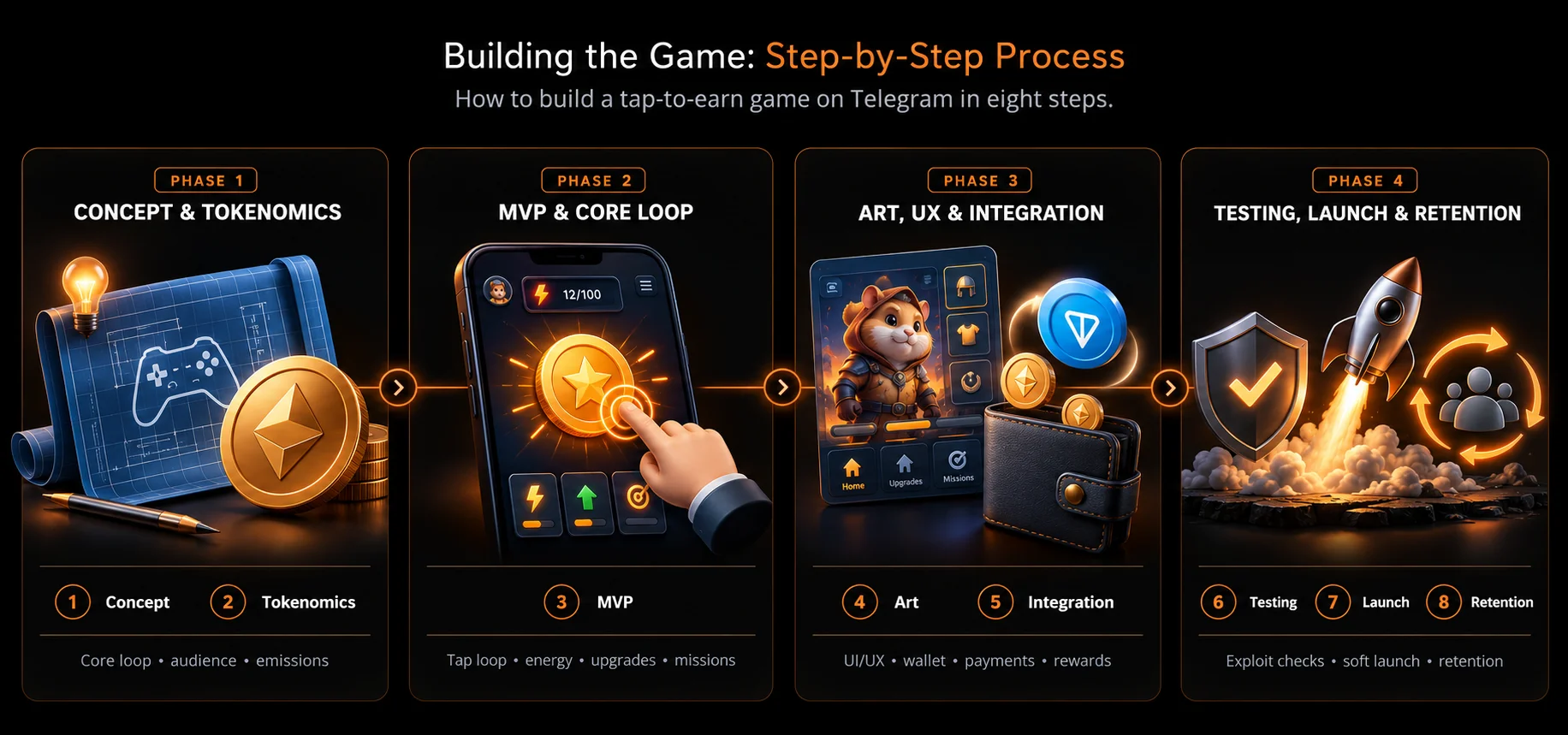
Building the Game: Step-by-Step Process
Phase 1: Concept and Tokenomics
Here is how to build a tap-to-earn game on Telegram in eight steps.
- Concept
- Tokenomics
- MVP
- Art
- Integration
- Testing
- Launch
- Retention
Start with concept and tokenomics before any code, using proven game development principles. Define the core loop, the audience, the emission schedule, and what players can actually do with tokens beyond selling them. A clear written brief saves months of rework later, especially when several teams touch the project.
Phase 2: MVP and Core Loop
Next, build the MVP. Tap loop, energy, one upgrade tree, referrals, and a few missions. Mini Apps are designed for mobile first, so teams with a lot of mobile game development experience usually make the most progress in touch controls, performance and low-bandwidth loading. Keep the scope tight because every new feature delays the point where real players test your economy, the only test that matters.
Phase 3: Art, UX, and Integration
Next are art and interface, which influence first impressions more than most founders realize. Good UI/UX design makes those first thirty seconds obvious. Players decide almost immediately if they want to keep tapping. Animations should be light and files compressed so that the game loads fast on mid-range smartphones.
The next steps in the integration are wallet connection, payments and claiming rewards, each having its own failure management. The engine choice matters here. Unity game development leans toward richer 3D or WebGL experiences while lightweight web frameworks lean toward simple tap loops. Then test for economic exploits, bot traffic and load. Soft launch with a small group. Plan retention efforts before launch day, not after.
Phase 4: Testing, Launch, and Retention
Retention is the stage teams can’t afford to skip. In its review of the Hamster Kombat downfall, DailyCoin argues that when players aren’t given a compelling experience, they leave the project. It’s a lesson any studio looking to release can learn from.
Retention and Virality: Where Most Tap Games Fail
Most tap games don’t fail before they launch, they fail after they launch. Many lose the vast majority of new users within the first week, so tap game retention is determined by what brings them back on day two, not what attracted them on day one.
1. Daily Engagement Loops
Good things are daily streaks, scheduled events, and progression that encourages repeat visits. Telegram games should leverage two-sided referral benefits and shareable moments like leaderboards for virality instead of forcing people to invite others. A telegram bot game development layer also gives reminders and community commands to keep players in the chat. Instant clarity and short sessions, the foundation of hyper-casual game development, are directly relevant.
2. Community as a Retention Lever
The final lever is community. Frequent, transparent communication keeps gamers engaged, and the controversy surrounding the Hamster Kombat airdrop showed how fast shady regulations can break trust.
3. Metrics That Matter
And finally, track the important stuff. Day one, day seven and day thirty retention. Conversion from referral. Average session length. Work on the weakest number before you spend on user acquisition.
Cost and Timeline: What It Actually Takes
1. Cost by Scope Tier
Costs vary depending on the scope, so consider these numbers as planning ranges, not as quotes. A MVP with the basic tap loop, energy, upgrades, referrals, and simple quests typically costs between $15K and $40K and takes six to ten weeks. A mid-tier game costs $50K-$120K over three to five months and has richer progression, live events, Stars payments and an admin dashboard. Full-featured builds with TON intelligent contracts, wallet claims and live operations start at $150K and usually take six months or more.
2. Hidden Line Items
Telegram game development cost is mostly defined by the amount of on-chain logic, backend complexity and artwork. Another often ignored line item is security audits for token contracts. Ask about the features that each tier includes, and get post-launch support conditions in writing when comparing tap-to-earn game development companies. And budget for recurring expenses such as hosting, monitoring and live content upgrades.
Need an Accurate Telegram Tap-to-Earn Game Cost Estimate?
How to Choose a Telegram Game Development Partner
1. What to Look for in a Portfolio
A good partner gives proof, not promises. Look at their game portfolio for mobile or telegram products that were released and ask if they have any games that didn’t die after their debut week. More than one portfolio of abandoned initiatives is far more telling than one with dazzling but short-lived launches.
2. Due Diligence Checklist
Before you sign on the dotted line, do your due diligence with the following questions:
- Live metrics: Does the partner have data on retention, session length, or revenue for a game that’s been shipped before?
- Economy design ownership: Is there an in-house economist or tokenomics head at the partner’s firm or is that on you?
- Contract audit history: Which security companies have audited TON contracts in the past and are they ready to publish their reports?
- Post-launch support: What’s the SLA for critical bugs? Who’s on call if something goes wrong at midnight?
- Bot and fraud experience: How do they handle farming, bot traffic, and referral abuse?
- Analytics integration: Is the measurement part of the MVP or is the analytics an afterthought?
A good tap-to-earn game development company should make its retention strategy as obvious as its programming. Teams that leverage AI development for analytics, bot traffic detection or personalization can gain a measurable edge over those that rely on guesswork. Equally important is post-launch support, because the early months decide whether a game will find an audience or wither away.
If you’d like to build with your own product team and keep strategy in-house, you can hire game developers regularly for technical labor.
Concluding Note
The 2024 boom showed that Telegram can provide distribution at a scale few platforms can match. The 2025 correction showed that distribution alone does not build a business. The studios that offer both courses are still growing.
Tap-to-earn is not a land grab anymore, but it’s far from over. The studios that win in 2026 will think of tokens as a reward layer, build economies that can absorb sell pressure, measure retention from day 1, and test the core loop with a small MVP before scaling. If you want Telegram tap-to-earn game development, you should speak to a team that has already launched Mini App games and can show you their numbers. A long term game is about clear, brief and honest expectations, not a temporary surge.
Frequently Asked Question:
1. What is a Telegram tap-to-earn game?
A lightweight game that runs as a Mini App on Telegram. Players tap to gain points in the game and these points can be spent on upgrades or exchanged for tokens. You don’t need to download anything or create a separate account, just sign in through the player’s Telegram profile.
2. Is tap-to-earn still worth building in 2026?
Yes, but now the model has changed. The 2024 boom fueled by airdrop anticipation is over, with Hamster Kombat losing the majority of its monthly players in weeks after token’s launch. What still works: authentic gameplay, transparent tokenomics, and retention loops that last beyond the airdrop.
3. How much does it cost to build a Telegram tap-to-earn game?
An MVP costs $15 to $40 thousand and takes six to ten weeks to build. A mid-tier game that has room to grow. Live events and Stars payments between 50K-120Kover three to five months. Builds with TON contracts and live operations that are fully-featured start at around $150K and take six months or more.
4. How long does it take to build a tap-to-earn game on Telegram?
MVP builds typically take six to ten weeks. Mid-tier games are three to five months. TON intelligent contracts, wallet claims and live operations typically take six months or more to fully build and deploy.
5. What tech stack do I need for a Telegram tap-to-earn game?
Four layers: Web App Front End (React or lightweight engine) Server-based backend for validation and anti-cheat TON Wallet Connection via TON Connect Telegram Stars payments Client side logic is not trustworthy. You have to check every tap side of the server.
Want to Build a Successful Telegram Tap-to-Earn Game?