Key Takeaways
- Indie games typically cost $50K–$500K, while AAA productions can exceed $300M including development and marketing expenses.
- Small indie teams prioritize creative control and rapid iteration, while AAA teams rely on specialized departments and structured approvals.
- Indie development usually takes one to three years, whereas AAA production commonly requires three to six years or longer.
- Scope, platform requirements, team depth, and production complexity significantly influence development costs, timelines, and technical requirements across both models.
- Hybrid development combines lean internal teams with external specialists, helping studios balance creative control, production capacity, quality, and costs.
Introduction
Every game sits somewhere on a spectrum. At one end, a handful of developers ship a focused title on a modest budget. At the other, hundreds of specialists spend years on a blockbuster with a nine-figure price tag. For founders, publishers, and enterprises, indie vs aaa game development is no longer an abstract debate, because rising production costs, crowded storefronts, and a tight talent market make the choice of approach one of the most consequential decisions in a project’s life.
Neither model is universally better. Indie offers creative control and lower cost, while AAA offers scale and production polish. This guide compares both across definitions, budgets, team structures, production steps, timelines, and outsourcing, using examples such as Hades, Baldur’s Gate 3, and Stardew Valley, so you can judge which approach fits your project, what it will realistically cost, and when an external partner makes sense. Each section ends with practical guidance rather than a verdict.
What Do Indie and AAA Game Development Mean?
1. What Is Indie Game Development?
The indie game industry is composed of small, independent teams of two to fifteen people who self-fund or get limited support from a publisher. Indie game budgets are usually $50K to $500K. The price can go over $1 million for big projects. The scope is purposefully small, often looking at 2D game development to keep the asset counts and costs low. The founders have creative control, so a design pivot is a conversation, not a committee, and releases can be made rapidly in response to player input. And then you have the mid-size independents like Supergiant and Hades, 15-50 people, who are showing what you can do with polish with a small team. Benefits can be significant: Stardew Valley passed 41 million copies by late 2024 after being built by a single developer.
2. What Is AAA Game Development?
To develop a AAA game, you need between 100 and 500 people on the team, a strong publisher, and a budget between $50 million and $300 million (including marketing costs). Projects like Rockstar’s GTA VI have a cinematic scope, large production cycles and global debuts, and require hundreds of professionals working together over many years. But scale is not a proxy for ownership: Larian’s Baldur’s Gate 3 shows that independent developers are able to aim for blockbusters. The difference between indie game makers and AAA companies, and AAA vs indie games in general, really comes down to money, risk-taking and how deep the company is, not quality.
Indie vs AAA Game Development: Comparison Table
The table summarizes typical ranges rather than fixed rules, and these gaps shape every indie vs aaa game development cost discussion.
| Factor |
Indie |
AAA |
| Funding |
Self-funded, grants, small publishers |
Large publishers, platform holders |
| Budget |
$50K–$500K; $1M+ ambitious |
$50M–$300M+ with marketing |
| Team structure |
2–15 people, shared roles |
100–500+, specialist departments |
| Creative control |
Founder-led, fast decisions |
Layered approvals |
| Scope |
Focused, often stylized |
Large worlds, cinematic polish |
| Timelines |
1–3 years typical |
3–6+ years |
| Publishing |
Self-publish or small deals |
Global multi-platform launch |
Budget is the clearest divider. Figures from a UK regulator review put AAA development budgets at $200M or more for games greenlit for 2024–25, up from $50–150M five years earlier.
Indie or AAA? Build a Plan That Fits Your Game.
Budget Structure and Funding
1. Development, Marketing, and Ongoing Support
The bulk of Indie game development cost is salaries, tools, and a small push at launch, with support done through part-time patching. Production Marketing (sometimes rival development budget) Live operations These are the costs of developing AAA games. Court documents in the FTC v. Microsoft lawsuit reportedly said that Horizon Forbidden West was valued at around $212 million and said that it had over 300 employees working on it at its peak. Patches, ports and content updates continue to eat up budget long after release, so support matters as well. Thus, a good game development cost estimate breaks down spending into build, launch, and post-launch costs, rather than giving a single number.
2. Cost Ranges by Game Type and Platform
Game costs depend on genre, platform and team size. A 2D puzzle or narrative indie game could be in the $50K-$150k range because art assets are limited and engine complexity is low. A 3D action game or metroidvania with more systems and animation usually costs from $200K to $500K. Live-ops support is an ongoing expense, but often live-first indie projects are priced lower since the scope and platform requirements are fewer. On the AAA side, a mid-tier console title with broad multiplayer systems generally costs $50 million to $100 million, whereas open-world games with cinematic production, celebrity voice talent and global marketing cost more than $200 million. The platform matters as well: certification for consoles creates testing constraints that teams that are mobile-first rarely encounter, so multi-platform releases tend to sit higher in each band.
3. Self-Funding, Publishers, and External Investment
Indie teams live off savings, grants, platform deals and publishers who trade cash for revenue shares. Risk is spread across a portfolio by major publishers or platform owners in AAA initiatives. Studios of all sizes are already stretching their budgets through partnerships and analyst predictions for the game outsourcing market are over $1.9 billion by 2024, though figures vary widely between research firms. Each funding avenue comes with a trade-off of control for capital so pick the one that fits your risk appetite.
Team Size, Specialist Roles, and Decision-Making
1. Team Responsibilities and Specialist Involvement
Every workflow is determined by the size of the indie vs AAA dev teams. In teams of 2 to 15, one developer can be responsible for gameplay, tools and builds, and the same artist for ideas, 3D modeling and user interface. The mid-sized studio, 15 to 50 people, has dedicated artists, designers and producers, each with their own role. AAA companies with 100-500+ employees will generally be structured in departments for animation, audio, narrative, tech art, and online services. Game development outsourcing is common to help manage workloads that are too much for internal teams to handle during busy periods. With the growth of the workforce comes the need for clear role boundaries, with every unclear handoff replicated across departments.
2. When to Bring in Specialists
Specialist positions develop at different levels depending on the type of project. You can make a 2D indie game without a technical artist. One is almost always required for a 3D project that uses custom shaders or complex animation. Online multiplayer features require networking experts, backend engineers and anti-cheat specialists, which are not always available in independent teams of five. Audio design, localization and platform certification expertise are often outsourced, rather than hired. One of the most important planning decisions a small studio makes is determining what shortfalls in experts could jeopardize production, and whether a project will ship on time or stall due to talents that were never in-house.
3. Approval Processes and Creative Control
Pivots are cheap, because conversations are independent decisions. AAA decisions must pass through creative directors, production leadership and publisher milestones. This preserves budget and quality, but slows change. Mid-size studios often mix informal design talks with firm budget and platform commitments. The level of uncertainty that remains in your design dictates the appropriate structure.
Indie vs AAA Game Development Process: Step by Step
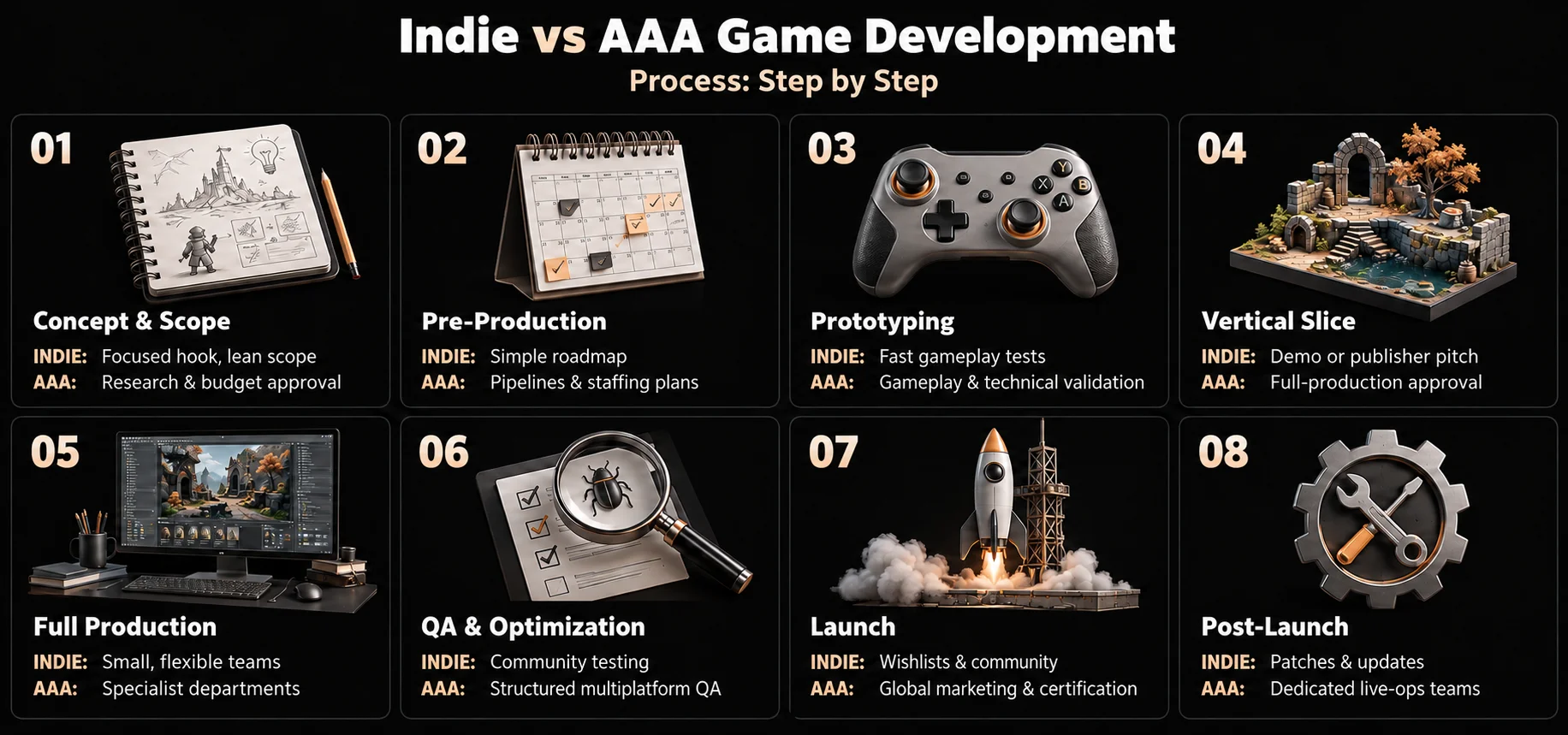
The general lifetime is the same in both models, but the depth is drastically different at each stage. In AAA game development, gates are formalized with documentation, reviews and sign-offs. However, indie teams truncate stages and iterate in the open. The engine choice affects the pipeline as well, and Epic makes their Unreal Engine licensing terms public: free until $1 million in revenue, then 5%.
1. Concept and Scope Definition
Indie teams find a compelling hook and narrow scope early, usually with a one-page design brief and a list of explicitly out of scope items. For AAA projects, we produce a full concept document, competitive analysis, market estimate and budget approval before allocating engineering resources. In both cases scope discipline predicts success, because every additional feature adds to the testing and art that must be done later. The difference is that indie teams treat scope cuts as creative decisions, whereas AAA teams consider them budget decisions that require stakeholder approval.
2. Pre-Production and Planning
Indie planning is usually some rework and is done on a roadmap and a common board. AAA pre-production sets up tool chains, naming standards, and staffing plans that will dictate thousands of different actions, and teams often choose Unity game development because it is more adaptable than Unreal in terms of fidelity. It is expensive to change early technical choices at any scale, so document them well enough that future staff can take the plan without a handover meeting.
3. Prototyping and Gameplay Validation
Indie developers are able to make prototypes in days and test them with friends or early-access players. A bad prototype can be discarded at a low cost. AAA studios also prototype, but they validate against production targets for performance, memory, and platform needs that will be met during full development. Either way, the idea is to figure out what’s fun before you pay for art. The teams that don’t validate often pay for it in revisions later.
4. Vertical Slice Development
A vertical slice has the entire experience in miniature. Indies might skip it or ship a polished demo. AAA teams use it as a financing gate. Often built using Unreal game development pipelines, so they can achieve high fidelity images. The publisher will use the slice to decide if they go into full production, so the quality here sets the standard for everything that follows. The same logic applies on a smaller scale, and many indie studios now make vertical slices to pitch to publishers.
5. Full Production
Indie production is lean. Artists and technologists work together in sprints, and responsibilities begin to blur as deadlines loom. AAA production takes years and involves multiple departments working in parallel. The full realization of 3D game development depends on the consistent delivery of content across art, animation and engineering. The more teams, the more overhead, which makes great producers all the more important. Both models predict scope creep, burnout and schedule slip in the middle of production.
6. Integration, QA, and Optimization
Indies constantly test with small groups and community feedback and errors are often fixed in the next patch instead of holding them back from the release. AAA studios use standardized test plans on multiple hardware configurations. Many have external QA services to manage console certification and device matrices. Track your frame rate and memory performance budgets from the first playable build, not the last. Retrofitting optimization onto a finished game is exponentially more expensive than designing to budget from the beginning.
7. Release Preparation and Launch
The shop page, wishlists and community channels are the lifeblood of indie releases, and the launch window is chosen to avoid competing with larger releases. AAA ships coordinate global marketing, platform certification and day one patches, with release dates planned years or months in advance. Many mobile game development teams now do many soft launches before committing to a global release as it bridges both techniques and reveals retention issues before a full rollout.
8. Post-Launch Support
Indie developers patch quickly, and sometimes even grow from free updates, as Stardew Valley has with years of feature expansions. AAA live support necessitates dedicated staff, seasonal content and live-ops tooling that could take years and cost an increasing portion of the original budget. The scope always tends to expand, never contract, once the game is out and expectations are high for the game, so plan this budget before launch, not after.
Your Game Deserves More Than Just a Great Idea
Production Timelines and Milestones
Founders underestimate the variance in time; the difference between a well-scoped indie release and a AAA blockbuster is years, not months. Understanding what causes the difference; and where schedules often fall short, enables you to set achievable goals and not take on a plan the team cannot deliver.
1. How Scope and Dependencies Affect Schedules
Scope creeps, teams depend on each other, and timelines get tight. An indie title with a well-defined scope can ship in a year or two, three at the maximum. AAA game production takes three to six years because art, engineering and design all have to work together on shared builds. According to reports, it took around five years for Horizon Forbidden West. Dependencies are the hidden scheduling risk. One late tool or art batch can delay an entire department.
2. Key Milestones and Common Causes of Delays
Typical milestones are prototype, vertical slice, alpha, beta and certification. Delays are often due to late scope changes, engine rework, and integration issues. Supergiant’s Early Access approach for Hades is one indie solution: release a limited version early and improve it based on user input. Ensure that you have slack in each milestone, especially certification.
Art Pipelines, Technology, and QA
Pipeline design and team talent are equally important for production quality. Indie vs AAA differ in how art creation, engine choice, and testing scale, and choices made early in any of these areas compound as the project progresses. The following sections discuss where the techniques differ, and when both benefit from external professionals.
1. Asset Creation and Outsourcing
At the extremes, asset creation is vastly different. Indie teams buy or stylize assets, reuse modular kits and rely heavily on great visual direction to compensate for low volume. AAA teams have dedicated pipelines of concept artists, modelers, riggers, and technical artists, each one responsible for a particular part of the project. Outsourced game art production fills the gaps in both, allowing for increased capacity without the overhead of permanent hires. It works best if the studio has a strong art bible and pipeline in place. Specialists in rigging, topology and engine budgeting, often found outside of huge studios, are beneficial for hero assets like 3D character design.
2. Engine Selection and Integration
The selection of engine affects the whole downstream pipeline. Unity is great for smaller teams because of its tooling and asset store 2D games and mobile-first projects. Unreal is great for high fidelity 3D modeling and cinematic production but requires a little more specialized skills. When a studio requires systems not found in any commercial engine, custom engines are a common occurrence at the AAA level. With bigger teams, integration is harder. Smaller teams can integrate assets on a continuous basis, but bigger teams need structured asset pipelines and tools to make sure that one department’s changes don’t break another department’s work.
3. Testing and Performance Requirements
Test depth depends on scope and number of platforms. Indie teams have a limited amount of target devices to test on and rely on player input after launch. AAA studios test their games on dozens of hardware set-ups and have to pass platform certification standards before they can be published. Platform holders publish strict guidelines for console releases, and Microsoft’s Xbox Requirements documentation shows how extensive the certification can be. Frame rate, memory, load time, crash rate; these are all hard standards that have to be met regularly, not just on launch day.
Outsourcing and Co-Development
There are few studios that do all disciplines in-house anymore, and outsourcing is no longer just for little teams. What to delegate, when co-development is preferable to simple outsourcing, and how to align distributed work are the factors that determine whether a partnership accelerates production or introduces coordination overhead that slows it down.
1. What Can Be Outsourced?
Studios will often outsource art, animation, porting, QA and engineering support. It’s also possible to do full-cycle builds. A reputable game development company will put in writing exactly what deliverables you can expect, from batches of assets to tested builds. Keep core creative decisions like game feel and story internal as much as possible.
2. When Is Co-Development Appropriate?
Game co-development services are perfect for games that need extra capacity but want to retain creative direction. Examples include AAA support during crunch time or an indie vertical slice to pitch to publishers. Do co-development when the partner should own features and outsourcing for well defined deliverables.
3. How to Coordinate Internal and External Teams
Early definition of interfaces. Common build pipelines, naming conventions, review cadences. Designate an internal owner for each workstream. Best game development service providers have one point of contact, weekly demos, and clear acceptance criteria. If you need more engineers, hire game developers that understand your engine and your timeline.
Which Production Approach Fits Your Project?
Use a simple assessment methodology before you select a model. Rate your project low to high on each of the following factors and then compare the pattern rather than any individual rating. Most teams know they need a hybrid.
- Budget certainty: High certainty favors indie, where scope can be adjusted to fit cost. Low certainty or investor-backed funding favors AAA, where larger budgets absorb change.
- Scope risk: High scope risk (unproven mechanics, evolving design) favors indie, where pivots are cheap. Low risk (well-understood genre, clear design) suits AAA, where the cost of change is higher.
- Team depth: Shallow internal teams lean indie or outsourced support. Deep in-house teams with specialist departments lean AAA.
- Time to market: Indie benefits from tight deadlines. AAA is about long and staged releases.
- Creative control: Founders who want direct ownership of design decisions favor indie. Teams comfortable with layered approvals and publisher input can work at AAA scale.
A hybrid approach, with a lean internal core and specialist partners, often gives the best balance of cost and quality. What is the best way to determine fit before signing with a partner? The easiest way is to look at their game portfolio for similar scope, engine and platform experience.
Concluding Note
The choice between indie and AAA game development is a question of fit, not prestige. Indie production rewards focus, speed, and creative control at a fraction of the cost, while AAA production rewards scale, polish, and the depth to sustain long roadmaps. Most real projects land in between, pairing lean internal leadership with external specialists for art, engineering, and QA. Treat this comparison as a starting framework, then validate it with a prototype, a cost estimate, and an honest look at your team’s strengths. Whichever path you choose, honest scoping early prevents expensive rework later.
Frequently Asked Questions
1. What is the main difference between indie and AAA game development?
Indie development is done by small teams of 2 to 15 people and costs anywhere from $50K to $500K. The founder makes the decision. AAA development costs $50-$300 million, involves 100-500 person teams and layered approvals. Mostly it’s a matter of scale, not quality, and both can make amazing games.
2. How much does indie game development cost?
Typical costs, independent $50K to $500K. More ambitious productions can easily run to more than $1 million. A 2D puzzle or narrative indie game costs between $50K and $150K, but a 3D action game will cost between $200K and $500K. Projects starting with mobile are lower on the scale, because they have a simpler scope and platform requirements.
3. How much does AAA game development cost?
AAA budgets start at around $50 million and can be over $300 million including marketing. A mid-tier console release with multiplayer systems runs $50-100 million, and open-world games with dramatic production, global marketing, cost more than $200 million. Horizon Forbidden West reportedly cost more than $212 million and employed more than 300 people.
4. How long does it take to develop an indie game versus a AAA game?
Most indie titles with a clear scope will ship within one or two years. AAA productions can take three to six years or more, as art, engineering and design have to work together on common builds. Horizon Forbidden West reportedly took about five years.
5. Do I need a publisher to make an indie game?
No. Many indie teams fund themselves, get grants or self-publish on sites like steam. Publishers become valuable when a project need funding for increased scope, marketing reach, or platform certification assistance. There is some trade-off of creative autonomy for the funds in each funding strategy.
Turn Your Game Concept Into a Clear Development Roadmap