What Are Smart Contracts in Blockchain? Complete Guide (2026)
Gone are the days of blockchain technology being only about cryptocurrencies. It is evolving rapidly and smart contracts are at its center. Let’s take some time to understand what are smart contracts in blockchain and why they are transforming industries in 2026. This guide will cover everything; from how smart contracts work step by step to real-world use cases, risks, costs, and future trends—to give you in-depth knowledge and clarity for founders, enterprises and developers exploring blockchain adoption.
Introduction to Smart Contracts
Smart contracts are the building blocks of modern blockchain systems. They enable automated, trustless agreements that execute without intermediaries. Thus, making them a powerful alternative to traditional contracts.
What Are Smart Contracts in Blockchain?
Simply, a smart contract is a self-executing digital agreement where the terms and conditions are written directly into code and stored on a blockchain. When the system detects a fulfillment of predefined conditions, the contract automatically executes the agreed action—be it transferring ownership, releasing funds, or updating records.
A simple example of smart contract is an escrow payment where, when a product delivery is verified, the smart contract automatically releases payment to the seller. There is no need for a bank, lawyer, or a third-party escrow service here. Companies implementing such automation usually rely on smart contract development solutions & services to build secure, self-executing agreements on blockchain networks.
Brief History of Smart Contracts and Blockchain
In the 1990s, cryptographer Nick Szabo first introduced the concept of smart contracts. But it only gained traction after blockchain platforms like Ethereum began emerging in 2015. Ethereum provided developers with programmable contracts where they could build decentralized applications development (DApps) using Solidity.
👉 Get a Free Consultation Today
Why Smart Contracts Matter Today
To venture into decentralized finance (DeFi), NFTs, gaming, supply chains, and enterprise automation, one must understand what are smart contracts in blockchain. Smart contracts reduce costs, increase transparency, and enable global, permissionless collaboration by removing intermediaries. Many DeFi products are built by teams specializing in Web3 dApp development, combining smart contracts with seamless frontend experiences.
How Do Smart Contracts Work?
Starting from the base, understand how smart contracts work step by step and what makes them secure and reliable should be the main agenda. The steps explained below provide seamless smart contract blockchain automation examples like lending protocols, or insurance payouts.
How Smart Contracts Work Step by Step
- Contract Creation – Developers write the contract logic using languages like Solidity.
- Deployment – The contract is deployed to a blockchain network.
- Triggering Conditions – Predefined conditions are monitored on-chain.
- Automatic Execution – When conditions are met, the contract executes automatically.
- Immutable Record – All actions are permanently recorded on the blockchain.
Key Components of a Smart Contract
- Blockchain Network – The decentralized infrastructure (Ethereum, Solana, Polygon)
- Conditions – Logical rules defined in code
- Code – The executable program governing actions
- Cryptography – Secures transactions and verifies identities
Popular Smart Contract Platforms
- Ethereum – The most widely adopted platform, offering mature tooling and a large ecosystem
- Solana – High-speed execution and low fees
- Polygon – Layer-2 scalability for Ethereum-based contracts
- BNB Chain – Cost-effective and EVM-compatible
Many developers rely on ethereum smart contract templates to speed up development and reduce errors.
Smart Contract Development
Smart contract development is a highly nuanced field that needs a properly structured approach along with technical expertise, and deep security awareness.
Smart Contracts Development Tutorial (High-Level)
A typical smart contracts development tutorial involves:
- Defining the business logic
- Writing code using Solidity
- Testing on testnets
- Conducting security audits
- Deploying to mainnet
- Monitoring and upgrading (where supported)
For developers, a Solidity smart contract programming guide is essential to understand state variables, functions, modifiers, and events.
Best Platforms for Smart Contract Development
When you need to choose the best platforms for smart contract development, it comes down to cost, scalability, ecosystem, and security needs. To this day, Ethereum dominates enterprise-grade applications whereas Polygon and Solana blockchain development are perfect for cost-sensitive and high-throughput use cases.
Smart Contract Use Cases in Industry
Let’s delve into the industries where smart contracts are delivering real business value.
Decentralized Finance (DeFi)
Smart contracts are highly useful in DeFi like Solana DeFi Development, Polygon etc., where they automate borrowing, lending, staking and trading without the need for banks. Several platforms today use smart contract logic to manage billions in digital assets.
Supply Chain Management
Smart contracts can easily track goods in real time, thus, successfully executing payments upon delivery. They also reduce fraud by ensuring data integrity across the supply chains.
Healthcare
Contracts based on blockchain effectively improve transparency in record-keeping, consent management and insurance claims while upholding privacy
Voting Systems
Smart contracts enable tamper-proof, transparent digital voting systems with verifiable results.
Insurance
Companies can automate claim processes and payouts through smart contracts, which reduces delays and administrative overhead.
Claims processing and payouts can be automated using smart contracts, reducing delays and administrative overhead.
These smart contract use cases in industry highlight how automation improves efficiency and trust.
Benefits of Smart Contracts
Smart contracts offer clear advantages over traditional systems.
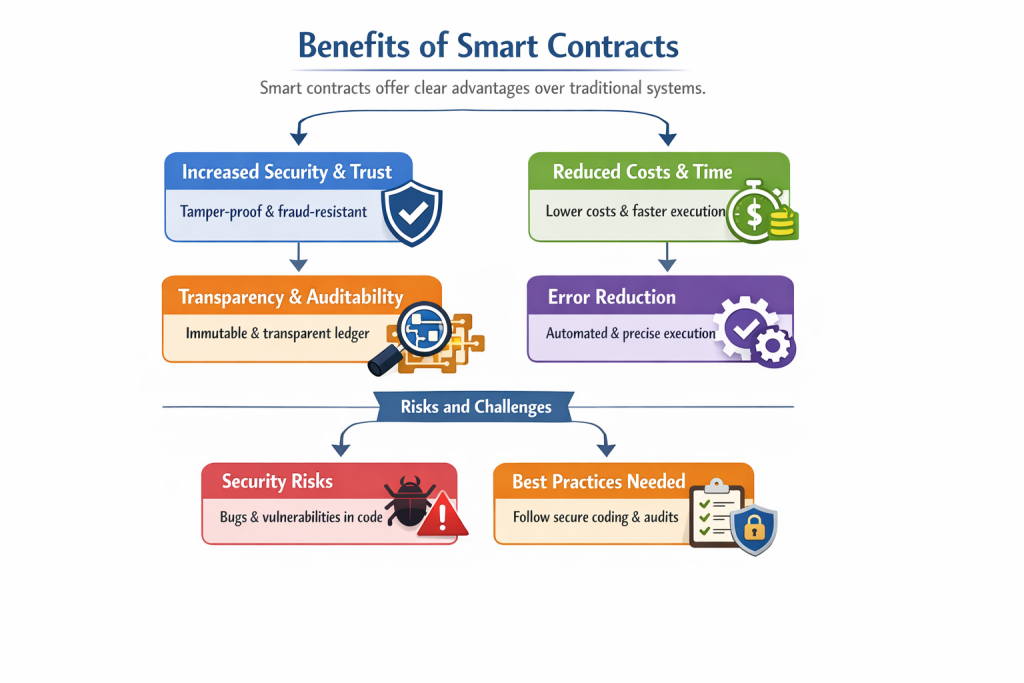
Increased Security and Trust
Decentralization and cryptographic verification reduce the risk of tampering and fraud.
Reduced Costs and Time
By eliminating intermediaries, smart contracts lower operational costs and accelerate execution.
Transparency and Auditability
Every transaction is recorded on an immutable ledger, enabling real-time audits.
Error Reduction
Automatic execution minimizes human error and enforces precise contract terms.
Risks and Challenges
Despite their benefits, smart contracts come with important challenges.
Security Risks
Bugs and vulnerabilities in code can lead to exploits. Following smart contract security best practices is critical to minimizing risk.
Smart Contract Audit Checklist
A robust smart contract audit checklist typically includes:
- Code review for logic flaws
- Reentrancy and overflow checks
- Input validation
- Gas optimization analysis
- Access control verification
Apart from these, businesses should also explore smart contract risk mitigation strategies like multi-signature wallets, upgradeable contracts and pause mechanisms.
Legal and Regulatory Uncertainty
Legal recognition of smart contracts varies by jurisdiction, creating compliance challenges.
Scalability and Complexity
High network congestion and complex logic can impact performance and cost.
Smart Contract Costs
Now comes the important part! How much these smart contracts cost to plan complete blockchain projects.
Smart Contract Gas Fees Explained
You’ve probably heard about gas fees in crypto exchanges. They represent the computational cost charged each time a contract is executed on a network like Ethereum.
Fees vary based on:
- Contract complexity
- Network congestion
- Platform choice
Optimizing code and choosing scalable networks can significantly reduce expenses.
Smart Contract Audit Services Cost
Other than gas fees, another cost to consider is the smart contract audit services cost that depends on contract size, complexity, and risk level. At the beginning of any project, these audits may appear to be expensive but they prove to be more affordable than recovering from a security breach.
Smart Contracts vs Traditional Contracts
When comparing smart contracts vs traditional contracts, the differences are clear:
- Execution: Automatic vs manual enforcement
- Speed: Instant vs delayed processing
- Cost: Lower operational costs vs intermediary fees
- Trust: Code-based trust vs institutional trust
Smart contracts are especially powerful for digital, cross-border, and high-frequency transactions.
The Future of Smart Contracts (2026 and Beyond)
As the days progress, the future of smart contracts is more and more tied in the advancements in blockchain and AI combined.
Faster and More Efficient Blockchains
Businesses are experiencing greater execution speed and reduced costs with layer-2 solutions and next-generation blockchains.
AI and Smart Contracts
Industries will trigger smarter decision-making as AI-driven contracts quickly adapt to real-world data.
Regulatory Evolution
More and more governments worldwide are defining clearer frameworks, encouraging enterprise adoption and legal certainty.
With 2026 rolling in, smart contracts will prove to be foundational for all digital infrastructures across industries.
Frequently Asked Questions (FAQ)
What are smart contracts in blockchain?
Smart contracts are self-executing digital agreements stored on a blockchain that automatically run when predefined conditions are met.
How do smart contracts work step by step?
They are written in code, deployed on a blockchain, triggered by conditions, executed automatically, and recorded immutably.
Are smart contracts legally binding?
This depends on jurisdiction. Many regions are developing regulations to recognize smart contracts legally.
What is the biggest risk in smart contracts?
Security vulnerabilities in poorly written code are the biggest risk, which is why audits are essential.
How much does smart contract development cost?
Costs vary based on complexity, platform, gas fees, and audit requirements, but proper planning can optimize expenses.
Concluding Note
Smart contracts have proven their worth and are consistently redefining how we create agreements, and execute/enforce them in the digital era. When you understand what are smart contracts in blockchain, you unlock transparency, automation, and efficiency to scale. Every other industry today is proving that smart contracts are no more a concept, but production-ready solutions shaping the future. With greater progression in blockchain technology, organizations can adopt smart contracts to gain early advantage with faster operations, enhanced trust, and greater ROI. In case you are wondering how to integrate smart contracts in your business, ChicMic Studios can offer you end-to-end smart contract development, blockchain solutions.|
If you are planning to adopt blockchain automation, ChicMic Studios offers end-to-end smart contract development and blockchain solutions tailored to your business goals.