WhatsApp
microsoft-logo
pg-logo
samsung-logo
stanford-university-logo
systique hughes logo
cashback-logo
luxel-logo
Frugi logo
athleta-logo-1
Funko Logo
hzm logo
swiggy-logo
cardano-logo
animaca
Turning Generative AI Into Business Value

Turning Generative AI Into Business Value

Generative AI development is the combination of foundation models, big language models, data retrieval, software engineering and workflow automation to build applications that can generate, summarize, search, classify, and modify corporate data. ChicMic Studios is a generative AI development company. We work with enterprises to create custom AI solutions that meet their data, users, workflows, integrations, security requirements, and business goals.

Generative AI Development Services We Offer

We offer generative AI development services that cover strategy, model selection, application engineering, integration, deployment and post-launch improvement. We choose the right mix of foundation models, retrieval, prompt engineering, fine tuning, automation, and good old software development for the use case at hand.

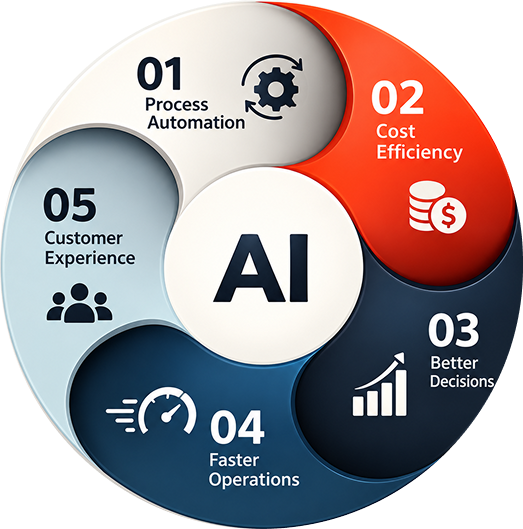
The Real-World Payoff of Custom Generative AI

Custom generative AI solutions help businesses increase efficiency, reduce repetitive tasks and provide new product features. The benefits depend on the use case, the data quality, the adoption, the workflow design, and the review process.

Faster access to information

Faster access to information

Generative AI assistants use natural language interfaces to distill texts, acquire relevant knowledge, and deliver information.

Reduced manual work

Reduced manual work

AI automation can assist with repetitive tasks like data extraction, document processing, report generation, content writing, and request classification.

Better customer experiences

Better customer experiences

AI chatbots, virtual assistants, and in-product copilots can provide faster, more consistent service through digital channels.

Improved employee productivity

Improved employee productivity

Generative AI productivity solutions can boost the efficiency of teams studying, writing, summarizing, analyzing and executing routine knowledge jobs.

Smarter products and services

Smarter products and services

Ways to add value to existing products include AI search and suggestions, content creation, personalization, copilots, and intelligent help.

Scalable AI adoption

Scalable AI adoption

They can start with one targeted workflow, and then move to other teams, departments, products and use cases when they see value and governance needs.

Generative AI Technology Stack

Technology choices depend on the project’s use case, privacy requirements, performance targets, scalability needs, integration surface, and budget. ChicMic Studios selects the appropriate stack for each solution rather than using one fixed combination.

CrewAI

CrewAI

LangGraph

LangGraph

LlamaIndex

LlamaIndex

Microsoft AutoGen

Microsoft AutoGen

Hugging Face

Hugging Face

LangChain

LangChain

LangGraph

LangGraph

LlamaIndex

LlamaIndex

Django

Django

FastAPI

FastAPI

GraphQL

GraphQL

PostgreSQL

PostgreSQL

Redis

Redis

REST

REST

AWS

AWS

Docker

Docker

Google Cloud

Google Cloud

Kubernetes

Kubernetes

Python

Python

PyTorch

PyTorch

Scikit-learn

Scikit-learn

TensorFlow

TensorFlow

Grafana

Grafana

LangSmith

LangSmith

MLflow

MLflow

OpenTelemetry

OpenTelemetry

Prometheus

Prometheus

embeddings

embeddings

Haystack

Haystack

hybrid search

hybrid search

LlamaIndex

LlamaIndex

Unstructured

Unstructured

AWS IAM

AWS IAM

Microsoft Entra ID

OAuth 2.0

OAuth 2.0

Okta

Okta

OpenID Connect

OpenID Connect

Anthropic Claude

Anthropic Claude

Google Gemini

Google Gemini

Meta Llama

Meta Llama

Mistral

Mistral

OpenAI

OpenAI

Generative AI Development for Industries

ChicMic Studios builds generative AI solutions customized to the unique data, workflows, users and security requirements of each enterprise. The following use cases are subject to project-specific feasibility and compliance review

Finance and Banking
Insurance
Retail and E-commerce
Manufacturing
Real Estate
Education
Legal Services
SaaS Companies
01

Finance and Banking

Generative AI use cases for financial institutions include document analysis, internal knowledge search, financial assistants, customer assistance, reporting and regulated process automation – all within strict governance frameworks.

  • Automated document and financial-data analysis.
  • Internal banking knowledge assistants.
  • Customer-facing financial assistants.
  • Compliance and reporting support.
  • Fraud and risk-information workflows.
02

Insurance

Insurance companies may utilize generative AI to increase speed and accuracy of document-intensive activities such as claims documentation, policy search, customer service, underwriting support, and internal knowledge management.

  • Claims document summarization.
  • Policy and coverage search.
  • Customer-support assistants.
  • Underwriting document analysis.
  • Broker and employee copilots.
03

Retail and E-commerce

Generative artificial intelligence can help retailers and e-commerce companies in developing product content, personalizing experiences, enhancing search, automating support and empowering merchandising teams across catalogs and channels.

  • Product description generation.
  • AI shopping assistants.
  • Product and catalog search.
  • Customer-support automation.
  • Merchandising and inventory insights.
04

Manufacturing

Generative AI can enable manufacturers to improve access to operational paperwork, maintenance data, manufacturing records and supply chain expertise, which could reduce downtime and assist frontline personnel.

  • Maintenance knowledge assistants.
  • Production-report summarization.
  • Supplier and operations document processing.
  • Worker and supervisor copilots.
  • Internal process and safety knowledge search.
05

Real Estate

Generative artificial intelligence can be used by real estate organizations to improve listing workflows, process documents, communicate with clients, search for properties, and provide agents and brokers with access to market information.

  • Property description generation.
  • Listing and document summarization.
  • Client-matching assistants.
  • Property search assistants.
  • Market-information analysis.
06

Education

Educational institutions may utilize Generative AI to support personalized education, administrative processes, institutional knowledge discovery and content creation for students, staff and academics.

  • Learning and tutoring assistants.
  • Course-content generation.
  • Faculty and staff knowledge search.
  • Administrative workflow automation.
  • Student-support assistants.
07

Legal Services

Generative artificial intelligence can be applied to document-heavy work like research, drafting, matter summarization and internal information retrieval by legal firms provided that acceptable standards for professional review and confidentiality are followed.

  • Contract review and clause extraction.
  • Legal research assistance.
  • Matter and case summarization.
  • Document drafting support.
  • Client intake automation.
08

SaaS Companies

SaaS companies can embed generative AI into their products in many ways, including copilots, natural-language search, workflow automation, knowledge assistants and personalized user experiences.

  • In-product AI copilots.
  • AI-powered search.
  • Customer-support features.
  • Document and knowledge assistants.
  • AI workflow automation.

Build Your Generative AI Solution With ChicMic Studios

ChicMic Studios can help evaluate your use case, select the right development approach, and build a scalable application around your data, users, and business objectives.

A Proven Process for Building Generative AI That Works

The generative AI development process combines business discovery, data assessment, model selection, application engineering, evaluation, deployment, and ongoing optimization.

Discovery and Use-Case Validation

First we learn about your business goals, current operations, data availability and metrics for success.

Discovery and Use-Case Validation

AI Architecture and Model Strategy

We will find the best model, development approach and integration strategy for your use case

AI Architecture and Model Strategy

Generative AI Development and Integration

We develop the AI application, model workflows, APIs, interfaces and integrations your solution needs.

Generative AI Development and Integration

Testing, Evals, and Safety Checks

We analyze the system in terms of quality, dependability, performance and safety before deployment.

Testing, Evals, and Safety Checks

Deployment and Pilot Rollout

We usually deploy the solution on scalable cloud infrastructure, beginning with a controlled pilot.

Deployment and Pilot Rollout

Responsible Generative AI, Security and Compliance

Generative AI systems may be subject to a number of legal, regulatory and contractual requirements depending on their use case, sector, location, data and risk level. During discovery ChicMic Studios works with clients to surface key issues and embed appropriate controls in the generative AI architecture, development process and deployment plan.

  • EU AI Act Generative AI applications may require risk classification, transparency, oversight by humans, technical documentation, monitoring and other precautions, depending on what a system is designed to do, who uses it and its market and risk category.
  • GDPR and data-protection laws Processing of personal data for generative AI applications may also be subject to lawful processing, purpose limitation, data minimization, retention, user transparency, data-subject rights, and international data transmission safeguards.
  • HIPAA and healthcare privacy requirements Healthcare generative AI apps that process protected health information may need appropriate administrative, technical, and contractual safeguards such as controls on access, auditability, data handling practices and appropriate vendor agreements. HIPAA and health information privacy standards.
  • Financial-services regulations Generative AI used for fraud detection, lending, risk assessment, payments, financial advising or consumer choices may need explainability, documentation, oversight by humans, model validation, output review and safeguards against discriminatory results.
  • SOC 2, ISO 27001, and client security standards Enterprise clients may require evidence of security controls at the organizational level, identity and access management, risk management, incident response, data governance, vendor management and AI-system oversight.
  • Industry-specific and regional requirements Laws may also apply to generative AI applications in employment, education, biometrics, children’s services, critical infrastructure, government services, legal activities and other sensitive industries.
Responsible Generative AI, Security and Compliance
A Proven Process for Building Generative AI That Works

A Proven Process for Building Generative AI That Works

ChicMic Studios combines generative AI capabilities with mobile, online, backend, cloud and product engineering expertise. The whole solution is built around the AI component and you don’t need to hire separate developers for the application, integrations, infrastructure and AI process.

We align generative AI recommendations to your business objectives, user workflows, data readiness, desired outcomes, and execution feasibility.

We build applications around your data, products, processes, integrations, access requirements, and user experience rather than forcing your business into a generic platform.

We can support discovery, architecture, design, application development, integrations, testing, deployment, monitoring and continuous improvement.

We can develop knowledge retrieval, document intelligence, AI assistants, copilots, and workflow agents where these approaches fit the use case.

We have the know-how to build mobile, web, backend and cloud development that turns generative AI features into fully functional products, not just isolated demos.

Based on your scope, time-frame, requirements and level of uncertainty, pick a fixed-price project, dedicated development team or a time and materials engagement.

Generative AI Development Cost and Engagement Models

The cost of generative AI development is determined by the scope of the solution, data readiness, model strategy, integrations, security requirements, infrastructure, anticipated usage, and post-deployment maintenance. Here the ranges are rough planning figures. A detailed quote requires discovery & technical evaluation.

What Affects Generative AI Development Cost?

Security and compliance
For sensitive use cases, you may need access restrictions, data isolation, audit logs, output validation, human review, monitoring and additional documentation.
Infrastructure and usage
Running costs are determined by things like cloud hosting, model inference, storage, API calls, vector search, monitoring and traffic volume.
Product requirements
A complete online, mobile, SaaS application has more than just the generative AI part: UX, frontend, backend, QA, deployment and release work.
Integrations
More engineering and testing is required to connect generative AI with CRMs, ERPs, helpdesks, data warehouses, payment platforms and legacy systems.
Ongoing support
Monitoring, fast updates, retrieval improvements, model changes, performance improvements, and new integrations all impact total cost of ownership.
RAG architecture
The cost of RAG depends on the quantity of documents, source systems, embeddings, vector databases, quality of retrieval, citations, and access restrictions.
Data requirements
Document preparation, cleaning, permissions, chunking, labeling and data pipeline creation can substantially increase the effort to implement.
Use-case complexity
Generally, building an AI content or summary feature for a specific area takes less work than building an AI agent that can perform multi-step operations across multiple business applications.
  • Security and compliance
    For sensitive use cases, you may need access restrictions, data isolation, audit logs, output validation, human review, monitoring and additional documentation.
  • Infrastructure and usage
    Running costs are determined by things like cloud hosting, model inference, storage, API calls, vector search, monitoring and traffic volume.
  • Product requirements
    A complete online, mobile, SaaS application has more than just the generative AI part: UX, frontend, backend, QA, deployment and release work.
  • Integrations
    More engineering and testing is required to connect generative AI with CRMs, ERPs, helpdesks, data warehouses, payment platforms and legacy systems.
  • Ongoing support
    Monitoring, fast updates, retrieval improvements, model changes, performance improvements, and new integrations all impact total cost of ownership.
  • RAG architecture
    The cost of RAG depends on the quantity of documents, source systems, embeddings, vector databases, quality of retrieval, citations, and access restrictions.
  • Data requirements
    Document preparation, cleaning, permissions, chunking, labeling and data pipeline creation can substantially increase the effort to implement.
  • Use-case complexity
    Generally, building an AI content or summary feature for a specific area takes less work than building an AI agent that can perform multi-step operations across multiple business applications.

How Much Does Generative AI Development Cost?

01

$10K–$30K

Generative AI prototype or PoC

3–8 weeks

02

$25K–$75K

Generative AI MVP application

8–16 weeks

03

$20K–$65K

AI chatbot or virtual assistant

8–16 weeks

04

$35K–$100K

RAG application or document assistant

10–20 weeks

05

$50K–$150K

AI agent or copilot

12–24 weeks

06

$40K–$120K

LLM customization or fine-tuning

12–24 weeks

Ready to create an impact?

Let’s talk
about
your project

The cost of development depends on the scope of the solution, the readiness of the data, the requirements for.

username

email

mobile

security badge Your Idea is Fully Protected By Our Non Disclosure Agreement (NDA)
Requirement

Frequently Asked Questions

Find answers to your business inquiries in our comprehensive FAQ section.

Generative AI refers to advanced algorithms capable of creating content such as text, images, videos, and more. It uses techniques like machine learning and deep learning to learn patterns from large datasets and generate outputs that mimic human creativity.

We develop models like GPT (for text generation), DALL-E and StyleGAN (for image creation), VQ-VAE (for multimedia content generation), and transformer models for advanced natural language processing.

Generative AI analyzes user behavior and preferences to create personalized experiences, such as tailored content, targeted recommendations, or customized interactions.

Our expertise lies in delivering intuitive, scalable, and future-ready solutions tailored to meet your specific business goals. We combine innovation with usability to ensure impactful results.