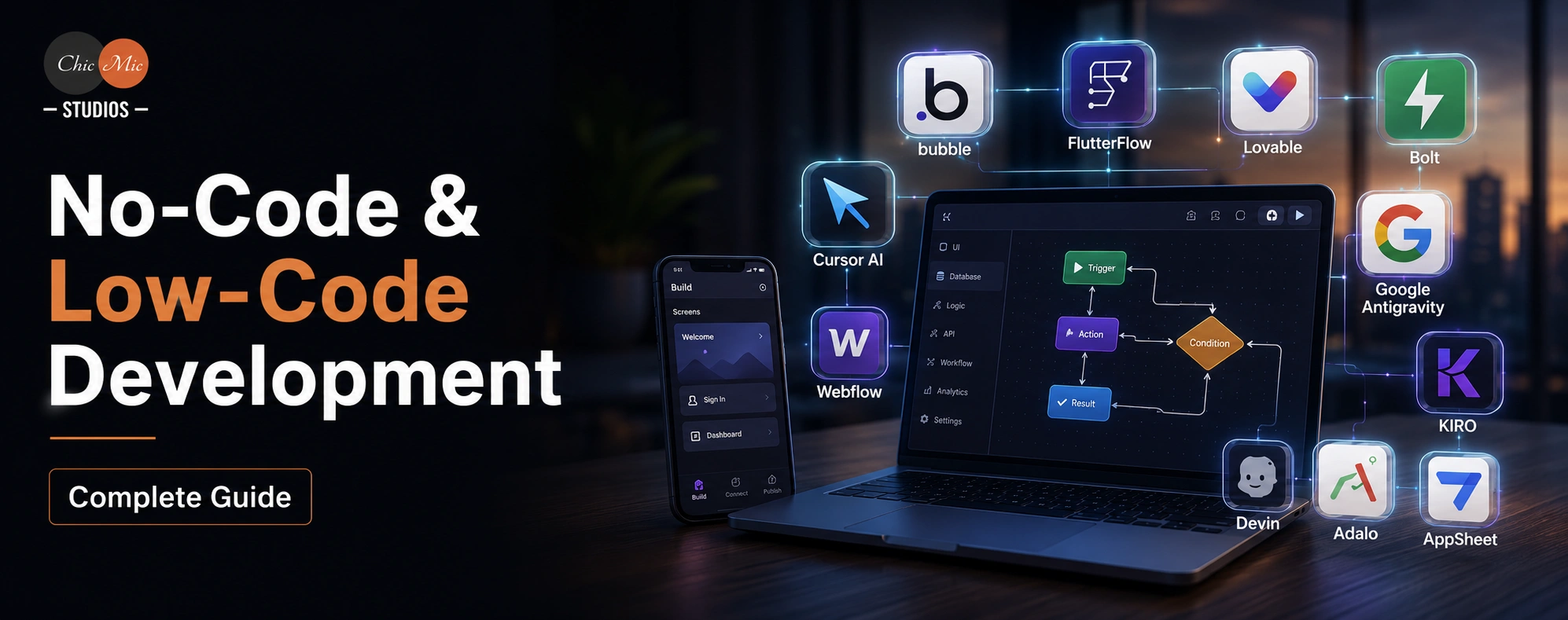
The capacity to create digital products was protected for many years by a “syntax barrier.” You had to know Python, Java, or C++, the language of machines, in order to innovate. This resulted in a bottleneck where the developers with the technical know-how were buried under a mountain of repetitive, “boilerplate” tasks, and the people with the best business ideas frequently lacked the technical means to implement them. We are seeing the Great Democratization of Software as 2026 progresses. The relationship between human intent and digital execution has been radically altered by the rise of no-code versus low-code development. Software is no longer “written”; instead, it is “assembled” and “orchestrated.”
As 2026 progresses, industries will witness more and more organizations use low-code or no-code tools to develop applications. Market institutions like Gartner even predict this adoption to be across 70% of businesses worldwide. When compared to only 25% in 2020, this shows a serious shift in the development methodology.
Whether you’re building a business tool or a playable experience, the same rapid development mindset applies—especially in full-cycle game production.
Understanding the Landscape: No-Code vs. Low-Code Development
The terms are often used interchangeably, but the distinction in no-code vs. low-code development is vital for choosing the right tech stack. Each development methodology enables specific development cycles based on the business requirements and goals.
What is No-Code Development?
Anyone can create useful applications using no-code platforms, even if they have no prior programming experience. These platforms allow users to assemble pre-built logic blocks using a “drag-and-drop” interface. These blocks are more advanced than ever in 2026; they can automatically handle responsive design and intricate API integrations.
“Citizen developers,” business analysts, project managers, and marketers are the intended audience. Accessibility is the central tenet. You can create a no-code application if you know how to use a PowerPoint presentation.
Ideal For: No-code MVP development for startups, landing pages, customer portals, and basic internal tools.
What is Low-Code Development?
The middle ground for professionals is low-code development. Eighty percent of the repetitive “boilerplate” code is handled by visual interfaces; the remaining twenty percent is left up to professional developers to write custom scripts. This offers the flexibility required for proprietary algorithms, intricate integrations, and distinctive business logic. As IBM explains, low-code platforms enable visual development with reduced hand-coding, making development faster and more accessible.
IT teams, technical founders, and professional developers are the target audience.
Efficiency is the core philosophy. When a platform can create a login system in a matter of seconds, why write one for the thousandth time?
Ideal For: Enterprise low-code development, legacy system modernization, and mission-critical applications.
The AI Revolution: AI-Powered No-Code Development
The complete integration of artificial intelligence is expected to be the largest trend in 2026. These platforms have evolved from basic “visual builders” to “autonomous co-creators” thanks to AI-powered no-code development. AI-driven tools are now used to generate game logic, animations, and even level designs—making AI-assisted development faster and more efficient.
Generative Development
These days, platforms have AI agents that enable “Prompt-to-App” workflows. Instead of simply dragging a button, you instruct the AI to “Create a dashboard that tracks real-time logistics and alerts the manager via WhatsApp if a shipment is delayed,” and the platform creates the automation logic, database schema, and user interface.
Using AI Tools to Speed Up Software Development
The speed of delivery has increased by over 400% thanks to:
- Instant Refactoring: AI reviews the visual logic and optimizes it for performance, reducing the risk of “spaghetti logic.”
- Synthetic Data Generation: AI populates your app with realistic data during the build phase so you can test features before going live.
- Automated QA: Using AI tools to speed up software development includes instant bug detection. AI simulates thousands of user journeys in seconds to find edge cases that a human tester might miss.
Comparison: Low-Code vs. Traditional Development
Why would a business decide against employing a group of Python or React developers in favor of a visual platform? The balance between speed, cost, and control is typically what separates low-code development from traditional development.
| Feature |
Traditional Development |
Low-Code / No-Code |
| Speed to Market |
Slow (Months/Years) |
Rapid (Days/Weeks) |
| Development Cost |
High (Senior Dev Salaries) |
Lower (Platform Fees + Lean Team) |
| Talent Pool |
Rare & Expensive |
Abundant (Internal Staff) |
| Customization |
Infinite |
High (but restricted by platform) |
| Maintenance |
Manual (Security patches/updates) |
Managed (Handled by the platform) |
| Scalability |
Architected Manually |
Built-in (Cloud-native) |
Low-code is the more cost-effective option for 90% of business applications, but traditional development is still required for creating the “next big thing” in core technology (such as a sophisticated gaming engine or a new database engine).
Industry-Specific Use Cases
Visual development offers immense versatility, ensuring various corporate sectors experience its impact in unique ways. Lean entrepreneurs testing a hypothesis find as much value as massive conglomerates managing thousands of employees, particularly as no-code and low-code solutions provide tailored benefits addressing specific operational pain points. These technologies allow sectors such as healthcare, finance, and retail to digitize at a previously unimaginable pace.
MVP Development Without Code for Startups
The “Validation-First” strategy is crucial for startups. Finding product-market fit is more important than creating a flawless product. Founders can release a version 1.0 in two weeks using the best no-code tools for startups. This eliminates the financial risk of a $150,000 technical failure and enables real-time user feedback.
Low-Code Development for Enterprises
In the enterprise sector, the “Shadow IT” problem (where employees use unauthorized apps) is solved by providing official low-code application development tools. IT departments can set the security guardrails while allowing department heads to build their own custom workflows. This clears the IT backlog and empowers the workforce.
Top Tools to Watch in 2026
Identifying the right technology requires understanding the specific strengths of the leading platforms dominating the current market. The industry now features specialized solutions ranging from “vibe coding” agents for creative startups to high-performance engines designed for mission-critical enterprise infrastructure.
Leading No-Code App Development Platforms
- Bubble: For web applications, Bubble continues to be the best option. It has a deep enough logic engine to construct nearly anything.
- FlutterFlow: For startups that prioritize mobile, FlutterFlow is the best option. Crucially, it enables code export and lets you build for both iOS and Android at the same time.
- Softr: The quickest method for converting data from Google Sheets or Airtable into a working web portal.
Professional Low-Code Application Development Tools
- Mendix: A leader in the enterprise space, offering high-end capabilities for multi-cloud deployments.
- OutSystems: It is really good at handling legacy migrations. It does this with ease, which’s a big help, to a lot of people who use OutSystems.
- Appian: Focuses heavily on Business Process Management (BPM) and automation.
No-Code App Scalability Challenges
It would be dishonest to say no-code is perfect. As your user base grows from 1,000 to 1,000,000, you will encounter no-code app scalability challenges:
- Performance Overheads: these platforms use layers of abstraction, making them “heavier” than a hand-coded app.
- Platform Dependency: If the platform goes down, your app goes down.
- Data Sovereignty: Some enterprises struggle with the no-code approach due to strict regulations defining data storage.
The Hybrid Strategy: The companies that will make a mark in 2026 will rely on a “Decoupled Architecture.” The teams will build frontend in a no-code tool like FlutterFlow but deploy scalable backend through AWS, Supabase, or Xano. It will ensure faster building of the interface while building the data engine for scalability.
Security and Governance in the Visual Era
A common misconception is that no-code is “less secure.” In reality, because platforms like Microsoft Power Apps or OutSystems are used by Fortune 500 companies, they have security protocols that far exceed what a small team of developers could build manually.
- SOC 2 Type II Compliance: Most major platforms carry this certification.
- Automated Updates: Security patches are applied globally by the platform provider, meaning your app is never running on an outdated, vulnerable version of a library.
- Role-Based Access (RBAC): Implementing complex user permissions is often a “toggle” rather than a 40-hour coding task.
FAQ: Frequently Asked Questions
1. Does “No-Code” mean I don’t need a developer?
For simple apps, yes. However, for a professional-grade product, you often need a “No-Code Architect”—someone who understands database structure and user experience, even if they aren’t typing syntax.
2. Is no-code development secure for banking or healthcare?
Yes, provided you choose a platform that is HIPAA or GDPR compliant. A lot of tools that help you build things without coding are made for industries that have to follow a lot of rules.
3. Can I migrate away from a no-code platform later?
It depends on the tool. For example FlutterFlow and Draftbit let you export the source code you made. Tools like Bubble or Glide are different. They are like closed systems so if you decide to leave you usually have to start over again with the frontend of your project, which can be a lot of work.
4. How much faster is low-code than traditional coding?
On average, low-code development is 5x to 10x faster than traditional methods, especially when you factor in the time saved on testing and deployment.
Concluding Note
The use of no-code and low-code development does not mean that real coding is coming to an end. In fact it is freeing up developers to work on the worlds toughest problems, such, as quantum computing, advanced AI ethics and deep-tech infrastructure. At the time no-code and low-code development is giving the rest of the workforce the power to fix their own operational inefficiencies. However, the ease of these tools brings a new responsibility: Architecture. While anyone can drag a box onto a screen, not everyone can design a secure, scalable, and user-centric ecosystem. This is where the risk of no-code app scalability challenges becomes real. Without a strategic partner to oversee the data flow and security protocols, a fast-built app can quickly become a “legacy nightmare.”
Transform your idea into reality. Call Us to Setup a Free Consultation