AI Agents for Real Estate: Pricing Guide & Cost Breakdown (2026)
Key Takeaways
- Key Value: AI agents for real estate automate routine tasks, improve customer engagement, and help agencies convert more leads efficiently.
- Core Services: AI agents handle lead qualification, property recommendations, appointment scheduling, CRM updates, follow-ups, and customer support.
- Business Benefits: Businesses gain faster responses, higher conversions, lower workloads, improved productivity, and better customer experiences.
- Industry Use Cases: AI agents support real estate agencies, brokerages, property managers, rental companies, and enterprise real estate businesses.
- Emerging Trends: AI agents will deliver smarter automation, voice interactions, multilingual support, predictive insights, and deeper integrations across real estate operations.
Introduction
Relationships, quick responses, and local knowledge have always been essential in real estate. By 2026, however, AI agents for real estate have become a major competitive advantage. They help agencies qualify leads, arrange property tours, and answer buyer inquiries around the clock without weakening the client experience.
The question is no longer whether artificial intelligence can help a real estate business. Decision-makers now want to understand what AI agents cost, what drives the price, and whether the investment can deliver measurable returns. This guide explains pricing models, cost factors, and the steps required to choose the right AI solution. Businesses planning a custom implementation can explore our AI development services for tailored automation.
Real estate companies can also combine intelligent automation with specialized real estate technology solutions to modernize customer journeys and property operations.
Why Are More Real Estate Businesses Investing in AI Agents?
Today’s buyers and sellers expect timely and accurate answers throughout their real estate journey. A delay in responding to a listing inquiry, property-tour request, or neighborhood comparison can quickly push a prospect toward another agency. As a result, more businesses are using AI agents for real estate to deliver 24/7 support and faster, more reliable service.
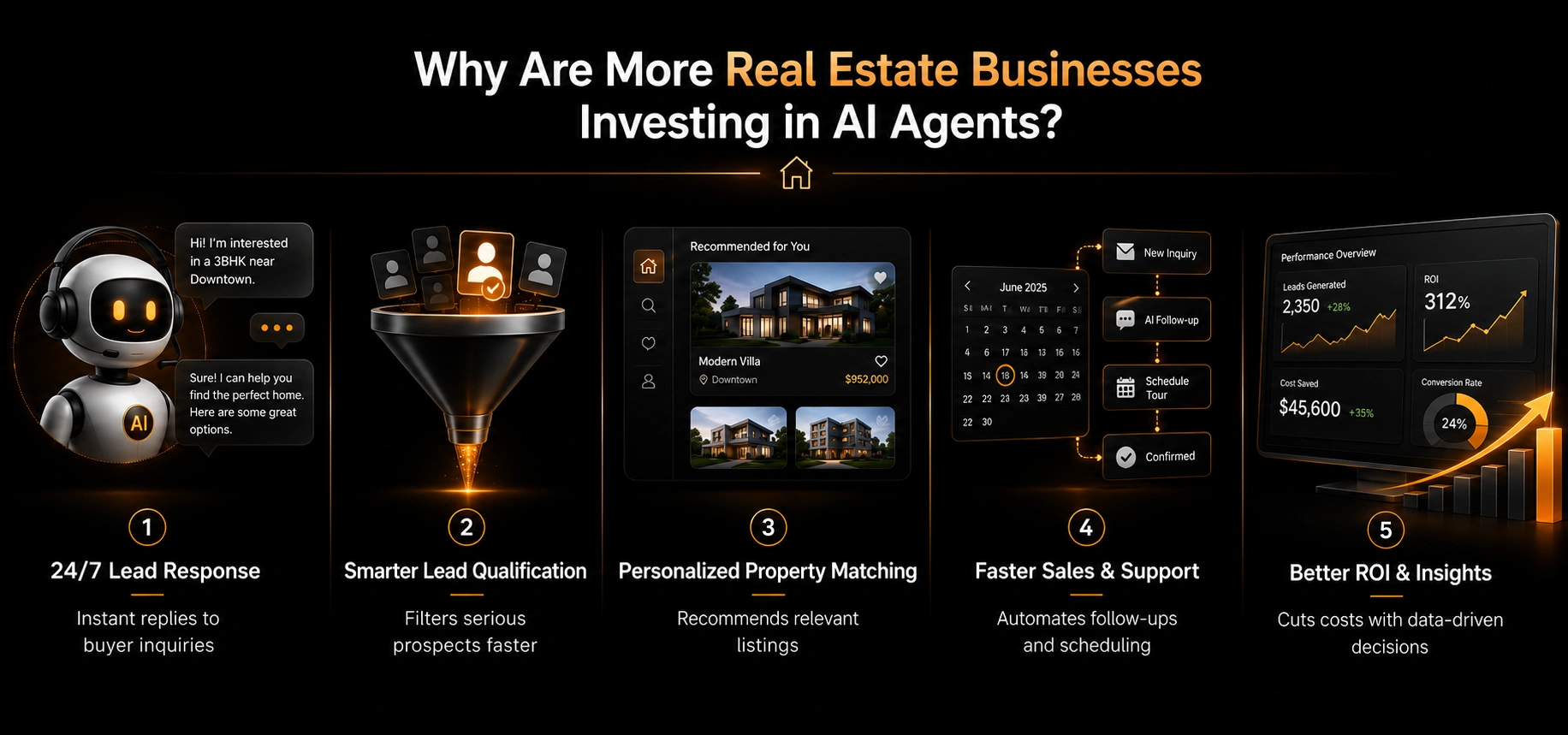
An AI agent acts like a virtual team member that is always available. It can qualify leads, answer property questions, recommend suitable listings, schedule appointments, and manage follow-up conversations with limited human involvement. This leads to faster responses, better lead qualification, more bookings, less administrative work, and consistent communication across customer touchpoints.
For businesses that need instant responses across websites and messaging channels, a custom AI chatbot solution can serve as the first layer of customer engagement.
What Can AI Agents Do for Real Estate?
Real estate AI agents support every stage of the customer journey. They automate repetitive tasks, reduce response times, and help agents provide faster, more personalized experiences. Behind these interactions are advanced machine learning models that improve performance as more business data becomes available.
1. Lead Qualification
AI agents identify serious prospects and prioritize leads by asking about budget, preferred location, property type, financing status, and purchasing timeline.
2. Personalized Property Recommendations
AI agents recommend relevant listings based on customer preferences, making property discovery faster and more personalized for every buyer.
3. Appointment Scheduling
AI agents connect with calendars, arrange property visits, send confirmations, and deliver reminders. This reduces manual coordination and improves the booking experience.
4. 24/7 Customer Support
AI agents answer questions about availability, financing, listings, pricing, and documents at any time, so clients do not have to wait for business hours.
5. CRM Management
AI agents update client records, capture conversation history, and organize lead data automatically. Reliable automation also depends on scalable database development that keeps customer and property information accurate.
6. Automated Follow-Ups
AI agents nurture prospects through reminders, new-listing alerts, and re-engagement campaigns. Businesses seeking more advanced content generation and conversational workflows can also explore generative AI solutions.
What Determines AI Agent Cost?
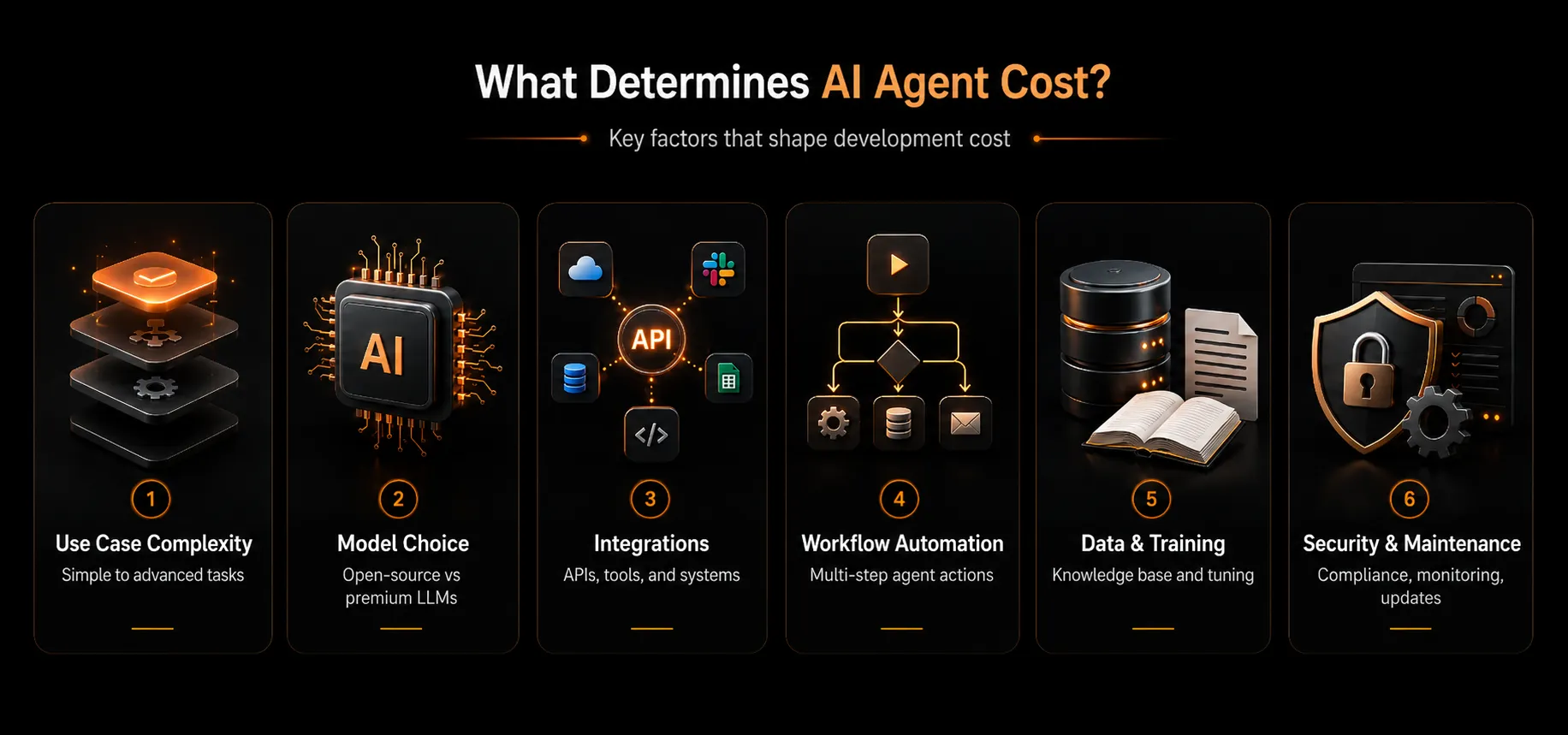
The cost of an AI agent for a real estate business depends on the level of automation, customization, integrations, and technical complexity. Business size, security requirements, and expected customer volume also influence both the initial investment and long-term operating cost.
1. Business Size
Large brokerages usually require complex workflows, enterprise security, higher scalability, and support for greater customer volumes. Smaller agencies may only need basic lead and customer-support automation.
2. System Integrations
Connecting an AI agent with CRMs, MLS platforms, calendars, email, WhatsApp, property databases, and other business tools increases development complexity and implementation cost.
3. Conversation Complexity
A simple FAQ assistant costs less than an advanced agent capable of lead qualification, personalized recommendations, document collection, and multi-step customer interactions.
4. Custom AI Training
Training AI on company listings, neighborhood data, pricing policies, legal procedures, and internal documents improves accuracy but requires more preparation, testing, and continuous updates. For advanced domain-specific systems, businesses may evaluate custom LLM development options.
5. Communication Channels
Deploying AI across websites, social media, WhatsApp, SMS, email, and voice calls requires deeper integrations and increases deployment complexity.
6. Security and Compliance
Enterprise brokerages handling sensitive customer data may need stronger access controls, audit trails, private deployments, and compliance procedures. These measures add to implementation and maintenance costs.
AI Agent Cost Breakdown in 2026
AI agent pricing depends on the solution’s complexity, customization, and integration requirements. The following ranges provide a practical starting point for budgeting.
| Solution Type |
Typical Cost Range |
Best For |
| Basic AI Chatbot |
$1,000–$5,000 |
Individual agents and small real estate agencies |
| Custom AI Assistant |
$5,000–$20,000 |
Growing real estate businesses with custom workflows |
| AI Agent with CRM Integrations |
$20,000–$60,000 |
Mid-sized agencies requiring automation and system integrations |
| Enterprise AI Platform |
$60,000–$150,000+ |
Large brokerages and enterprise property-management companies |
The total investment includes more than implementation. Businesses should also budget for AI-model usage, cloud infrastructure, maintenance, workflow improvements, knowledge-base updates, and ongoing optimization.
Hidden Costs Businesses Often Overlook
Initial development receives the most attention, but ongoing expenses also shape the total cost of ownership. Planning for these expenses helps businesses avoid surprises and protect long-term value.
1. AI Usage Fees
Many AI providers charge according to usage. Monthly expenses increase as conversation volume, model requests, and customer interactions grow.
2. Data Preparation
Property listings, documents, FAQs, and business knowledge must be organized before deployment so the AI can provide accurate answers.
3. System Maintenance
Real estate information changes frequently. AI agents need regular updates to listings, pricing, policies, and workflows to maintain reliable performance. A structured DevOps process can simplify releases, monitoring, and production improvements.
4. Employee Training
Teams need to understand how to supervise AI interactions, manage escalations, and identify situations that should be transferred to a human agent.
5. Continuous Optimization
Successful businesses review AI conversations, refine responses, improve workflows, and add capabilities over time. Investing in dependable quality assurance helps the system remain stable as usage grows.
Is Investing in AI Agents Worth It?
The business case comes down to whether AI solves the operational problems limiting growth. Common challenges include:
- Slow response times
- Missed leads after business hours
- High administrative workload
- Inconsistent follow-up
- Low conversion from inquiries to appointments
A well-designed AI agent addresses these challenges by automating repetitive work, answering questions instantly, and keeping leads engaged. This allows human teams to spend more time building relationships, negotiating, and closing deals.
How to Choose the Right AI Solution
Choosing the right AI agent is not only about comparing prices. The solution should fit your technology stack, support existing processes, and continue delivering value as the business grows.
1. Look for Real Estate Expertise
Choose a provider that understands buyer behavior, property operations, real estate terminology, and the needs of agents, brokers, and property managers.
2. Prioritize Seamless Integrations
The AI should connect with CRM systems, property databases, calendars, and communication tools to reduce manual work and information gaps.
3. Choose a Customizable Solution
A flexible solution can adapt to your qualification process, customer journey, brand language, and internal procedures instead of forcing the business into rigid workflows.
4. Plan for Future Growth
Choose technology that can support more users, listings, conversations, and automations without requiring a complete rebuild. Businesses can also review this guide to AI agent development services for enterprises before selecting a provider.
5. Use Data to Improve Performance
Look for analytics that reveal customer behavior, conversation patterns, lead quality, booking rates, and opportunities to improve engagement and conversion.
6. Design a Simple Customer Experience
Even advanced AI can underperform when the experience is confusing. Professional UI/UX design helps customers interact with the agent naturally across web and mobile interfaces.
Questions to Ask Before Hiring an AI Development Partner
Selecting an AI development partner involves more than finding the lowest quote. The provider should understand your business, propose the right architecture, and support future improvements.
- What industries have you worked with?
- Can you build custom workflows?
- Which AI models do you use?
- What integrations are included?
- How is customer data protected?
- What ongoing support is available?
- How are future improvements handled?
- What metrics do you track after launch?
The answers reveal how a provider approaches strategy, implementation, and long-term support. Reviewing an AI portfolio is another useful way to assess real-world experience.
Best Practices for Maximizing ROI
Technology alone does not guarantee results. Businesses generate stronger returns when AI is aligned with practical goals, trained with accurate information, and continuously improved.
1. Start with Lead Qualification
Automate lead qualification first, then expand into other workflows. This helps sales teams focus on high-intent prospects and creates measurable early results.
2. Train AI with Real Business Data
Use property listings, FAQs, pricing, neighborhood information, and internal knowledge to improve response accuracy and personalization.
3. Monitor Performance Regularly
Review conversation logs, customer feedback, and failed queries to identify gaps and continuously improve responses.
4. Keep Information Updated
Update listings, prices, policies, and availability so the AI always gives customers reliable information.
5. Combine AI with Human Expertise
Let AI manage repetitive work while human agents focus on negotiations, relationships, complex questions, and deal closing.
6. Measure What Matters
Track appointment bookings, response times, qualified leads, handoff rates, and conversions to understand the actual value of the investment.
The Future of AI Agents in Real Estate
The future of real estate AI extends beyond answering customer questions. As the technology evolves, AI agents will support voice conversations, predictive lead scoring, automated document processing, multilingual communication, and personalized property recommendations. Solutions like Maica demonstrate how AI voice agents can automate property inquiries, qualify leads, schedule viewings, and provide 24/7 customer support.
As real estate tokenization gains momentum, AI agents will also simplify digital property transactions, support investor communications, and help manage tokenized assets more efficiently.
AI agents will become an integral part of marketing, sales, customer service, and back-office operations, helping agencies deliver seamless customer experiences, improve efficiency, and stay competitive in an increasingly digital real estate market.
Conclusion
As customer expectations increase, AI agents for real estate are becoming a practical investment for businesses seeking greater productivity, faster responses, and better customer experiences. Costs vary according to customization, integrations, data requirements, security, and scale, but the long-term value can include more qualified leads, smoother operations, and stronger growth.
Choosing the right AI solution is not simply about installing new technology. It is about building a smarter and more adaptable real estate business. For a tailored strategy, businesses can contact our AI development team to discuss features, integrations, timelines, and budget.
Frequently Asked Questions
1. How much do AI agents for real estate cost?
Costs vary according to features and customization. Basic solutions may start around $1,000, while enterprise-grade AI platforms can exceed $150,000.
2. Are AI agents better than traditional chatbots?
AI agents can understand context, qualify leads, schedule appointments, integrate with CRMs, and complete multi-step workflows. Traditional chatbots are usually limited to predefined answers.
3. Can AI agents integrate with real estate CRM systems?
Yes. Custom AI solutions can integrate with CRM platforms, property databases, calendars, communication tools, and property-management systems.
4. How long does it take to build a custom AI agent?
Simple implementations may take a few weeks. Highly customized enterprise solutions may require several months, depending on integrations, data preparation, testing, and workflow complexity.
5. Are AI agents suitable for small real estate agencies?
Yes. Small agencies can begin with lead capture, FAQ support, and appointment scheduling, then add more capabilities as their business grows.
6. Can AI agents work 24/7 for real estate businesses?
Yes. AI agents can respond to inquiries, qualify leads, recommend properties, and schedule appointments around the clock.