Agentic AI in Automotive Supply Chains: Hype or 2026’s Real Shift
Key Takeaways
- Core Value: Agentic AI helps automotive supply chains make faster decisions, automate routine tasks, and respond to disruptions more effectively.
- Comprehensive Services: It supports procurement, logistics, inventory management, predictive maintenance, digital twins, and real-time decision-making.
- Business Benefits: Companies can improve efficiency, reduce costs, strengthen resilience, and make smarter, data-driven decisions.
- Industry Use Cases: Tier 1 suppliers are using agentic AI to optimize procurement, inventory, logistics, maintenance, and supply chain planning.
- Future Trends: By 2026, agentic AI is expected to become a key driver of smarter, more connected automotive supply chains.
Introduction: The Rise of Agentic AI in Automotive Supply Chains
The automotive sector has been on a years-long journey toward automation, smart manufacturing and predictive analytics. “Now this is being driven by agentic AI automotive supply chain solutions. Businesses are increasingly partnering with AI development services providers to build intelligent, enterprise-ready supply chain solutions. Unlike traditional AI, which primarily analyzes data and generates recommendations, agentic AI can make decisions, coordinate workflows, and adapt to changing conditions with minimal human intervention. This enables automotive businesses to respond faster and operate more efficiently.
What Is Agentic AI and How Does It Work?
Most businesses are familiar with traditional AI, which forecasts demand, identifies trends, and makes suggestions based on historical data. Agentic AI goes a step further and understands goals, considers multiple options, takes authorized actions and learns continuously from results. It’s more like an intelligent digital operator that can adapt to evolving business conditions, rather than just supporting decisions.
This means that in automotive supply chains an AI system can respond to issues such as supplier delays by assessing inventory, looking for alternatives, adjusting logistics plans and proposing the best course of action before production is affected. AI-driven automotive logistics solutions today complement existing supply chain systems to improve operational efficiency and enable faster AI-enabled decision-making. These solutions are powered by machine learning, large language models and business data.
Recent advances in generative AI are making these systems more capable of understanding context and automating complex workflows.
Current Use Cases in Tier 1 Automotive Supply Chains
As automotive supply chains grow more complicated, Tier 1 suppliers are finding useful ways to utilize agentic AI in their operations. Intelligent AI agents don’t replace existing systems, but instead work with supply chain professionals to provide visibility, automate routine decisions and respond to disruptions faster. Here are a few of the most popular application cases that are already helpful.
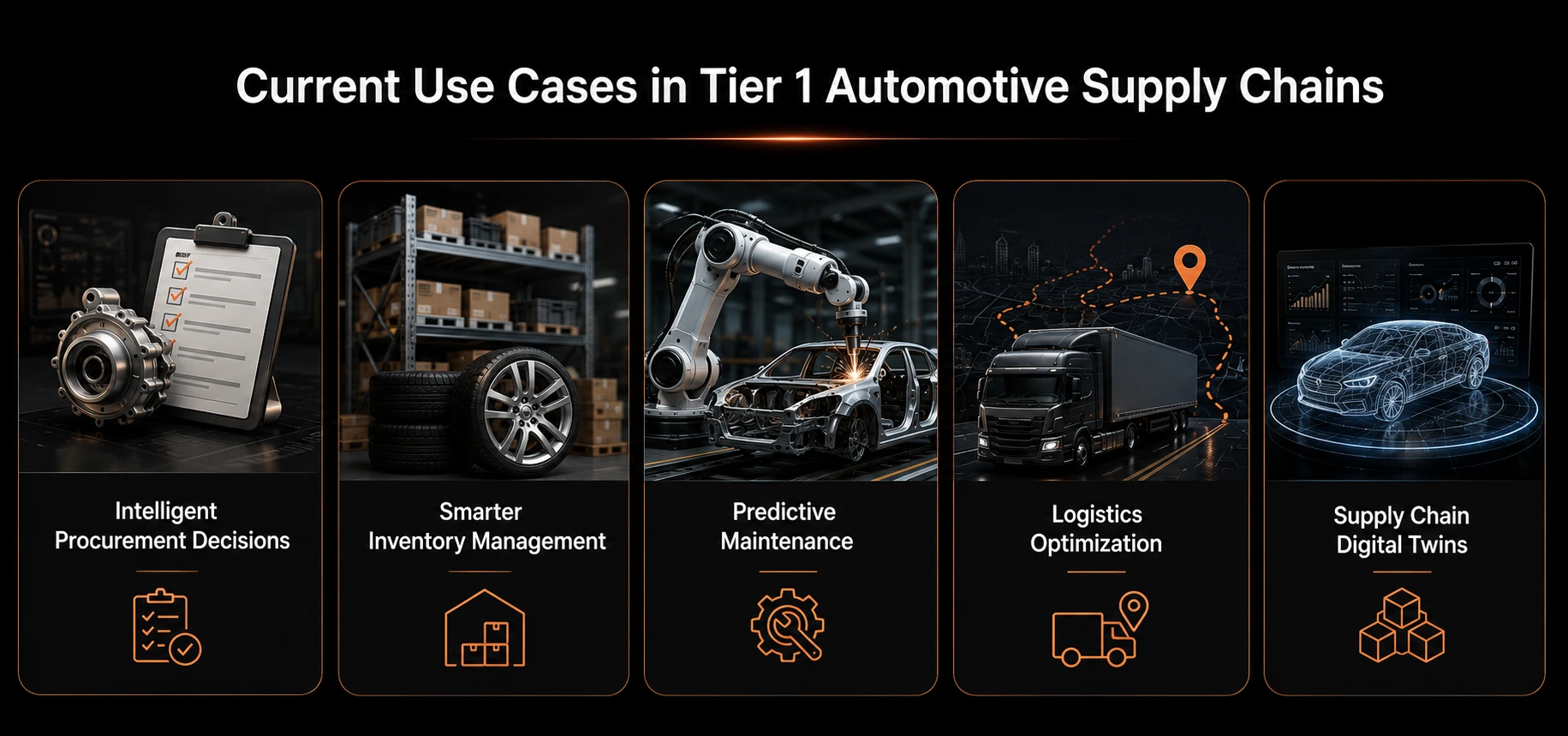
1. Intelligent Procurement Decisions
Agentic AI can help procurement teams to analyze sourcing options, monitor supplier performance and spot any dangers before they impact production. This strengthens supplier relationships and enables businesses to make buying decisions faster.
2. Smarter Inventory Management
With AI inventory management automotive solutions manufacturers are constantly adjusting the levels of inventory based on production schedules, supplier availability and current demand. This helps to prevent overstocking and costly stockouts.
3. Predictive Maintenance
Supply chain AI agents use predictive maintenance to track equipment health, detect early signs of failure and schedule maintenance ahead of unplanned breakdowns. This helps to reduce downtime and keep production lines moving efficiently. These capabilities become even more effective when combined with IoT app development for continuous equipment monitoring.
4. Logistics Optimization
AI-driven automotive logistics enable companies to track shipments, alter shipping routes, and react quickly to delays caused by bad weather, traffic, or supplier problems. The result is better delivery performance and smoother automotive operations.
5. Supply Chain Digital Twins
Manufacturers build supply chain digital twins to see how changes in operations might play out. Combined with agentic AI, these virtual models augment AI-enabled decision-making by helping teams to evaluate risks and identify the best path forward.
Benefits of Agentic AI in Automotive Supply Chains
Agentic AI is helping automotive companies to transition to automation by improving decision-making, operational efficiency and the robustness of supply chains. Adoption is increasing and Tier 1 suppliers are seeing measurable benefits in production planning, logistics, inventory control and procurement.
1. Faster Operational Decisions
Agentic AI enables supply chain teams to respond quickly to disruptions, minimize delays and make faster, more informed business decisions by analyzing operational data in real-time.
2. Improved Supply Chain Resilience
Intelligent AI agents allow businesses to anticipate disruptions and keep operations running smoothly by constantly monitoring supplier risks, inventory levels and logistical performance.
3. Better Forecast Accuracy
Agentic AI uses machine learning in automotive supply chain processes to continually improve demand forecasts and thus the accuracy of production scheduling, inventory allocation and purchasing.
4. Lower Operational Costs
Routine tasks such as inventory management, logistics and procurement can be automated to cut down on manual labour, reduce operational inefficiencies and free up teams to focus on strategic goals.
5. Enhanced AI-Enabled Decision-Making
Agentic AI gives leaders real-time information from multiple systems to make faster, more confident data-driven decisions across the supply chain.
6. Improved Automotive Operations Optimization
Agentic AI is able to coordinate workflows across procurement, manufacturing, warehousing, and shipping to automotive operations optimization on an ongoing basis for improved productivity and resource use.
Challenges & Barriers to Implementation
Agentic AI is extremely promising but it is not as simple as just adding another technology to your existing stack. Many automotive suppliers continue to use legacy systems, fragmented data and complex workflows. To truly benefit from agentic AI, businesses need a strong foundation, a clear strategy and teams that are ready for change.
1. Legacy Systems
The majority of Tier 1 suppliers still use legacy supply chain and ERP systems that were not built for autonomous AI. Often the first hurdle before agentic AI deployment can begin is modernizing and connecting these systems. Modern DevOps services help organizations integrate legacy systems with AI-powered platforms more efficiently.
2. Data Quality
No matter how smart AI gets, it cannot make reliable decisions using insufficient data. Inconsistent inventory records, disconnected systems and out-of-date supplier data can hurt the accuracy and reliability of AI recommendations.
3. Building Trust
There’s a time lag before you can give the AI more responsibility. Typically companies start by using AI to help them make decisions, then gradually implement it to automate repetitive tasks, but still have humans involved in strategic decisions that require human judgment.
4. Governance and Security
Good governance is important as agentic AI handles sensitive operational and supplier data. Routine monitoring, secure access restrictions, and well-defined approval processes are the paths to responsible AI.
5. Managing Change
This journey is not only about technology. Employees need training, clarity around new ways of working and confidence to make AI adoption successful across the company.
6. Scaling Across Operations
What applies in one department or plant may not work in another. Extending agentic AI across global production facilities and supplier networks requires consistent procedures, interconnected systems, and ongoing development.
Comparison: Hype vs Real-World Deployment
Agentic AI is generating a lot of buzz in the automotive industry, but not all of its promises are consistent with today’s realities. Technology is advancing rapidly, but most Tier 1 suppliers are adopting a phased approach, focusing on pragmatic use cases with measurable commercial value before scaling up.
| Industry Hype |
Real-World Deployment |
| Fully autonomous supply chains with no human involvement |
AI supports human teams by automating repetitive operational decisions. |
| AI completely replaces planners and procurement managers |
AI improves productivity while people continue making strategic decisions. |
| Instant implementation across global operations |
Most organizations begin with pilot projects before expanding gradually. |
| Every supply chain process becomes autonomous |
Companies focus on high-impact areas like procurement, inventory, and logistics first. |
| Immediate ROI after deployment |
Business value grows over time as AI learns and workflows become more efficient. |
The difference between hype and reality is execution. Organizations that start with a few use cases, and then scale the use of agentic AI, are seeing better, more sustainable results than those who try to automate everything all at once.
How Tier 1 Suppliers Can Prepare for 2026
As agentic AI becomes more practical, preparation will matter more than speed. The Tier 1 suppliers that invest in the right data, processes and people today will be better positioned in the next few years to scale AI successfully and remain competitive.
1. Build a Strong Data Foundation
Agentic AI needs detailed, interconnected data. Connecting production, logistics, supplier-management, and procurement data enables better AI-driven decision-making.
2. Focus on High-Impact Areas First
Begin with areas where AI can provide short-term wins such as inventory planning, supplier risk monitoring, logistics planning, demand forecasting, and production scheduling.
3. Create Cross-Functional AI Teams
To successfully deploy agentic AI, supply chain executives, procurement teams, manufacturing specialists, logistics specialists and IT must work together to solve real operational problems. Many organizations also modernize their web development services to improve integration across enterprise platforms.
4. Invest in Supply Chain Digital Twins
Supply chain digital twins allow companies to test different strategies, simulate disruptions and enhance decision-making before real-time operations are impacted.
5. Keep People at the Center
Agentic AI is most effective when it augments human expertise rather than replacing it. When you combine intelligent automation with seasoned decision makers, you get stronger accountability and better results.
6. Start Small and Scale Gradually
Begin with experimental projects, evaluate the results, and then scale AI adoption based on proven business value and operational readiness, instead of undertaking a complete overhaul at once.
The Future Outlook: Agentic AI in Automotive Supply Chains
Agentic AI is expected to progress from initial trials to a useful business capability for automotive supply chains by 2026. As global operations become more complicated and customer demands continue to climb, businesses will depend more and more on intelligent AI technologies to automate routine choices, enhance coordination, and react to disruptions faster.
Agentic AI won’t replace existing business software, but rather will work in conjunction with ERP, manufacturing and logistics systems to create more intelligent, integrated operations. Tier 1 suppliers will need to invest in AI-ready infrastructure, competent people and responsible governance to translate operational data into faster, more confident decision-making. Working with experienced AI experts can accelerate enterprise AI adoption while reducing implementation risks.
Conclusion: Is Agentic AI the Real Shift of 2026?
Agentic AI is turning out to be a useful tool for modern automotive supply chains beyond the industry hype. It helps teams make faster, smarter decisions around production, logistics, inventory and procurement, not replace people. The real opportunity for Tier 1 suppliers is to prepare now by modernizing operations, strengthening data and deploying AI where it delivers quantifiable value. The question today is not whether agentic AI will impact automotive supply chains, but how fast companies are willing to adapt to it.
Frequently Asked Questions
1. What is agentic AI in automotive supply chains?
Agentic AI refers to intelligent AI systems that can analyze situations, make decisions, and execute approved supply chain tasks with minimal human intervention across procurement, logistics, inventory, and manufacturing.
2. How is agentic AI different from traditional AI?
Traditional AI mainly provides predictions or recommendations. Agentic AI goes further by planning actions, coordinating workflows, learning from outcomes, and supporting autonomous operational decision-making.
3. Which automotive areas benefit most from agentic AI?
Procurement, inventory management, logistics, production planning, supplier risk management, predictive maintenance, and demand forecasting are among the areas seeing the greatest impact.
4. Are there real examples of agentic AI in automotive supply chains?
Yes, many automotive manufacturers and Tier 1 suppliers are already using AI-powered systems for supplier monitoring, inventory optimization, logistics planning, predictive maintenance, and production scheduling. Fully autonomous supply chains are still emerging, but practical implementations are expanding rapidly.
5. What are the main challenges in implementing agentic AI?
Common challenges include integrating legacy systems, improving data quality, establishing AI governance, maintaining cybersecurity, and building organizational trust in AI-assisted decision-making.
6. How can Tier 1 suppliers prepare for agentic AI adoption?
Organizations should modernize their data infrastructure, improve cross-functional collaboration, invest in digital twins, identify high-impact automation opportunities, and establish responsible AI governance.
7. Will agentic AI replace human decision-makers?
No, agentic AI is designed to augment human expertise by automating repetitive operational tasks while allowing people to focus on strategic planning, supplier relationships, compliance, and business growth.
8. How does agentic AI improve supply chain resilience?
It continuously monitors operational data, identifies potential disruptions early, recommends corrective actions, and helps businesses respond faster to changing supply chain conditions.
9. What role do digital twins play in agentic AI?
Digital twins create virtual models of supply chain operations, allowing AI agents to simulate scenarios, evaluate risks, and optimize decisions before implementing changes in the real world.
10. Is 2026 expected to be a major year for agentic AI adoption?
Industry analysts expect 2026 to be a significant milestone as more automotive companies move beyond AI pilots and begin deploying agentic AI across core supply chain operations, supported by stronger data platforms and enterprise AI governance.