How Much Does Blockchain Game Development Cost in 2026
Key Takeaways
- Key Insight: Understand the factors that influence blockchain game development costs and plan your budget with confidence.
- Core Services: Blockchain game development involves smart contracts, NFTs, wallets, backend infrastructure, security, and ongoing maintenance.
- Business Value: Blockchain games can create new revenue opportunities, increase player engagement, and support long-term digital ecosystems.
- Industry Use Cases: Blockchain technology powers NFT games, play-to-earn platforms, multiplayer games, and metaverse experiences.
- Future Trends: Scalable platforms, cross-chain compatibility, and player-owned digital assets will continue shaping Web3 gaming.
Introduction
If you are looking to develop a Web3 game, one of the first things you need to understand is the blockchain game development cost. Whether you are planning a multiplayer blockchain game, an NFT-powered experience, or a play-to-earn game, the total investment depends on the features, complexity, and technology required to bring the concept to life.
The cost of blockchain game development is not fixed. A simple game costs much less than a large platform with smart contracts, NFT integration, tokenomics, multiplayer infrastructure, and cross-chain features. This guide explains typical 2026 price ranges, major cost drivers, hidden expenses, and practical ways to optimize your budget.
Why Are Businesses Investing in Blockchain Games?
Gaming has evolved beyond simply playing a game. Players increasingly expect ownership of in-game assets and the freedom to buy, sell, and trade digital collectibles, characters, skins, and virtual land. Blockchain technology makes this possible through NFTs, smart contract technology, and decentralized economies. These systems give players more control over digital possessions and make ownership and transactions more transparent.
Many businesses are investing in NFT game development to build engaging player-owned economies. Blockchain gaming can create revenue through NFT sales, in-game marketplaces, token economies, premium memberships, and community-driven ecosystems. However, these features also increase technical complexity and directly affect the cost of blockchain game development.
What Is the Average Blockchain Game Development Cost in 2026?
There is a common misconception that every blockchain game requires a massive budget. In reality, the cost to build a blockchain game depends on its scale, gameplay features, art requirements, blockchain functionality, security, and technical specifications.
Here is a practical cost estimate for 2026:
| Game Type |
Estimated Cost |
Typical Scope |
| Simple Blockchain Game |
$30,000–$80,000 |
Basic gameplay, wallet connection, and limited on-chain features |
| NFT Collectible Game |
$60,000–$150,000 |
NFT minting, inventories, rarity systems, and marketplace support |
| Play-to-Earn Game |
$100,000–$250,000 |
Tokenomics, reward systems, staking, and anti-fraud controls |
| Multiplayer Blockchain Game |
$150,000–$400,000+ |
Real-time multiplayer, servers, matchmaking, and advanced economies |
| AAA Web3 Game |
$500,000 to several million dollars |
High-end art, expansive worlds, complex gameplay, and enterprise-scale infrastructure |
These estimates vary according to blockchain selection, smart contract complexity, game mechanics, security requirements, content volume, and the development approach. Defining the project scope early is the most reliable way to estimate the budget accurately.
What Determines Blockchain Game Development Cost?
Every blockchain game has different technical and creative requirements. The final budget is primarily influenced by game complexity, blockchain technology, smart contracts, NFT functionality, visual production, backend systems, and multiplayer features.
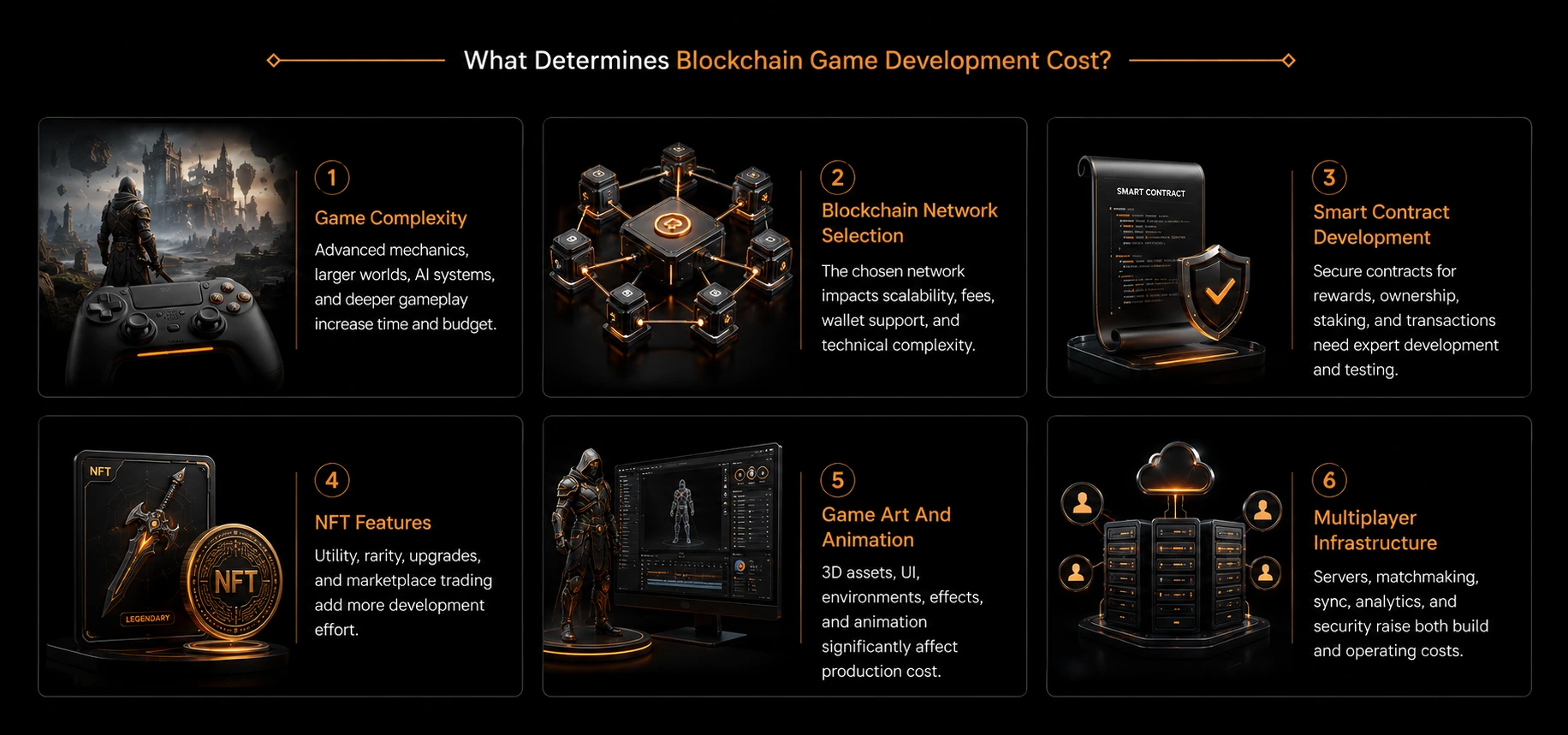
1. Game Complexity
The size and complexity of the game directly affect development costs. Games with advanced mechanics, expansive environments, AI systems, progression models, and immersive gameplay require more design, engineering, testing, and production time. Large-scale titles often need specialized 3D game development expertise to deliver polished characters, environments, animation, and visual effects.
2. Blockchain Network Selection
The selected blockchain network affects development complexity, transaction fees, scalability, wallet compatibility, smart contract tools, and infrastructure requirements. The best network is not always the most popular one; it should match the game’s transaction volume, security needs, target audience, and long-term roadmap.
3. Smart Contract Development
Smart contracts manage essential blockchain operations such as asset ownership, rewards, transactions, staking, and marketplace activity. Developing secure and efficient contracts requires specialized blockchain expertise, extensive testing, and security review.
4. NFT Features
NFT functionality increases development effort when assets include in-game utility, dynamic attributes, upgrade systems, marketplace support, rarity mechanics, metadata, or trading capabilities. The more deeply NFTs are connected to gameplay, the greater their effect on the project budget.
5. Game Art and Animation
High-quality games require concept art, character design, animation, environments, UI design, visual effects, sound, and promotional assets. Production costs increase significantly when the game needs original 3D content, cinematic animation, or a large volume of collectible assets.
6. Multiplayer Infrastructure
Multiplayer games need dependable backend infrastructure for matchmaking, real-time synchronization, player sessions, dedicated servers, communication systems, analytics, and security. These systems increase both initial development effort and long-term operating expenses.
How Does Web3 Functionality Affect Development Costs?
Traditional games primarily require gameplay systems, content, and backend infrastructure. Web3 games need additional blockchain components that increase development time, security requirements, testing, and ongoing maintenance.
The more Web3 features the team must build, test, secure, and maintain, the higher the overall development cost. However, carefully selected features can also support long-term player engagement, digital ownership, community participation, and new revenue models.
Does Play-to-Earn Increase the Budget?
Yes. Development costs are generally higher when a game uses a play-to-earn model. In addition to providing cryptocurrency rewards, the team must build a sustainable in-game economy that remains secure, scalable, balanced, and engaging over time.
- Token supply and distribution
- Reward allocation
- Inflation management
- Marketplace activity
- Staking mechanisms
- Governance rules
- Anti-fraud systems
A successful P2E environment requires expertise in blockchain engineering, game design, tokenomics, analytics, and security. These additional planning and technical requirements typically make play-to-earn development more expensive than a standard blockchain game.
Unexpected Costs Businesses Should Consider
The blockchain gaming platform development cost includes more than upfront design and engineering. Security, infrastructure, launch preparation, updates, and live operations can significantly affect the total cost of ownership.
1. Smart Contract Audits
Professional smart contract audits help identify security weaknesses before launch. Audits protect the game, players, and digital assets while reducing the risk of costly exploits and emergency fixes.
2. Blockchain Transaction Fees
Transaction costs vary according to the selected blockchain and network usage. These recurring expenses should be included in the game’s long-term operating budget, especially when the game processes frequent on-chain actions.
3. Backend Infrastructure
Beyond blockchain integration, a game requires reliable backend technology for cloud storage, authentication, player accounts, matchmaking, analytics, multiplayer systems, notifications, and platform performance.
4. Ongoing Maintenance
Regular maintenance includes bug fixes, security upgrades, performance improvements, blockchain compatibility updates, new content, economy balancing, and player support. These investments help the game remain secure, competitive, and engaging after launch.
How to Reduce Blockchain Game Development Cost Without Compromising Quality
Reducing development cost does not mean removing every important feature. The better strategy is to make disciplined product, technology, and production decisions from the beginning.
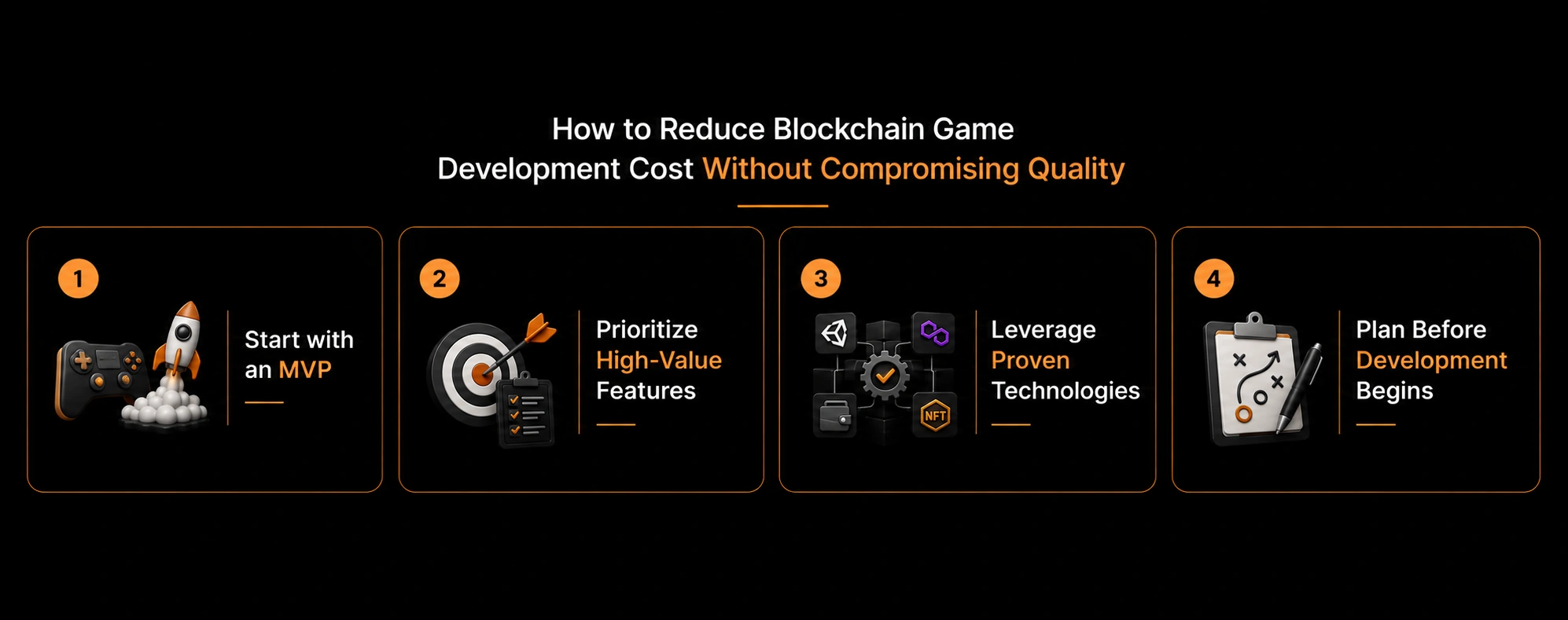
1. Start with an MVP
A Minimum Viable Product allows you to test the core game concept with essential features before committing to a full-scale release. This approach is widely used in mobile game development and can be extended to Web3 projects. Once the concept is validated, the team can add more gameplay systems, NFTs, multiplayer capabilities, and advanced blockchain features.
2. Prioritize High-Value Features
Focus on features that strengthen gameplay and support commercial goals. Avoid adding every popular Web3 feature unless it creates a clear benefit for players or the game economy.
3. Leverage Proven Technologies
Established blockchain frameworks, wallet integrations, NFT standards, backend services, and popular game engines can accelerate development, reduce technical risk, and improve reliability.
4. Plan Before Development Begins
A clear project roadmap reduces rework, limits uncontrolled scope changes, and keeps design and development aligned. Time invested in discovery, architecture, prototyping, and technical planning often produces substantial savings later.
Outsourcing as a Cost-Saving Strategy
Outsourcing blockchain game development gives businesses access to specialized expertise without the cost and delay of building a complete in-house team. It can improve resource flexibility, shorten the hiring cycle, and accelerate delivery.
- Access to specialized blockchain and game development expertise
- Faster project delivery and reduced hiring time
- Lower recruitment and operational costs
- Scalable development teams based on project needs
- Expertise in smart contracts, NFTs, and Web3 technologies
- Dedicated quality assurance and security testing
- Ongoing maintenance and post-launch support
Choosing the right development partner is essential for building a secure, scalable, and high-quality blockchain game. Evaluate technical expertise, relevant portfolio work, communication practices, security capabilities, and long-term support before making a decision.
Is Blockchain Game Development Worth the Investment in 2026?
Blockchain gaming remains a compelling opportunity for businesses developing next-generation digital products. Players increasingly value digital ownership, transparent in-game economies, tradable assets, and rewarding experiences. Blockchain technology enables companies to combine engaging gameplay with new revenue streams and community-driven ecosystems.
Developing a blockchain game can cost more than creating a comparable traditional game because it requires additional infrastructure, security, and specialized expertise. However, a clear product strategy, strong gameplay, sustainable tokenomics, and disciplined feature planning can create long-term business value.
Final Thoughts
Estimating a budget is not only about identifying a price range. The most important step is making informed choices that support the project’s long-term success. Whether you are developing an NFT game, a play-to-earn platform, a multiplayer title, or a complete Web3 gaming ecosystem, the investment will depend on the features, technology, content quality, security, and scalability you require.
By defining requirements early, prioritizing high-value features, and working with an experienced team, businesses can control development costs while building a secure and engaging blockchain game.
Frequently Asked Questions
1. What is the average blockchain game development cost?
Development costs can range from approximately $30,000 for a simple blockchain game to more than $500,000 for a large-scale multiplayer or AAA Web3 game. The final budget depends on gameplay complexity, blockchain integrations, NFTs, multiplayer systems, art production, security, and project scope.
2. What affects the cost to develop a blockchain game the most?
The biggest cost factors include game complexity, smart contract development, blockchain selection, NFT functionality, multiplayer infrastructure, art and animation, backend systems, security audits, and ongoing maintenance.
3. Why is Web3 game development more expensive than traditional game development?
Web3 games require extra components such as wallet integration, smart contracts, token economies, NFT management, blockchain data synchronization, and enhanced security. These specialized requirements add development and testing time.
4. Does adding NFTs significantly increase development costs?
NFT functionality can add smart contract development, minting systems, metadata management, inventory systems, marketplace integration, asset utility, and security testing. The cost increase depends on how deeply NFTs are integrated into gameplay and the economy.
5. How long does blockchain game development typically take?
A simple blockchain game may take approximately 3–6 months. Larger projects with multiplayer capabilities, custom NFTs, advanced gameplay systems, and extensive content may require 9–18 months or longer.
6. Is blockchain game development profitable in 2026?
It can be profitable when the game delivers strong gameplay and uses sustainable tokenomics. Revenue may come from NFT sales, in-game marketplaces, premium content, subscriptions, memberships, and digital asset transactions.
7. Which blockchain is best for game development?
The best blockchain depends on project requirements. Ethereum offers a mature ecosystem, while Polygon, Solana, Avalanche, and BNB Chain are often considered for scalability and lower transaction costs. The final choice should balance performance, security, ecosystem support, and budget.
8. Can blockchain games be updated after launch?
Yes. Blockchain games can receive new content, gameplay improvements, bug fixes, security upgrades, balance changes, and additional NFT features. Ongoing maintenance is essential for long-term engagement and compatibility.
9. How can businesses reduce blockchain game development costs?
Businesses can reduce unnecessary costs by starting with an MVP, prioritizing essential features, using proven frameworks, validating technical choices early, and creating a clear development roadmap.
10. How do I choose the right blockchain game development partner?
Look for a partner with proven experience in game development, blockchain engineering, smart contracts, NFTs, Web3 security, and live operations. A strong portfolio, transparent communication, robust quality assurance, and dependable post-launch support are important selection criteria.