
15K–40K
DePIN Proof of Concept
4–8 weeks




















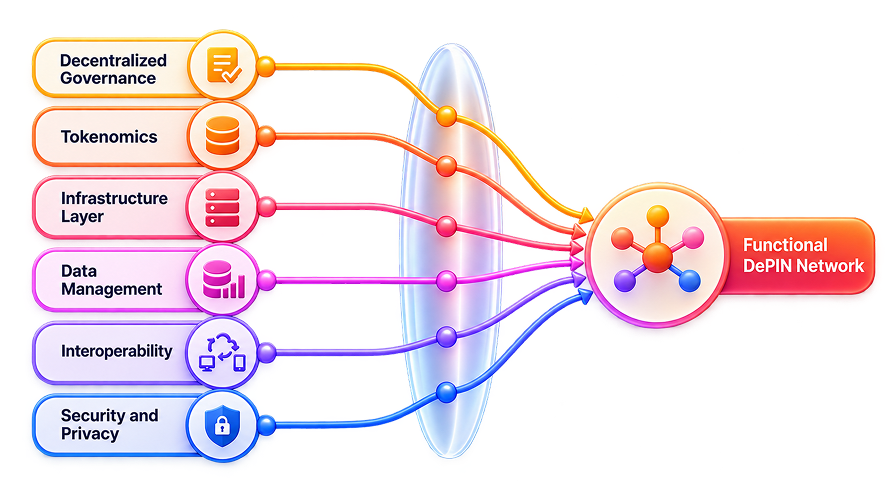
DePIN development is the practice of building blockchain networks that coordinate real-world hardware, sensors, routers, servers, storage arrays, and energy devices through decentralized software rather than a single controlling entity. Instead of a company owning and operating all infrastructure, a DePIN network lets independent participants contribute resources and earn token rewards for doing so. Smart contracts handle the rules: who can join, what counts as valid work, how much a contributor earns, and when payouts happen. The result is an infrastructure model that is open to anyone, verifiable by everyone, and capable of scaling without a central operator.
We deliver DePIN development services that cover everything from initial tokenomics design to production deployment and long-term network operations.

No DePIN contract goes live without a thorough third-party audit. We test on testnet, resolve findings, and only then deploy to mainnet or enterprise environments.

Your DePIN platform ships with your identity, including a custom domain, interface design, color scheme, and logo, so it feels like a product you built rather than a template.

We keep your RPC nodes, validators, and network infrastructure running with defined uptime commitments and rapid incident response.

Launch with only what you need, such as device registration, rewards, or analytics, and add governance, staking, or advanced verification as your network grows.

After launch, we manage protocol upgrades, security fixes, contract refinements, and onboarding of new device types.

Your engineers and operators receive complete technical documentation, deployment playbooks, and hands-on training to run the network confidently.
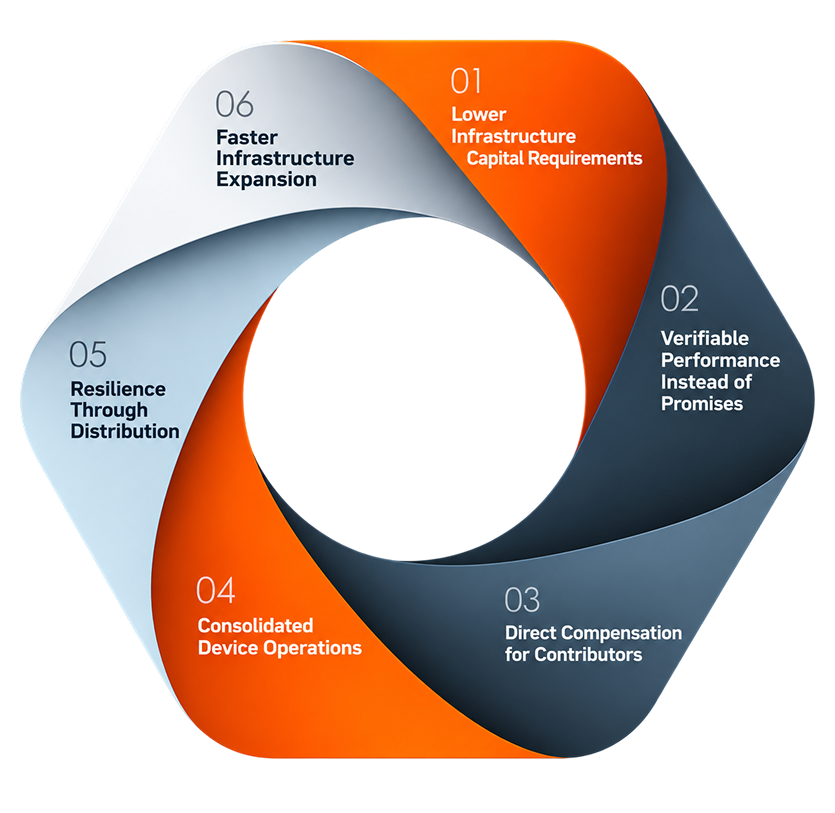
Building and maintaining physical infrastructure the traditional way is capital-intensive, hard to verify, and slow to expand. Companies that rely on proprietary hardware networks, manual device management, and isolated systems often struggle with cost overruns and limited visibility. DePIN changes the economics: instead of one company funding everything, a network of contributors supplies the hardware, and software handles coordination, verification, and payment. This model supports use cases from agentic process automation for device orchestration to real estate tokenization for asset representation.
Instead of purchasing and maintaining every sensor, server, or hotspot, organizations can tap into contributor-owned hardware, shifting capital expenditure to a distributed network.
DePIN replaces trust-based claims about uptime, bandwidth, or coverage with cryptographic proofs that anyone can independently check.
Participants who supply resources receive tokens automatically, without invoices, intermediaries, or reconciliation delays that can affect traditional payment flows.
Onboarding, monitoring, access control, usage tracking, and payouts live in one system rather than being scattered across disconnected tools.
Because no single operator controls the network, DePIN systems can reduce dependence on a single infrastructure provider and distribute operational risk across multiple contributors.
Distributed contributors allow businesses to expand network coverage and capacity without waiting for centralized infrastructure deployment or large upfront investments.

Every device that joins the network receives a unique on-chain identity with metadata describing its owner, capabilities, and location.

Oracles and validator nodes confirm that devices actually delivered what they claimed, including uptime, bandwidth, compute cycles, or coverage, using cryptographic evidence.

Smart contracts match incoming tasks to available devices based on demand, device capability, geography, and current network load.

After completing work, devices submit attestations with performance data, timestamps, and contribution records for validation.

The protocol's incentive rules, factoring in service quality, network demand, and contribution volume, determine how many tokens each device earns.

Tokens are sent directly to contributor wallets in batched transactions that minimize gas costs and eliminate manual payment processing.
Our DePIN solutions combine blockchain development services for secure network architecture with wallet infrastructure for contributor payments.
Every device is represented by a unique NFT that carries its metadata, ownership proof, and full lifecycle history on-chain.
Validators confirm storage availability, bandwidth delivery, location coverage, reliability, and compute output from distributed edge devices.
Smart contracts compute and distribute token incentives according to protocol rules and verified device activity.
Workloads are assigned and balanced across geographically dispersed nodes using smart contract coordination.
Operators and contributors see device health, earnings, utilization, uptime, and performance metrics in real time.
A single device identity can operate across multiple blockchains, eliminating fragmented ownership records.
We provide DePIN development services for enterprises that need secure, scalable, and verifiable decentralized infrastructure, backed by deep blockchain development expertise.
DePIN supports industries that depend on distributed physical infrastructure, from commodity tokenization for energy and asset markets to enterprise AI assistants for predictive operations.
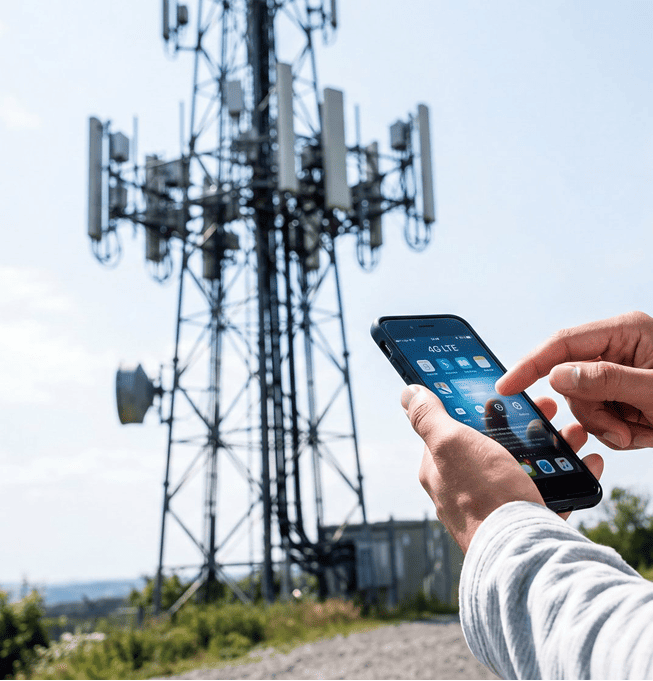



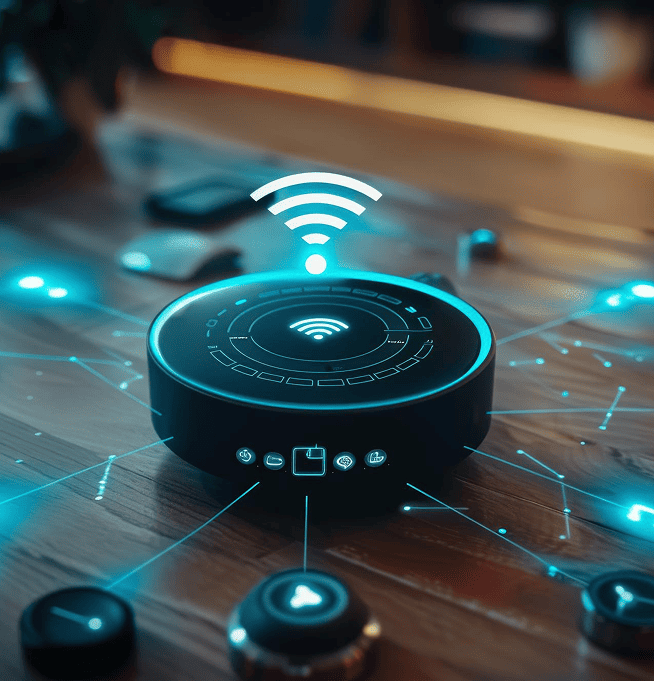
Our end-to-end DePIN development lifecycle incorporates web3 development services for scalable, verifiable network operations and smart contract audits for reward security.
We map out device categories, define what counts as a valid contribution, model reward curves, set staking requirements, and design incentive mechanisms that keep the network growing sustainably.

We implement device registries, contribution verification logic, and reward distribution using secure, modular, and upgradeable OpenZeppelin-based contracts.

We create lightweight client libraries that let embedded and IoT hardware register devices, submit proofs, claim rewards, and connect to wallets automatically.

We integrate decentralized oracles and validator nodes to reliably verify device availability, bandwidth, compute work, and contribution attestations.

We run rigorous security audits on testnet, validate network behavior under real conditions, and launch mainnet with community bootstrapping for sustainable adoption.


With our combined blockchain and IoT expertise, you can hire DePIN developers from ChicMic Studios to build secure, scalable, and high-performance decentralized physical infrastructure networks.
The cost of DePIN platform development depends on the complexity of contribution verification, device types, tokenomics models, and blockchain deployment requirements.



15K–40K
4–8 weeks
50K–120K
12–16 weeks
120K–250K+
20–24 weeks
$250K+
24+ weeks
200K–400K+
24–32 weeks
Ready to create an impact?
The cost of development depends on the scope of the solution, the readiness of the data, the requirements for.

DePIN stands for Decentralized Physical Infrastructure Network. It is a blockchain-based model where independent contributors supply hardware resources, such as compute, storage, bandwidth, or connectivity, and smart contracts verify their contributions and distribute token rewards automatically.
Devices generate cryptographic proofs, such as uptime attestations, bandwidth measurements, or compute results, and submit them to oracles or validator nodes. Smart contracts verify these proofs before releasing any rewards.
Traditional IoT platforms rely on centralized servers and offer no built-in incentives for device owners. DePIN networks use blockchain to coordinate devices trustlessly and reward contributors with tokens for the resources they provide.
Smart contracts calculate rewards based on contribution metrics like reliability, bandwidth delivered, compute work performed, network demand, and staked collateral. Payouts happen automatically through batched transactions.
Yes. Device identities can be unified across chains, allowing the same physical device to contribute to DePIN networks on Ethereum, Solana, or Polygon while claiming rewards through a single interface.
Compute power, storage capacity, bandwidth, connectivity, sensor data, energy, mobility services, and environmental monitoring data are all tokenizable. Regulated infrastructure assets may fall under securities tokenization frameworks.
Costs depend on contribution verification complexity, device types, tokenomics design, and blockchain deployment scope. Contact us for a detailed estimate tailored to your specific requirements.
A basic DePIN network with standard device verification typically takes 12–16 weeks. Complex multi-chain deployments generally require 20–24 weeks.
DAO-style governance lets contributors vote on network upgrades, reward adjustments, and protocol changes, with smart contracts executing the approved decisions automatically.
Tokenized infrastructure assets, such as storage nodes, WiFi hotspots, or compute units, can be divided into fractional shares, enabling multiple owners to hold stakes and receive proportional revenue on-chain.
2026 © Copyright ChicMic Studios | Privacy Policy | Disclaimer