
$10K–$30K
AI Agent Prototype / PoC
3–8 weeks




















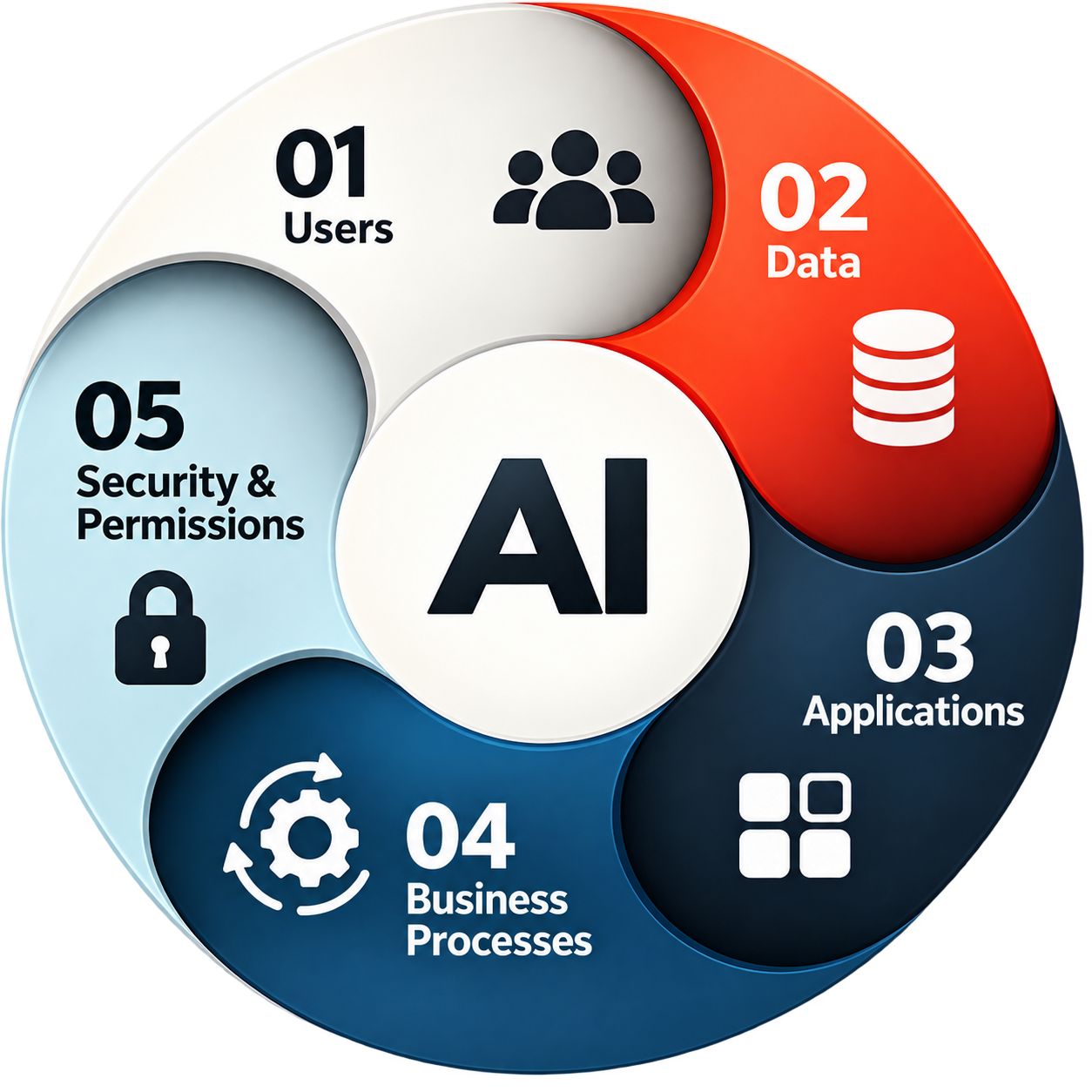
ChicMic Studios is an Agentic AI development company that helps organizations identify practical opportunities for autonomous agents and build custom agentic AI solutions around their users, data, applications, business processes, permissions, security requirements, and measurable objectives. Agentic AI development combines Large Language Models (LLMs), reasoning, planning, and workflow orchestration to build AI systems that can move from instructions to action.
Our Agentic AI development services cover strategy, architecture, agent design, LLM integration, RAG, tool calling, orchestration, application engineering, deployment, evaluation, and continuous improvement.
The Benefits of Agentic AI go beyond generating content or answering questions. The Benefits of AI Agents for Businesses depend on the process, data, integrations, level of autonomy, and governance model.

AI Agents automates multi-step knowledge work that traditionally requires employees to search for information, interpret data, update applications, prepare outputs, and coordinate follow-up actions.

AI automates repetitive tasks across customer service, document processing, research, data handling, reporting, IT support, and other operational workflows.

AI Productivity Solutions can give employees intelligent assistants and copilots that help them find information, summarize documents, analyze business data, prepare reports, draft content, research topics, and complete routine actions.

One of the key Agentic AI business benefits is the ability to automate workflows involving multiple steps and changing context.

The AI Automation Benefits can extend beyond simple task automation. Agentic AI can connect LLMs, business rules, APIs, databases, enterprise applications, and human approvals to create intelligent workflows.

Enterprise Automation Benefits include the ability to standardize repetitive workflows, connect existing systems, improve access to organizational knowledge, and introduce controlled AI automation across departments.

AI agents can support customers through conversational interfaces, product assistants, service portals, and automated support workflows.

AI decision-making systems can help users investigate issues, compare information, prepare recommendations, and determine appropriate next steps while keeping people involved where required.
Agentic AI is most useful when an application needs to do more than generate an answer. A well-designed AI agent can interpret a goal, determine the steps required, access approved information and tools, perform actions, evaluate results, and involve people where the workflow requires judgment or approval.

AI agents can coordinate tasks that previously required employees to search for information, interpret documents, update systems, prepare outputs, and communicate next steps manually.

Agentic AI can automate defined processes involving data entry, document processing, request classification, research, reporting, system updates, and other repetitive knowledge tasks.

Goal-oriented AI agents can move information between systems, retrieve relevant context, prepare decisions, trigger workflows, and complete approved actions without requiring users to manage every individual step.

AI copilots and assistants can help employees research information, summarize work, prepare documents, analyze data, locate knowledge, perform routine actions, and navigate complex internal processes.

Customer service AI agents can understand requests, retrieve customer and product information, complete supported actions, recommend next steps, and escalate conversations when an issue falls outside their operating boundaries.
Businesses can add intelligent agents to SaaS products, enterprise applications, mobile apps, portals, and internal tools without rebuilding their entire technology environment.
Agentic AI solutions are most effective when connected to real data, enterprise systems, clear objectives, and measurable workflows. ChicMic Studios develops AI-powered automation solutions for scenarios such as the following.
AI agents can search, retrieve, synthesize, and organize information from internal documents, policies, knowledge bases, project records, databases, product information, and enterprise systems.
Research AI agents can gather information from approved sources, compare materials, summarize findings, organize evidence, and prepare structured research outputs for human review.
Customer service AI agents can answer questions, retrieve account or product information, classify requests, recommend next actions, perform approved tasks, and route complex cases to human teams.
Sales AI agents can assist with account research, lead qualification, customer information retrieval, meeting summaries, follow-up preparation, proposal support, CRM updates, and sales workflow automation.
Marketing AI agents can support content research, campaign preparation, content creation, audience analysis, competitive research, reporting, and marketing workflow coordination.
Finance AI agents can assist with document analysis, reporting, reconciliation workflows, financial information retrieval, invoice processing, research, and internal finance operations subject to appropriate controls.
HR AI agents can support employee questions, policy retrieval, candidate workflow coordination, document processing, onboarding processes, internal knowledge access, and administrative tasks.
Data analysis AI agents can interpret natural-language requests, retrieve approved business data, execute analytical workflows, summarize findings, generate reports, and help users investigate business questions.
IT support AI agents can classify requests, search technical knowledge, troubleshoot defined issues, retrieve system information, create or update tickets, and escalate incidents based on established procedures.
Software development agents can assist with code generation, repository search, documentation, testing, debugging, issue analysis, code review preparation, and developer knowledge retrieval where appropriate.
ChicMic Studios builds enterprise Agentic AI solutions around industry-specific workflows, data environments, users, integrations, security controls, and regulatory considerations. Each use case is subject to project-specific technical and compliance assessment.









An AI agent is more than an LLM responding to a prompt. Agentic AI systems combine models with context, tools, memory, planning, rules, and application logic so they can perform tasks within a defined environment.
The agent interprets the user's request or receives a predefined business objective. The application provides relevant context, constraints, permissions, and expected outcomes.

The agent determines the tasks or sequence of actions required to complete the objective. Planning can be simple for straightforward workflows or involve multiple stages for more complex processes.

The agent can retrieve information from knowledge bases, enterprise databases, documents, APIs, vector databases, or other approved sources using retrieval mechanisms such as RAG.

Through API tool integration, an agent can interact with approved systems and applications. Depending on permissions, this may include searching records, creating tickets, updating information, generating reports, or initiating workflows.

The agent performs the defined actions while maintaining workflow state and following business rules, permissions, and operating boundaries.

Agentic AI systems can check whether an action produced the expected result. Validation can include business rules, structured checks, model-based evaluation, application logic, or human review.

If the task is incomplete, the agent may perform another approved step. If it encounters uncertainty, a policy boundary, or a required approval, the workflow can route the task to a human.


The Agentic AI Development Process: From Idea to Production
Technology choices depend on the agent's complexity, model requirements, data sources, integration surface, privacy requirements, latency targets, scalability, and budget. ChicMic Studios selects the appropriate combination rather than forcing every project into a fixed stack.













Our Agentic AI development process combines business discovery, workflow analysis, data assessment, agent architecture, application development, evaluation, deployment points, data sources, systems involved, expected outputs, automation opportunities, and risks.
We identify the business process, users, objectives, decision points, data sources, systems involved, expected outputs, automation opportunities, and risks. We then determine whether an AI agent is appropriate and what level of autonomy makes sense.
We map the existing workflow and identify where an agent can retrieve information, make decisions, use tools, perform actions, or request human approval.
We determine the appropriate models, agent frameworks, retrieval mechanisms, memory approach, orchestration architecture, APIs, databases, security controls, and deployment environment.
We build the agent instructions, prompts, tools, retrieval pipelines, memory, business rules, APIs, application interfaces, workflow states, and orchestration logic required by the solution.
We connect agents to approved enterprise systems, APIs, databases, SaaS applications, internal tools, knowledge bases, and other resources required to perform their assigned tasks.
We evaluate reasoning, planning, retrieval, tool selection, task completion, output quality, failure handling, security, latency, cost, consistency, and human escalation behavior.
We deploy the system in a controlled environment with authentication, authorization, logging, monitoring, configuration management, and appropriate workflow controls. Depending on the use case, we can begin with a pilot or limited user group.
Agentic AI systems require continuous improvement. We analyze performance, user feedback, failures, costs, model changes, retrieval quality, workflow outcomes, and new business requirements to improve the system over time.
Autonomous AI systems introduce additional considerations because they can retrieve information, make decisions, use tools, and take actions. Enterprise Agentic AI solutions therefore require controls around identity, permissions, data access, oversight, monitoring, and accountability. ChicMic Studios considers these requirements during discovery and architecture rather than treating them as an afterthought.


ChicMic Studios combines AI engineering with web, mobile, backend, cloud, SaaS, and product development expertise. This allows us to build the complete application around an AI agent rather than treating the agent as an isolated technical component.
We connect AI agent recommendations to your business objectives, workflows, users, data, systems, expected outcomes, and implementation constraints.
We build custom AI agents around your specific processes, applications, data, permissions, and user experience rather than forcing your business into a generic automation platform.
We can support discovery, architecture, UX, agent development, RAG, integrations, APIs, testing, deployment, monitoring, and continuous improvement.
For workflows that benefit from multiple specialized agents, we can design collaborative AI agents, orchestration logic, shared context, task delegation, validation, and human escalation.
We combine agents with APIs, databases, business rules, and human approvals to develop autonomous business process automation and intelligent process automation solutions.
Depending on scope, uncertainty, timeline, and internal capabilities, organizations can work with us through a fixed-price project, dedicated development team, or time-and-materials engagement.
The cost to build an AI agent depends on what the agent needs to understand, what systems it needs to access, how many steps it needs to perform, how much autonomy it requires, and how much engineering is required around the underlying model.
$10K–$30K
3–8 weeks
$20K–$60K
6–12 weeks
$30K–$85K
8–16 weeks
$25K–$75K
8–16 weeks
$50K–$150K
12–24 weeks
$75K–$200K
16–28 weeks
$100K–$300K+
20–40+ weeks



Ready to create an impact?
The cost of development depends on the scope of the solution, the readiness of the data, the requirements for.

Agentic AI development involves designing and building AI systems that can interpret goals, reason through tasks, retrieve information, use tools, make decisions within defined boundaries, and perform actions through connected applications or workflows.
An AI agent is a software system that uses AI models, context, tools, instructions, and application logic to perform a defined task or achieve a specific goal. Depending on its design, an agent can retrieve information, plan actions, interact with software, evaluate results, and involve a human when necessary.
Generative AI primarily focuses on generating or transforming content such as text, images, code, audio, or other outputs. Agentic AI uses generative models and other technologies as components of a broader system that can plan tasks, use tools, make workflow decisions, and perform actions toward a defined objective.
AI agent development can range from approximately $10,000–$30,000 for a focused prototype to $100,000–$300,000+ for a larger enterprise Agentic AI platform. The actual cost depends on agent complexity, autonomy, data, integrations, security, infrastructure, model strategy, and ongoing support.
A focused AI agent prototype may take approximately 3–8 weeks, while an enterprise AI agent or multi-agent platform can require several months. Timeline depends on workflow complexity, integrations, data readiness, security requirements, evaluation needs, and product scope.
AI agents can be developed for finance, banking, insurance, retail, manufacturing, healthcare, education, legal services, real estate, SaaS, technology, customer service, sales, marketing, HR, finance, and IT operations. The suitability of an agent depends on the specific process and requirements.
Yes. AI agents can automate defined business processes involving information retrieval, document processing, classification, research, decision support, system interaction, reporting, customer service, and other knowledge-intensive tasks. The appropriate level of autonomy depends on risk, workflow design, and business controls.
AI agents can be designed for enterprise environments with identity and access management, data isolation, encryption, tool permissions, audit logging, monitoring, validation, human approval, and other controls. Security requirements depend on the systems, data, users, industry, deployment model, and actions available to the agent.
Agentic AI solutions can use Large Language Models such as GPT, Claude, Gemini, Llama, or Mistral alongside frameworks and technologies such as LangChain, LangGraph, CrewAI, AutoGen, LlamaIndex, RAG, vector databases, APIs, Python, cloud platforms, databases, observability tools, and enterprise identity systems.
Multi-agent systems are architectures in which multiple specialized AI agents collaborate to complete a broader task. Agents may have different roles, such as research, planning, analysis, execution, review, or coordination, and an orchestration layer manages how they interact.
2026 © Copyright ChicMic Studios | Privacy Policy | Disclaimer