UAE Crypto Regulation 2026: Complete Compliance Guide
Key Takeaways
- Mature Regulatory Framework: The UAE offers one of the world’s most mature crypto regulatory frameworks, with clear oversight through VARA, DFSA, and ADGM to support innovation while protecting investors.
- Mandatory Licensing: Licensing is mandatory for most crypto businesses, including exchanges, custodians, brokers, and payment providers, with rigorous governance and operational requirements.
- Ongoing Compliance: Compliance extends beyond licensing, requiring ongoing AML/KYC procedures, cybersecurity, consumer protection, regulatory reporting, and strong internal governance.
- Function-Based DeFi Oversight: DeFi and tokenized asset projects are regulated based on their actual functions, meaning protocols with identifiable control or investor exposure may fall under regulatory oversight.
- High Non-Compliance Risk: Non-compliance can lead to severe consequences, including license suspension, banking restrictions, reputational damage, operational disruption, and personal liability for executives.
- Competitive Advantage: Businesses that build compliance into their operations from day one gain a competitive advantage, improving investor confidence, regulatory trust, and long-term growth opportunities in the UAE.
UAE Crypto Regulation 2026 – Complete Compliance Guide
If you are building, investing or scaling a blockchain or cryptocurrency firm, you simply can’t ignore UAE crypto regulation 2026. Today, the UAE is one of the most structured and advanced jurisdictions in the world for regulating digital assets, and it is much more than being “crypto friendly”.
From the VARA licensing framework in Dubai to the ADGM regulations in Abu Dhabi and the DIFC’s blockchain governance and innovation-first strategy, the UAE has created a regulatory environment where serious builders are rewarded and dangerous or non-compliant operators are weeded out. For businesses planning to launch regulated blockchain products, working with an experienced blockchain development company can help align product architecture with compliance, security, and scalability requirements from the start.
In this guide, we’ll break down everything you need to know about cryptocurrency law UAE 2026, including licensing requirements, crypto compliance frameworks, DeFi monitoring, and what businesses need to do to stay compliant with regulators without using legalese or a robotic tone.
Introduction: Why UAE Crypto Regulation Matters
The UAE didn’t just happen to become a global hub for cryptocurrency. It has grown on the back of thoughtful, forward-looking policy decisions that stressed early regulation, regulatory clarity and savvy oversight. Rather than reacting defensively against digital assets, the country chose to face them head-on and formulate regulations that recognize the dangers and long-term possibilities of blockchain innovation.
By 2026, UAE crypto regulation 2026 will be a model for governments around the world on how to encourage innovation while maintaining strict crypto compliance frameworks. Instead of banning cryptocurrency or over-regulating the sector with unclear rules, the UAE focused on predictability and clarity.
The strategy has given international investors confidence, banks have helped licensed crypto companies and businesses can use blockchain technology without the constant legal grey areas. This has raised standards across the industry and provided better protections for customers. With the UAE’s clarity of law, you’re not just creating a safety net for your crypto project, you’re creating a competitive advantage, whether you’re creating a crypto exchange, a DeFi protocol, tokenizing physical assets or deploying enterprise blockchain solutions.
Key Regulatory Bodies: VARA, DFSA, and Others
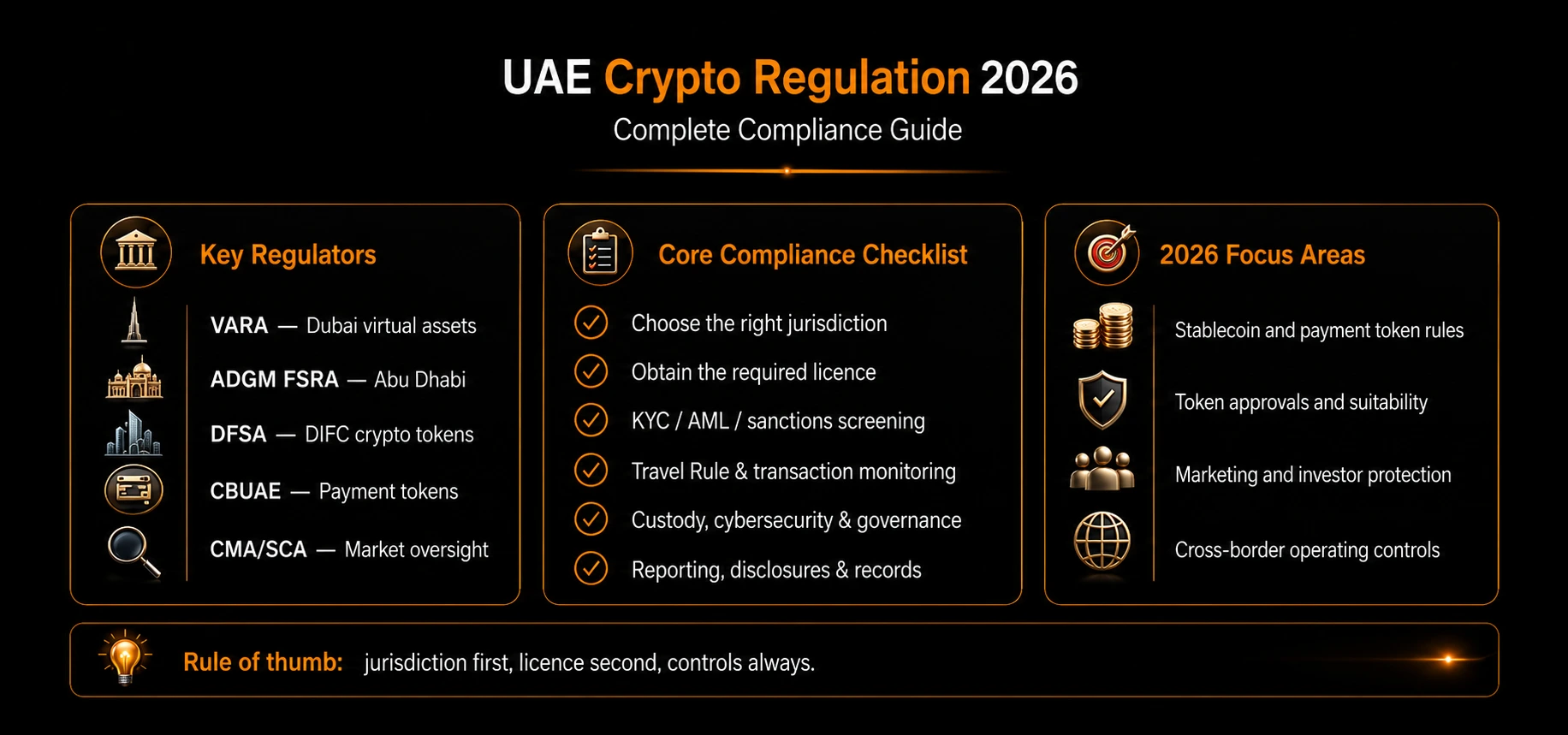
The UAE has a multi-regulator framework for crypto regulations instead of a single authority. Each regulator is responsible for a certain jurisdiction and kind of activity under UAE crypto regulation 2026, ensuring that crypto companies are supervised based on their size, risk profile and use case.
This approach allows the UAE to strike a balance between control and innovation. Institutions develop familiar compliance norms, investors get better safeguards, and startups get regulatory clarity. These authorities together provide the framework for the regulation of digital assets in the UAE and set out the practical application of the UAE 2026 cryptocurrency law.
1. VARA – Virtual Assets Regulatory Authority
The Virtual Assets Regulatory Authority regulates activities involving virtual assets outside of the DIFC in Dubai. Along with providing VARA licenses for the UAE, it regulates token issuance, DeFi protocols, exchanges, brokers and custodians, and maintains standards for disclosure, market integrity and consumer protection.
2. Dubai Financial Services Authority (DFSA)
Cryptocurrency activity at the DIFC is overseen by the Dubai Financial Services Authority. Its focus is on institutional-grade digital asset regulation in the United Arab Emirates, including security tokens, regulated investments, enterprise blockchain deployments, and risk-based governance in line with conventional financial markets.
3. FSRA and Abu Dhabi Global Market
The Financial Services Regulatory Authority-regulated Abu Dhabi Global Market is Abu Dhabi’s cryptocurrency hub. Its compliance-driven, global regulatory framework attracts Web3 infrastructure providers, custodians, and institutional exchanges.
UAE Crypto Regulators at a Glance
| Regulator |
Jurisdiction |
Primary Focus |
| VARA |
Dubai outside DIFC |
Virtual assets, exchanges, brokers, custodians, token activities and market conduct. |
| DFSA |
Dubai International Financial Centre |
Security tokens, regulated investments, institutional blockchain activity and financial governance. |
| FSRA / ADGM |
Abu Dhabi Global Market |
Digital asset businesses, institutional exchanges, custodians and Web3 infrastructure providers. |
Licensing of Crypto Exchanges in the UAE
In the UAE, the distinction between experimentation and legitimacy is at the licensing level. According to UAE crypto exchange rules, any business that provides exchange services, brokerage, custody, payments or advising services must be licensed in the relevant jurisdiction before it can operate. If your business model involves trading, brokerage, liquidity, or digital asset exchange operations, our cryptocurrency exchange development services can help you build secure, scalable, and compliance-ready exchange platforms.
The UAE licensing process is usually a staged one, starting with initial approval and then operational readiness assessments before a full market licence is issued. DIFC and ADGM apply similar rigour, but with more emphasis on risk management and institutional safeguards. Licensing is hard work, but it pays off commercially.
1. Licensing Builds Trust
Licensing is what distinguishes legitimate crypto companies from experimentation, building trust with regulators, banks, investors and enterprise partners in global marketplaces around the world.
2. Staged Approval Process
The VARA license will be issued in stages beginning with a preliminary approval and an operational readiness review of governance, compliance, cybersecurity and financial resilience.
3. Regulatory Institutional Standards
DIFC and ADGM have adopted institutional standards for risk management, capital adequacy, internal controls and safeguards that meet global financial expectations.
Compliance Requirements for Businesses and Startups
The UAE crypto regulation 2026 requires ongoing compliance, which is not a one-time task completed at launch. It is an operational discipline that is ongoing and impacts the governance, risk management, and system security of cryptocurrency firms.
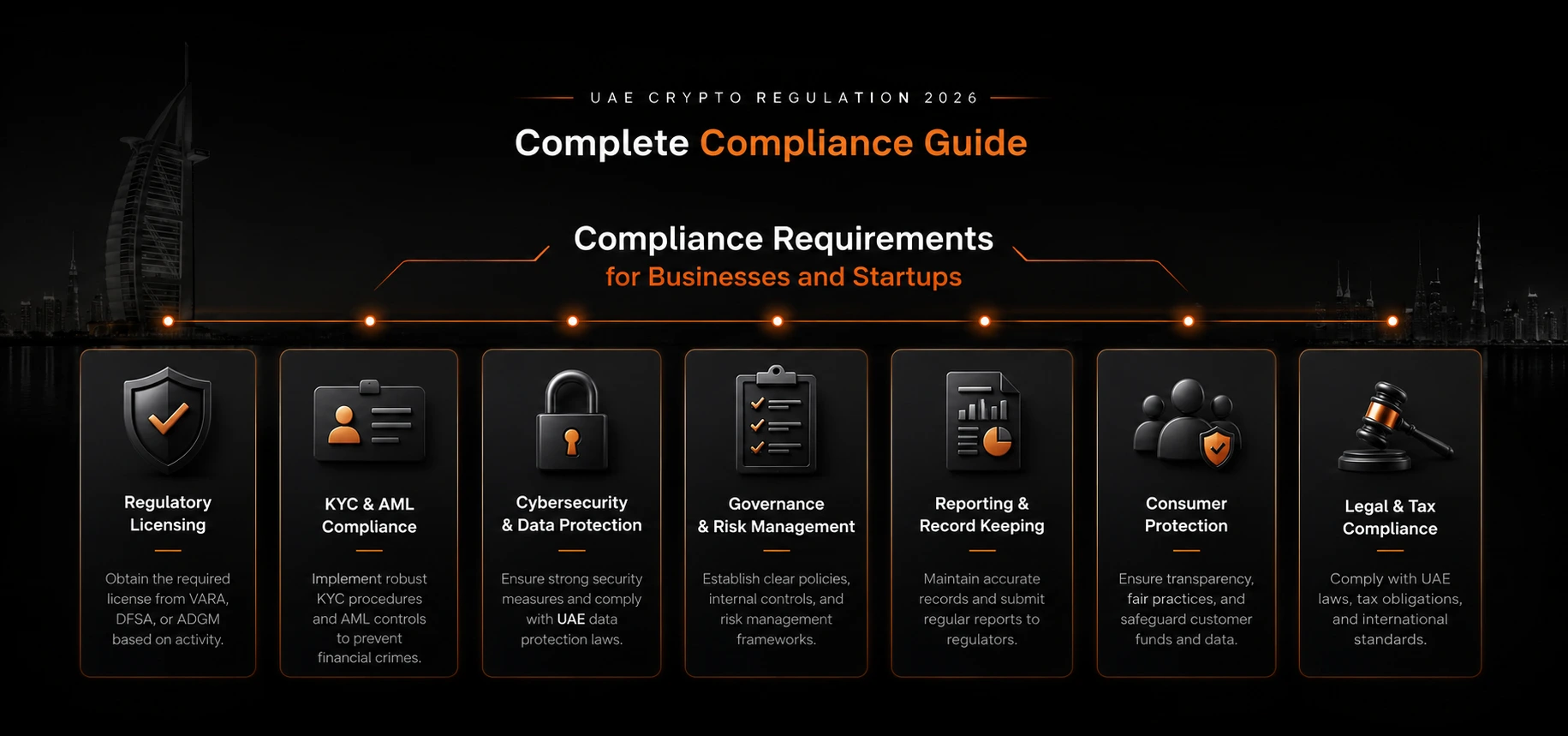
Regulators expect businesses to have good cybersecurity controls, real governance and consumer protection measures in place from day one. Internal controls need to be regularly assessed, boards and senior management need to be aware of the risks specific to cryptocurrency, and user transparency is needed. Regulatory requirements kick in long before significant income or size, and even early-stage firms are expected to weave compliance into their foundations. For companies handling private keys, custody flows, or user asset storage, secure crypto wallet development services are essential for protecting users and meeting operational security expectations.
1. Governance and Risk Management
Regulators expect active boards, responsible senior management and workable internal controls that are documented, tested and part of the daily routine.
2. Technology and Security Controls
Wallet security, private key management, access restrictions, incident response planning and third-party technology risk assessments need to be part of cybersecurity.
3. Consumer Protection Standards
All cryptocurrency company models adhere to strict segregation of customer assets, honest marketing practices, transparent disclosures and effective complaint handling.
4. AML and KYC Compliance
Businesses should have strong AML KYC UAE rules in place such as customer due diligence, transaction monitoring, sanctions screening and reporting suspicious behavior.
5. Ongoing Regulatory Reporting
As operations and risk profiles change, licensed organizations must ensure ongoing reporting, audit preparation and proactive engagement with authorities.
6. Early Stage Compliance Expectations
Even for startups and pre-revenue platforms, governance, security and compliance measures need to be embedded into operations from the outset.
DeFi, Tokens & Digital Assets: Rules and Guidelines
In the UAE, DeFi and token-based initiatives function inside a regulated framework that is both flexible and structured. The UAE crypto regulation 2026 places more emphasis on a protocol’s or digital asset’s practical operation than its branding. Licensing, disclosures, and continuing compliance requirements are contingent upon the existence of control, governance, revenue extraction, or investor exposure. Since DeFi platforms may trigger licensing or compliance obligations based on their actual function, businesses should plan their DeFi development with governance, smart contract security, and risk controls in mind.
UAE Rules and Guidelines for DeFi, Tokens and Digital Assets
| Area |
UAE Rules and Guidelines |
| DeFi Oversight |
DeFi is regulated based on function. Financial service-like activities may trigger licensing and compliance obligations. |
| Level of Decentralization |
Truly decentralized protocols face fewer requirements if no central control or monetization exists. |
| Identifiable Control |
Front ends, developers, DAO operators, or governance mechanisms can create regulatory accountability. |
| Token Classification |
Tokens are classified by use case, including utility, governance, asset-backed tokens, and stablecoins. |
| Disclosure Standards |
Issuers must disclose token economics, risks, governance rights, and use of proceeds transparently. |
| Enterprise Tokenization |
Real-world asset tokenization projects face enhanced scrutiny due to investor protection concerns. |
For businesses exploring regulated digital ownership models, RWA tokenization can help structure real-world assets on-chain while keeping investor protection and compliance in focus.
AML, KYC, and Reporting Obligations
One of the most tightly regulated aspects of UAE crypto regulation 2026 is AML and KYC compliance. Cryptocurrency firms will need to be subject to the same standards as traditional financial institutions, including regular regulatory reporting, automated systems and transparent audit trails. Weak or manual compliance processes are considered high risk and have a direct impact on long-term profitability, banking access and licensing. Businesses building customer-facing Web3 products should ensure their Web3 dApp development approach includes identity checks, transaction monitoring, and secure user flows from the beginning.
1. Customer Due Diligence
The law requires firms to keep accurate and up-to-date records, assess the level of risk, carry out further checks on high-risk users and verify the identity of their customers.
2. Transaction Monitoring Systems
All supported assets should be monitored continuously for anomalous trends, high-risk behavior and potential money laundering.
3. Sanctions Screening Controls
Crypto firms should update their systems as sanctions regimes evolve, and check clients and transactions against international sanctions lists.
4. Suspicious Activity Reporting
Report suspicious transactions fast with tight deadlines, detailed documentation and regulator-ready audit trails.
5. Travel Rule Compliance
To meet international transparency standards, businesses will have to provide information about who sent and received cryptocurrency transfers.
Risks of Non-Compliance for Enterprises
Non-compliance in the UAE carries serious and lasting consequences that are far-reaching, and they extend well beyond regulatory fines. Noncompliance with UAE crypto regulation 2026 is a threat to financial stability, consumer safety and market integrity, regulators say. Small governance or control issues can create big business and legal risks for large businesses.
1. License Suspension or Revocation
Regulators could suspend or revoke licenses, forcing companies to cease operations, sever ties with clients and reapply under tougher terms.
2. Public Enforcement Actions
Enforcement notices tend to get publicized and this can damage one’s reputation for years to come, affecting credibility worldwide, enterprise partnerships and investor confidence.
3. Loss of Banking Access
Banks rapidly cut off fiat access, payment processing and operational liquidity to cryptocurrency and blockchain companies that fail to comply.
4. Personal Management Liability
Senior executives and board members can be personally liable when there are governance issues, neglect or lack of oversight.
5. Operational Disruption
Compliance upgrades, rapid system changes, and product shutdowns that disrupt core business operations may be required by remediation efforts.
6. Enterprise Blockchain Exposure
If tokenization, wallets or on-chain settlements become regulated activities, businesses that use blockchain internally are at risk of regulatory attention. Enterprises using blockchain for internal workflows, settlements, or asset tracking should review their enterprise blockchain development strategy before launching regulated use cases.
7. Long-Term Growth Impact
Compliance can hinder international growth, potential licensing deals and interest from institutional investors.
Compliance is not optional or symbolic in the regulated digital asset environment of the United Arab Emirates. This is a fundamental prerequisite for sustainable business growth, market trust and operational continuity.
How to Prepare for Future Regulatory Changes
The crypto regulatory roadmap UAE is heading to more responsibility, more compliance requirements and more oversight rather than sudden or extreme restrictions. As the cryptocurrency ecosystem matures, regulators are shifting their focus to long-term market stability, investor protection, and institutional confidence.
That means standards set by regulators will continue to evolve, especially for rapidly growing or complex product offerings, or for business that is integrated with existing financial systems. Businesses can remain in good standing with authorities, pay less in reactive compliance costs and change easily by being prepared ahead of time. In the UAE, forward-looking compliance is not an inhibitor to innovation, but a sign of operational maturity and seriousness.
1. Build Compliance Early
Compliance should be a dedicated team focused on compliance and risk from the start, rather than a secondary or reactive function.
2. Proactive Regulator Engagement
Early regulatory engagement builds trust and clarifies expectations, and reduces friction in licensing, product launches and future expansions.
3. Regulation-Ready Design
Develop products and procedures with governance, transparency and consumer protection in mind. Choosing the right technical partner is also important, and this guide on how to choose a blockchain development company can help businesses evaluate expertise, compliance awareness, and delivery capability.
4. Scalable Monitoring Systems
Invest in reporting, transaction monitoring and automated AML systems that can scale with the volume of users and transactions.
5. Strong Documentation Culture
Maintain detailed records of all decisions, controls, regulations and events. Clear records show transparency and reduce regulatory risk.
Transparency is a strategic advantage in the UAE. Regulators are rewarded for being open and prepared, and silence and ambiguity tend to invite deeper scrutiny.
If you are planning to build a regulated crypto, Web3, or tokenization product in the UAE, ChicMic Studios can help you turn compliance-first planning into a secure and scalable blockchain solution.
Conclusion: Navigating Crypto Regulation in UAE
UAE’s 2026 crypto law is not to stifle experimentation or hinder innovation. Instead, it reflects the nation’s long-term aim to build a digital asset ecosystem that is trustworthy, sustainable and institution-ready. The UAE has put a strong emphasis on accountability, governance and clarity, creating an environment that attracts serious builders, international businesses and long-term investments rather than short-term speculation.
For businesses of this sector, compliance is now a competitive advantage, not just a legal need. Including compliance as part of the operating strategy allows businesses to secure faster access to financing, enterprise partnerships and regulatory confidence. Compliance as an afterthought leads to delays, risk of enforcement and missed opportunities. The UAE has made its intentions clear. The opportunity is huge, but only there for those willing to build ethically, openly, with a long-term perspective.
Frequently Asked Questions
1. What is VARA and its role in UAE crypto regulation?
VARA is Dubai’s virtual assets regulatory authority responsible for licensing and supervising virtual asset activities across Dubai.
2. What are the licensing requirements for crypto exchanges in UAE?
Crypto exchanges must obtain licenses from VARA, DFSA, or ADGM depending on jurisdiction and meet governance, AML, cybersecurity, and operational standards.
3. How does UAE crypto regulation affect DeFi projects?
DeFi projects with identifiable control or revenue structures may fall under regulatory oversight focused on governance, disclosures, and AML exposure.
4. Are there penalties for non-compliance?
Yes, penalties can include fines, license suspension, reputational damage, and potential criminal liability in serious cases.
5. How can enterprises stay compliant with UAE crypto laws?
Enterprises should implement strong governance, maintain AML KYC controls, engage regulators early, and work with experienced compliance partners.
6. What changes are expected in 2026?
Expected changes include deeper DeFi oversight, stronger consumer protections, and increased alignment with global regulatory standards.
Build a Compliance-Ready Crypto Product in the UAE
Building a crypto business in the UAE is no longer only about launching fast. It is about launching with the right governance, technology, compliance architecture and security controls from the beginning.
ChicMic Studios helps startups, enterprises and Web3 businesses design and develop secure blockchain, crypto exchange, wallet, DeFi, tokenization and enterprise blockchain solutions aligned with modern regulatory expectations.