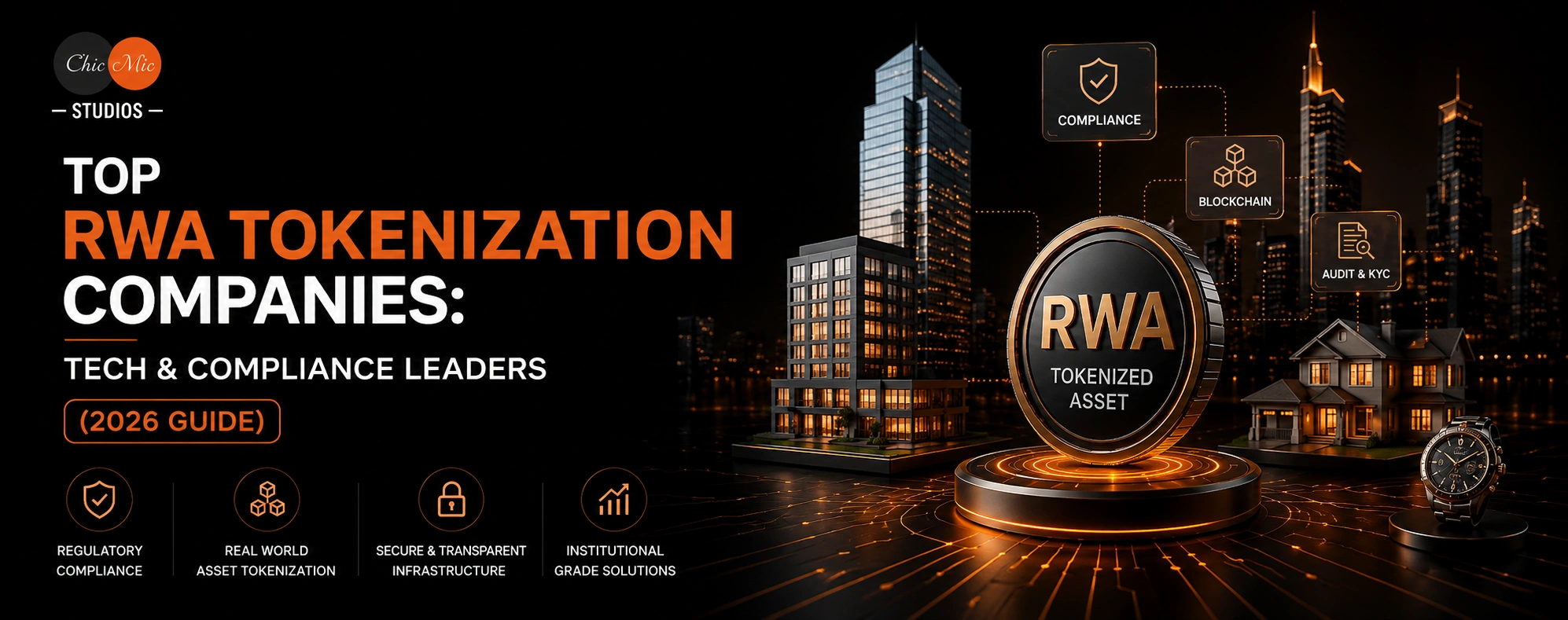
Top RWA Tokenization Companies: Tech & Compliance Leaders (2026 Guide)
Key Takeaways:
- Core Shift: The RWA tokenization model is production-ready and an institutional finance model in 2026
- What RWA Tokenization Delivers: Compliance and security are guaranteed through the legally valid ownership of real-world and financial assets.
- Role of Top Tokenization Companies: The leading tokenization companies are providing institutional-grade and compliance-first tokenization infrastructure to their clients.
- Compliance as a Foundation: Regulations are integrated into the tokenization model to ensure that security and compliance are guaranteed in the transactions that are carried out through the model.
- Enterprise vs Startup Platforms: Institutional investors are choosing to use enterprise-grade, which are more reliable, as opposed to startup platforms that are still not yet reliable enough to be used in the tokenization of assets.
- High Growth Use Cases: Real estate, private credit, funds, and financial assets.
- Strategic Partner Selection: Strategic tokenization partnership is a long-term infrastructure decision.
Tokenization of physical-world assets has shifted from an experimental phase to realities of traditional finance, real estate, and capital markets. By 2026, real-world asset digitization Real World Asset (RWA) tokenization offers institutions essential elements to develop: execution, compliance, and scalable infrastructure.
Currently, in 2026, the on-chain value of tokenized real-world assets stands at more than $24 billion, reflecting an increase of more than 180% compared to the same value in 2024. The increase in value is attributed to tokenized government securities, private credit, funds, and real estate.
The leading asset tokenization providers are critical to this shift in tokenizing RWAs by providing the technical and regulatory framework that allows physical and financial assets to be issued, managed, and transferred on blockchain networks. These companies do not just provide technology; they provide the infrastructure that underpins the next evolution of global finance. For businesses exploring this space, a detailed blockchain development service guide can help explain how blockchain infrastructure is built and implemented in real-world use cases.
This guide will discuss how tokenization works, why institutions are engaging with tokenization at scale, and which companies are emerging as leaders in digital asset tokenization; enterprise blockchain tokenization; and regulated tokenization solutions.
The Institutional Evolution of RWA Tokenization
Tokenizing real-world assets provides a way of digitizing the ownership and economic rights of RWAs on blockchain-based tokens. These tokens are created to represent a legally enforceable right, and thus need to function within pre-existing legal and regulatory systems. In contrast to early crypto assets, the vast majority of tokenized assets today are being structured in some form as securities, funds or regulated financial instruments.
Institutional asset tokenization fundamentally adjusted the way that blockchain is being leveraged in the financial industry. Tokenization is no longer an alternative to the traditional system of finance but has become part of it. Banks, asset managers and other financial institutions are using platforms for security token platforms, to help streamline issuance, automate compliance, and reduce operational barriers to entry.
Forbes highlights that asset tokenization is becoming a foundational layer for modern capital markets rather than an alternative financial system.
As a result, there is now an expanding global tokenization ecosystem where there is a convergence of traditional finance and decentralised infrastructure, resulting in faster settlement, greater transparency, and better access to a wider pool of capital for all investors.
Why RWA Tokenization Is Accelerating in 2026
The rapid advancement of digital asset tokenization is not occurring due to simple speculation. Rather, it is a result of long-standing structural inefficiencies within many traditional financial markets. Cashflow, excessive minimum investment amounts, fragmentation of ownership records and long settlement cycles have restricted asset markets for many years.
Digitalization of financial assets using blockchain technology helps alleviate these issues in a matter of seconds by employing smart contracts. These automate processes that require the use of an intermediary, as well as provide consistent governance and transferability via token standards. Moreover, the issuance of digitally tokenized financial assets has become a viable alternative to the emission of physical securities. Additionally, regulators throughout the world’s major financial centers have now provided more clarity around the regulatory framework that governs digital asset tokenization solutions. Making it possible for financial institutions to develop regulated tokenization solutions that can be deployed at an institutional scale.
Consequently, digital asset tokenization has become a top strategic priority for businesses seeking to secure their financial infrastructure for the future.
Market Growth Signals Strong Institutional Adoption
What Separates the Top RWA Tokenization Companies from the Rest
Although many platforms that provide token issuance exist, not all qualify as market leaders in the area of RWA tokenization. There are a number of unique traits that the best providers of digital asset tokenization possess.
First, the top platforms have compliance embedded within their protocol. Leading platforms offer compliant tokenization infrastructure that automatically enforces both investor eligibility and jurisdictional rules, as well as imposes transfer limitations. This compliance-by-design model mitigates legal risk while enhancing operational efficiency.
Secondly, enterprise readiness is vital to institutional tokenization providers. Institutional tokenization providers must support high transaction volumes, integrate with custodians and banks, and satisfy stringent security and audit requirements. If an institutional tokenization provider does not possess these capabilities, tokenization will only continue to operate on a pilot basis rather than as a production infrastructure.
Thirdly, asset diversity matters. The ability to support multiple types of asset classes is essential in an ever-expanding tokenized market, from tokenized real estate platforms to private credit, private placement funds, and structured products.
Companies Defining the Future of RWA Tokenization
A handful of organizations have emerged as the leaders of the global tokenization landscape and are driving the growth of the token ecosystem by establishing technology, governance, and regulatory standards.
ChicMic Studios
ChicMic Studios offers in-depth blockchain development services with a focus on tokenizing real-world assets across a diverse range of industries. The company’s products enable organizations to tokenize traditional assets like real estate, equities and commodities natively on a blockchain, enabling fractional ownership and greater liquidity. Its tokenization solutions are built for institutions and enterprises, with security, compliance and scalability at the heart of it.
ChicMic Studios assists organizations in establishing transparent, compliant, and future-ready asset management systems through the integration of smart contracts and DeFi concepts. They approach tokenization holistically, including legal structuring, asset modelling, issuing of tokens and lifecycle management to ensure a smooth process.
Techfyte
Techfyte is a blockchain innovator that adds liquidity and transparency by providing bespoke real world asset tokenization solutions to illiquid markets. Their platform allows companies to tokenize real estate, securities and commodities for fractional ownership and global market buying and selling.
Techfyte builds tokenization systems for KYC/AML and Smart Contract Automation, focusing on regulatory compliance and security. Its scalable and compliance-ready infrastructure enables organizations to easily integrate RWA tokenization into their digital transformation strategy.
Securitize
One company that is viewing the future of security tokens is Securitize, and is known as one of the oldest and most well respected companies that provides security token technology. Their complete end-to-end solution supports the issuance of securities, onboarding of investors, compliance of their securities, and accessing the secondary market for tokenized securities.
Securitize has positioned itself as the leading platform for managers and funds to tokenize equities, funds and alternative investments (through the use of security tokens). Whereas complying with regulatory requirements within the United States and Europe. One of the models of a successful enterprise blockchain tokenization is to seamlessly integrate blockchain technology into traditional capital markets.
Tokeny
Tokeny is a major provider of compliant tokenization architecture in Europe. Tokeny is also known for establishing the ERC-3643 token standard that was specifically designed for use with regulated assets. The ERC3643 token standard was created to embed identity validation into the security tokens, with embedded logic for compliance with securities regulation in Europe.
By being more focused on compliance to regulation and less on speed, Tokeny has become the preferred partner in the financial services marketplace in Europe for enterprises that are trying to securely digitize their assets on the blockchain. The influence of Tokeny is larger than just establishing technology. Tokeny is promoting industry-wide standards for how tokenization will be executed in regulated markets.
Polymath
Polymath has been working with security tokens since they first started back, so they’ve had quite some time to get used to different types of legal, technical and compliance requirements for issuing digital tokens. They can easily help companies create compliant digital assets through the use of Polymath’s technology.
They were one of the first companies to provide a platform for tokenization of securities, and thanks to that early start they have been able to set the standard for using security tokens as a means of capital raising.
Fireblocks
Fireblocks don’t issue tokens themselves, but they have a central role in tokenization. Secure custodianship and transaction management are necessary conditions if institutions are going to adopt tokens. Fireblocks is the company with the infrastructure that makes it possible for both the tokenization and enterprise level of companies to safely manage their digital tokens.
Most of the tokenized real estate platforms and tokenization providers for institutions use Fireblocks to physically secure their private keys and to facilitate transactions on the blockchain. Without enterprise-grade custodianship, the ability for tokens to be used on a wide scale as a means for companies to raise capital through a regulated tokenized alternative will not be feasible.
ConsenSys
ConsenSys currently works with tokenization by providing companies with enterprise blockchain tools, consultancy services, and deep expertise of the Ethereum ecosystem. ConsenSys has been involved with numerous projects relating to the development of smart contracts. They have been instrumental in helping organizations move away from traditional systems to modern blockchain based infrastructure.
ConsenSys involvement in all these tokenization projects illustrates that building scalable and compliant digital asset ecosystems requires a strong technical foundation.
| Company |
Focus |
Compliance Strength |
Best For |
| ChicMic Studios |
Real-world asset tokenization |
Security, compliance, scalability |
Institutions and enterprises |
| Techfyte |
Real-world asset tokenization for illiquid markets |
KYC/AML, smart contract automation |
Organizations seeking scalable, compliant tokenization |
| Securitize |
Institutional tokenization |
SEC compliance |
Financial institutions |
| Polymath |
Security tokens |
Regulatory infrastructure |
Enterprises |
| Fireblocks |
Digital asset custody |
Institutional security |
Fintech |
| Tokeny |
Tokenization infrastructure |
EU compliance |
Asset managers |
| ConsenSys |
Enterprise blockchain tools & smart contract development |
Ethereum ecosystem expertise |
Organizations building scalable blockchain infrastructure |
Tokenized Real Estate Platforms as a Catalyst for Adoption
Currently, real estate is one of the most visible and impactful examples of utilizing Real World Assets through tokenization for transaction purposes. Traditionally, real estate properties are illiquid, expensive to transact on and cannot be transacted on in cross-border transactions due to their location. By utilizing tokenization through fractional ownership, the distribution of income automatically, and programmable governance, you are helping to eliminate these challenges of traditional real estate.
The modern, tokenized real estate platforms that operate today, provide compliant and legally enforceable rights through the use of a token that represents ownership interest in an underlying asset. A large portion of these modern, tokenized real estate platforms depend on institutional tokenization providers in order to provide compliant, secure storage of capital (or assets) as well as cross-border access for investors.
With an increase in regulatory acceptance, tokenized real estate will continue to become a viable alternative option for connecting traditional real estate markets with the blockchain financial institution environment.
Forbes notes that tokenized real estate can significantly improve liquidity while maintaining regulatory safeguards.
Enterprise Blockchain Tokenization vs Early-Stage Platforms
Two different groups have emerged regarding enterprise-grade tokenization providers versus early stage tokenization providers. The companies who are using tokenization for their business objectives primarily want stability, compliance to regulations and long-term plans for integrating with their financial institution systems. Start-ups or early stage tokenization providers, while they are innovative, have a narrower focus on tokenizing certain asset types or in particular geographic jurisdictions.
The more traditional issuers of large volumes, banks and asset management companies require institutional tokenization providers to give them the level of certainty and guarantees they need in order to deploy capital on a large scale. This definition illustrates why using regulated tokenization solutions has become the default means of transaction for qualified participants in the marketplace.
How Organizations Should Evaluate RWA Tokenization Partners
Selecting a tokenization partner does not simply involve a technical evaluation. Instead, organizations have to consider regulatory coverage — including frameworks such as the U.S. SEC digital asset securities guidance – asset compatibility, security architecture, and ecosystem integration, among other factors. Therefore, the ideal partner has to be one that currently meets the needs of the organizations while being agile for future regulatory and market changes.
What sets the top RWA tokenization companies apart from the rest is that they provide a long-term infrastructure that can support the growth of institutions, not just a one-off tokenization event.
The Future of the Global Tokenization Ecosystem
Blockchain-based asset digitization is quickly becoming part of the standard financial system. Tokenized bonds are being considered by governments, tokenized funds are being created by asset managers, and private markets are moving on-chain through advanced blockchain development solutions.
As this process continues to speed forward, the companies building today’s security token platforms and enterprise blockchain tokenization systems will determine how value is transferred in the digital world.
Frequently Asked Questions
1. What is RWA tokenization and why is it important in 2026?
The process of tokenization in the field of real-world assets and finance is known as RWA tokenization. By 2026, this process has become important because it helps institutions to improve liquidity, automate compliance, reduce settlement times, and access capital markets.
2. How is modern RWA tokenization different from early crypto token models?
Unlike the early crypto tokens, the modern RWA tokenization process occurs within a regulated environment. In the modern process, the assets are created as securities, funds, or regulated products, and the compliance, eligibility, and enforcement features are built into the infrastructure.
3. What makes the top RWA tokenization companies different from other platforms?
The best RWA tokenization providers offer enterprise-grade, compliance-focused infrastructure rather than token issuance solutions. This makes them suitable for institutional use, with support for regulatory enforcement, transaction volume, custody, and multi-asset tokenization.
4. Why do institutions prefer enterprise-grade tokenization platforms over startups?
Regulatory clarity, security, scalability, and reliability are key areas that institutional investors look for in any platform. While enterprise-grade platforms are production-ready, startup platforms are often limited to pilots or certain jurisdictions.
5. Which asset classes are driving RWA tokenization adoption today?
High-growth use cases for tokenization include real estate, private credit, funds, equities, and other financial assets. These types of assets benefit the most from tokenization.
Conclusion
RWA tokenization has entered a decisive phase of maturity. The market is no longer driven by experimentation, but by regulation, infrastructure, and institutional adoption. The top RWA tokenization companies in 2026 are those that successfully combine advanced technology with deep compliance expertize.
For enterprises and financial institutions, partnering with the right tokenization provider is a strategic decision that will shape their role in the future of global finance. As the global tokenization ecosystem continues to expand, compliant, scalable, and enterprise-ready platforms will lead the next era of asset ownership and capital markets.
Looking for RWA Tokenization Experts? ChicMic helps you.