Key Takeaways
- AI agents in healthcare are transforming operations: Enabling smarter, faster, and more efficient care delivery.
- Healthcare automation using AI reduces costs and errors: Automates repetitive administrative and clinical workflows.
- Intelligent agents in healthcare enhance clinical decisions: Real-time insights improve accuracy and patient outcomes.
- AI medical workflow automation boosts productivity: Frees up staff to focus on high-value patient care.
- AI in patient management improves experience: Personalized, 24/7 interactions increase satisfaction and engagement.
- AI agents use cases in healthcare are rapidly expanding: Driving innovation across hospitals, insurance, and research.
- Future of AI in healthcare is interconnected systems: Multi-agent ecosystems will power next-gen healthcare delivery.
What Are AI Agents in Healthcare
It is important to first define what a true “AI agent” is before trying out various applications of AI. An AI agent is defined broadly by its function (i.e., it is an autonomous system that interacts with its environment (e.g., the hospital database, the patient’s questions) in order to accomplish specific goals).
Standard AI models differ from true AI agents. An AI model can be thought of as a virtual brain (such as a Large Language Model (LLM)), which may be used to forecast text or process digital data, and does not perform any actions independently on its own. The “hands” associated with the AI model are the computer programs that wrap around it to enable interaction with its environment (e.g., an AI agent may be able to execute a transaction, a capability typically delivered by a custom AI agent development company building autonomous healthcare systems.).
Examples of intelligent agents in healthcare include:
- Chatbot Agents: Collecting patient intake and triage data using AI chatbot development services
- Diagnostic Agent: Analyzing imaging studies to identify and flag bleeding abnormalities
- Workflow Automation Agent: Completing prior authorizations and billing code documentation
Why Healthcare Needs AI Agents in 2026
The requirement to utilize AI healthcare solutions is not a luxury, but rather the result of hard data. Recent comprehensive industry analyses found that healthcare administrative expenses approximate 25% (healthcare cost reporting data) of all expenditures on healthcare in The United States. In addition, according to a study conducted by the American Medical Association, physicians average 15.5 hours of paperwork every week; therefore, rather than spending time in front of a computer (i.e., doing paperwork), they are missing valuable time spent with patients.
The key elements for this movement are:
- Increasing Patient Loads: Too many patients and not enough specialists mean unacceptable waiting times, a trend supported by WHO global healthcare statistics.
- Administrative Burden: Administrative staff is overwhelmed with inputting data (entry of data into an electronic database), verifying insurance coverage, and scheduling appointments manually.
- Human Error: As a result of all of the manual entry of data into electronic databases, there is a high incidence of human error with regard to medication and/or diagnosis.
- Speed: In an urgent care situation, the immediate availability of accurate information is critical. Automated systems can analyze and report results of a blood test and provide alerts to the staff for a potential patient who is developing sepsis. In these cases, human delays in the reporting and analyzing of the blood tests can take hours.
Key Capabilities of AI Agents in Healthcare
In order to make workflows more efficient, these agents have attributes that set them apart from traditional software.
- Real-Time Decision Making: Agents can evaluate streaming data from IoT devices (ex: heart monitors) and make immediate decisions such as adjusting insulin dosages or notifying a nurse.
- Process Multi-Source Data: Agents combine data from multiple, disconnected sources (EHRs, imaging, genomic data, and wearable devices), creating a complete picture of the patient.
- Automate Repetitive Tasks: Agents can perform high-volume and low-complexity tasks such as sending appointment reminders, enabling staff to focus on providing more complex care.
- Automated Personalized Interaction: With Natural Language Process (NLP), agents can interact with patients in an organic and caring manner, adapting the language used based on the level of health literacy (ex: elementary school level or 12th-grade level).
- Connect Older Systems with New Technologies: Agents act as middleware allowing older “legacy” hospital systems to connect to newer applications. This prevents the necessity of a complete infrastructure upgrade.
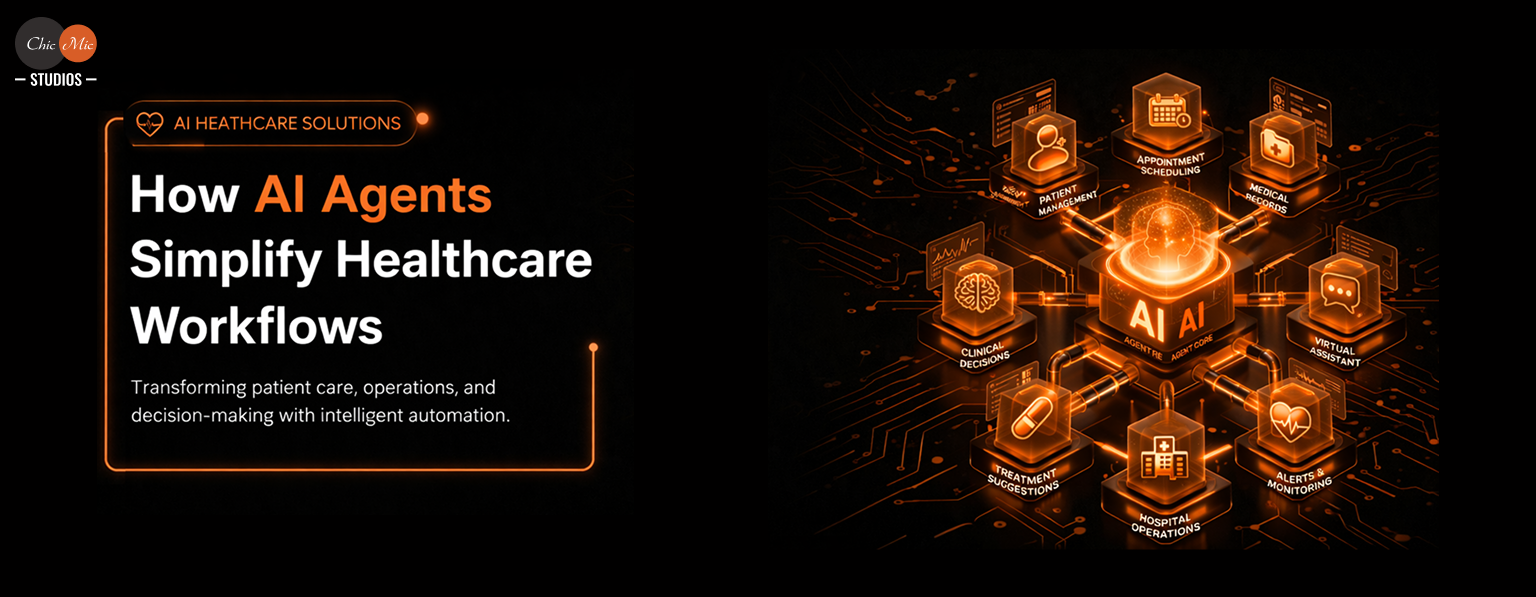
How AI Agents Simplify Healthcare Workflows
This is the core of ai medical workflow automation. It represents a flattening of traditional silos in the way we do business and deliver value to customers in our multiservice delivery systems.
- Patient Management & Virtual Assistance: In addition to flattening traditional silos for our patients, patient management and virtual assistants can help streamline the process of getting an appointment by allowing patients to book an appointment through an artificial intelligence agent that can do the administrative work that normally would have taken several minutes, in a matter of seconds!In many cases we can avoid long waits in emergency departments by using the same technology to help patients check their symptoms and determine how quickly they should seek care.
- Clinical Decision Support: In an effort to continue to provide value to our physicians at the point of care, intelligent healthcare agents can provide clinical decision support that assists physicians with diagnosing their patients, supported by AI in healthcare research insights, as well as suggesting treatment options based on years of patient history using artificial intelligence.On top of it, as AI agents continue to grow and develop, they also will provide our physicians with information about potential drug interactions that they might not see or recognize themselves! Finally, they can provide physicians with real-time patient vital signs, allowing them to predict any deterioration (e.g., fall or cardiac arrest) in advance to prevent loss of life.
- Administrative Automation: Artificial agents give the greatest return on investment to back-office administration. Billing and claims processing are historically complex operations. AI agents are capable of auto-coding procedures, verifying patients’ insurance eligibility, and submitting claims at an extremely high level of accuracy, thus significantly reducing their rate of denial. For the purpose of recording medical evidence, ambient listening agents can listen to doctor-patient conversations and then transcribe them in their entirety into the EHR record, eliminating the so-called “pajama time” (after-hours paperwork) for physicians.
- Remote Monitoring & Care: With respect to chronic disease management, AI agents facilitate the continuous provision of healthcare outside of a hospital environment through remote patient monitoring solutions using AI. Agents continuously track chronic disease management through wearable devices (e.g., smart watches and glucose monitoring devices) integration; tracking of patients’ vitals in real-time allows automatic alerts to be sent to physicians when patient vitals exceed pre-defined thresholds, enabling physicians to initiate treatment immediately and thereby prevent expensive hospital readmission.
Real-World Use Cases of AI Agents in Healthcare
The different areas of the health ecosystem are using AI to improve hospital automated processes with unique applications.
- Hospitals: Large hospital networks use AI agents for “bed management.” Agents predict discharge times and coordinate with cleaning staff and admitting to ensure that post-surgery beds are available the moment they are needed.|
- Telemedicine Platforms: Telemedicine platforms utilize AI agents for the pre-visit workflow. AI prescreens patients for their visit by obtaining demographic and medical history, confirming their identity prior to the appointment, and then directing the patient to the specialist (primary care physician, neurologist, etc.) who can best provide for their need based on the patient’s medical symptoms.
- Health Insurance Companies: Health insurance companies utilize AI to improve and speed up prior authorization processes so that prior authorizations are completed in minutes rather than days.
- Pharma & Research: AI agents are assisting clinical trial research with patient recruitment; they use algorithms to search and analyze electronic health records (EHR) data and create a list of potential candidates for clinical trial participation. This use of AI speeds up drug development and produces better quality drug products.
Benefits of Using AI Agents in Healthcare
The transition to AI in patient management provides practical and measurable advantages for all areas:
- Lower Operating Costs: Automation reduces the need for human resources for traditional administrative functions. For example, the payroll expense can be reduced by as much as 30% in specific areas.
- Enhanced Patient Experience: Shorter wait times, 24/7 access, and customized communications will improve patient satisfaction scores (HCAHPS).
- Quicker Diagnosis and Treatment: By using AI agents to quickly process data, specialists can receive critical test results immediately.
- Decreased Staff Burnout: Agents take over repetitive tasks, allowing physicians and nurses to return to the “people” aspect of caring for patients, creating job satisfaction.
- Better Data Utilization: Unstructured data (doctor’s notes, PDFs) is converted into structured, actionable insights.
Challenges of Implementing AI Agents in Healthcare
Despite the promise, integrating healthcare ai development is not without hurdles. Recognizing these challenges is essential for a successful rollout.
- Data Privacy & Compliance: Healthcare is one of the most controlled industries regarding security. AI agents must function under strict laws supported by blockchain development solutions for secure healthcare data, such as HIPAA (USA) and GDPR (Europe). Data breaches and/or mishandling of data can result in severe legal consequences.
- Integration with Legacy Systems: Many hospitals have EHR systems that have been in use for decades and were never designed to interface with a modern API methodology; therefore, it can be difficult to link the new AI solutions with current technology, which will require significant middleware development to interface.
- Accuracy & Trust Issues: If an AI agent makes a mistake, such as a missed diagnosis or a billing error; who is liable? Building trust requires explainable AI (XAI) where the agent can show its reasoning.
- High Initial Investment: Custom-built AI solutions have a prohibitively high initial cost due to the tech infrastructure required (cloud service), staffing (data scientists) and ongoing compliance monitoring.
- Regulatory Concerns: AI solutions in the healthcare field are subject to evolving regulatory frameworks defined by the FDA regulations for AI-enabled medical devices, ensuring safety, effectiveness, and compliance. AI solutions in the healthcare field are subject to acceptable/integrated regulations established by the US FDA in most cases. The regulatory process for AI agents acting autonomously is currently being established.
How AI Agents Work in Healthcare Systems (Architecture Overview)
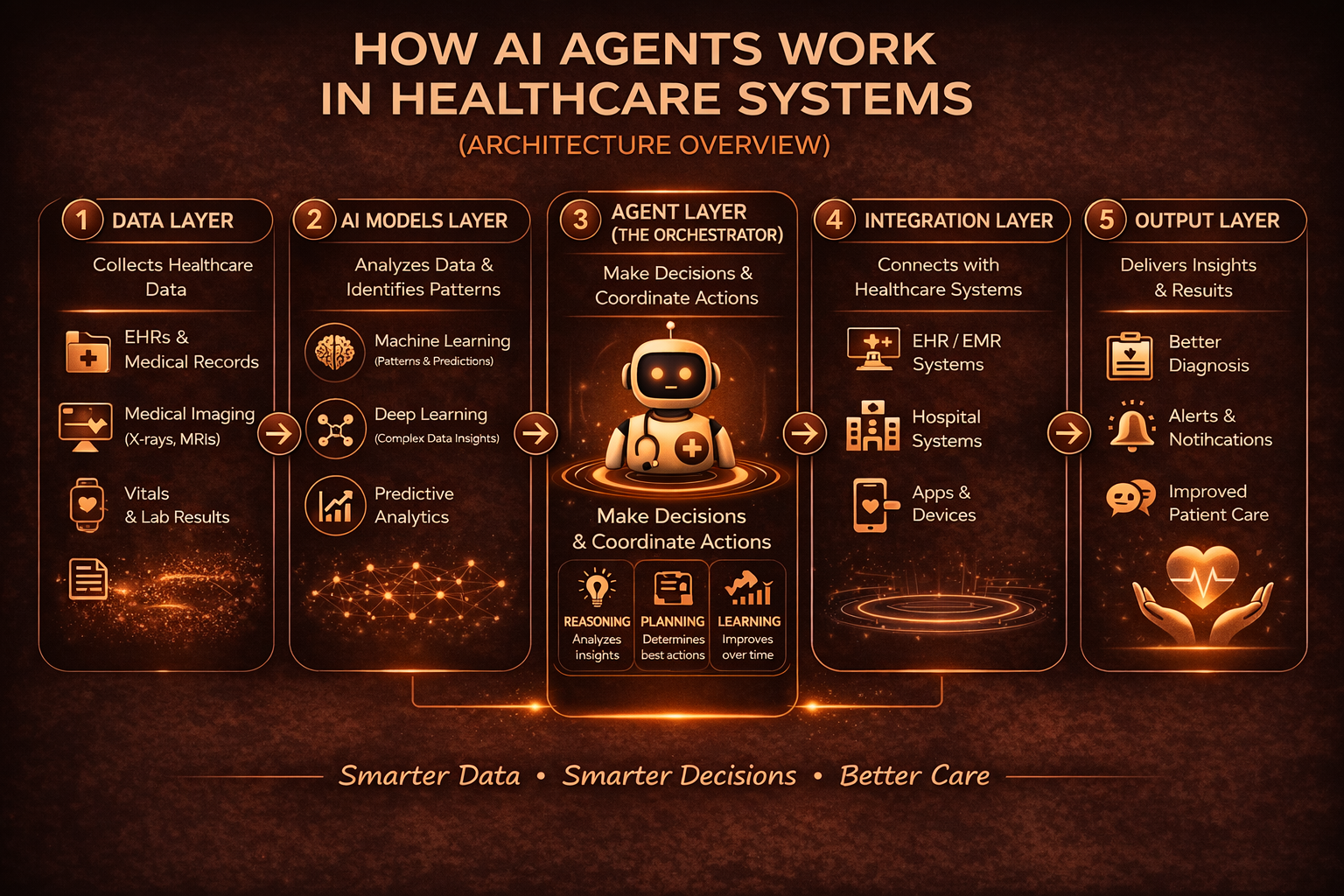
To understand the scalability of ai healthcare solutions, it helps to look at the underlying architecture. A typical enterprise-grade AI agent system is built on a layered structure:
- Data Layer: This is the source of truth. It includes structured data (EHRs, lab results, billing codes) and unstructured data (clinical notes, PDFs, DICOM images from MRIs) pulled via APIs or HL7/FHIR interfaces.
- AI Models Layer: This contains the specialized models. This could be a Natural Language Processing (NLP) model for reading doctor’s notes, a predictive analytics model powered by machine learning solutions for healthcare for readmission risk, or a computer vision model for radiology”
- Agent Layer (The Orchestrator): This is the “brain” that decides what to do. It takes the output from the AI models, combines it with business logic (e.g., “If risk is high, alert attending physician”), and executes actions.
- Integration Layer: This connects the agent to the outside world. It translates the agent’s commands into actions that hospital systems (like Epic or Cerner) or communication tools (like SMS or Slack) can understand.
- Output Layer: Finally, the results are displayed to end-users via dashboards built with scalable web development solutions for administrators, alerts for clinicians, or chat interfaces for patients.
Future of AI Agents in Healthcare
Beyond 2026, the pathway indicates fully autonomous ecosystems, as highlighted in recent AI in healthcare industry report findings. The future of AI in healthcare is focused on transitioning from isolated agents to mutually connected “multi-agents systems.”
- Autonomous Hospitals: “Hospital-at-home” models are on the rise. However, there are micro-hospitals on the horizon that will have the ability for AI agents alone to manage logistics, inventory, and schedule surgeries with robotic systems without human help.
- AI-powered Robotic Care: Robotic Process Automation (RPA) combined with AI will progress from digital tasks to physical tasks, such as robots delivering medication and meals, using AI agents as their guide.
- Predictive and Preventive Healthcare: Rather than treating disease, AI agents will work to prevent individuals from becoming ill. AI agents will analyze individuals’ genetic data and lifestyle factors to create personalized wellness plans for them years before they develop a disease.
- Multi-Agent Ecosystems: Different types of AI agents will have different specializations and will negotiate with one another in real-time to optimize every aspect of workflow in the hospital.
AI Agent Development Services for Healthcare
Implementing such advanced systems requires a partner who understands both the intricacies of AI and the stringent demands of the healthcare industry. At ChicMic Studios, we specialize in bridging the gap between cutting-edge technology and practical healthcare needs.
We offer end-to-end healthcare ai development services tailored to your specific operational challenges:
- Custom AI Agent Development: We build bespoke autonomous agents that integrate seamlessly into your existing infrastructure, whether you need a virtual nursing assistant or a claims processing bot.
- Healthcare Workflow Automation Solutions: Our team analyzes your bottlenecks and deploys agents to automate repetitive tasks, ensuring your staff can focus on patient care.
- AI + Blockchain Integration: For clients concerned with data integrity and security, We combine AI with blockchain development services to create immutable audit trails for patient data and consent management.
- EHR Integration & System Modernization: We specialize in connecting modern AI agents with legacy EHR systems using HL7/FHIR standards, ensuring interoperability.
- Scalable AI Infrastructure: We build cloud-native solutions that scale with your patient volume, ensuring reliability during peak times.
Ready to simplify your healthcare workflows?
FAQ Section
Q: What are AI agents in healthcare?
A: AI agents in healthcare are fully automated software systems, created to gather information from around the clinical environments, come to conclusions about interventions based on gathered information and perform actions (scheduling appointments, assisting with diagnostic information or performing patient billing) without the need for humanity.
Q: How do AI agents improve hospital operations?
A: AI agents are used to automate routine administrative work , manage patient flow more efficiently, provide clinical decision making assistance to reduce errors, and support 24 hour a day access for patients.
Q: Are AI agents safe for healthcare use?
A: AI agents are developed properly by following the appropriate frameworks and sufficiently tested; however, AI agents are viewed as assistive devices; therefore, the ultimate responsibility for major medical decisions rests with a licensed medical professional, to maintain accountability and patient safety.
Q: What are examples of AI agents in healthcare?
A: Common examples include in-home ambient clinical scribes documenting medical visits, AI triage chatbots directing patients to the proper site of care, predictive notification to clinicians, identifying when patients have a declining condition and robotic process automation (RPA) AI agents performing claims processing.
Q: How much does it cost to build AI healthcare solutions?
A: The cost range for AI healthcare solutions is so vast that the low end would be approximately $50,000 (e.g., simple chatbot) and can reach over $500,000 plus (e.g., an enterprise system with multiple AI agents, fully integrated with legacy electronic health records, predictive analytics, etc.).
Q: How can businesses implement AI agents in healthcare?
A: First, businesses usually carry out a discovery phase to determine the biggest impact bottlenecks (examples include scheduling and prior authorizations). After identifying high-impact bottlenecks, companies should work with an experienced developer like ChicMic Studios to create a scalable, compliant, and interoperable solution to fit their specific workflows.