Key Takeaways:
- Core Value: AI agents make it possible for goal-driven systems to think, plan, and act in ways that go beyond what is possible with regular automation.
- Comprehensive Services: Memory, tool orchestration, security, governance, and human supervision are all things that enterprise agents need to work.
- Business Benefits: AI agents make things run more smoothly, help people make decisions faster, and let companies grow without hiring more people.
- Industry Use Cases: Real estate, healthcare, finance, and support teams use agents to automate complicated decision-making processes.
- Future Trends: Multi-agent systems, planning-driven execution, and measurable real-world impact are becoming more common in enterprise AI.
AI agent development services are no longer just an idea for the future or a lab experiment. In 2026, they are now a major business capability, built on advances in AI development services for enterprises that go beyond traditional automation. According to McKinsey’s State of AI report, over 60% of organizations are actively experimenting with advanced AI systems, with a growing share scaling them into core business functions. In the US and other countries, companies are moving from basic automation and chatbots to self-driving systems that can think, plan, and act on their own. If you’re looking into AI agent development services, you’re probably trying to figure out what’s really important, what’s just hype, and what will really help your business.
This guide is for business leaders, product owners, and technical decision-makers who don’t like jargon. We’ll talk about how autonomous AI agents work in the real world, how they are different from chatbots and RPA, what architectures can grow, and what to think about when choosing an AI agent development partner in 2026.
What Are AI Agent Development Services
AI agent development services focus on building intelligent systems from start to finish that can work on their own or with some help to reach business goals. Unlike regular AI tools that only respond to cues, AI agents can think, plan, and act across many systems without needing help from people all the time.
In business settings, these services go far beyond just helping you choose a model. These include making memory and context management systems, putting tools and APIs together, making rules and security controls, and building autonomous AI agent architecture for business settings.
The main thing that AI agents do is work toward goals. They don’t just answer questions; they also finish tasks, make decisions, and get better with time. For this reason, companies see them as a way to automate things in the long term instead of just adding them once.
Why Enterprises Are Investing in AI Agent Development in 2026
The use of agentic AI is growing quickly because companies have hit the limits of traditional automation. According to Gartner’s enterprise AI agent adoption survey, only about 15% of organizations are currently piloting or deploying fully autonomous agents, largely due to governance and readiness challenges. Businesses have to deal with data that isn’t structured, situations that change quickly, and decisions that don’t follow simple rules.
In 2026, AI agents will be used more often to make things run more smoothly. Instead of relying on many tools, handoffs, and approvals, agents coordinate work across systems and teams. This means less overhead, fewer mistakes, and faster execution.
Another big reason is decision intelligence. Businesses don’t want dashboards that only show what happened yesterday anymore. AI agents help with understanding data in real time, comparing options, and suggesting actions. This change is shaping the future of agentic AI systems in business, especially in fields where speed and accuracy have a direct effect on revenue. McKinsey’s agentic AI value estimates that it could unlock $2.6 to $4.4 trillion in annual economic value, largely by improving decision quality, speed, and execution.
How Autonomous AI Agents Work in Real-World Systems
To understand their value, it’s helpful to know how autonomous AI agents work in real world.
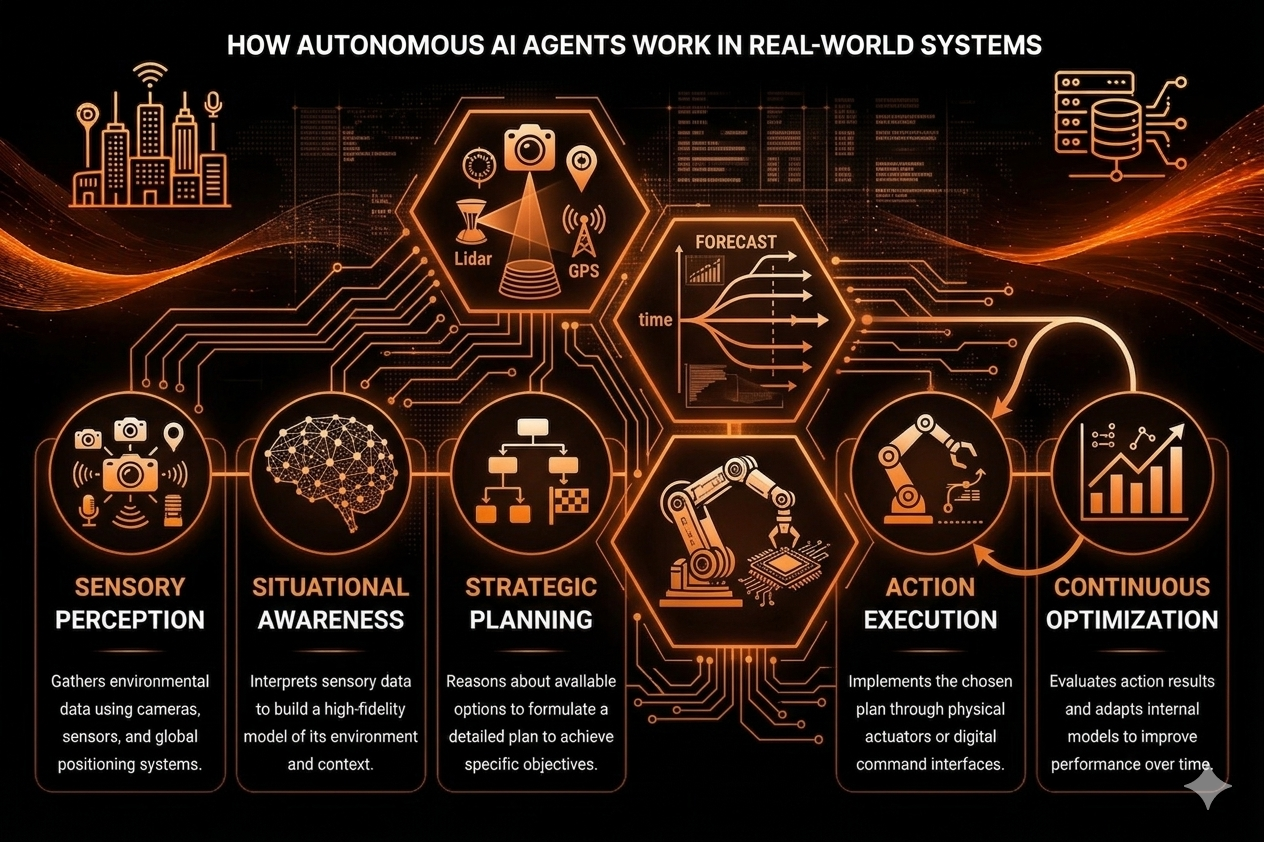
Every AI agent operates in a continuous loop. This perception-decision-action loop is powered by core technologies powering modern AI systems that enable reasoning, memory, and tool use. First, it takes in information from its surroundings. This could include information from internal systems, documents, APIs, voice calls, and user input. After that, the agent uses what they know to make choices by looking at limits, understanding the situation, and making choices. Finally, it works by starting workflows, getting in touch with tools, updating records, or telling people about problems.
The strength of this loop comes from memory. AI agent memory and context management systems help agents remember what they did in the past, keep track of information during interactions, and change their behavior over time. Agents appear superficial in the absence of memory. This makes them reliable partners.
Also, advanced enterprise agents use tools in a dynamic way. They choose the right tool at the right time instead of being hard-coded, which is very important for working in complicated systems.
AI Agent Architecture and Design Patterns for Enterprise Systems
AI agent architecture and design patterns are what mostly determine how well they work. An isolated agent might not work right when used on a large scale.
In simpler cases, one agent can handle the whole workflow. In business settings, though, multi-agent artificial intelligence systems, where different agents do different tasks, are often better. One agent can gather information, another can evaluate it, and a third can take action. This division makes things more scalable and reliable.For businesses exploring scalable solutions, our AI development services help design systems where multiple agents collaborate efficiently across workflows.
Planning agents are another important trend. Instead of responding step by step, they plan out action sequences before doing them. Orchestration layers then coordinate these plans. They also make sure that agents talk to each other and follow escalation and approval rules.
In this case, best practices for designing AI agents with humans in the loop are very important. Businesses want to be in charge and see what’s going on, especially in industries that are heavily regulated. The best architectures find a balance between oversight and freedom that builds trust without slowing things down. To ensure compliance and transparency, businesses often combine automation with generative AI solutions that support human-in-the-loop decision making.
Frameworks and Tools for Building AI Agents
The frameworks for building AI agents you choose can have a big effect on how quickly and reliably agents can be built.
LangChain is popular because it can be used in many different ways. It allows for the use of tools, the management of memory, and the chaining of workflows. However, it requires careful design choices to avoid making systems that are too fragile. CrewAI works well in structured multi-agent processes with clear roles because it focuses on teamwork.
AutoGen is great at agent-to-agent communication and iterative reasoning, especially for jobs that require a lot of research or planning. Businesses are increasingly using MCP protocol integration in agentic AI systems to make it easier for people to find and use tools in different settings.
Tools are not as important as experience. Frameworks do not replace careful system design.
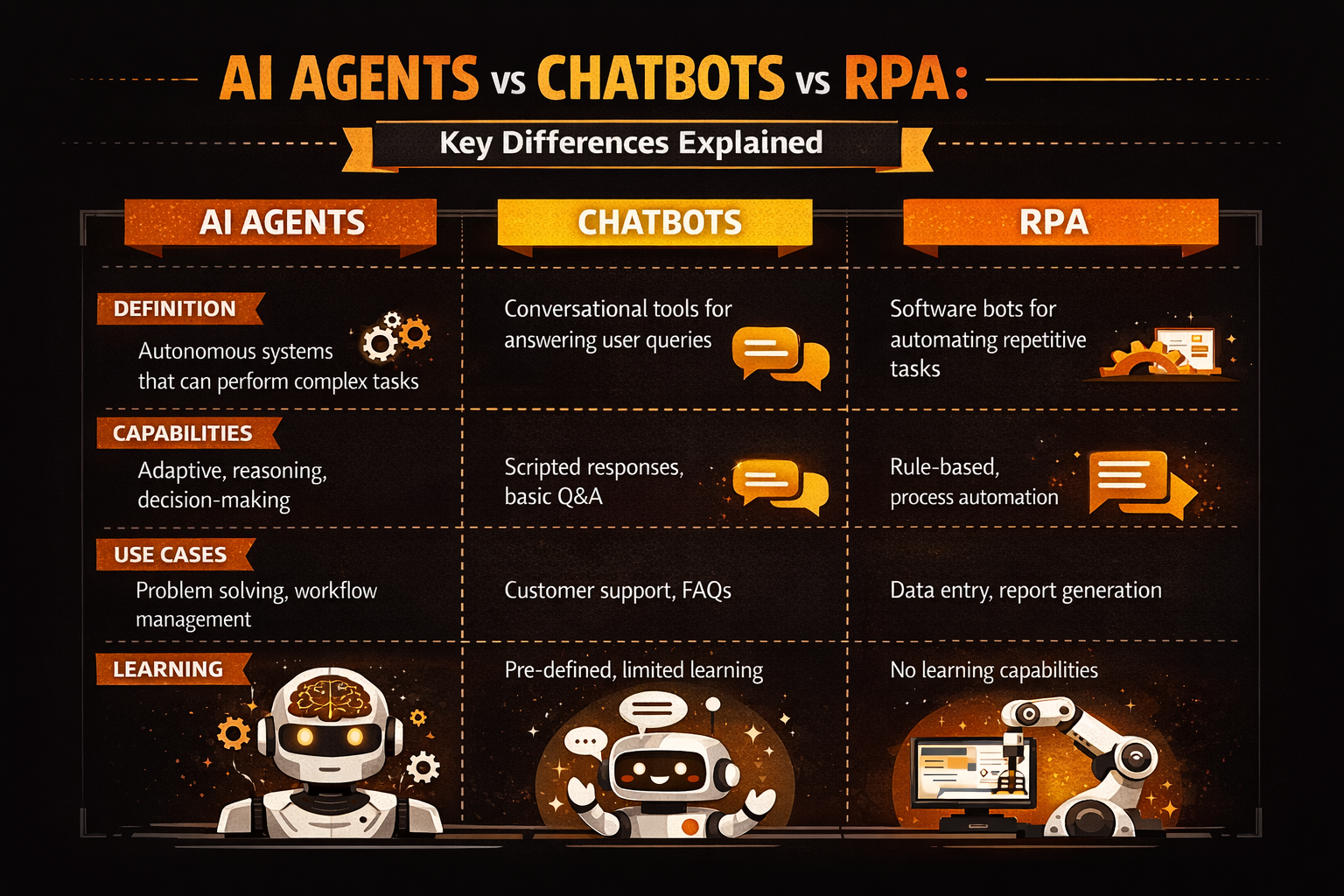
AI Agents vs Chatbots vs RPA
People still don’t know the AI agents vs chatbots differences explained, which often leads to bad buying choices.
Enterprise Use Cases of AI Agents Across Industries
AI agents are no longer just experiments or restricted to the tech teams. Today, they are used in real business environments for handling complex processes, helping with decision-making and reducing manual work in many industries. The most important AI agents use cases in healthcare, finance , real estate and customer support show how quickly this shift is happening.
In healthcare, AI agents are helping clinics and hospitals run their day-to-day operations more smoothly. They help with patient intake, scheduling appointments and organizing medical records, freeing up staff time to actually care for patients. And they make it easier for administrators and doctors to get the right information when they need it, by helping to connect data across systems.
In finance, AI agents are used to monitor transactions deeply, to spot fraud early and to support compliance teams on an ongoing basis. Financial teams can leverage agents that detect anomalous activity in real time and help accelerate decision-making in a regulated and accurate way, rather than wait for end-of-day reports.
In real estate, AI agents are streamlining lead management, buyer-property matching and pricing trend analysis. They can screen postings, understand customer needs and allow agents to focus solely on high-intent opportunities. Accelerates deal velocity through a substantial reduction in manual follow-up.
In customer support, AI voice bots such as Maica24, are transforming how companies interact with consumers. Unlike agents that only answer simple questions, these agents are able to understand what the customer really wants, resolve issues throughout and only escalate to human agents when needed. It makes support more natural, faster, and less irritating for users.
AI chatbot use cases in customer support, as well as voice-based solutions, are delivering positive results for many companies. These chatbots handle a huge number of chats on websites, applications and messaging services, helping clients to follow requests, get quick replies and resolve common issues fast. They offer a more consistent and reliable support experience across channels when used with AI voice assistants.
All of these areas are being progressively and insidiously integrated into the way modern companies do business by AI agents. They enable teams to scale, be more accurate and save time without continually adding more headcount.
AI Voice Agents for Customer Support Systems
AI voice agents are speedily becoming a part of routine customer service work. Unlike basic call handlers, AI voice agents for customer support systems are able to comprehend what customers want, answer them in a natural way, and take action without the need for constant human intervention. Use cases highlighted in HubSpot’s research on AI in customer service show how intelligent agents reduce response times and improve user experience. This allows teams to handle more conversations without sacrificing quality.
Call automation is one of the key benefits. Voice agents can answer calls, understand what the caller wants, get account information, and resolve common problems right away. Support staff spend less time on repetitive queries, and customers get faster responses.
With voice agents in place, the handling of incoming and outgoing calls is also easier. Instead of intimidating them with long menu options, they have friendly incoming calls that help clients with problems. They handle outbound service notices, reminders, and follow-ups at scale, but in a helpful, conversational tone.
Voice agents also help a lot with schedules. They are able to book appointments, change schedules, check availability and automatically update systems. This keeps teams and customers aligned and eliminates unnecessary back and forth.
In general, AI voice agents assist customer service representatives to work faster, more consistently and with better customer service. Businesses can offer help without adding complexity or workload by automating calls, controlling incoming and outgoing discussions and managing scheduling.
Key Features to Look for in AI Agent Development Services
Before selecting a development partner, it’s worth understanding the AI agent infrastructure foundations that support scalability, security, and long-term performance. These features have a significant impact on the reliability of your agents, the ease of their integration into your company and the long-term value creation.
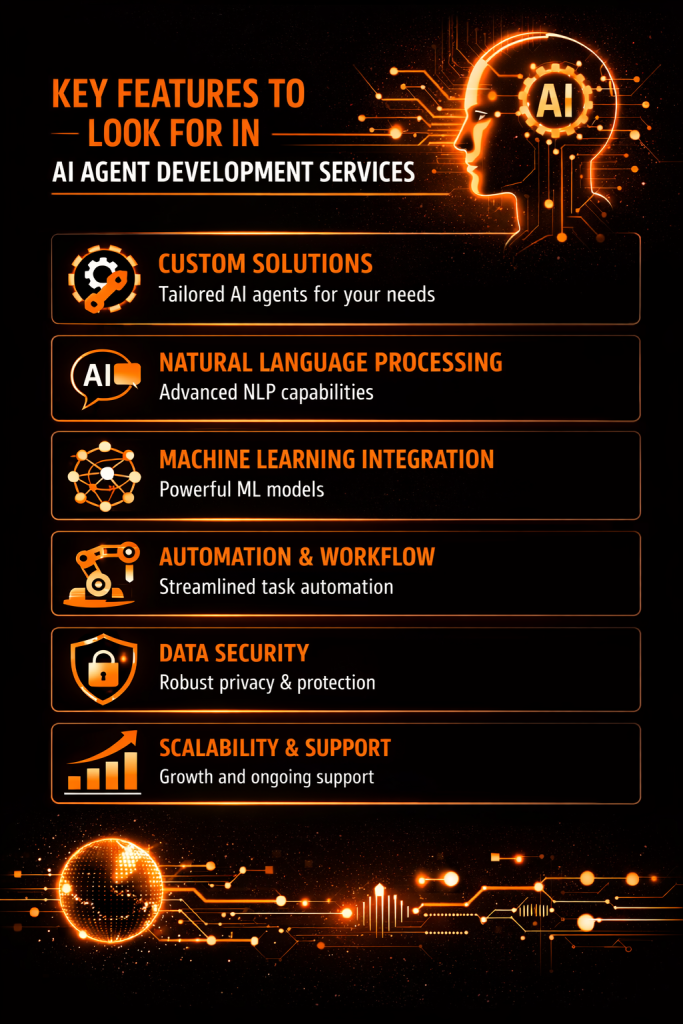
- Scalability for Real-World Development
Agents should be able to handle increasing user data and workloads without frequent changes or performance degradation.
- Strong Security by Design
The integrated security meets enterprise requirements, secures sensitive data and provides appropriate access control.
- Useful Customization Options
Agents adapt to your workflows, business rules and decisions instead of imposing uniform behavior.
- Easy System Integration
Seamless interfaces connect agents with databases, internal platforms and APIs, without interruption to business operations.
- Fast and Reliable Response Times
Low latency enables real time decision making, builds trust and maintains responsiveness of agents.
- Ongoing Monitoring and Stability
Clear monitoring helps teams catch issues early, maintain reliability, and slowly improve agent performance.
AI Agent Deployment: AWS vs Azure vs GCP
Choosing where to run your AI agents is a practical decision with implications for long-term reliability, cost and performance. When teams compare AI agent deployment on AWS vs Azure vs GCP, the conversation usually boils down to infrastructure flexibility and how ready each platform is for enterprise scale workloads. Here’s a simple, practical analogy.
| Platform |
Infrastructure Comparison |
Enterprise Readiness |
| AWS |
Gives teams a lot of control with flexible compute options and scaling built for heavy AI agent workloads |
Trusted by large enterprises with strong security, compliance coverage, and global infrastructure |
| Azure |
Works naturally with Microsoft tools, identity management, and existing enterprise systems |
A comfortable choice for enterprises already running on Microsoft with built in governance support |
| GCP |
Designed for data intensive and machine learning focused workloads with efficient infrastructure |
A solid option for teams prioritizing data platforms and AI performance at growing enterprise scale |
There is no single cloud that is perfect for everyone. The top choice is usually the one that best fits your security needs, current tech stack, and long-term growth strategy for your AI agents.
Security and Compliance in AI Agent Development
As AI agents are used to do real work inside corporate systems, security and compliance will naturally become a top priority. These agents are doing more than just answering questions. They can access data, initiate activities and help make critical decisions.
One issue teams often raise is how to prevent prompt injection in AI agents. Typically, this comes down to setting limits. Roles must be well defined, inputs must be verified, and sensitive activities must always be subject to further verification. Early guardrails kept agents on task.
Data privacy is equally important. AI agents interact often with company records, internal documents, and customer data. Risk can be mitigated while agent effectiveness is maintained by constraining access, hiding key information and deliberate use of data. These actions also enable teams to meet compliance and privacy requirements without constraining them.
Governance is the glue for everything. Practices similar to those outlined in IBM’s AI governance framework help enterprises maintain visibility, control, and trust in autonomous agents. They need logs that explain what happened and why, explicit approval processes for important decisions and insight into agent behavior. Good governance is not about micromanaging every step. It just makes sure that AI agents work in a way the company can understand, trust and grow with confidence.
Measuring ROI from AI Agent Development Services
Most teams’ next question after AI agents go live is simple: are they really adding value? For US-based businesses, the measurement of agentic AI ROI measurement for US enterprises is more about actual business impact than abstract measurements. The goals are to see what has improved, what is cheaper, and where teams are doing things faster than before.
The cost savings is usually the first thing companies notice. AI agents can eliminate the need for humans to perform repetitive tasks, which in turn reduces operating costs over time. That could mean fewer support tickets that humans have to handle, shorter processing times in financial workflows, or less work on data cleansing and follow-ups. When agents work at scale, these savings compound quickly.
Another strong indicator of ROI is an increase in efficiency. AI agents enable teams to move faster by bringing together tools, data and options into one flow. And the work that used to take hours or days can now be done in minutes. This increased speed lets teams focus on higher-value tasks rather than getting stuck in operational bottlenecks.
This influence is visible with the help of automation measures. Teams may track metrics like job completion rates, error reduction, escalation frequency, and response times to measure how well agents are performing. These measures are about whether the AI agents are really producing results, or just shuffling tasks around over time.
ROI from AI agent development services can be easily justified when measured with care. The real benefit is lower costs, more efficient operations, faster decisions and more productive teams.
Future of Agentic AI Systems in Business
AI is being adopted at a rapid clip by businesses, with agentic systems leading the charge. It’s more important to rethink how work actually gets done across the company than simply adding another tool to the stack for the future of agentic AI systems in business.
As businesses become more comfortable with AI agents managing entire processes rather than specific phases, autonomous workflows will proliferate. Instead of doing things one at a time, teams will depend on agents to organize activities, move work from system to system, and manage simple decisions themselves. Humans still make decisions, but most of the daily work is automatic.
AI-native companies are also starting to emerge. These companies are AI agents at the core from day one. They develop workflows assuming that agents will take care of tasks, provide insights and keep things running instead of embedding automation into existing processes. This has allowed lean teams to now operate at a scale that used to require much larger enterprises.
The real value of agentic AI will come from its thoughtful application as it matures. Those businesses that invest in building strong foundations and clarity in monitoring early will be in a better position when the day comes that AI agents are simply part of everyday work.
How to Choose the Right AI Agent Development Company
Working with the right enterprise AI assistant development company can make the difference between experimentation and real business impact. It’s not about who is the most tech savvy, it’s about who can use it to solve real business problems. This list provides an excellent starting point for making decisions when weighing your options.
- Hands On Deployment Experience
Look for groups that have used AI agents in real-world settings, not just demonstrations or prototypes.
- Built For Scale And Security
Its growth and security are built in from the ground up, rather than after the fact of manufacturing issues.
- Customization That Fits Your Business
Your AI agents should learn what makes your operations different, rather than using generic templates.
- Smooth Integration With Existing Tools
The perfect business knows how to connect agents to your existing systems without interrupting business operations.
- Clear Control And Visibility
You should always know what your agents are doing and be able to step in when needed.
- Support Beyond Initial Launch
The first delivery is as important as the continued monitoring, enhancements and assistance.
If you are looking for AI agents with a big impact, choose a development company that is a partner, not just a vendor. The right team will help you build systems that grow with your business. Set realistic goals and ask the right questions.
Final Thoughts
AI agent building services have come a long way from the experimenting days. In 2026, they offer businesses an effective way to rethink how work is done, how decisions are made, and how systems share information with one another. These assistants are different not only in their intelligence, but also in their goal. Such systems are not only reactive but are designed to seek targets and respond to changing conditions and to act across tools and workflows.
The real value for businesses is in mastering the fundamentals. Features such as memory, orchestration, security, governance, and human oversight are important. They are what make an AI agent robust and scalable. Well-designed agents can help teams be more productive, reduce operational friction and scale without always having to hire more people.
These agents are already showing value in a variety of industries, including healthcare, banking, real estate, and customer service, carrying out complex decision making and end-to-end processes. That is why the future will be full of more multi-agent systems, autonomous workflows and AI-native business models that will redefine how businesses operate.
The ones following trends won’t be the ones who win with agentic AI. They will invest in strong foundations, choose the right partners and aim for practical results rather than innovation. AI agents are not intended to replace humans. They want to give teams better tools so teams can concentrate on what matters most.
Frequently Asked Questions
1. What are AI agent development services?
With AI agent development services, businesses can build smart systems that can reason over tasks, decide and act on their own. These agents work across tools, data and workflows, and act towards goals rather than responding to specific inputs.
2. How do AI agents differ from chatbots?
Chatbots are created to respond to questions. AI agents are made to act. They are far more useful in actual company operations, because they can use tools, plan processes, remember context and adjust when circumstances change.
3. What industries benefit most from AI agent development?
Industries that are most affected include those that deal with complicated decisions and large workloads. Agents in healthcare, banking, real estate, customer service, and operations teams benefit from reduced manual effort and quicker decision-making.
4. What frameworks are used for AI agent development?
Teams use a mixture of proprietary API and business system based architecture, orchestration layers and agent frameworks. The best configuration will depend on how autonomous the agent needs to be and how well it needs to integrate with existing tools.
5. How much does AI agent development cost?
The price isn’t set. Costs are influenced by the complexity of the agent, integrations, security requirements, and scale. Many businesses start with a very focused use case and then expand as they see clear benefits and performance improvements.
6. How can businesses measure ROI from AI agents?
ROI usually is time savings, lower operating costs, fewer mistakes and faster execution. Businesses also take into account the long-term effects of reduced team workloads and higher quality production.
7. Are AI agents secure for enterprise use?
They can, if the security is built in from the beginning. Enterprise agents are using governance regulations, monitoring, data protection and access controls to remain secure and compliant in real production environments.
8. What is multi-agent system architecture?
Multi-agent systems comprise multiple agents that each have a different role. That makes it easier to scale, it makes it more reliable and it allows complex processes to run smoothly without overloading a single agent.