Public vs Private vs Hybrid Blockchain: Which Architecture Fits Your Business?
Key Takeaways:
- Core Value: Blockchain architecture defines the structure of trust, control and transparency within a corporate network.
- Inclusive Services: For blockchain adoption to be successful, it is important to consider the use cases, governance, compliance and integration of systems.
- Business Benefits: The right architecture mitigates implementation risk and enhances scalability, efficiency and compliance.
- Industry Use Cases: Public, private and hybrid blockchains are tailored to address the different needs within businesses and cooperative ecosystems.
- Future Trends: Hybrid blockchain systems are becoming the model of choice for scalable, compliant enterprise adoption.
Introduction
Blockchain has gone from a niche invention to a strategic technology that companies actively think about when it comes to practical use. Today, the hype surrounding blockchain simply doesn’t impress businesses. According to Forbes, 86% of senior executives believe blockchain is broadly scalable and likely to reach mainstream adoption, signaling strong enterprise interest in the technology. They want solutions that increase long term growth, reduce friction and increase efficiency. Here’s where the real difficulty begins.
Most organizations struggle to clearly understand the public vs private blockchain difference, especially when hybrid blockchain is introduced as a third option. Every architecture claims to deliver security, transparency and scalability, but not every model is right for every kind of business.
The wrong blockchain architecture may result in limited acceptance, complexity of operation and wasted investment. Selecting the right one can enable large-scale collaboration, automation and trust. The purpose of this blog is to help decision makers to understand differences between public, private and hybrid blockchains and to choose the architecture that best meets their business objectives.
What Are Blockchain Architectures?
Architecture is the specification of the structure, functionality and governance of a blockchain network. It defines who can participate, how transactions are validated, how information is accessed, and how decisions are made in the network. Architecture is not a technological afterthought for the businesses. It’s a fundamental design decision and exploring various blockchain architectures is a crucial part of blockchain development.
When organizations look at blockchain, they are essentially deciding how trust should be allocated. Should trust be distributed between private and public systems, centrally administered within the company, or completely decentralized across a global network? This choice affects long term scalability, security, performance and compliance.
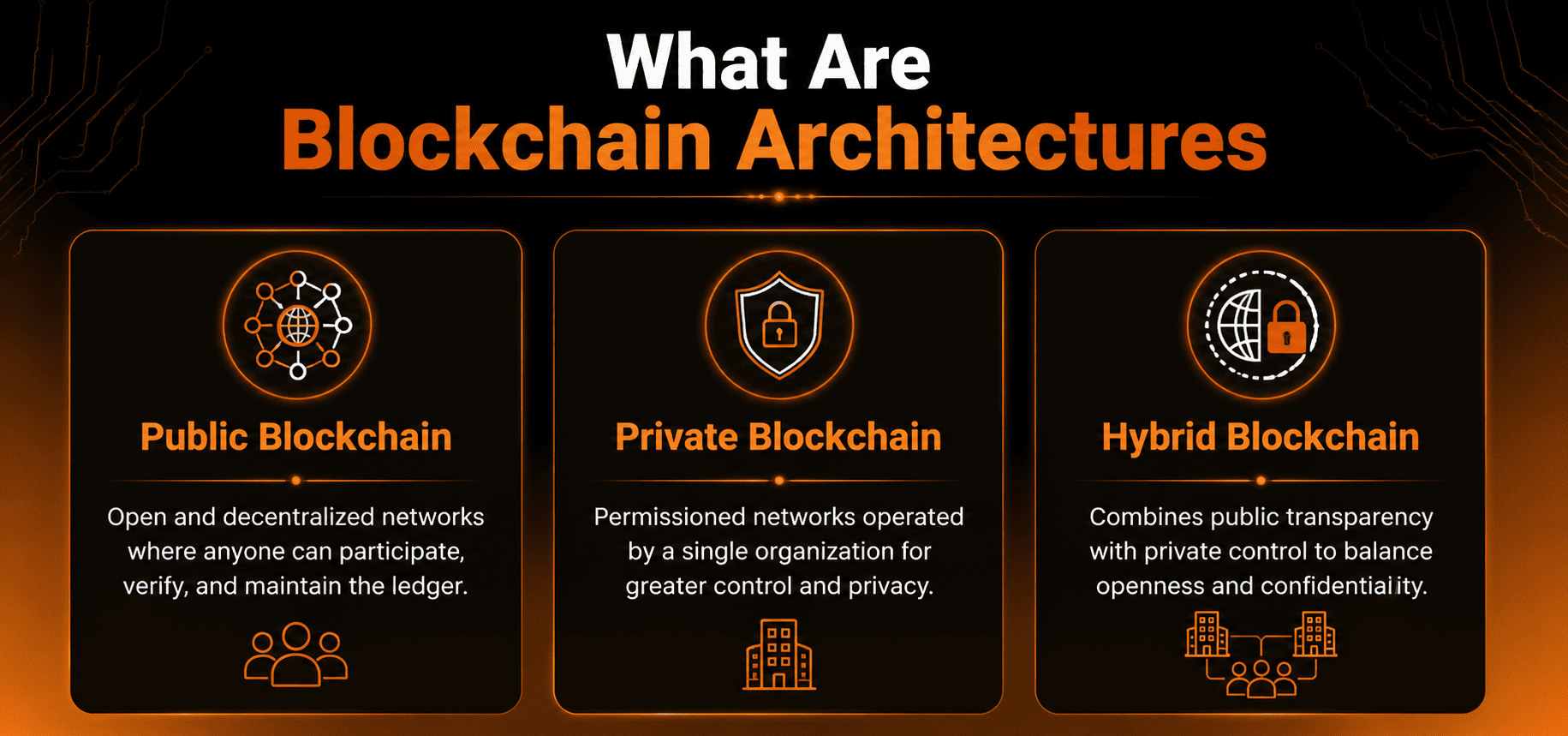
An enterprise blockchain architecture comparison helps businesses better understand how various models match operational requirements. Public blockchains prioritize decentralization and transparency. Research by McKinsey highlights that enterprises are increasingly exploring blockchain configurations including public, private, and hybrid models. They desire to unlock strategic value through efficiency and trust, not just decentralization.
Private blockchains are efficient and give more control. Hybrid blockchains combine privacy with transparency to create a balance between the two. Early understanding of the blockchain architecture ensures that technological choices support business strategy, and not that companies later adapt to technical limitations.
Public Blockchain Explained
A public blockchain is an open network where anyone can register, participate and verify transactions without any permission. To maintain trust and data integrity, these networks use cryptographic algorithms and consensus mechanisms instead of a central authority. Public blockchain systems, like Ethereum, are great for decentralized applications, but are facing competition from new blockchain solutions.
Public blockchains rely on transparency and immutability, creating strong trust guarantees. Once data is recorded it is very difficult to change. This makes public blockchains suitable for use cases requiring global participation, censorship resistance, and open verification. These characteristics form the foundation for decentralized finance infrastructure, including decentralized exchanges that operate entirely on public blockchain networks.
These blockchains do have great advantages but also great disadvantages from a business perspective. Transparency can be a strength for trust-driven ecosystems, even if it can be in conflict with data protection regulations, consensus overhead may restrict transaction throughput, impacting performance at scale.
On the spectrum of decentralization of blockchain systems from decentralized to centralized , public blockchains are the most decentralized. They work best when neutrality and transparency matter more than control.
Private Blockchain Explained
A private blockchain’s restricted network is only open to authorized participants. One entity or consortium is responsible for access, governance and operational norms. Unlike public blockchains, permissions are clearly defined and identities are known.
Private blockchains are very much in line with traditional enterprise processes, and so businesses know about them. They enable businesses to use distributed ledgers and smart contracts without giving up control over operations or data.
These blockchains provide better performance, predictable transaction rates and easier regulatory compliance. This architecture is suitable for internal operations and regulated industries as access is controlled protecting important corporate data. According to IBM, many enterprises are moving beyond experimentation and deploying permissioned blockchain solutions in production for supply chain, finance, and internal automation.
The trade-off is a loss of decentralization. The operational organization also has a high concentration of trust, which can hinder interoperability and outside transparency. Private blockchains are, of course, the permissioned side of the permissioned vs. permissionless blockchain model that many businesses prefer. Polkadot’s parachains allow for highly customized and scalable private blockchain networks.
Hybrid Blockchain Explained
The hybrid blockchain technology combines the advantages of both private and public infrastructures. Private sensitive data and critical actions are kept private, while some data or cryptographic proofs are posted on a public blockchain for trust and verification.
This method enables companies to regulate access and safeguard privacy without giving up complete openness. Hybrid blockchain is especially useful when multiple businesses need to collaborate but cannot depend on a single centralized authority.
From the enterprise’s point of view, hybrid blockchain offers flexibility. Companies determine which information is kept private and which is available to the public for verification. This layered governance provides external trust and internal oversight. The increasing adoption of hybrid blockchain use cases enterprise is a move towards practical blockchain solutions that prioritize economic results over ideological purity.
Hybrid blockchain technology can be a great solution for real-world asset tokenization, allowing businesses to balance privacy with transparency
Public vs Private vs Hybrid Blockchain: Key Differences
The public vs private blockchain difference becomes clearer when architectures are compared across core enterprise factors such as access, governance, security, and scalability.
| Aspect |
Public Blockchain |
Private Blockchain |
Hybrid Blockchain |
| Access |
Open participation |
Restricted access |
Controlled with public verification |
| Governance |
Community driven |
Centrally managed |
Shared governance structure |
| Transparency |
Fully transparent |
Limited visibility |
Selective transparency |
| Security |
Cryptographic incentives |
Identity based controls |
Combined security model |
| Scalability |
Limited throughput |
High performance |
Optimized scalability |
| Compliance |
Challenging |
Easier to enforce |
Flexible compliance |
| Enterprise Fit |
Open ecosystems |
Internal systems |
Cross organization workflows |
This comparison also supports a meaningful blockchain scalability and performance comparison, which is often one of the most important decision factors for enterprises. When exploring blockchain types, understanding cross-chain interoperability becomes crucial for seamless communication between public and private networks.
Advantages and Disadvantages of Each Blockchain Type
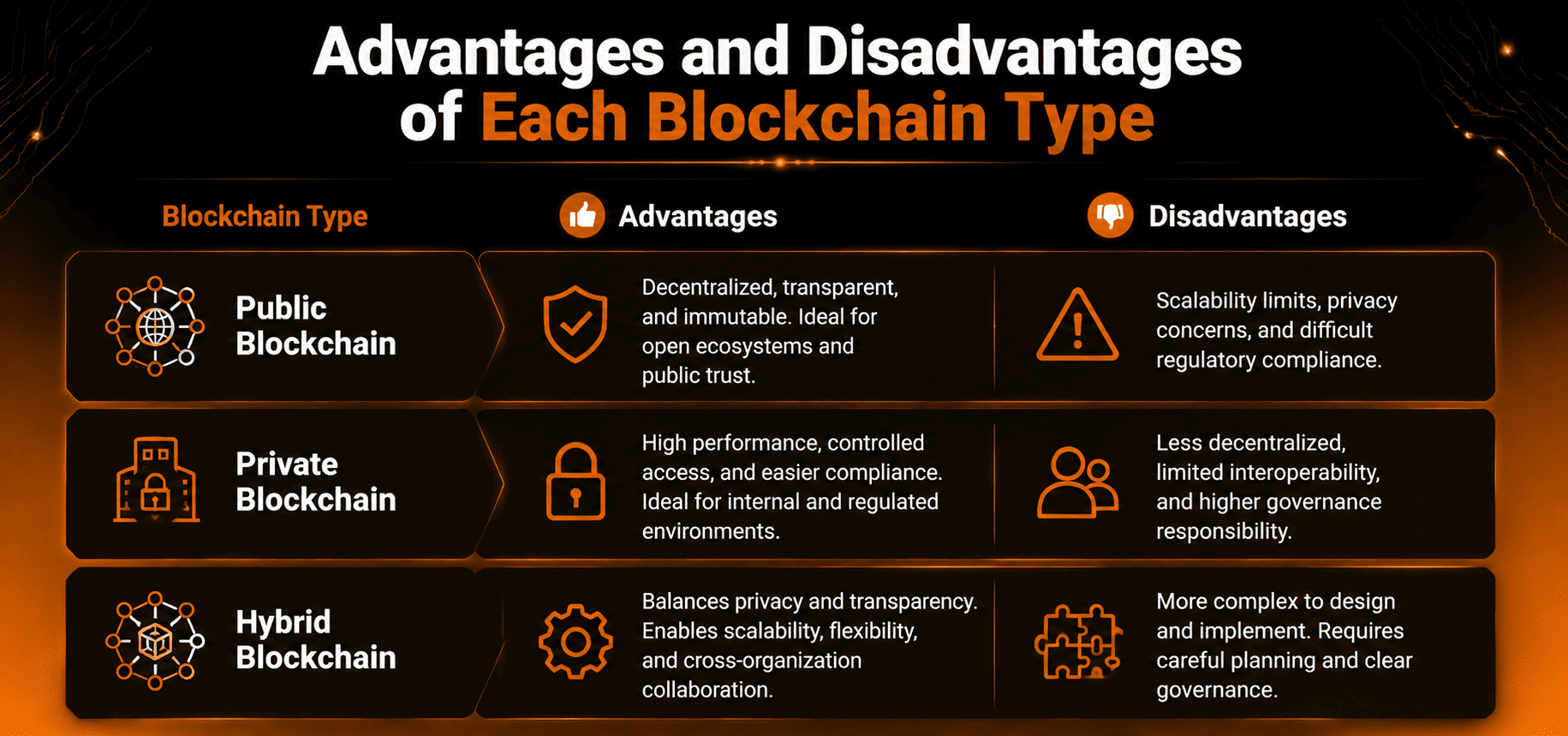
The table below provides a clear side by side view of the advantages and disadvantages of public, private, and hybrid blockchain architectures, making enterprise evaluation faster and easier.
| Blockchain Type |
Advantages |
Disadvantages |
| Public Blockchain |
Strong decentralization ensures trust is distributed across the network. High transparency and immutability support open ecosystems and public verification use cases. |
Scalability limitations can affect enterprise performance. Data transparency raises privacy concerns, and regulatory compliance is difficult due to lack of centralized control. |
| Private Blockchain |
Predictable performance, low latency, and controlled access make private blockchains suitable for regulated and internal enterprise systems. Data confidentiality and compliance are easier to manage. |
Reduced decentralization concentrates trust within the operating organization. Interoperability is limited, and governance responsibility increases operational complexity. |
| Hybrid Blockchain |
Balances privacy and transparency by combining private control with public verification. Supports enterprise scalability, flexible governance, and cross organization collaboration. |
More complex to design and implement. Requires careful integration planning and clearly defined governance models to avoid operational challenges. |
Use Cases of Public, Private, and Hybrid Blockchains
A. Public Blockchain Use Cases
- Open Financial Ecosystems
Public blockchains allow global access, verifiable transactions, programmability of financial products over open networks, and transparent financial systems where consumers interact without intermediaries.
- Public Verification Platforms
Without depending on a central authority, certificates, academic qualifications and audit proofs can be released for public verification while preserving confidence.
- Digital Asset Marketplaces
Public blockchains support tokenized assets that can be traded across borders with transparency, liquidity, and integrated ownership verification.
B. Private Blockchain Use Cases
- Enterprise Process Automation
Private blockchains employ smart contracts to automate internal processes, minimize human labor, but still maintain departmental secrecy and limited access.
- Internal Ledger Systems
Shared ledgers allow for reconciliation between business units, subsidiaries and internal stakeholders, while keeping data completely private.
- Permissioned Supply Chains
Trusted parties can share logistics and inventory information securely on private blockchains with defined permissions and governance policies.
C. Hybrid Blockchain Use Cases
- Cross Organization Collaboration
Hybrid blockchains empower multiple businesses to cooperate with each other securely, while still having autonomous control and verifiable trust over shared processes.
- Regulatory Reporting Solutions
Sensitive enterprise data remains confidential, while audit trails and compliance proofs are publicly verifiable for regulators and stakeholders.
- Digital Identity Systems
Hybrid identity models use public networks to allow decentralized verification of identity and trust, while protecting personal information.
These examples exhibit real world hybrid blockchain use cases enterprise adoption across industries. As blockchain technology continues to evolve, different industries are exploring unique use cases for public, private, and hybrid systems.
How to Choose the Right Blockchain Architecture?
Choosing the optimum blockchain architecture requires a systematic and business-oriented approach. Enterprises should begin by clearly defining their use case, data sensitivity, and regulatory obligations.
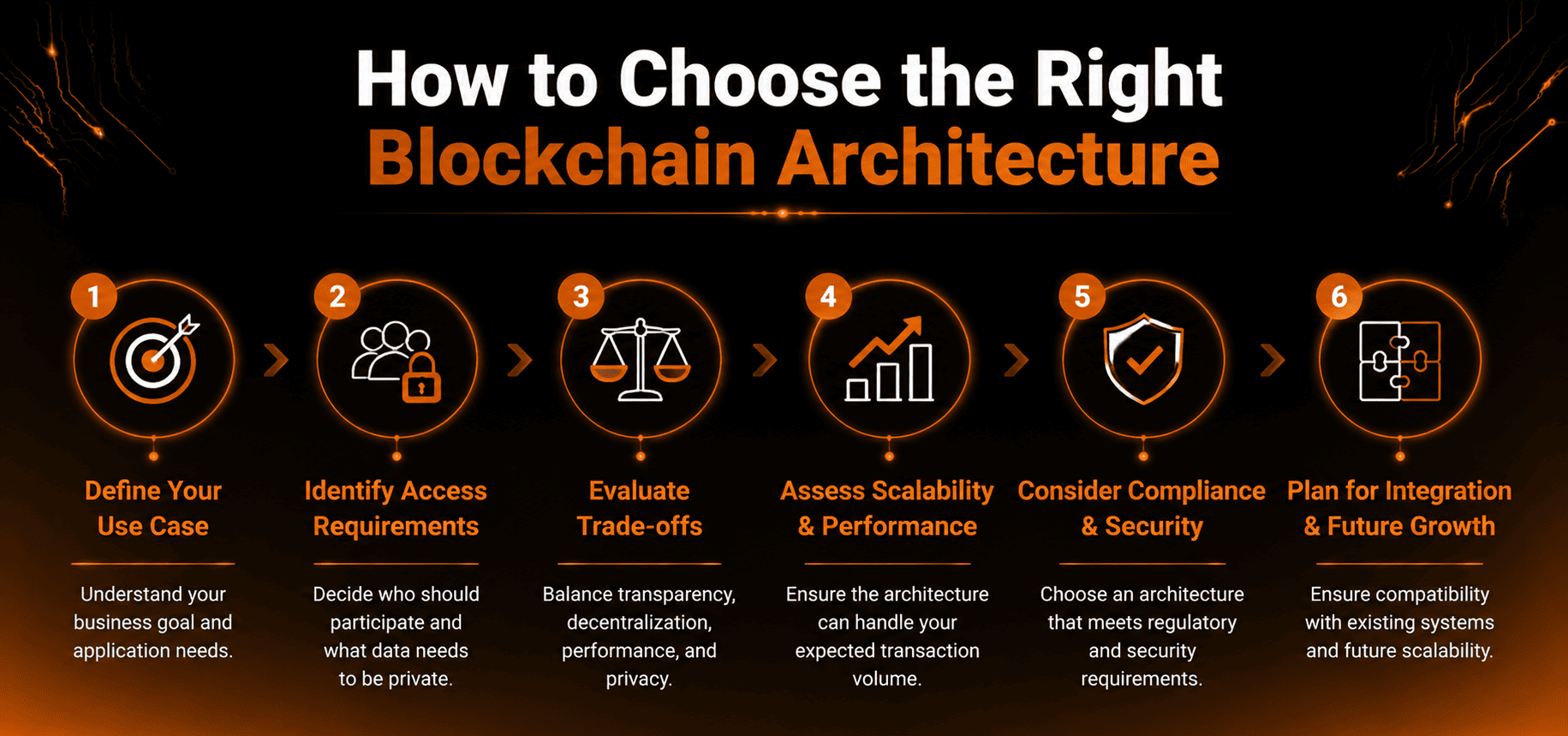
Scalability and performance expectations must be evaluated early to avoid future bottlenecks. The network governance requirements, such as who is responsible and how decisions are made, should be specified up front. Integrating with existing systems is equally important. For organizations evaluating real-world implementation options, exploring enterprise-focused blockchain development approaches can help translate architectural decisions into scalable, production-ready systems.
The structured evaluation is a valuable platform for blockchain architecture decision framework that minimize risk and align technology with business strategy. A clear blockchain deployment strategy for business ensures that blockchain technology is used purposefully and not randomly.
Challenges in Selecting Blockchain Architecture
One of the hardest parts of choosing blockchain architecture is choosing technology before understanding business needs. Many companies underestimate the difficulties of governance, or overestimate the advantages of complete autonomy.
Integration is another difficulty. Blockchain has to be integrated seamlessly into the existing enterprise systems, and is rarely used in isolation. In practice, this often requires strong backend systems, databases, APIs, and DevOps pipelines to support blockchain networks and enterprise workflows. Additionally, regulatory ambiguity, particularly in highly regulated sectors such as government, healthcare, and financial services, can further complicate adoption decisions.
These challenges highlight the need for preparation, stakeholder alignment, and architectural clarity before any blockchain approach is committed.
Future of Blockchain Architectures in 2026
By 2026, blockchain architectures are expected to be more enterprise friendly, interoperable, and modular. Companies will likely look for a balance of scalability, privacy and trust, and hybrid solutions will likely be the most popular.
The current adoption constraints will be addressed by advances in governance frameworks, privacy-preserving technology and scalability solutions. Businesses that adopt a structured approach to corporate blockchain implementation now, will be in a better position to adapt as the technology matures. “As blockchain technologies evolve, industries like healthcare are expected to increasingly leverage hybrid architectures for secure, scalable solutions. Learn more about how blockchain is shaping the healthcare sector.
Final Perspective
Blockchain architecture is not applicable everywhere. The best decision depends on the regulatory landscape, operational reality and corporate goals. By understanding the differences between public and private blockchains, businesses can move past the hype and make wise, strategic decisions.
Public, private and hybrid blockchains have a place. The secret is to choose the architecture that is best for your company, not the current fad.
Frequently Asked Questions
1. What is the difference between public and private blockchain?
The main differences between public and private blockchains are access and control. Public blockchains are decentralized and permissionless. Private blockchains are permissioned and controlled by a single company or consortium.
2. What is a hybrid blockchain?
Hybrid Blockchain is a combination of public and private blockchain functionalities. In public blockchain, some information or proofs are exchanged to ensure openness and trust while not revealing private information, sensitive material is kept private.
3. Which blockchain is best for business?
There is no silver-bullet. Public blockchains are best for open ecosystems, private blockchains are best for internal enterprise systems, and hybrid blockchains are best for companies that want to have it all: control and transparency.
4. What are the benefits of private blockchain?
Private blockchains are better performing, have restricted access, provide more data privacy and are easier to comply with regulations. They are perfect for organizations that deal with sensitive corporate data and internal processes.
5. What industries use hybrid blockchain?
Hybrid blockchain is employed in sectors like finance, healthcare, supply chain, government and real estate to strike a balance between data protection and openness, especially when several companies need to collaborate securely.
6. Is public blockchain secure?
Public blockchains are safe because of cryptography, decentralization, and consensus procedures. However, understanding data visibility is critical for enterprise use cases and designing smart contracts correctly are important to security.
7. What is permissioned vs permissionless blockchain?
Permissioned blockchains permit only approved users to join and validate transactions, whereas permissionless blockchains allow anyone to join. Permissioned or hybrid models are preferred by most enterprise systems for better control and compliance.
8. How does blockchain governance differ across architectures?
Private blockchains are centrally managed, public blockchains are governed by communities, and hybrid blockchains adopt layered governance models that combine shared trust and organizational authority.