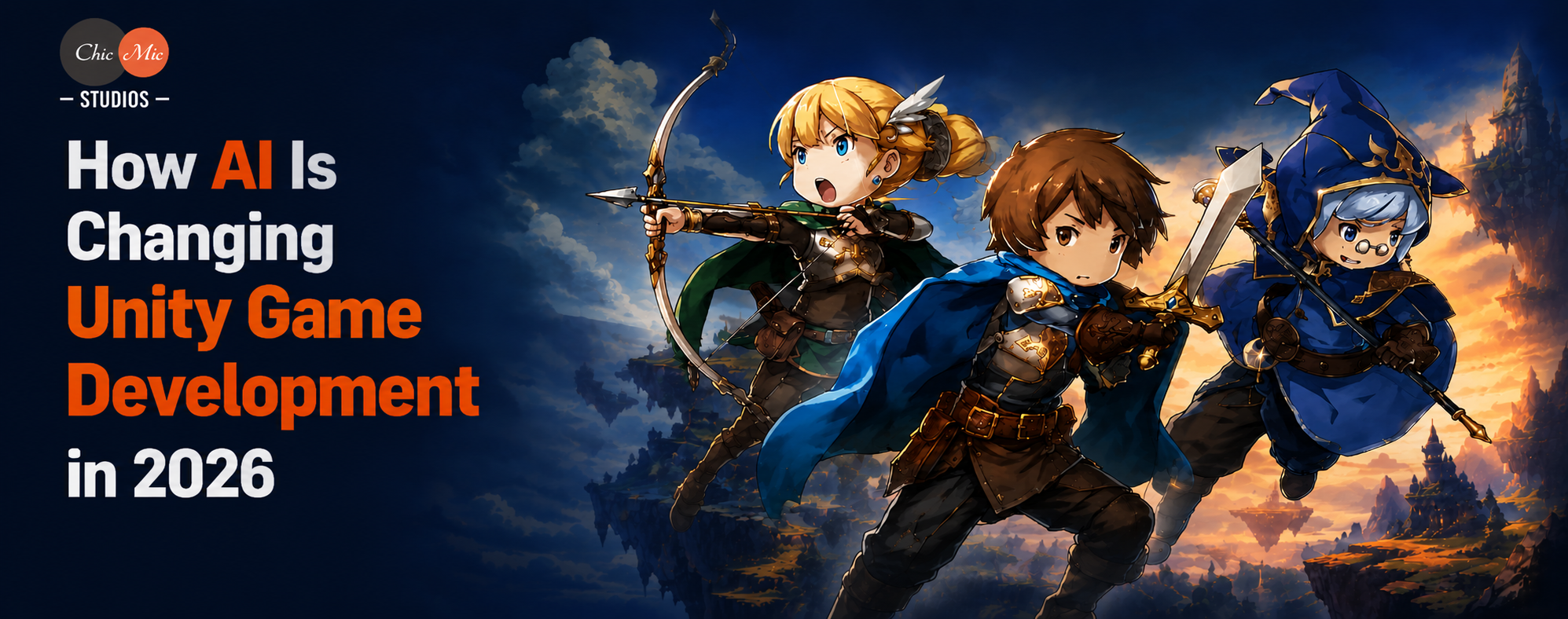
How AI Is Changing Unity Game Development in 2026?
Key Takeaway
- Core Value: AI helps Unity developers build games faster, reduce repetitive work, and deliver smarter, more engaging player experiences.
- Key Technologies: Machine learning, generative AI, predictive analytics, computer vision, and NLP power intelligent, adaptive, and efficient Unity game development.
- Business Impact: AI lowers development costs, accelerates production, improves testing, boosts player retention, and supports long-term game scalability.
- Game Applications: AI enhances NPC behavior, procedural level generation, automated testing, personalized gameplay, and real-time game balancing.
- Future Outlook: The future of Unity game development lies in combining AI-powered automation with human creativity to build innovative gaming experiences.
Introduction
AI is driving the fastest ever shift in game development. Developers are discovering new ways to make better games faster, like writing cleaner code, producing game assets, creating smarter NPCs and personalized player experiences. AI in Unity game development is no longer just an experimental trend. For companies trying to cut production costs, speed up development and deliver compelling gameplay without sacrificing quality, it has become a useful advantage. Whether they’re working on a mobile game, multiplayer game, or an immersive augmented reality experience, AI is allowing Unity developers to spend more time on creativity, less time on boring work. Businesses looking to build intelligent games often rely on Unity game development services to combine AI with scalable production workflows.
What Is AI in Unity Game Development?
In Unity game development, artificial intelligence is applied to improve the creation, testing, and gameplay of games. AI allows games to learn, adapt and respond to the player’s behavior in real time, instead of relying solely on prewritten scripts, which leads to more dynamic and engaging experiences.
Unity’s modern AI tools can automate coding tasks, power smart NPCs, generate assets, analyze player data, and make testing games easier. These capabilities are increasingly delivered through specialized AI development services that simplify AI integration for game studios. Thanks to built-in tools, third-party connectors and frameworks such as Unity ML-Agents, developers don’t need to be highly skilled in machine learning to include AI capabilities into their Unity projects.
Why Is AI Becoming Essential for Unity Developers in 2026?
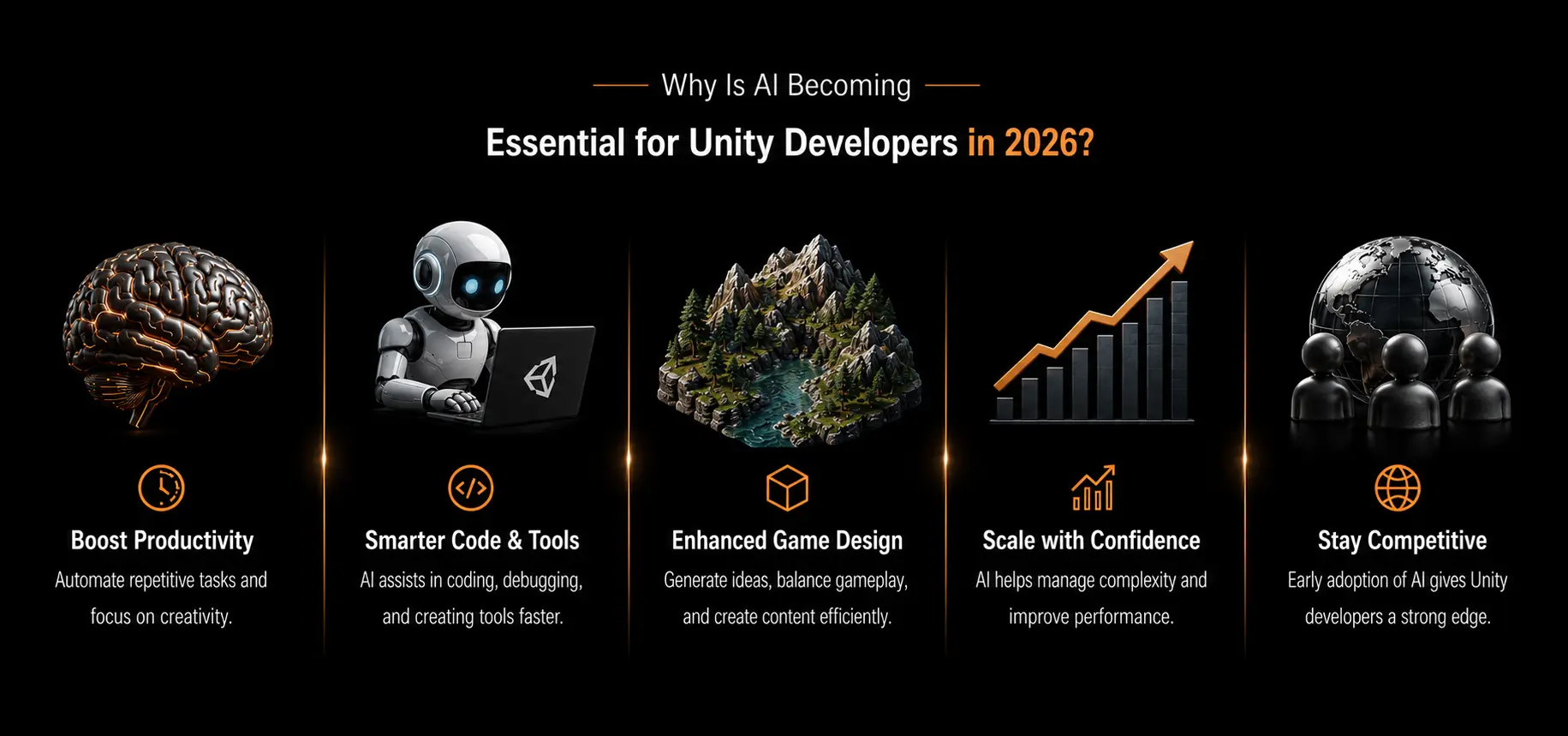
Games are getting more complex, and developers need faster ways to build, test and improve them. AI is a key aspect of today’s Unity development process as it can be used to automate tedious tasks, reduce costs of production and create smarter, more personalized gaming experiences.
1. Faster Development Cycles
AI automates coding, testing, debugging and asset generation, so developers can prototype faster and get more time to improve gameplay quality.
2. Lower Development Costs
AI helps to reduce production costs by automating repetitive tasks, which allows smaller teams to develop high-quality Unity games faster.
3. Smarter Player Experiences
Smart NPCs, flexible gameplay, AI creates lively game worlds that respond naturally to player decisions and actions.
4. Better Content Personalization
AI can analyze player behavior to customize challenges, rewards and recommendations that can improve player engagement, enjoyment and long-term retention.
Key AI Technologies Used in Unity
There are several AI technologies that are pushing progress in the area of AI Unity game development. They allow programmers to create games that are smarter, faster, and more captivating. These technologies together accelerate development, improve gaming, and offer players more personalized experiences.
1. Machine Learning
Allows game characters to learn, adapt and improve their behavior using data, including reinforcement learning and Unity ML-Agents.
2. Generative AI
Let developers create textures, animations, conversations, environments and code faster without limiting artistic freedom. Modern generative AI solutions are helping development teams reduce production time while maintaining creative quality.
3. Predictive Analytics
Evaluates user behavior to improve player retention, optimize revenue and make better gaming decisions throughout the game’s lifetime.
4. Computer Vision
Delivers gesture tracking, object recognition and augmented reality interactions to create dynamic game experiences across all platforms. These capabilities are widely adopted in AR app development to create highly immersive interactive experiences.
5. Natural Language Processing
Allows for voice interactions, conversational NPCs, and intricate dialogue systems that enhance the realism and appeal of player interactions.
7 Ways AI Is Transforming Unity Game Development
AI is transforming every phase of the Unity game production lifecycle from code and test, to gameplay and analytics. These developments help creators make smarter, faster, and more engaging games.
1. AI-Powered NPC Behavior
Unity’s AI NPCs respond to player actions, make intelligent decisions, and generate realistic interactions that improve gameplay and immersion.
2. Procedural Level Generation
Procedural content creation creates balanced missions, environments and levels automatically, increasing replayability and requiring less manual design work.
3. Automated Game Testing
AI game testing helps developers deliver more stable games more quickly by finding flaws, simulating gameplay and speeding up quality assurance.
4. AI-Assisted Coding
Coding is automated, improvements are recommended, and Unity game development workflows are made more efficient by using GitHub Copilot, Cursor, and Unity AI tools.
5. AI Asset & Animation Generation
AI speeds up production while helping artists with textures, animations, environments, voiceovers, concept art, and more. AI has become equally valuable in 3D game development, where it accelerates asset creation and animation workflows.
6. Personalized Gameplay
AI monitors player behavior to adjust difficulty, suggest content and personalize experiences to enhance engagement and long-term retention.
7. Live Game Analytics & Balancing
AI uses real-time analytics and insights to track user data, balance gameplay, improve retention, and help creators optimize revenue.
Best AI Tools for Unity Developers in 2026
The best AI tools will depend on the goals of your project. Some tools focus on intelligent NPCs, some on asset development or voice generation, and some are designed to increase coding efficiency. Together they create a development workflow that is faster and more efficient.
| Tool |
Best For |
Integration with Unity |
| Unity ML-Agents |
Intelligent NPCs and reinforcement learning |
Excellent |
| GitHub Copilot |
AI-assisted coding |
Excellent |
| ChatGPT |
Script writing, debugging, documentation, and gameplay logic |
High |
| Inworld AI |
Dynamic NPC conversations |
Excellent |
| Leonardo AI |
Concept art, textures, and visual assets |
Medium |
| ElevenLabs |
AI voice generation and character dialogue |
High |
Each of these tools deals with a different stage of the development pipeline. Most successful studios are using a combination of AI technologies not just one to enhance productivity from the design stage through post-launch enhancements.
Benefits of Using AI in Unity Game Development
Embracing AI is about a whole lot more than saving time. It enables development teams to create smarter games while making better use of their resources.
Key benefits include:
- Automated workflows that accelerate game production.
- Reduce repetitive manual work to cut development costs.
- Adaptive AI systems that deliver more engaging gameplay.
- Smarter NPCs that respond to player actions in a more natural way.
- Better testing with automated gameplay verification and bug detection.
- Customized experiences result in improved player retention.
- Better scalability for large live service and multiplayer games.
- Faster prototyping enables developers to test new ideas quickly.
- Real-time player analytics for data-driven decisions.
- AI-driven balance for continuous game tuning.
For many studios, AI is now a normal part of contemporary AI game development workflows, rather than a competitive advantage.
Challenges of Implementing AI in Unity Projects
AI brings significant advantages, but successful implementation requires careful planning. Developers must address technical, ethical, and operational challenges to ensure reliable performance, security, and long-term scalability.
1. Training Data
AI models require accurate, quality data. Bad datasets can degrade overall gameplay, NPC intelligence, and personalization accuracy.
2. Performance Optimization
The AI features can increase CPU and memory utilization, so they need to be optimized carefully to ensure smooth gameplay on mobile and cross-platform devices.
3. Ethical Considerations
When building materials, dialogue and player experiences, developers should be thinking about copyright, bias, transparency and responsible AI use.
4. Cost of AI APIs
Cost planning is important for long term game development and scalability as AI services often have subscription or usage based pricing.
5. Security and Privacy
Securing player data through secure storage, privacy compliance, and ethical AI practices builds trust and lowers security risks.
Is AI Replacing Unity Developers?
Artificial intelligence is changing the gaming industry, but it will not replace the people who make great games. Instead it lets developers work faster and focus on their ideas.
Here’s why AI won’t replace Unity developers:
- AI automates repetitive processes such as testing, debugging and coding.
- We still need humans to innovate in storytelling and game design.
- AI cannot mimic the strategic choices of creators.
- AI accelerates prototyping and improves the development process.
- Balancing and game mechanics still require human skills.
- Artistic vision is a must-have for artistic direction and player experience.
- AI supports developers, rather than taking their place.
- The best games combine AI efficiency with human creativity.
As AI evolves, the best Unity developers will be those who use AI as a powerful development partner, not a replacement.
How to Successfully Integrate AI into Your Unity Game?
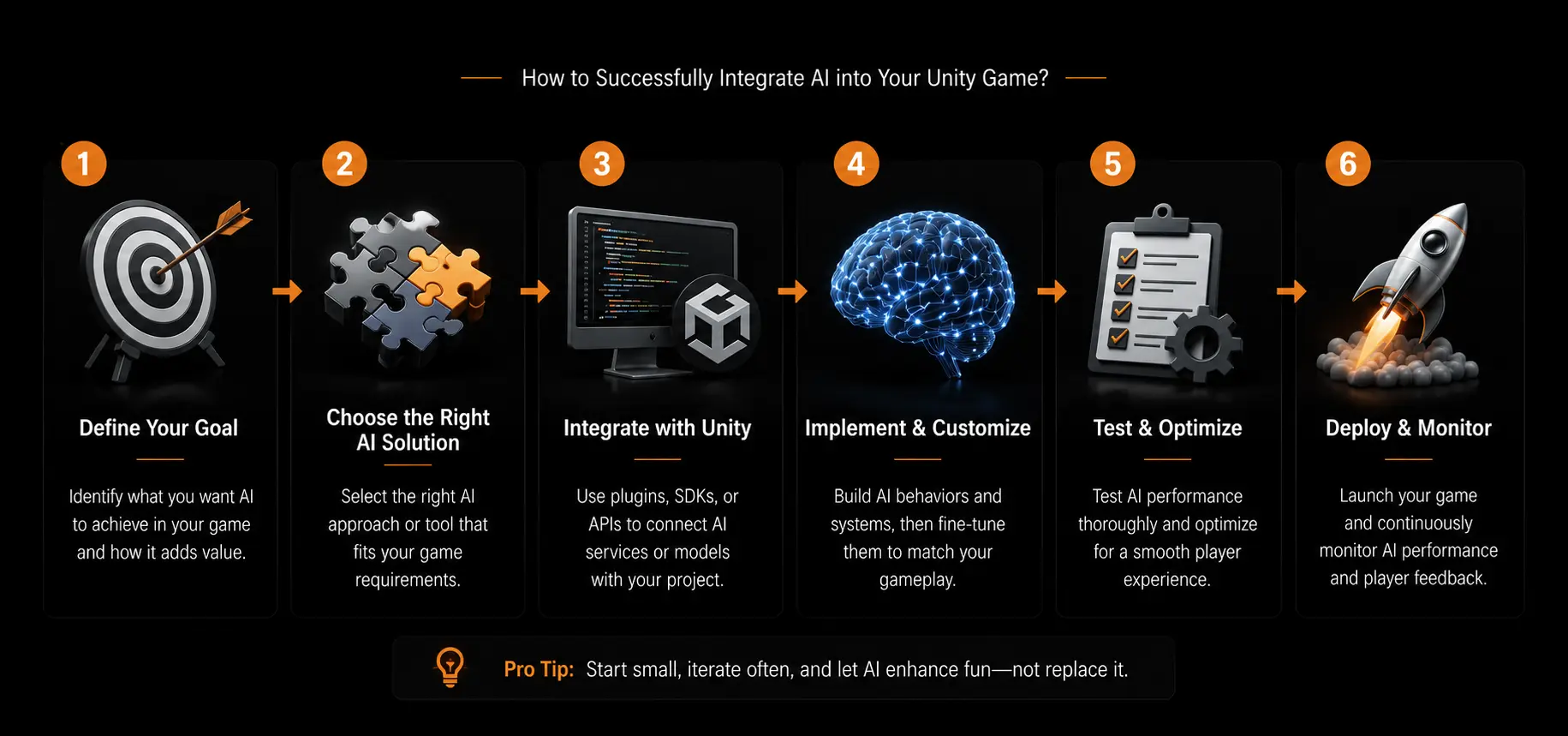
The best way to integrate AI is gradually. Pick the right tools, begin with real-world scenarios and then iterate the AI features based on player feedback and testing.
1. Identify Automation Opportunities
Look for repetitive processes that AI can make more productive and reduce development times such as coding, testing, asset production or analytics.
2. Choose the Right AI Tools
Select AI tools that fit your project objectives. Ensure they work well with Unity and enhance your workflow.
3. Train AI Models When Needed
Use strong training data to build reliable AI models that improve gameplay, NPC behavior, and player experience.
4. Test Continuously
Regularly test AI features to uncover issues, improve performance, and ensure balanced gameplay before pushing updates to players.
5. Monitor Player Feedback
Analyze user input and gameplay data to improve AI systems, boost engagement and optimize future game launches.
Conclusion
AI in Unity game development is helping studios build games faster, create smarter gameplay, and deliver more engaging player experiences. Instead of replacing developers, AI supports creativity by automating repetitive tasks and improving decision-making throughout the development process. Whether you’re building a mobile, multiplayer, or Web3 game, adopting AI can give your project a competitive edge. AI is also driving innovation across blockchain game development, enabling smarter gameplay and more engaging decentralized gaming experiences.
Frequently Asked Questions
1. What is AI in Unity game development?
AI in Unity game development uses artificial intelligence to automate coding, improve NPC behavior, generate assets, optimize testing, and create more dynamic, personalized gameplay experiences.
2. Which AI tools work best with Unity?
Popular Unity AI tools include Unity ML-Agents, GitHub Copilot, ChatGPT, Inworld AI, Leonardo AI, and ElevenLabs. The right choice depends on your game’s requirements.
3. Can AI create Unity game assets?
Yes, AI can generate textures, concept art, animations, character models, environments, and voiceovers, helping developers reduce production time while maintaining quality.
4. Does Unity support machine learning?
Yes, Unity ML-Agents enables developers to build and train intelligent agents using machine learning for adaptive NPCs and smarter gameplay systems.
5. Is AI expensive to integrate into Unity games?
Not always, many AI tools offer free or affordable plans, while advanced cloud-based services may increase costs depending on project size and usage.
6. Will AI replace Unity developers?
No, AI supports developers by automating repetitive tasks, while human creativity, storytelling, design, and strategic decision-making remain essential.
7. Can AI improve NPC behavior in Unity games?
Yes, AI enables NPCs to learn from player actions, make smarter decisions, and react dynamically, creating more realistic and immersive gameplay experiences.
8. What are the benefits of using Unity ML-Agents?
Unity ML-Agents helps developers train intelligent game agents using machine learning. It improves NPC behavior, gameplay simulations, and adaptive game mechanics.
9. How does AI speed up Unity game development?
AI automates repetitive tasks like coding, testing, asset generation, and analytics, allowing developers to build games faster and focus on creativity.
10. Is AI suitable for indie Unity game developers?
Absolutely, many AI tools offer affordable or free plans, helping indie developers reduce development time, lower costs, and create high-quality games with smaller teams.
Talk to Our Unity AI Experts to discover how intelligent Unity solutions can turn your game idea into reality.