Key Takeaways:
- NFT game development cost in 2026 depends mainly on game complexity, blockchain architecture, features, art, and security requirements.
- A basic NFT game MVP can typically cost around $30,000–$80,000, while advanced projects can exceed $500,000.
- Smart contracts, NFT functionality, wallets, marketplaces, and tokenomics can significantly increase development costs.
- The blockchain game development cost varies based on the network, transaction requirements, scalability, and technical architecture.
Introudction
NFT gaming has moved beyond the idea of simply attaching digital collectibles to a conventional game. NFT game development cost are affected with factors like real-time gameplay, blockchain-based asset ownership, smart contracts, wallets, token economies, NFT marketplaces, multiplayer infrastructure, and sometimes metaverse environments.
A realistic estimate is $30,000 to $80,000 for a basic NFT game MVP, $80,000 to $200,000 for a mid-complexity game, and $200,000 to $500,000+ for a feature-rich or AAA-style NFT gaming ecosystem. The final figure depends heavily on the game genre, platforms, blockchain architecture, art quality, smart-contract complexity, multiplayer requirements, and token economy.
In this blog get a practical understanding of the technology and components involved in NFT Game Development and the costs associated with it.
NFT Game Development Cost in 2026
The NFT game development cost varies significantly because an NFT game is not one technology stack. It is usually a combination of game development and Web3 infrastructure.
| Basic NFT Game MVP |
$30,000–$80,000 |
3–5 months |
| Advanced NFT Game |
$200,000–$350,000 |
9–15 months |
A small 2D blockchain game with limited NFTs can cost a fraction of a multiplayer 3D RPG with an NFT marketplace, token economy, and multiplayer cross-platform support.
What Is NFT Game Development?
NFT game development involves creating a game in which selected digital assets are represented as non-fungible tokens on a blockchain.
These assets can include:
- Characters
- Weapons
- Skins
- Land
- Collectibles
- Cards
- Vehicles
- Equipment
- Virtual items
Unlike conventional in-game assets that typically remain within a publisher-controlled database, blockchain-based assets can provide verifiable ownership and support blockchain-enabled transfers or trading.
However, not every part of a game needs to be stored on-chain. In most practical architectures, gameplay logic, graphics, matchmaking, and other performance-sensitive operations remain off-chain, while ownership, transactions, token balances, or selected game-state elements interact with blockchain infrastructure.
Plan Your NFT Game With a Clear Cost Estimate
How Much Does It Cost to Develop an NFT Game?
The simplest way to estimate NFT game development cost is by looking at project complexity.
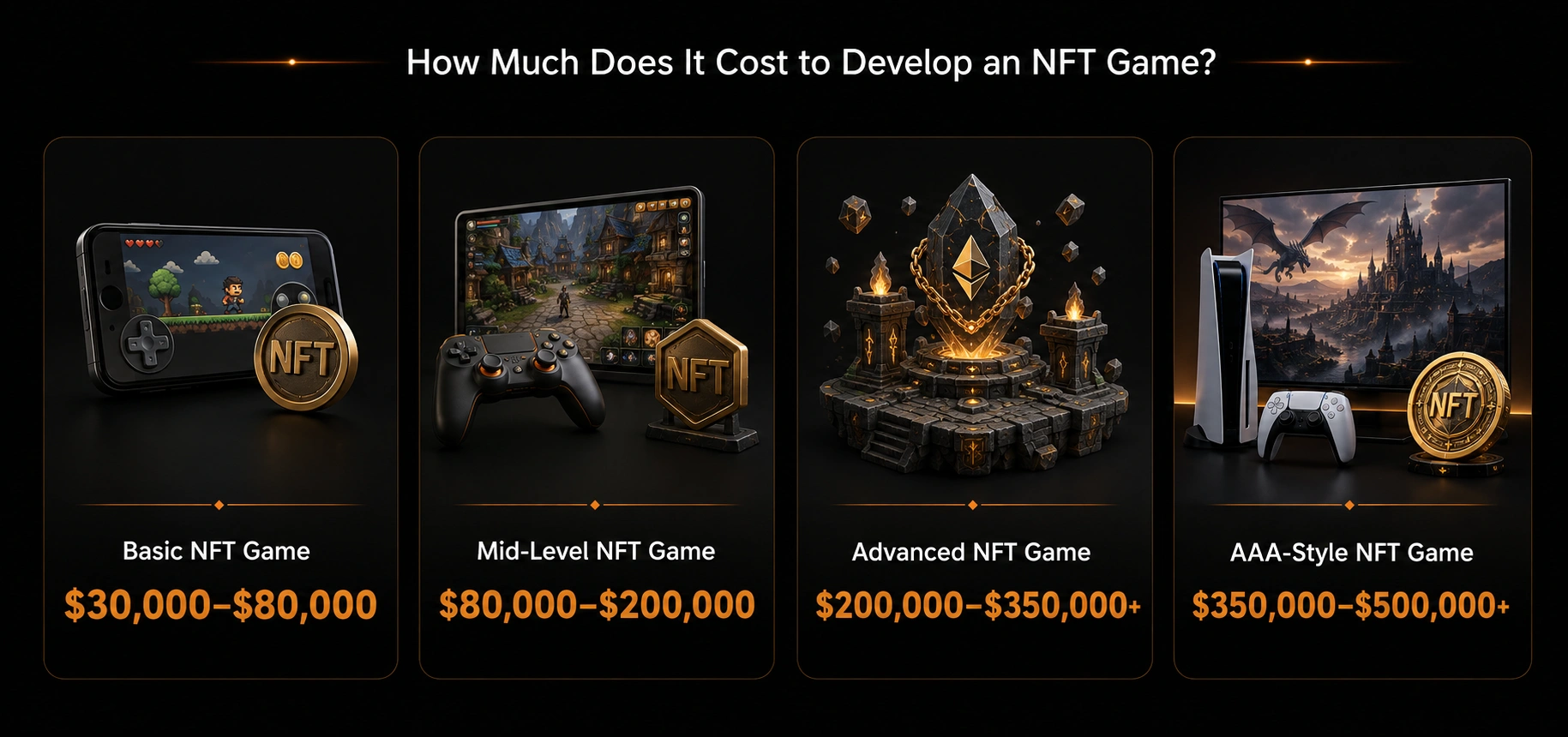
1. Basic NFT Game: $30,000–$80,000
A basic project may include simple 2D or lightweight 3D gameplay, wallet connectivity, a limited NFT collection, basic smart contracts, user authentication, and a small backend.
This approach is suitable for validating a game concept before investing in a larger ecosystem.
2. Mid-Level NFT Game: $80,000–$200,000
A mid-level game may introduce multiplayer functionality, more sophisticated game mechanics, 2D/3D artwork, NFT minting, token integration, marketplace functionality, player profiles, leaderboards, and more complex backend infrastructure.
This is where development becomes considerably more involved because game systems and blockchain systems need to work together reliably.
3. Advanced NFT Game: $200,000–$350,000+
Advanced projects may involve large multiplayer environments, sophisticated economies, extensive NFT collections, advanced 3D assets, multiple platforms, complex smart contracts, analytics, anti-cheat systems, and extensive QA.
4. AAA-Style NFT Game: $350,000–$500,000+
AAA-quality Web3 games development can exceed this range substantially. High-end character production, cinematic assets, large-scale multiplayer infrastructure, custom blockchain components, sophisticated economies, and continuous content production can push budgets significantly higher.
10 Factors That Affect NFT Game Development Cost
Several technical decisions determine the final blockchain game development cost.
1. Game Genre and Complexity
A card game and a real-time multiplayer RPG have very different development requirements.
RPGs, metaverse games, strategy games, racing games, and multiplayer shooters generally require more gameplay systems, networking, assets, and testing than simple casual games.
2. Game Engine
Unity, Unreal Engine, and other engines can support different production requirements. Unity can be practical for cross-platform development, while Unreal Engine is preferred for 3D projects that require advanced visual fidelity. The engine itself is only one part of the budget; developer expertise, asset requirements, and project complexity matter as well.
3. Blockchain Network
Blockchain selection affects transaction costs, development tooling, wallet support, scalability, and smart-contract architecture. Ethereum offers a mature ecosystem, while networks such as Polygon, Solana, BNB Chain, and other platforms may be considered depending on the game’s requirements.
Blockchain game development information notes support for multiple blockchain platforms, including Ethereum, BNB Chain, Solana, Polygon, and others.
4. Smart Contracts
Smart contracts manage blockchain-based rules such as NFT minting, transfers, marketplace transactions, staking, or token distribution.
The more complex these contracts become, the more development and testing they require. Security testing and independent audits can add further costs but are particularly important when contracts control valuable assets.
5. NFT Architecture
An NFT game may use NFTs for only a few collectibles or build an entire economy around tokenized assets.
The development effort can increase with:
- NFT minting
- Metadata management
- Dynamic NFTs
- NFT upgrades
- Rarity systems
- Marketplace integration
- Royalties
- Cross-chain functionality
6. Tokenomics
A P2E game needs more than a token contract. The development team must consider how rewards enter the economy, where tokens are spent, how supply is controlled, and how player incentives affect the overall game.
Poorly designed tokenomics can create economic problems even when the underlying game technology works correctly.
7. Multiplayer Infrastructure
Real-time multiplayer introduces additional requirements for matchmaking, synchronization, networking, servers, player state, anti-cheat systems, and scalability.
For a blockchain game, these systems must also coexist with wallet and blockchain interactions without making gameplay unnecessarily slow.
8. UI/UX and Game Art
Characters, environments, animations, effects, interfaces, sound, and other assets can become a major portion of development expenditure. A stylized 2D game will usually require a different art budget from a photorealistic 3D game.
9. Wallet and Marketplace Integration
Wallet connectivity allows players to interact with their blockchain assets. A marketplace may allow players to list, purchase, transfer, or trade NFTs. These systems require both frontend and backend work, along with blockchain integration.
10. Testing, Security and Maintenance
Testing should cover both conventional game functionality and Web3-specific risks. After launch, infrastructure, smart contracts, APIs, servers, analytics, and game content may also require ongoing maintenance.
This can include:
- Functional testing
- Performance testing
- Multiplayer testing
- Wallet testing
- Smart-contract testing
- Security testing
- Load testing
- Device compatibility testing
Ready to Start Your NFT Game Project?
NFT Game Development Cost Breakdown by Feature
A typical budget can be distributed across several technical layers:
| Game design and planning |
5–10% |
| Game development |
25–35% |
| Blockchain integration |
10–15% |
| Backend and APIs |
10–15% |
| Deployment and post-launch work |
5–10% |
Blockchain Game Development Cost by Blockchain
There is no universally affordable or best blockchain for every NFT game. The important factor is that blockchain game development cost is determined by the complete architecture, not simply by the blockchain fee structure.
1. Ethereum
Ethereum provides a mature ecosystem and extensive tooling, but transaction economics may need careful consideration depending on the application’s design.
2. Polygon
Polygon can be considered when a project requires an EVM-compatible environment with lower transaction costs for many use cases.
3. Solana
Solana is another option for applications that prioritize high throughput and a different blockchain development stack.
4. BNB Chain
BNB Chain can be considered for projects looking for EVM compatibility and access to a broad Web3 ecosystem.
P2E Game Development Cost: What Makes It Different?
P2E game development adds an economic layer to conventional game development. A play-to-earn system may include tokens, NFT rewards, staking, marketplaces, player-to-player transactions, reward pools, and other financial mechanics.
Consequently, the play-to-earn game development cost can be higher than that of an NFT game that only uses NFTs as collectibles.
The economic design also needs to be tested against scenarios such as excessive token issuance, farming, bot activity, asset inflation, and changes in player behavior.
Web3 Game Development Cost vs Traditional Game Development
The Web3 game development cost can be higher than conventional game development because Web3 introduces additional infrastructure.
| Centralized player accounts |
Wallet-based or hybrid identity |
| Conventional purchases |
Tokens/NFT transactions |
| Standard backend |
Backend + blockchain infrastructure |
The Development Approach for Building NFT Game
A professional NFT game project generally moves through several stages.
Step 1: Discovery and Game Design
The team defines gameplay, target platforms, user journeys, monetization, NFT utility, and technical requirements.
Step 2: Blockchain Architecture
The team decides what should be on-chain and what should remain off-chain. This is an important cost-control decision because putting unnecessary gameplay data on-chain can introduce latency and transaction overhead.
Step 3: UI/UX and Game Art
Designers create interfaces, characters, environments, animations, NFT visuals, and other assets.
Step 4: Game Development
Developers build the core game mechanics, backend systems, multiplayer functionality, and platform-specific implementations.
Step 5: Web3 Integration
Wallets, NFT contracts, token systems, marketplaces, and blockchain APIs are integrated into the game.
Step 6: Testing and Security
The complete system undergoes functional, performance, multiplayer, blockchain, quality assurance and security testing. Smart contracts may also undergo independent auditing.
Step 7: Deployment
The game is deployed to the required platforms, blockchain contracts are deployed, and infrastructure is configured.
Step 8: Post-Launch Optimization
Analytics, player feedback, performance data, security updates, balance changes, and new content inform subsequent releases.
How to Choose an NFT Game Development Company
Choosing an NFT game development company should involve more than comparing hourly rates. An experienced NFT game developer understands the difference between blockchain functionality and actual game design. A technically functional NFT system does not automatically produce an engaging game.
Evaluate the team based on:
- Game development experience
- Blockchain architecture expertise
- Smart-contract development
- Security and auditing practices
- Multiplayer development
- 2D/3D art capabilities
- Backend infrastructure
- Wallet and marketplace integration
- QA capabilities
- Post-launch maintenance
For a broader view of available technical capabilities, the game development services covers game development alongside blockchain and related technology services.
Take Your Web3 Game From Idea to Launch
Final Thoughts
The NFT game development cost in 2026 depends far more on the game’s overall scope than on NFTs alone. A basic project may require around $50,000–$100,000, a mid-level game can move into the $100,000–$300,000 range, and advanced multiplayer or AAA projects can reach $500,000 to $1 million or more. The most important budgeting decision is therefore not simply choosing a blockchain. It is defining what the game actually needs to deliver at launch.
For teams evaluating the technical scope of a Web3 gaming project, ChicMic Studios’ NFT game development services provide a useful reference for the components involved, including NFT game development, NFT art and design, in-game wallets, and smart-contract auditing. ChicMic Studios also provides Unity Game Development Services for projects that use Unity as their core game engine.
FAQs
1. How much does it cost to develop an NFT game in 2026?
A basic NFT game can cost approximately $50,000–$100,000, while mid-level projects can range from $100,000–$300,000. Multiplayer and AAA-scale games can exceed $500,000 and may reach or surpass $1 million depending on scope.
2. What is the minimum cost to develop an NFT game?
A small prototype may be possible for less, but a production-ready NFT game generally requires a budget in the tens of thousands of dollars. Extremely low-cost estimates often represent limited prototypes rather than complete commercial games with secure smart contracts, backend infrastructure, QA, and production-quality assets.
3. How much does P2E game development cost?
P2E game development can range from roughly $100,000 for a relatively simple commercial project to several hundred thousand dollars or more for games with advanced gameplay, tokenomics, multiplayer systems, and blockchain infrastructure. The economic model and security requirements can significantly affect the final cost.
4. How much does blockchain game development cost?
There is no fixed blockchain game development cost. A simple blockchain-enabled game may cost $30,000, while a sophisticated multiplayer game can require $5,00,000. The blockchain itself is only one component of the overall development budget.
5. Is NFT game development more expensive than traditional game development?
It can be, particularly when the game includes smart contracts, tokenomics, wallets, NFT marketplaces, blockchain security, and additional infrastructure. However, the total budget is still primarily determined by the scope of the underlying game.
6. Which blockchain is best for NFT game development?
Developers should evaluate transaction costs, throughput, ecosystem maturity, wallet support, developer tooling, scalability, and the game’s expected transaction volume. Blockchain gaming resources note support for ecosystems including Ethereum, BNB Chain, Solana, and Polygon, depending on project requirements.
7. What does an NFT game developer do?
An NFT game developer may work on conventional game systems as well as blockchain functionality. Depending on specialization, responsibilities can include game mechanics, wallet integration, NFT minting, smart contracts, marketplace functionality, blockchain APIs, backend systems, and testing.
Plan Your NFT Game Budget With Confidence