Key Takeaways
- Monetization Models include use of rewarded ads, interstitials, IAP, ad removal, sponsorships, and publishing deals.
- Hyper-casual games are evolving toward deeper progression, customization, challenges, and longer play sessions.
- Development teams at ChicMic Studios support prototyping, gameplay, UI/UX, 2D/3D assets, monetization, analytics, QA, and deployment.
- The cost to build a hyper casual game costs between $5,000 to $30,000. It also depends on mechanics, graphics, platforms, backend, monetization, multiplayer, and post-launch requirements.
Introduction
Hyper casual games are built on a simple concept that allows players to understand the core mechanic and start playing with minimal instruction. In 2026, developers looking to earn money from hyper casual games need to consider user acquisition, retention, advertising performance, in-app purchases, analytics and lifetime value from the early stages of development.
This requires a structured approach to hyper casual game development that considers both technical and commercial factors. Many games combine hyper-casual mechanics with progression, customization, challenges and additional monetization systems. The hybrid-casual approach helps create more opportunities to retain players and increase revenue per user.
This guide explores hyper-casual game monetization models and practical approaches to building sustainable game economics.
Is Hyper Casual Game Development Still Profitable in 2026?
Yes, hyper-casual games can still generate revenue in 2026, but profitability depends on more than downloads. The relationship between user acquisition cost (CPI) and lifetime value (LTV) is central to the business model.
If acquiring a player costs more than the revenue that player generates over their lifetime, scaling the game will increase losses rather than profits. Conversely, strong retention and monetization can improve LTV and create room for sustainable acquisition.
The market has also moved toward hybrid-casual experiences. Instead of offering only a short gameplay loop, developers can introduce progression, collections, missions, upgrades, and customization while retaining the accessibility of hyper-casual gameplay.
This means modern hyper casual game development needs to balance three elements: easy-to-learn gameplay, repeat engagement, and monetization opportunities.
Have a Hyper-Casual Game Idea? Turn It Into Reality!
7 Ways to Earn Money From Hyper Casual Games
There is no single monetization model that works for every hyper-casual title. The appropriate combination depends on session length, player behavior, geography, game mechanics, retention, and the amount of advertising or purchasing a player is willing to accept.
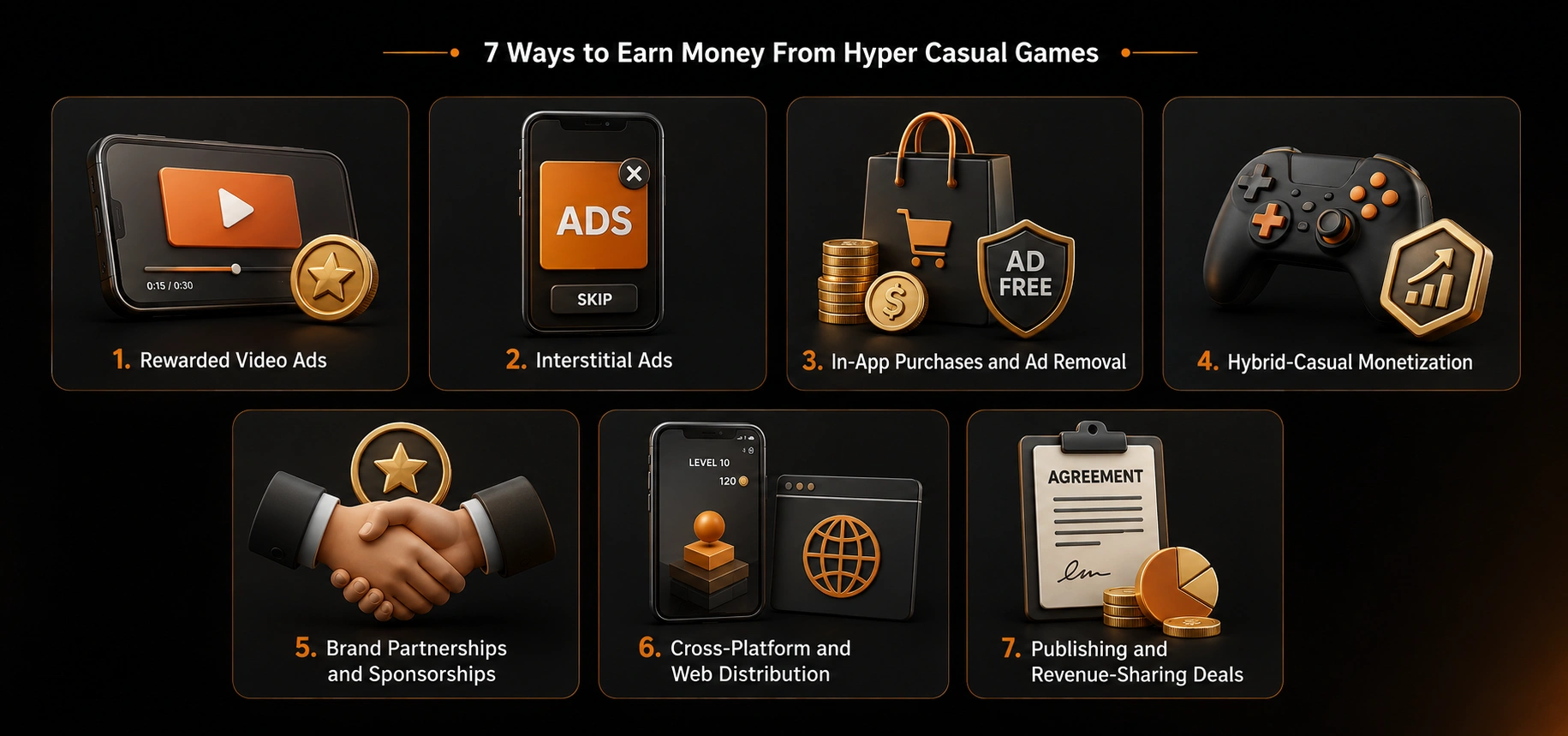
1. Rewarded Video Ads
Rewarded video is one of the most natural advertising formats for hyper-casual games. Instead of interrupting gameplay, the player voluntarily watches an advertisement in exchange for an in-game benefit.
Common rewards include:
- An additional life
- A second chance after failure
- Extra coins or currency
- Temporary boosters
- Double rewards
- Unlocking a bonus level
The technical advantage is that the player chooses when to engage with the advertisement. Developers can monitor metrics such as rewarded-ad impressions per user, completion rate, eCPM, and revenue per daily active user (ARPDAU) with conversion rate of 0.94%.
Rewarded ads work particularly well when the reward is meaningful but does not make non-paying or non-watching players feel unable to progress.
2. Interstitial Ads
Interstitials are full-screen advertisements displayed at natural breaks in the gameplay experience. In hyper-casual games, these breaks can occur after a completed level, failed attempt, or series of gameplay sessions.
The objective should not be to maximize the number of impressions at any cost. Excessive interstitial frequency can increase churn and reduce session length.
A better approach is to use frequency capping and event-based placement. For example, an interstitial may be shown after a completed gameplay cycle rather than immediately after every interaction.
Developers should compare advertising revenue against retention changes when adjusting ad frequency. A higher number of impressions is not necessarily better if it causes players to leave earlier.
3. In-App Purchases and Ad Removal
In-app purchases can supplement advertising revenue, particularly when a game develops a small but engaged player base.
Potential purchases include:
- Remove Ads
- Premium currency
- Character skins
- Boosters
- Extra lives
- Cosmetic customization
- Starter bundles
An ad-removal purchase can be particularly suitable for players who enjoy the game but prefer uninterrupted sessions.
The important consideration is that purchases should provide optional value rather than making the core game unnecessarily restrictive. Poorly designed monetization can increase short-term revenue while damaging retention and long-term LTV.
4. Hybrid-Casual Monetization
Hybrid-casual monetization combines the accessibility of hyper-casual gameplay with deeper engagement systems.
A game might begin with a one-touch mechanic but gradually introduce:
- Character progression
- Missions
- Daily challenges
- Unlockable areas
- Collections
- Upgrades
- Cosmetic items
- Limited-time events
These systems create additional reasons for players to return. However, progression should support the core mechanic rather than overwhelm it. Adding unnecessary features simply to increase monetization can make a previously accessible game feel complicated.
5. Brand Partnerships and Sponsorships
Once a game has a substantial and relevant audience, brand partnerships can become another potential revenue channel.
Examples include sponsored challenges, branded environments, limited-time cosmetics, or promotional rewards.
This model is generally more suitable for games with established traffic because brands typically need measurable audience reach and engagement. It should therefore be considered an additional revenue stream rather than the primary monetization strategy for a new game.
6. Cross-Platform and Web Distribution
Mobile stores are not the only possible distribution channels. Depending on the game architecture, developers can explore web-based distribution alongside Android and iOS.
Web distribution can increase reach, but it also introduces technical considerations such as browser compatibility, loading performance, input handling, analytics implementation, and advertising differences.
For games intended for browser-based audiences, web game development can involve different optimization requirements from native mobile development.
Cross-platform distribution should therefore be planned during architecture rather than treated as a simple post-launch conversion.
7. Publishing and Revenue-Sharing Deals
A developer can also work with a publisher that evaluates the game’s marketability and helps with user acquisition, testing, distribution, or marketing.
This approach can reduce some of the developer’s direct acquisition responsibilities, but the commercial agreement needs careful evaluation.
Important factors include:
- Revenue-share percentage
- Intellectual property ownership
- User acquisition responsibilities
- Marketing budget
- Development funding
- Platform fees
- Exclusivity
- Termination conditions
A publishing deal can provide access to expertise and distribution, but the headline revenue percentage alone should not determine whether the agreement is beneficial.
Build a Hyper-Casual Game With a Smarter Monetization Model
How Does Hyper Casual Game Monetization Work Technically?
Hyper-casual monetization combines 95% of monetization from ads and other models like in-app purchases, analytics, and testing tools. Analytics tracks actions such as level completion, ad views, purchases, and session duration. Developers use this data to understand player behavior and optimize ad placement, rewards, and pricing.
A/B and quality assurance testing can also compare different monetization approaches to identify which version generates better revenue without negatively affecting player retention.
| CPI |
Measures user acquisition cost |
| D1/D7/D30 Retention |
Measures player retention |
| eCPM |
Measures advertising revenue efficiency |
| ARPDAU |
Measures average daily revenue per active user |
| IAP Conversion |
Measures the percentage of users making purchases |
| LTV |
Estimates revenue generated by a user over time |
| ROAS |
Measures return from user acquisition expenditure |
The objective is not to maximize one metric independently. For example, increasing ad impressions may improve short-term ARPDAU but reduce D7 retention. Monetization decisions therefore need to be evaluated against the complete player lifecycle.
Which Game Mechanics Can Improve Hyper Casual Game Revenue?
Gameplay mechanics directly influence monetization because they determine how frequently players return, how long they play, and where natural monetization opportunities occur.
1. Simple Controls
Tap, swipe, drag, timing, and one-touch controls reduce the learning curve. Players should understand the primary action quickly.
2. Short Gameplay Loops
Short rounds make it easy for players to restart and create natural transition points for advertisements.
3. Fail-and-Retry Systems
Failure can create opportunities for rewarded ads. A player who loses can optionally watch an advertisement for another attempt instead of being forced to leave the game.
4. Progression
Unlocks, levels, missions, and upgrades provide longer-term goals and can increase retention.
5. Collection and Customization
Skins, characters, environments, and collectibles can provide optional IAP opportunities without affecting the basic gameplay loop.
6. Content Variation
Procedural generation, randomized challenges, or configurable level elements can increase replayability while reducing dependence on manually creating every variation.
AI can also contribute to areas such as procedural content generation, personalization, testing, and player behavior analysis. For a broader look at this technology, see how AI is changing Unity game development in 2026.
How Should You Validate a Hyper Casual Game Before Scaling Development?
One of the biggest mistakes in game development is investing heavily in an unvalidated concept. A better approach is to treat the first version as a market test.
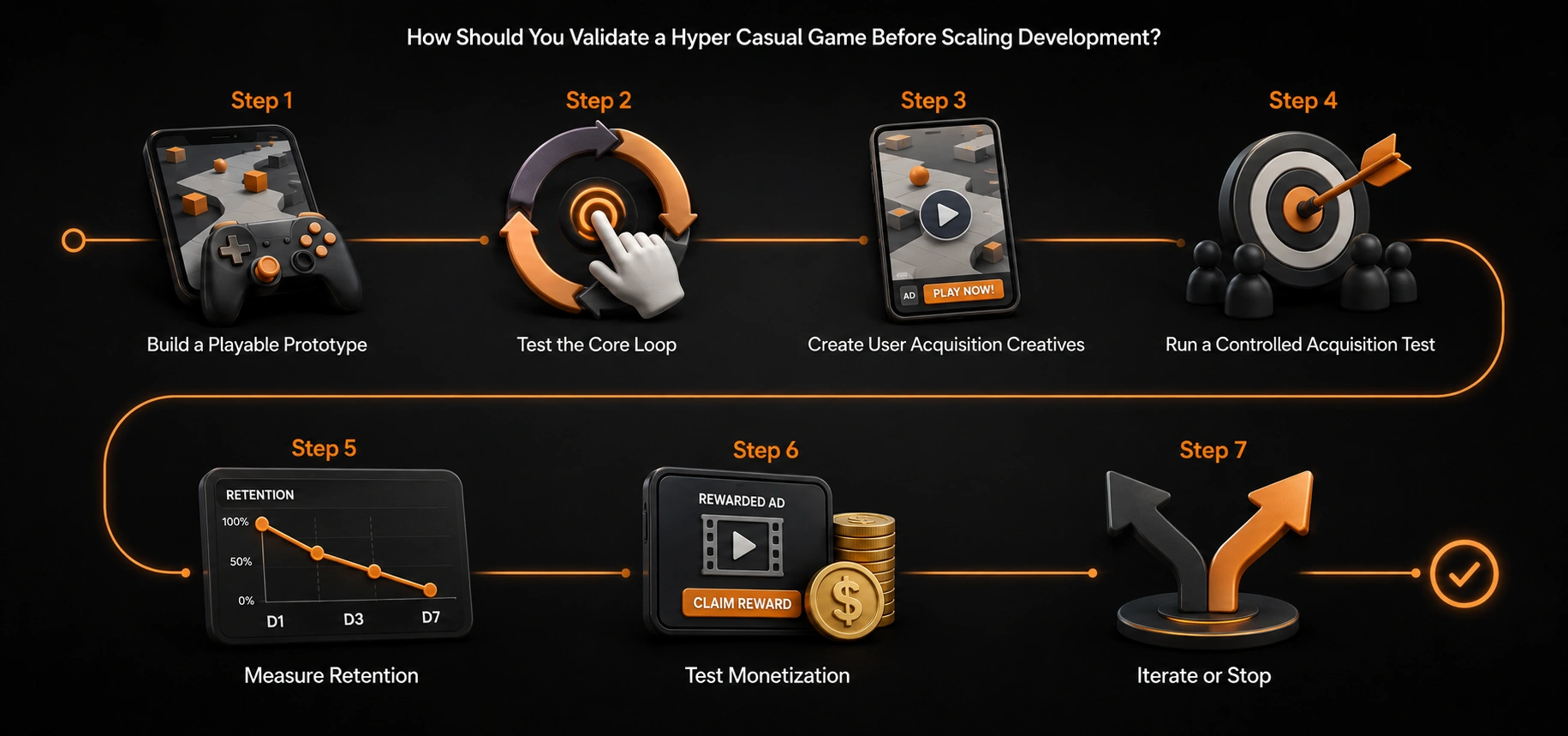
Step 1: Build a Playable Prototype
Develop only enough functionality to demonstrate the core mechanic.
Step 2: Test the Core Loop
Measure whether players understand the controls, complete the first interaction, and voluntarily restart.
Step 3: Create User Acquisition Creatives
Develop short advertisements that demonstrate the gameplay and test whether potential players respond to the concept.
Step 4: Run a Controlled Acquisition Test
Acquire a limited number of users rather than immediately spending heavily on marketing.
Step 5: Measure Retention
Track D1, D3, D7, and later retention where sufficient data is available.
Step 6: Test Monetization
Experiment with rewarded ads, interstitial placement, ad frequency, and optional IAP.
Step 7: Iterate or Stop
If the concept does not demonstrate sufficient engagement or viable economics, change the core mechanic or stop development.
This approach reduces the risk of spending a full production budget on a concept that cannot acquire or retain users.
How Much Does Hyper Casual Game Development Cost?
A basic hyper-casual game prototype may cost around $5,000 to $30,000, depending on its features, art requirements, platform, and development scope.
Major cost factors include:
- 2D or 3D graphics
- Number and complexity of mechanics
- Character and environment design
- Number of levels
- Multiplayer functionality
- Backend infrastructure
- Analytics
- Advertising SDKs
- In-app purchases
- QA and device testing
- Platform requirements
- Post-launch updates
A prototype may require a much smaller investment than a production-ready game with extensive content and LiveOps.
For developers evaluating a Unity-based mobile project, this guide to Unity mobile game development cost in 2026 provides additional context on the factors that influence development budgets.
Get a Clear Budget Estimate for Your Hyper-Casual Game
Why You Should Consider ChicMic Studios as A Hyper Casual Game Development Company
Choosing the right development team can simplify the technical and creative challenges of building a hyper-casual game. ChicMic Studios works across game prototyping, gameplay development, UI/UX, 2D/3D art, animation, analytics, monetization, QA, and deployment. Its game development services can support projects across mobile, web, and other platforms.
For hyper-casual games, rapid prototyping and iterative testing are particularly important for validating gameplay before full-scale development. A flexible development process also makes it easier to refine mechanics, levels, monetization features, and analytics based on player behavior and performance data.
Which Metrics Should You Track After Launch?
Launching a game is the beginning of the optimization process, not the end. Developers should establish analytics before launch and monitor metrics such as:
- Daily active users (DAU)
- Monthly active users (MAU)
- D1, D7, and D30 retention
- Average session duration
- Sessions per user
- Rewarded-ad completion rate
- Interstitial impressions per user
- eCPM
- ARPDAU
- IAP conversion
- LTV
- CPI
- ROAS
These metrics should be evaluated together. For example, if a change increases advertising revenue per session but causes D7 retention to fall significantly, the overall effect may be negative. Similarly, a lower CPI is not automatically positive if the acquired users generate little revenue.
Conclusion
A viable revenue opportunity in 2026 is still prevailing with casual game development in spite of challenges associated with mobile game development. However, a simple mechanic and attractive visuals are not enough to create a sustainable business.
For businesses seeking a reliable partner for hyper game development services rely on ChicMic Studios. They provide concept development, rapid prototyping, 2D/3D development, graphics and iterative game development.
For projects requiring advanced real-time 3D capabilities, hire developers that can explore Unreal Engine 5 development and its production considerations. They also build monetization strategies around player behavior and provide post-launch optimization support after launch.
FAQs
1. How do you earn money from a hyper casual game?
The most common revenue sources are rewarded and interstitial advertising, followed by optional in-app purchases such as ad removal, cosmetics, boosters, and virtual currency. Some games can also generate revenue through publishing agreements, sponsorships, or alternative distribution channels.
2. Are hyper casual games still profitable in 2026?
They can be, but profitability depends on the relationship between acquisition cost, retention, monetization, and LTV. High download numbers alone do not guarantee a profitable game.
3. What is the best hyper casual game monetization strategy?
There is no universal strategy. A combination of rewarded ads, carefully placed interstitials, and optional IAP can work well when the monetization points are aligned with the gameplay loop and do not significantly damage retention.
4. How much does it cost to develop a hyper casual game?
Development costs vary according to mechanics, art style, platform count, backend requirements, multiplayer functionality, monetization systems, QA, and post-launch support. A basic prototype and a fully featured commercial game can require very different budgets.
5. How long does hyper casual game development take?
A basic playable prototype can be developed considerably faster than a polished commercial release. The actual timeline depends on the number of mechanics, content requirements, art complexity, platforms, backend functionality, testing, and monetization integrations.
6. What does a hyper casual game development company do?
Companies like ChicMic Studios can support areas including concept development, rapid prototyping, gameplay development, 2D/3D design & development, multiplayer development, graphics and animation, testing, and launch-related development requirements. The appropriate scope depends on the project’s technical and commercial objectives.
Ready to Build a Revenue-Driven Hyper-Casual Game?