What Should You Know Before Choosing a Sports Betting Game Development Company?
Key Takeaways:
-
- Choose a sports betting game development company with proven sportsbook and real-time betting experience.
- Assess the company’s game development services beyond launch, including maintenance, monitoring, upgrades, and infrastructure scaling.
- Ensure the platform supports essential security, payment, fraud-prevention, KYC, AML, age-verification, and geolocation capabilities.
- Verify reliable sports betting API and data-feed integrations for live scores, statistics, markets, and odds.
Introudction
Choosing a sports betting game development company involves more than comparing portfolios, development costs, or UI/UX designs. A modern betting platform must process real-time sports data, manage odds, handle financial transactions, protect user information, and operate within applicable regulatory requirements.
The development partner you choose can directly affect the platform’s scalability, reliability, security, and ability to evolve. Before signing a contract, it is important to understand the technical architecture, integrations, compliance capabilities, ownership terms, and ongoing game development services the company provides.
Factors To Consider While Selecting Sports Betting Game Development Company
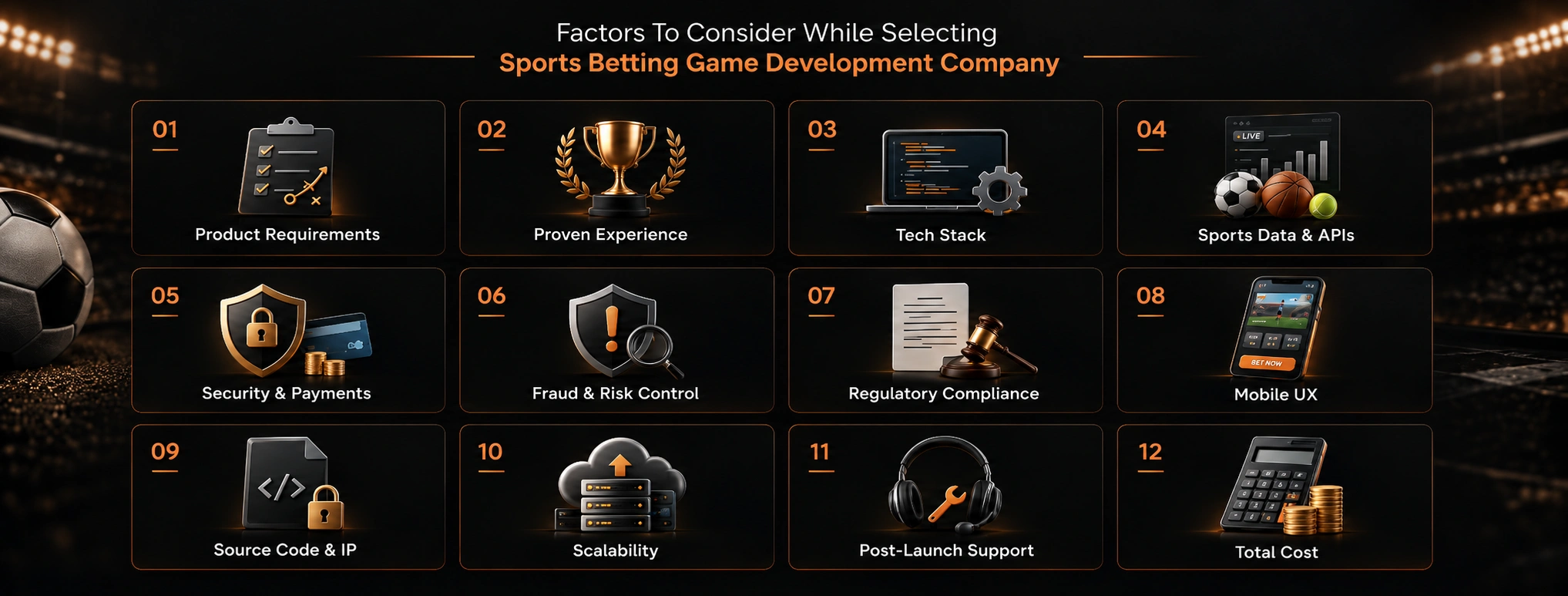
1. Define Your Sports Betting Product Requirements
Before approaching a game development company, clearly define what you want to build. A pre-match sportsbook has different technical requirements from a platform focused heavily on live betting.
Consider:
-
- Sports and leagues you want to support
- Pre-match and live betting
- Web, iOS, and Android platforms
- Target geographical markets
- Expected number of users
- Payment methods and currencies
- Betting markets and odds formats
- Custom platform or white-label solution
Your requirements determine the architecture, APIs, infrastructure, development timeline, and overall technology investment. A detailed product specification also makes vendor comparisons more meaningful because each company can respond to the same technical requirements.
2. Look for Proven Sports Betting Development Experience
A company that develops conventional mobile games or consumer applications may not necessarily have the expertise required for sportsbook development.
Look for a sports betting game development company with experience in real-time betting systems unnecessary delays. On the backend, services need to manage accounts, betting markets, odds, transactions, wallets, notifications, odds integrations, payment workflows, user wallets, KYC systems, and administrative dashboards. Ask potential vendors for evidence rather than relying only on marketing claims.
Questions to ask:
-
- Have you developed live betting functionality?
- Which sports data and odds providers have you integrated?
- How does your platform handle traffic spikes?
- What payment and KYC systems have you worked with?
- Can you demonstrate an existing sportsbook?
- What support is available after deployment?
A relevant portfolio can reveal whether the development team understands the operational complexity of sports betting.
Build a Scalable Sports Betting Platform
3. Examine the Technology Stack and Architecture
The technology stack is one of the most important areas to investigate during sports betting game development. At the frontend, the platform needs responsive interfaces that can deliver rapidly changing information without creating unnecessary delays. On the backend, services need to manage accounts, betting markets, odds, transactions, wallets, notifications, and settlement.
A scalable architecture may incorporate:
-
- Modular or microservices-based backend services
- REST or GraphQL APIs
- WebSockets for real-time updates
- Redis or similar caching technologies
- Load balancers
- Cloud infrastructure
- Containerisation
- Automated monitoring and logging
- Horizontal scaling
The important question is not simply which programming language the company uses. Ask how the architecture behaves when thousands of users interact with live markets simultaneously.
4. Evaluate Real-Time Sports Data and API Integration
Sports betting depends heavily on accurate and timely data. Your development partner should be capable of integrating and normalising feeds for fixtures, scores, statistics, markets, odds, results, and settlement.
During vendor evaluation, ask how the system handles:
-
- API latency
- Webhooks and event streams
- Data synchronisation
- Feed interruptions
- Duplicate events
- Stale odds
- API rate limits
- Provider failover
For live betting, even small delays can affect the user experience and operational workflow. A capable development team should therefore have a clear strategy for monitoring data freshness and responding when an external provider becomes unavailable.
5. Assess Security and Financial Infrastructure
A sportsbook handles sensitive identity, financial, and behavioural data, making security a core architectural requirement rather than an additional feature. Your game development services partner should demonstrate how it implements:
-
- TLS/SSL encryption
- Encryption at rest
- Secure authentication
- Role-based access controls
- API security
- Audit logging
- Vulnerability testing
- Security monitoring
Payment architecture also requires careful evaluation. Check whether the platform can integrate the payment gateways, currencies, deposits, withdrawals, and reconciliation processes required for your target markets. Where applicable, evaluate PCI DSS requirements and other relevant security obligations separately from broader gambling regulations.
6. Verify Fraud Prevention and Risk Management
Fraud prevention should be considered at both the account and transaction levels. A sportsbook platform may need controls for suspicious account behaviour, unusual transaction patterns, multiple-account activity, payment abuse, and other forms of risk. Depending on the product and jurisdiction, useful capabilities can include:
-
- Transaction monitoring
- Velocity rules
- Device and IP intelligence
- Account-risk scoring
- Suspicious activity alerts
- Payment risk controls
- Administrative investigation tools
Ask the vendor whether these capabilities are built into the platform, integrated through third-party services, or expected to be developed separately.
7. Don’t Overlook Regulatory Compliance
Regulatory requirements vary according to the jurisdiction in which the sportsbook operates. Therefore, compliance should be discussed during architecture and product planning not after development is complete.
A suitable sports betting game development company should understand how software can support requirements such as:
-
- KYC and identity verification
- AML processes
- Age verification
- Geolocation or geofencing
- Self-exclusion
- Deposit and loss limits
- Responsible-gaming controls
- Regulatory reporting
The development company does not necessarily become the licensed gambling operator. However, it should understand how applicable regulatory requirements translate into technical controls and third-party integrations.
8. Check Mobile UX and Betting Workflows
Sports betting users often interact with platforms while following live events, so usability and responsiveness are particularly important.
The interface should make common actions easy:
-
- Finding an event
- Browsing markets
- Reviewing odds
- Adding selections to a bet slip
- Confirming a wager
- Tracking open bets
- Managing deposits and withdrawals
A mobile-first approach should also consider performance on different devices and network conditions. Good UX in sports betting game development is not simply about attractive graphics. It is about reducing friction while presenting constantly changing information clearly.
Turn Your Sports Betting Idea Into a Real Platform
9. Understand Source Code and Intellectual Property Ownership
Ownership terms can have long-term consequences, particularly for custom sportsbook development.
Before signing an agreement, clarify:
-
- Who owns the source code?
- Who owns the intellectual property?
- Can you modify the software independently?
- What third-party licenses are involved?
- Are there recurring platform fees?
- Who owns custom integrations?
- What happens if the contract ends?
A low initial development price may become expensive if the platform has significant recurring licensing, infrastructure, data-feed, or maintenance costs. Make sure the contract clearly distinguishes between custom-developed components and third-party technologies.
10. Evaluate Scalability and Infrastructure
Sports betting traffic is not evenly distributed. Major tournaments, finals, championships, and other high-interest events can generate sudden increases in concurrent users and API activity. Ask the development company how its architecture handles these peaks.
Important considerations include:
-
- Horizontal scaling
- Auto-scaling infrastructure
- Load balancing
- Database optimisation
- Caching
- Queue-based processing
- CDN configuration
- Database replication
- Disaster recovery
- Performance monitoring
The goal is not merely to support today’s traffic. The platform should have a realistic path for scaling as the user base and betting volume increase.
11. Examine Post-Launch Game Development Services
Launching the sportsbook is only the beginning of its technical lifecycle. Reliable game development services should potentially cover ongoing maintenance, security updates, API for betting platforms, including the frontend, backend, betting workflows, API integrations, payment systems, administrative tools require real-time odds and event data, transaction processing, betting settlement, user wallets, security controls, regulatory integrations, and high scalability.
For a platform that operates continuously, determine whether the vendor provides appropriate monitoring and incident-response coverage, particularly for critical betting and payment services.
12. Compare the Total Cost
Cost should be evaluated across the entire platform lifecycle.
Your budget may include:
-
- Initial development
- UI/UX design
- Sports data feeds
- Odds providers
- Payment integrations
- KYC/AML services
- Cloud infrastructure
- Security tools
- Licensing
- Maintenance
- Technical support
- Future feature development
When comparing a game development company with another provider, make sure both proposals include comparable components. The cheapest quotation may not represent the lowest total cost if important services or integrations are excluded.
What Should You Ask Before Hiring a Sports Betting Development Company?
Use this checklist before making a final decision:
-
- Does the company have proven sportsbook development experience?
- Can it demonstrate real-time betting functionality?
- Which sports data and odds APIs can it integrate?
- How does it handle high-concurrency traffic?
- What security practices are included?
- How are KYC, AML, and geolocation integrations handled?
- What payment gateways can be supported?
- Who owns the source code and intellectual property?
- What third-party costs will continue after launch?
- What SLA and maintenance support are available?
- Can the platform be expanded into new markets and betting products?
Conclusion
Choosing a sports betting game development company is ultimately a technical and business decision. The right partner should understand more than interface design or application development.
Evaluate its ability to build scalable architecture, process real-time sports data, integrate payments and compliance services, protect sensitive information, manage sportsbook workflows, and provide long-term technical support.
Most importantly, look beyond the initial proposal. Examine the architecture, integrations, ownership model, recurring costs, security approach, and evidence of previous sportsbook work. A development partner like ChicMic Studios can support the platform from initial architecture through post-launch optimization and quality assurance services that can provide a stronger foundation for sustainable sports betting game development.
Frequently Asked Questions
1. What does a sports betting game development company do?
A sports betting game development company designs and develops software for betting platforms, including the frontend, backend, betting workflows, API integrations, payment systems, administrative tools, security controls, and other sportsbook functionality.
2. How is sports betting game development different from regular game development?
Sports betting platforms require real-time odds and event data, transaction processing, betting settlement, user wallets, security controls, regulatory integrations, and high scalability. These requirements make sportsbook development considerably different from conventional entertainment game development.
3. What APIs are required for a sportsbook?
Depending on the product, a sportsbook may require APIs for sports data, live scores, odds, statistics, KYC, AML, geolocation, payments, identity verification, notifications, and other external services.
4. How important is scalability in sports betting development?
Scalability is critical because user activity and data traffic can increase sharply during major sporting events. The architecture should be designed to accommodate high concurrent usage without compromising reliability or response times.
5. Should I choose custom or white-label sportsbook development?
The choice depends on your business model, budget, target markets, desired level of control, and product requirements. Custom development generally provides greater control over functionality and architecture, while white-label solutions can reduce initial development effort.
6. What should I check in a game development company?
Review its relevant industry experience, technical architecture, API expertise, security practices, regulatory knowledge, portfolio, development process, source-code ownership terms, pricing structure, and post-launch support.
7. What are the most important sportsbook development technologies?
There is no single technology stack suitable for every sportsbook. More important than a specific programming language is whether the architecture supports real-time communication, secure APIs, horizontal scalability, reliable data processing, monitoring, and maintainability.
Build a Secure, Scalable Sports Betting Platform