Cybersecurity Trends in 2026: Risks, Controls and Priorities
Key Takeaways
- AI is accelerating both cyberattacks and defensive security operations, making speed and automation increasingly important.
- Cloud-native infrastructure, SaaS and APIs require continuous visibility and security monitoring.
- Strong IAM, MFA, PAM and Zero Trust controls are essential for protecting users, machines and AI agents.
- Regular assessment, monitoring, vulnerability management and security automation are becoming essential to maintaining a strong security posture.
Introduction
A phishing email can now be generated by AI in seconds. An exposed identity can give an attacker access without deploying malware. An AI agent can make API calls on its own. And a software supply-chain compromise can turn one vulnerable dependency into an enterprise-wide problem. The recent cybersecurity trends in 2026 are changing the scenario.
Organizations are no longer securing just networks and endpoints. They are securing AI systems, identities, cloud infrastructure, APIs, software supply chains, SaaS platforms and autonomous agents often across environments they do not fully control.
Current threat research shows the same direction of travel: attackers are becoming faster and more automated, while defenders are adopting AI and security automation to close the gap. CrowdStrike reported an 89% year-over-year increase in attacks by AI-enabled adversaries and an average eCrime breakout time of 29 minutes in its 2026 Global Threat Report. So, what should businesses actually prioritize?
The Biggest Cybersecurity Trends Shaping 2026
1. AI-Powered Cyberattacks Are Accelerating
AI is becoming a practical tool in the attacker’s toolkit, not just a future threat. Threat actors can use generative AI to accelerate:
- Reconnaissance
- Phishing and social engineering
- Credential theft
- Vulnerability discovery
- Malware development
- Attack-path analysis
- Impersonation and deepfakes
CrowdStrike reported that AI-enabled adversaries increased their activity by 89% in 2025, while the average eCrime breakout time fell to 29 minutes. Its fastest observed breakout was just 27 seconds. IBM also reported a 44% increase in attacks beginning with exploitation of public-facing applications, linking the trend partly to AI-enabled vulnerability discovery. The takeaway for enterprise security teams is simple: The faster attackers operate, the less effective slow, manual security processes become.
2. Agentic AI Security Becomes a New Priority
Generative AI creates content. Agentic AI can take action. An AI agent may be able to access data, call APIs, execute workflows, update records or interact with other systems. That introduces a new class of agentic AI security risks:
- Excessive permissions
- Prompt injection
- Tool abuse
- Insecure API access
- Agent impersonation
- Uncontrolled autonomous actions
- Sensitive-data exposure
- Poorly defined trust boundaries
Google Cloud’s 2026 cybersecurity forecast highlights the need to treat AI agents as distinct digital actors with managed identities, authorization boundaries and monitoring.
This changes the security question from:
“Is the AI application secure?”
to:
“What can this agent access, what can it do, and who is accountable for its actions?”
Ready to Build a Future-Ready Cybersecurity Framework
3. Identity Is Becoming the New Security Perimeter
The traditional network perimeter has become increasingly difficult to define. Employees work remotely. Applications run across multiple clouds. SaaS platforms connect through APIs. Contractors need external access. Machines communicate automatically. As a result, identity-based attacks are becoming a central enterprise security concern.
Attackers may target:
- User credentials
- Session tokens
- Privileged accounts
- Service accounts
- OAuth permissions
- Machine identities
Strong identity and access management (IAM) should therefore include:
- MFA
- Passwordless or phishing-resistant authentication
- Privileged access management (PAM)
- Least-privilege access
- Conditional access
- Identity threat detection
- Machine-identity governance
Zero Trust security reinforces this approach by reducing implicit trust and continuously evaluating access.
4. Ransomware and Data Extortion Remain Major Risks
Ransomware has evolved beyond encrypting files and demanding payment. IBM’s 2026 X-Force Threat Intelligence Index reported a 49% year-over-year increase in active ransomware and extortion groups, from 73 in 2024 to 109 in 2025. IBM also reported that publicly disclosed victim counts increased by approximately 12%. That makes ransomware resilience just as important as ransomware prevention.
Businesses should prioritize:
- Endpoint detection and response
- MFA and PAM
- Network segmentation
- Vulnerability management
- Secure and isolated backups
- Recovery testing
- Incident-response planning
A backup strategy is only useful if the organization can actually restore critical systems under pressure.
5. Cloud and SaaS Security Continue to Expand
Cloud adoption has created a much larger and more dynamic attack surface.
Modern environments can include:
- AWS, Azure and Google Cloud
- SaaS applications
- Containers
- Kubernetes
- Serverless workloads
- APIs
- Cloud databases
- Remote endpoints
Cloud security therefore needs to cover more than configuration.
Organizations should monitor:
- Cloud identities
- Workloads
- Configurations
- Secrets
- Data
- APIs
- Internet-facing assets
- Administrative activity
For multi-cloud environments, consistent visibility and policy enforcement become particularly important.
6. Software Supply Chain Security Is an Enterprise Issue
Businesses increasingly depend on software they did not build themselves. That includes open-source libraries, SaaS platforms, APIs, managed services and third-party applications. IBM reported that large supply-chain and third-party compromises had nearly quadrupled since 2020, with attackers increasingly targeting software-development environments and SaaS integrations.
Effective software supply chain security should include:
- Vendor risk management
- Software composition analysis
- SBOMs
- Dependency monitoring
- Secure CI/CD pipelines
- Code signing
- Third-party access controls
- Continuous vulnerability monitoring
The key question is no longer simply:
“Is our vendor secure?”
It is:
“What happens to our business if this dependency is compromised?”
7. API Security Is Now Core Application Security
APIs connect applications, cloud services, SaaS platforms and AI systems.
They also create opportunities for attackers to exploit:
- Broken authentication
- Broken authorization
- Excessive permissions
- Exposed credentials
- Sensitive-data leakage
- Shadow APIs
- Poorly secured integrations
API security should begin with visibility. Organizations need to know; Which APIs exist? Who can call them? What data can they access? What happens when they are abused? This becomes even more important as AI agents increasingly interact with enterprise APIs.
8. Shadow AI Creates Unmanaged Security Risk
Employees are adopting AI faster than many organizations can govern it. Using unapproved AI tools for business tasks can create shadow AI risks involving:
- Confidential information
- Customer data
- Intellectual property
- Source code
- Credentials
- Regulatory obligations
- Unapproved integrations
AI governance should therefore establish clear rules for:
- Approved AI tools
- Sensitive-data usage
- AI-generated code
- AI-agent deployment
- Model access
- Third-party AI providers
- Logging and monitoring
The answer is not necessarily to block AI. It is to make secure AI adoption easier than unsafe AI adoption.
9. Vulnerability Exploitation Is Getting Faster
Vulnerability management has always been important. In 2026, the speed of exploitation makes it even more critical. IBM reported that exploitation of public-facing applications increased 44% year over year, while vulnerability exploitation represented 40% of incidents observed by X-Force in 2025.
Security teams should prioritize vulnerabilities based on:
- Exploit availability
- Internet exposure
- Asset criticality
- Threat intelligence
- Privileged access
- Business impact
A vulnerability with a lower theoretical severity but active exploitation against an internet-facing system may deserve faster attention than a higher-severity issue on an isolated asset.
10. Security Automation Becomes Essential
Security teams are dealing with enormous volumes of alerts, logs and threat intelligence.
AI-powered security operations can help with:
- Alert triage
- Threat correlation
- Investigation
- Log analysis
- Threat-intelligence enrichment
- Detection engineering
- Incident summarization
- Response workflows
Google Cloud forecasts greater use of AI agents in security operations, with analysts increasingly directing automated systems while retaining responsibility for complex decisions. The goal is not to remove humans from security operations. It is to give analysts more time for decisions that actually require human judgment.
10 Cybersecurity Risks Businesses Should Prioritize in 2026
The exact priority depends on the organization’s industry, architecture and threat exposure. However, these risks deserve particular attention in most enterprise cybersecurity programs.
| Risk |
Potential Business Impact |
Key Security Focus |
| AI-powered attacks |
Fraud, compromise, data exposure |
AI security and threat detection |
| Identity compromise |
Account takeover, unauthorized access |
IAM, MFA, PAM |
| Ransomware |
Operational disruption and extortion |
Prevention and recovery |
| Shadow AI |
Data and IP exposure |
AI governance |
| Cloud misconfiguration |
Data exposure and unauthorized access |
Cloud security |
| Third-party compromise |
Cascading business disruption |
Vendor risk management |
| API attacks |
Application and data compromise |
API security |
| Software supply-chain attacks |
Downstream compromise |
SBOM and dependency security |
| Insider threats |
Data loss and unauthorized activity |
IAM and DLP |
| Legacy infrastructure |
Exploitation and availability risk |
Modernization and segmentation |
What Cybersecurity Controls Should Businesses Prioritize in 2026?
Priority 1: Zero Trust Security
Zero Trust replaces implicit trust with continuous verification.
Apply it across:
- Users
- Devices
- Applications
- Workloads
- APIs
- Machine identities
- AI agents
Priority 2: Strong Identity and Access Management
Identity should be a foundational security control.
Prioritize:
- MFA
- PAM
- Least privilege
- Conditional access
- Passwordless authentication
- Service-account governance
- Identity threat detection
Priority 3: MFA and Passwordless Authentication
Stolen credentials remain valuable to attackers. MFA provides an additional layer of protection, while phishing-resistant and passwordless authentication can further reduce credential-based attack opportunities.
Priority 4: Endpoint Detection and Response
EDR provides visibility into endpoint behavior and enables security teams to detect and contain suspicious activity. Coverage should include business-critical endpoints and privileged systems.
Priority 5: Cloud Security
Cloud security should address:
- IAM
- Configuration
- Workloads
- Containers
- Data
- APIs
- Secrets
- Logging
Priority 6: AI Security and Governance
Organizations should maintain an inventory of AI applications and agents and define:
- Access controls
- Data boundaries
- Agent permissions
- Monitoring requirements
- Approved use cases
- Incident-response procedures
Priority 7: Data Loss Prevention
DLP can help prevent sensitive information from leaving controlled environments through email, endpoints, cloud applications or unauthorized AI services.
Priority 8: Vulnerability Management
Combine vulnerability scanning with Asset criticality, exploitability, exposure and threat intelligence. This creates a more practical remediation strategy than relying on severity scores alone.
Priority 9: Backup and Recovery
Backups should be:
- Protected from unauthorized deletion
- Segmented from production
- Regularly tested
- Monitored
- Aligned with recovery objectives
Priority 10: Continuous Monitoring
CISA’s Cybersecurity Performance Goals provide a practical baseline of prioritized cybersecurity practices and are designed to help organizations reduce risk, including small and medium-sized organizations and critical-infrastructure operators.
Ready to Identify Your 2026 Cyber Risks?
AI vs. AI: How Defenders Are Fighting Back
Cybersecurity in 2026 is increasingly becoming an AI-versus-AI contest. Attackers are using AI to automate reconnaissance, phishing, social engineering, vulnerability discovery and attack workflows, making cyber operations faster and easier to scale.
Defenders are responding by embedding AI into security operations to improve detection, investigation and response.
1. Attackers
- AI-assisted phishing and social engineering
- Automated reconnaissance and vulnerability discovery
- Deepfake-enabled impersonation
- AI-assisted malware development
- Automated attack workflows
2. Defenders
- AI-powered threat detection
- SOC copilots and automated investigation
- Behavioral analytics and threat-intelligence correlation
- AI-assisted vulnerability prioritization
- Automated incident response
Google’s 2026 cybersecurity forecast highlights the growing use of AI agents in security operations, where autonomous systems can analyze threats and support response while human analysts maintain oversight.
The objective is not to replace security teams with AI. It is to combine automation with human judgment to detect threats faster, reduce response times and manage an increasingly complex attack surface.
Cybersecurity Priorities for US Businesses in 2026
Cybersecurity risks vary by sector, so organizations should align their security strategy with their technology environment, business risks and regulatory requirements.
- SMBs: Strengthen the basics with MFA, endpoint protection, secure backups, patch management, email security and a practical incident-response plan.
- Enterprises: Focus on identity architecture, Zero Trust, cloud security, AI governance, third-party risk, security operations and overall cyber resilience.
- Healthcare: Prioritize system availability, identity security, ransomware resilience and sensitive data protection while meeting applicable HIPAA requirements.
- Financial Services: Strengthen identity security, fraud prevention, application and API security, third-party risk management, continuous monitoring and applicable regulatory controls.
- SaaS Companies: Secure cloud infrastructure, APIs and applications while enforcing strong IAM, tenant isolation and security throughout the software development lifecycle.
- Manufacturing & Critical Infrastructure: Protect both IT and operational technology with strong network segmentation, availability controls, continuous monitoring and tested recovery capabilities.
30/60/90-Day Cybersecurity Roadmap
A practical cybersecurity strategy does not need to start with a massive technology overhaul.
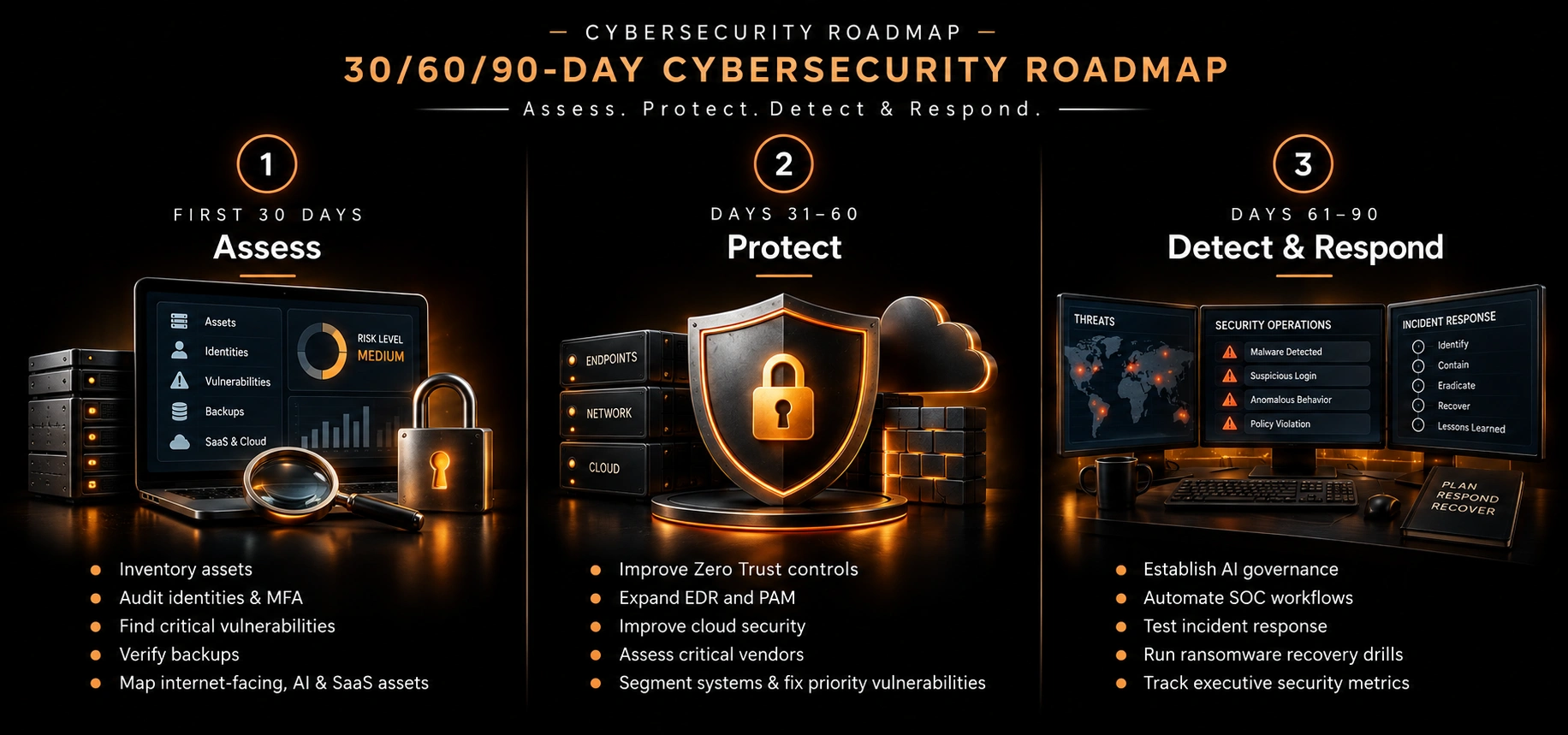
First 30 Days: Assess
- Inventory assets
- Audit identities
- Review MFA
- Identify critical vulnerabilities
- Verify backups
- Discover internet-facing assets
- Identify AI and SaaS usage
Days 31–60: Protect
- Improve Zero Trust controls
- Deploy or expand EDR
- Strengthen PAM
- Improve cloud security
- Assess critical vendors
- Segment sensitive systems
- Remediate priority vulnerabilities
Days 61–90: Detect and Respond
- Establish AI governance
- Automate SOC workflows
- Test incident response
- Conduct ransomware recovery exercises
- Review security maturity
- Establish executive security metrics
Cybersecurity Frameworks US Businesses Should Know
As AI, cloud and third-party technologies expand the attack surface, cybersecurity governance increasingly overlaps with regulatory compliance. UAE crypto regulation and compliance provides a useful example of how security and compliance requirements can intersect in Web3.
1. NIST Cybersecurity Framework 2.0:
NIST CSF 2.0 organizes cybersecurity risk management around Govern, Identify, Protect, Detect, Respond and Recover.
2. CISA Cybersecurity Performance Goals:
CISA’s CPGs provide prioritized baseline practices for reducing cybersecurity risk.
3. CIS Controls:
The CIS Controls provide a prioritized set of safeguards for strengthening security.
4. Zero Trust Architecture:
Zero Trust provides an architectural approach based on minimizing implicit trust and continuously evaluating access.
5. SOC 2:
SOC 2 can be relevant to service organizations that need to demonstrate controls over areas such as security, availability and confidentiality, depending on scope.
6. PCI DSS:
PCI DSS applies to organizations within the payment-card ecosystem and focuses on protecting cardholder data.
7. HIPAA:
HIPAA requirements apply to covered entities and business associates handling protected health information.
How to Build a 2026 Cybersecurity Strategy
Step 1: Assess
Identify assets, identities, applications, cloud environments, AI systems, vulnerabilities and third parties.
Step 2: Prioritize
Evaluate risk using business impact, exposure, exploitability and threat intelligence.
Step 3: Protect
Deploy appropriate security controls such as MFA, PAM, EDR, Zero Trust, segmentation and secure backups.
Step 4: Detect
Use security operations, monitoring, threat intelligence and behavioral analytics to identify suspicious activity.
Step 5: Respond
Maintain tested incident-response, containment, communication and recovery procedures.
When Should Businesses Work With a Cybersecurity Partner?
External cybersecurity expertise can be valuable when an internal team needs additional capacity or specialized skills.
Consider a cybersecurity partner for:
- Security assessments
- Cyber risk analysis
- Cloud migrations
- AI deployments
- Compliance preparation
- Penetration testing
- Application and API security
- Incident-response preparation
- DevSecOps
- Continuous monitoring
This is particularly relevant when new technology materially changes the organization’s attack surface.
How ChicMic Studios Can Support Your Cybersecurity Strategy in 2026
- Cybersecurity Consulting: Strengthen your security posture with security assessments, risk analysis, cybersecurity strategy, and practical security recommendations.
- Application Security: Protect web development and mobile applications and APIs through security testing, vulnerability assessments, and secure development practices.
- Cloud Security: Secure AWS, Azure, Google Cloud, and cloud-native environments with stronger configurations, access controls, monitoring, and infrastructure protection.
- AI Security: Secure AI applications, LLMs, and AI agents with AI security assessments, access controls, governance, and protection against emerging AI security risks.
- DevSecOps: Build security into your development lifecycle with CI/CD security, automated quality testing, vulnerability scanning, and software supply-chain protection.
- Penetration Testing: Identify exploitable weaknesses across web applications, APIs, cloud environments, networks, and infrastructure before attackers can exploit them.
Strengthen Your Cybersecurity Strategy for 2026
The cybersecurity challenge in 2026 is not about choosing between AI, Zero Trust, EDR, cloud security or threat intelligence. Modern security requires all of them to work together.
Attackers are moving faster. AI is increasing the speed and scale of attacks. Identities are becoming more important than network boundaries. Cloud and SaaS environments continue to expand. Third-party dependencies are creating interconnected risk.
For US businesses, the objective is not to eliminate every cyber risk. It is to build a security posture that can identify important risks early, reduce exposure and recover quickly when prevention fails.
Frequently Asked Questions
1. What are the biggest cybersecurity trends in 2026?
The major cybersecurity trends include AI-powered attacks, agentic AI security, identity-based attacks, ransomware and data extortion, cloud security, software supply-chain security, API security, shadow AI, rapid vulnerability exploitation and security automation.
2. What is the biggest cybersecurity risk in 2026?
AI is an important risk multiplier because it can increase the speed and scale of cyberattacks while organizations are simultaneously expanding their AI attack surface. The most significant risk varies by organization and industry.
3. How is AI changing cybersecurity in 2026?
Attackers are using AI for activities such as reconnaissance, social engineering and vulnerability discovery, while defenders are using AI for threat detection, investigation, threat intelligence and security operations.
4. Is ransomware still a major threat in 2026?
Yes. IBM reported a 49% year-over-year increase in active ransomware and extortion groups in its 2026 X-Force research.
5. What cybersecurity controls should businesses prioritize in 2026?
Key controls include strong IAM, MFA, PAM, Zero Trust, EDR, vulnerability management, cloud security, secure backups, continuous monitoring, incident response and AI security controls.
6. Why is Zero Trust important in 2026?
Zero Trust reduces implicit trust and continuously evaluates access. This is particularly useful in environments involving cloud services, SaaS, remote workers, third parties and machine identities.
7. How can companies protect AI applications from cyberattacks?
Organizations should control model and API access, protect sensitive data, manage AI-agent permissions, monitor activity, test for adversarial behavior and establish AI governance.
8. What is agentic AI security?
Agentic AI security focuses on protecting AI systems that can independently access tools, interact with applications, make decisions or take actions on behalf of users. As organizations move from generative AI toward autonomous systems, understanding how agentic AI works in real-world enterprise workflows becomes increasingly important.
9. What cybersecurity framework should US businesses use?
NIST CSF 2.0 is a useful foundation for cybersecurity risk management, while CISA’s Cybersecurity Performance Goals provide prioritized security practices. Other frameworks may apply depending on industry and regulatory requirements.
10. How often should a company conduct cybersecurity risk assessments?
There is no universal interval. Assessments should be performed regularly and whenever significant changes occur, such as cloud migration, AI deployment, major software changes, acquisitions, new suppliers or material changes in the threat environment.
Strengthen Your Cybersecurity Strategy for 2026