Key Takeaways:
- Core Value: AI-first companies are built around AI as a core system, not just a tool added on top of existing processes.
- Comprehensive Services: They use AI tools like models, pipelines, and automation to run operations.
- Business Benefits: They improve speed, efficiency, accuracy, and scalability while reducing manual work.
- Industry Use Cases: AI-first systems are used in finance, healthcare, e-commerce, logistics, and more.
- Future Trends: AI agents and autonomous systems will increasingly manage business operations.
The New Business Model Powering AI First Companies
If you’ve been hearing the phrase “what is an AI-first company” more frequently lately, it’s not just another tech buzzword. In fact, it is becoming one of the most vital shifts in the growth and scale of modern enterprises across industries. An AI-first company is essentially a company that doesn’t think of AI as a way to improve existing processes as an after-thought, but builds its core business, its decision-making systems and even its product around it.
This is a big modification as it changes the logic behind the working of businesses. Traditional businesses think people first, and tools second. AI-first companies counter this way of thinking by building intelligent systems first and then allowing humans to guide, supervise and improve them. The result is faster execution, richer insights, and continuous development without any manual intervention.
In today’s competitive environment, where speed and data are the keys to success, this approach is fast becoming a major advantage for modern businesses. According to McKinsey’s latest AI report, 88% of organizations already use AI in at least one business function, but most are still in early stages of scaling it across the enterprise. According to a report byPwC, AI could contribute up to $15.7 trillion to the global economy.
Let’s break it down in a sensible and useful way.
What Is an AI-First Company?
An AI first company meaning and definition refers to an organization that places artificial intelligence at the forefront of its strategy, product design and operations, rather than as an optional layer of technology. Businesses adopting AI strategies often also invest in advanced digital ecosystems like blockchain – learn more about Real-World Asset Tokenization
For these companies, AI is not just a tool. It’s part of the essential infrastructure that drives decision making, streamlines processes, and ultimately leads to better outcomes.
This model is powerful because it changes the way problems are approached. Instead of asking how AI can improve an existing process, AI-first organizations ask, “If intelligence is embedded in the system, then how can the entire workflow be designed?”
This way of thinking leads to systems that learn continuously, adaptive products and procedures that improve without ongoing manual adjustment. However, despite widespread adoption, nearly 66% of organizations are still in pilot or experimentation phase, meaning very few have fully transitioned to AI-first.
How AI-First Companies Work?
AI-first companies are intelligent ecosystems, not hierarchies.
Data is at the core of these enterprises. Every process, transaction and interaction generates data which is then fed into machine learning models. These models evaluate trends, predict what will happen and then instantly recommend or implement actions. These kinds of intelligent systems are now being deployed in real businesses to automate decision-making and optimize operations in modern AI systems.
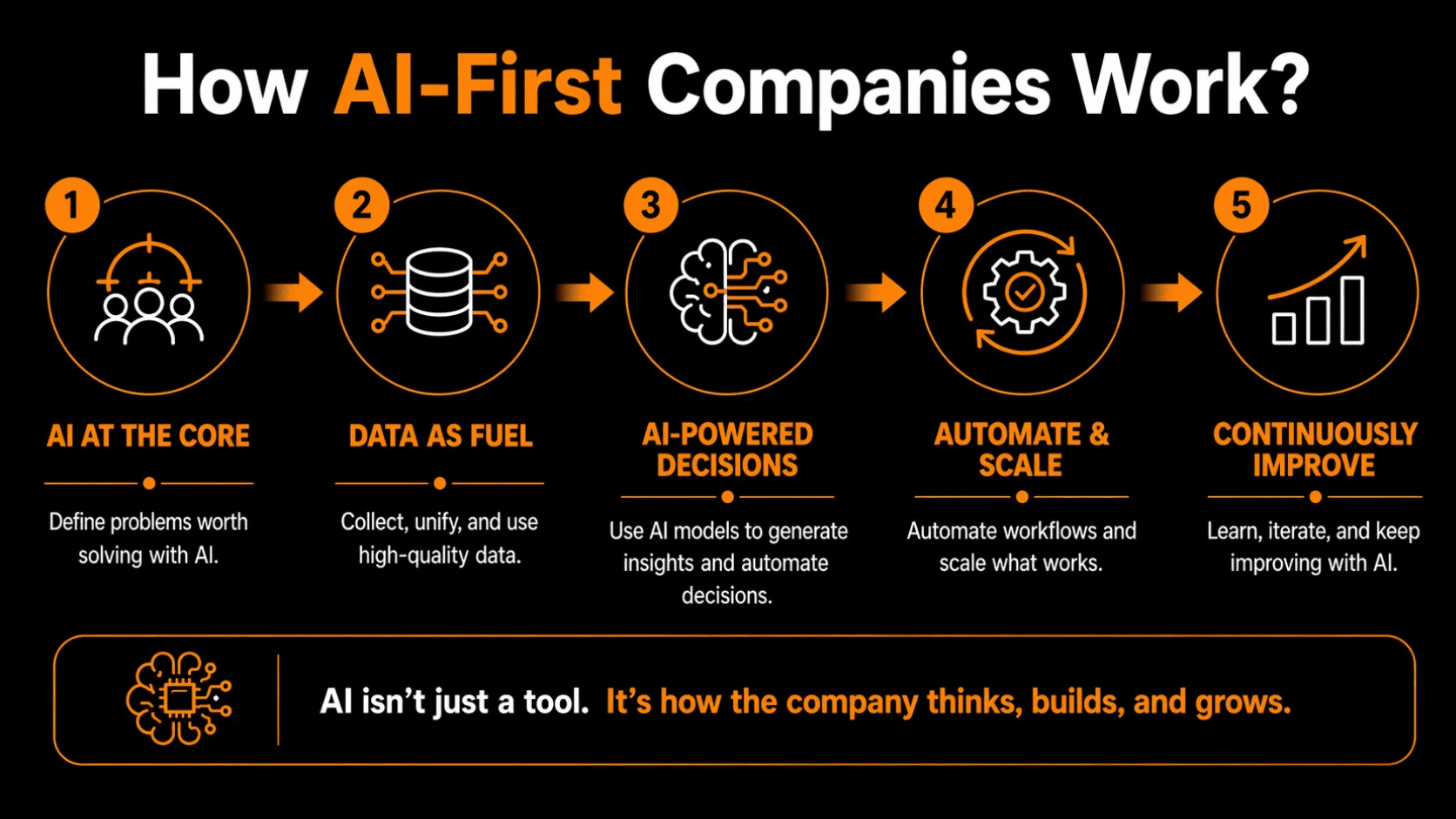
In this case, the enterprise AI adoption strategy roadmap is very important. General businesses will normally start small with automating boring processes and move up to systems that can make intelligent decisions on their own.
The system evolves to a point where AI starts to take over forecasting, personalization, optimization, and even resource allocation. Then, the human teams move from execution to strategy, innovation and supervision.
It leads to a self-improving system over time, where performance gets better with more data.
AI-First vs Traditional Companies: Key Differences
Companies are changing more meaningfully, as the shift from AI first vs digital first companies demonstrates. Simply translating old procedures into digital tools is no longer enough. Instead, businesses are increasingly attempting to create systems that can think, learn, and get better while they work. So technology is no longer an accessory in the background. It now informs decisions and affects how routine tasks are performed.
This difference becomes clear when comparing architectures. Traditional companies often lack structured AI systems, while AI first organizations use machine learning pipelines to manage and improve data driven decision making continuously.
| Aspect |
Traditional Companies |
Digital-First Companies |
AI-First Companies |
| Core Approach |
Rely on manual or semi-digital workflows |
Focus on moving existing workflows online |
Redesign workflows using intelligence and automation |
| Workflow Handling |
Processes depend heavily on human effort |
Forms, communication, and processes are digitized |
Workflows are continuously optimized using AI-driven logic |
| Decision Making |
Decisions are based on reports that are often outdated |
Faster access to digital reports and dashboards |
Real-time decisions supported by continuously updated data systems |
| Scalability |
Scaling requires proportional increase in manpower |
Improved scalability through digital tools |
High scalability with minimal increase in operational complexity due to automation |
| Operational Efficiency |
Slower and resource-heavy operations |
Moderately efficient due to digitization |
Highly efficient as AI handles repetitive and complex tasks automatically |
Many traditional companies are now transitioning toward AI-driven models alongside emerging technologies like Web3 – explore how in our blog on Asset Tokenization Development Services.
Traditional Business Models: Limitations
Human driven processes are the foundation of conventional company models and this naturally brings limitations to companies growth.
One of the major constraints is delay. Decisions have to go through multiple layers of approvals and data often moves slow between departments. This makes it less responsive, and slows down execution.
Another disadvantage is the inconsistency. Human based systems are different from the interpretation, experience and work load. Therefore, teams and regions behave differently.
It’s clear that manual processes struggle to keep up with efficiency at scale when we compare AI automation vs manual processes business impact. The more complex it becomes, the more coordination, communication and time are needed.
These drawbacks show why many companies are moving toward AI-first approaches, but they do not mean that traditional methods are obsolete.
Benefits of AI-First Business Models
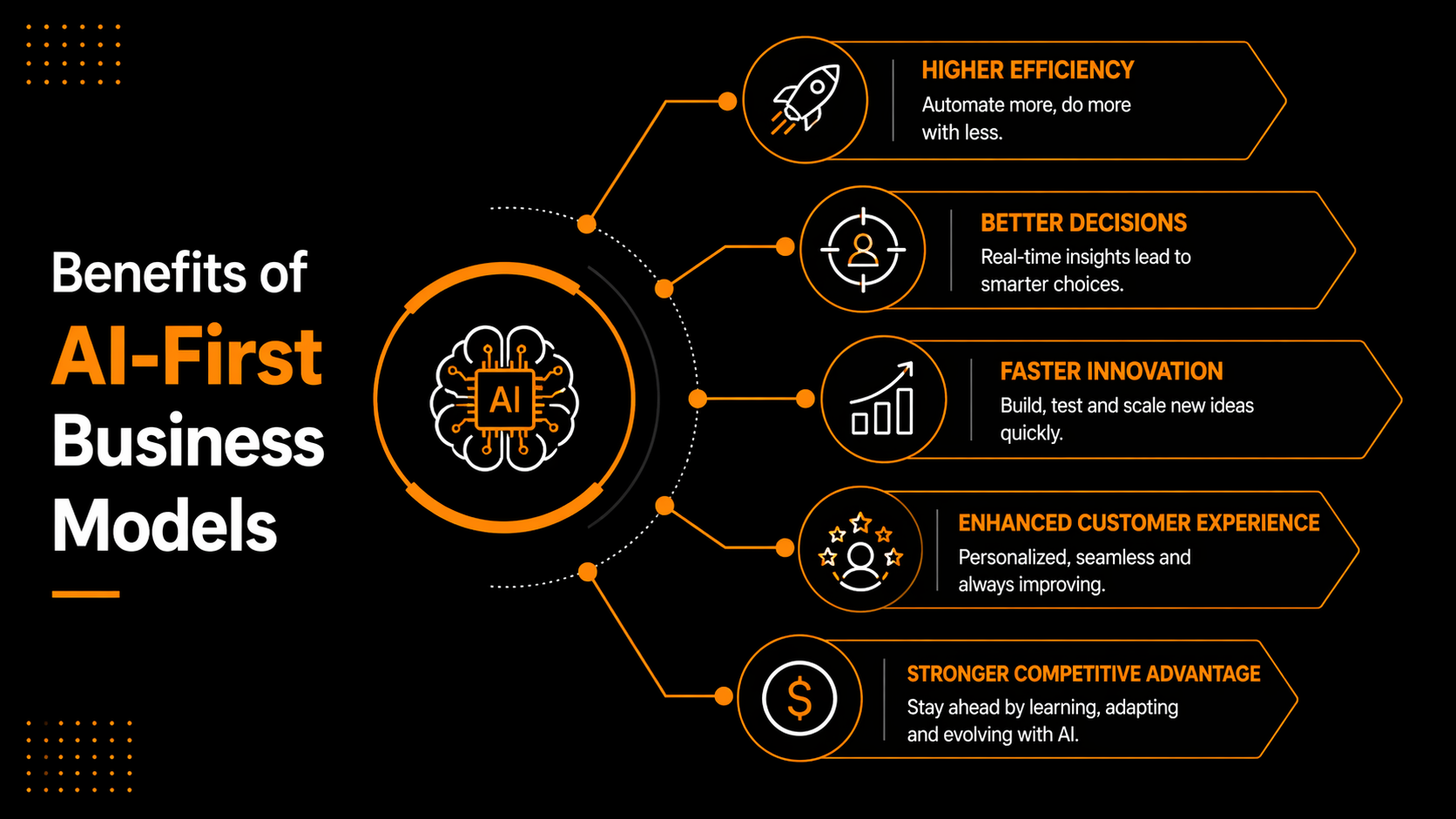
In today’s rapidly evolving digital business landscape, AI-first business models enable businesses to accelerate and innovate faster, make smarter decisions, improve customer experiences, reduce costs, unlock data-driven insights and remain competitive.
Speed of Decisions
With the rapid data processing of AI, businesses can respond quickly, reduce delays and make timely decisions that constantly boost overall performance.
Better Predictability
AI sees patterns in large data. This leads to better forecasting accuracy, less uncertainty and more effective strategic planning for companies’ overall expansion.
Personalized Client Experience
AI can tailor interactions based on user behavior, interests and history to create more relevant experiences that naturally increase enjoyment and engagement.
Enhanced Operational Efficiency
AI handles the mundane tasks allowing teams to focus on more significant work, less human effort, and more accuracy.
Better Business Agility
AI enables fast experimentation, faster adaptation to markets, and can help companies remain competitive in an ever-changing environment.
Unlock the power of AI and future-proof your business
Real-World Examples of AI-First Companies
While companies might not explicitly describe themselves as AI-first, we are already seeing AI catalyze meaningful business transformation in nearly every industry.
Streaming services have recommendation algorithms that learn from what viewers watch and make recommendations that are relevant and feel natural to each viewer.
- AI in e-commerce platforms is being used to understand consumer purchasing behavior, set smarter prices and anticipate future needs to make shopping more personalized and seamless.
- AI in finance makes systems safer and more responsive by detecting anomalous transactions, assessing credit risk and allowing for quicker decision-making.
- AI has also transformed the healthcare industry, helping doctors interpret scans and identify early signs of disease, often picking up on subtle clues that are easy to overlook.
- Logistics companies also use AI for very useful purposes, such as planning delivery routes, reducing delays and saving costs.
And all of this shows one simple thing. AI is no longer just a background tool in modern companies, it’s becoming a core part of how they operate. Businesses are now using dedicated AI development services to actually build and deploy these systems in real-world environments.
How AI Improves Business Efficiency?
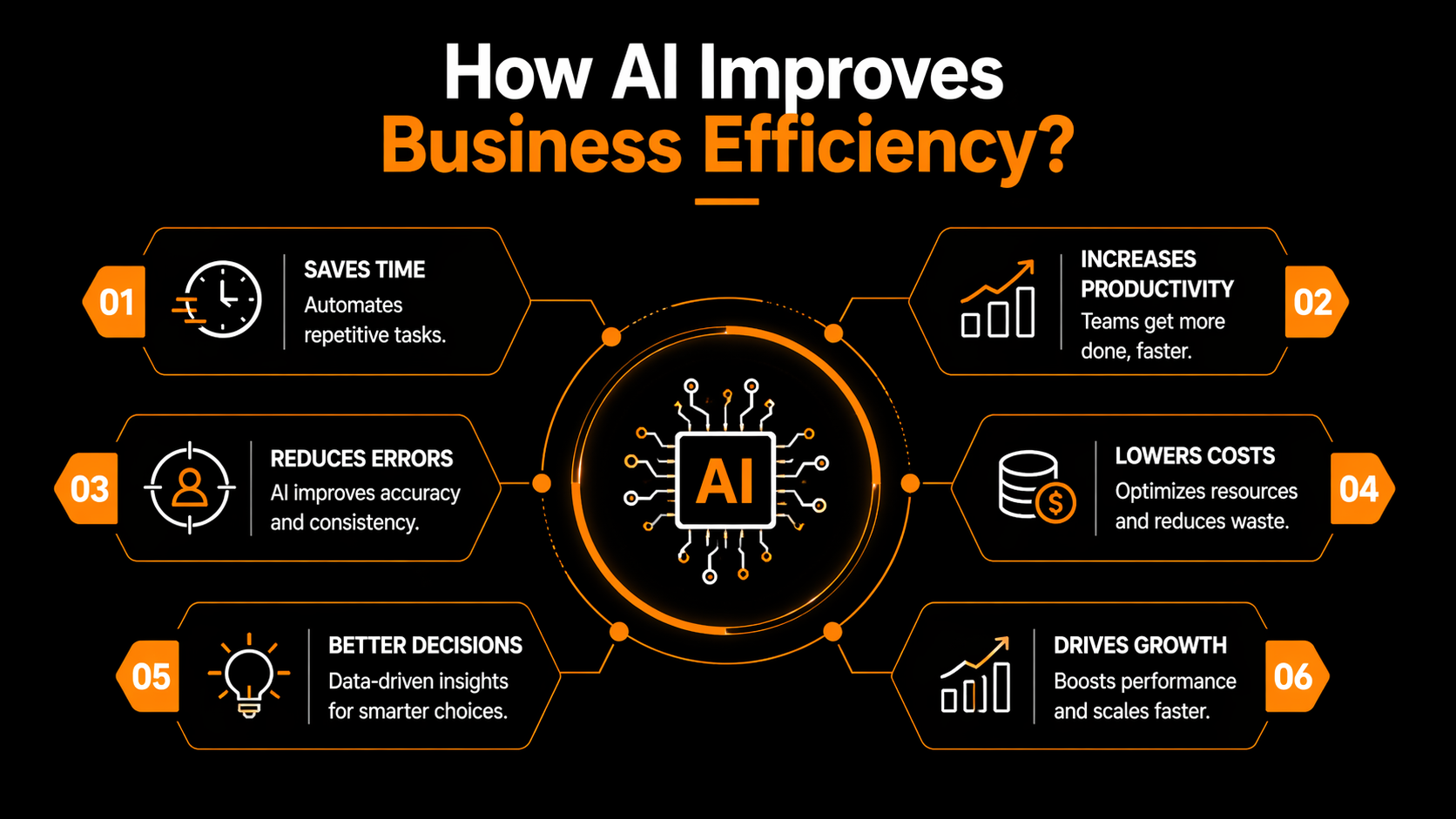
AI increases productivity by eliminating tedious tasks, and the need for human coordination.
It enables businesses to process massive amounts of data in seconds, automatically generate reports and identify inefficiencies that would be hard to find manually.
This is when the benefits of AI automation in business operations start to show more clearly.
Customer service systems, for example, can automatically answer frequently asked questions. AI can be a tool for marketing teams to optimize campaigns and segment audiences. Finance teams can automate forecasting and reporting.
The result is quicker execution and more uniform quality of output across the firm.
Challenges in Becoming an AI-First Company
There are several non-tech hurdles to cross when switching to an AI-first model.
One of the biggest issues is data quality. AI systems require clean and well-structured data. Poor quality data can lead to poor results.
The second problem is cultural resistance. Workers used to traditional workflows may be skeptical of automated technologies at first.
Another major challenge is integration with legacy systems. Many companies are still operating with legacy infrastructure that was never designed to support modern AI tools.
Last is the problem of cost and skill. For some firms, it could be difficult to invest in the infrastructure and qualified personnel to develop AI systems.
Future of AI-First Companies in 2026
The future of AI-driven enterprises is expected to be impacted by more automation and independent decision-making systems. By 2026, many organizations will likely use AI agents to manage entire workflows, from running operations to analyzing data. Client experiences will also be more personalized, with systems instantly adapting to user behaviour.
As AI becomes more advanced, businesses will increasingly depend on technology partners to build scalable intelligent systems.
Early adopters of AI will have a huge advantage because, while others are still in the transition phase, they will already have systems and improved models. This is not just a technology upgrade, but a structural change in the way companies operate. According to Gartner, AI will remain a top strategic technology trend.
Conclusion
So what is an AI-first company really about? It’s about building a company where intelligence is built in, not attached later.
These businesses are built to keep learning, adapting, and improving. Hence they often win on speed, efficiency and scalability over traditional organizations.
As industries evolve, the shift to AI-first models is becoming more and more essential for long-term competitiveness.
Ready to turn your business into an AI-first powerhouse?
Frequently Asked Questions
1. What is an AI-first company?
An AI-first company is one that designs its systems, products and decision-making processes around artificial intelligence, rather than as an add-on tool.
2. How do AI-first companies outperform traditional businesses?
They drive AI-based technologies that speed up decision making, cut down on manual effort, and boost accuracy through continuous data learning, outpacing traditional organizations.
3. Why are AI-first companies growing faster?
They grow faster because they remove operational bottlenecks, grow through automation and they use machine learning and real time data to continuously improve their systems.
4. Can traditional companies become AI-first?
Yep. Traditional businesses can make the transition by gradually introducing AI technologies, enhancing their data architecture and re-engineering procedures to integrate intelligence at their core.
5. What industries benefit most from AI-first strategies?
Given their heavy dependence on data, automation and fast decision making, sectors like finance, healthcare, e-commerce, logistics and SaaS are likely to see the biggest gains.
6. What are the challenges of becoming AI-first?
The main barriers are poor data quality, resistance to change by the team, interaction with legacy systems and cost of using AI.
7. What is the difference between AI-first and digital-first companies?
Digital-first businesses bring processes online, while AI-first businesses reinvent those processes with automation and intelligence at their core.
8. Do AI-first companies replace human workers?
Not really. AI-first businesses eliminate repetitive tasks to free up humans for strategy, innovation and higher-value decision-making.
9. What is the future of AI-first companies?
The future involves more autonomous systems, AI agents running the operations and companies using real-time data to improve themselves will constitute the future.