AI-Powered Game Systems: The Future of Game Development
Key Takeaways:
- Core Value: AI-powered game systems transform static games into adaptive, responsive experiences that evolve with player behavior.
- Development Capabilities: From NPC intelligence to procedural generation and adaptive difficulty, AI supports multiple systems working together inside modern games.
- Business Perks: AI reduces development costs, speeds up production, and improves player engagement through automation and smarter game balancing.
- Industry Use Cases: AI is actively used across single-player, multiplayer, and live-service games for behavior modeling, matchmaking, and content generation.
- Future Trends: The next generation of games will feature evolving worlds, long-term NPC memory, and AI-driven narratives shaped by player communities.
Why Is AI Redefining Modern Game Development?
Simply put, AI powered game systems explained are game creation tools that incorporate artificial intelligence to make gameplay smarter, more adaptable, and dynamic. Rather than simply following the rules written by developers, these systems learn, adapt, and react to player activity in real time. Thus, AI based game design systems are becoming an integral part of modern game development. This shift aligns with how modern studios are adopting advanced pipelines similar to our AI Development Services to build intelligent and scalable game ecosystems.
Games are becoming more than static experiences, which is why this change is so intriguing. Their behavior is starting to look like that of biological systems. Gameplay changes on how players actually play. Worlds react to foes learning. The AI in real time game mechanics don’t feel like interacting so much with software as entering a living space powered by AI.
Artificial intelligence is quietly changing the way games are made and played, from smarter opponents to shifting storylines.
What Are AI-Powered Game Systems?
AI-powered game systems are mechanisms within games that employ artificial intelligence to enhance the behavior, responsiveness, and adaptability of the game. These systems give flexibility to the games , rather than everything being predetermined . These intelligent systems are also transforming cross-platform ecosystems, similar to insights shared in how cross-platform gaming is transforming the industry.
Classic game design is based on static logic . All possible outcomes need to be spelled out by the developers . This strategy is altered by contemporary AI based game design systems, which enable behavior to change in response to player actions and data patterns.
What this means in practice is that the same game can play a little differently based on how someone plays it. The structure stands the same, but the experience becomes more personal.
At a deeper level these systems improve decision making inside games, make character behavior more realistic and allow environments to shift based on interaction. One of the main reasons the industry is taking AI seriously for the development of games.
How AI Works in Game Systems?
Artificial intelligence doesn’t think like a human in video games. Rather, it depends on machine learning models that emulate intelligent behavior and decision systems that detect patterns. According to Forbes, nearly 87% of game developers are already using AI-driven tools to automate testing, balance gameplay, and reduce manual development effort.
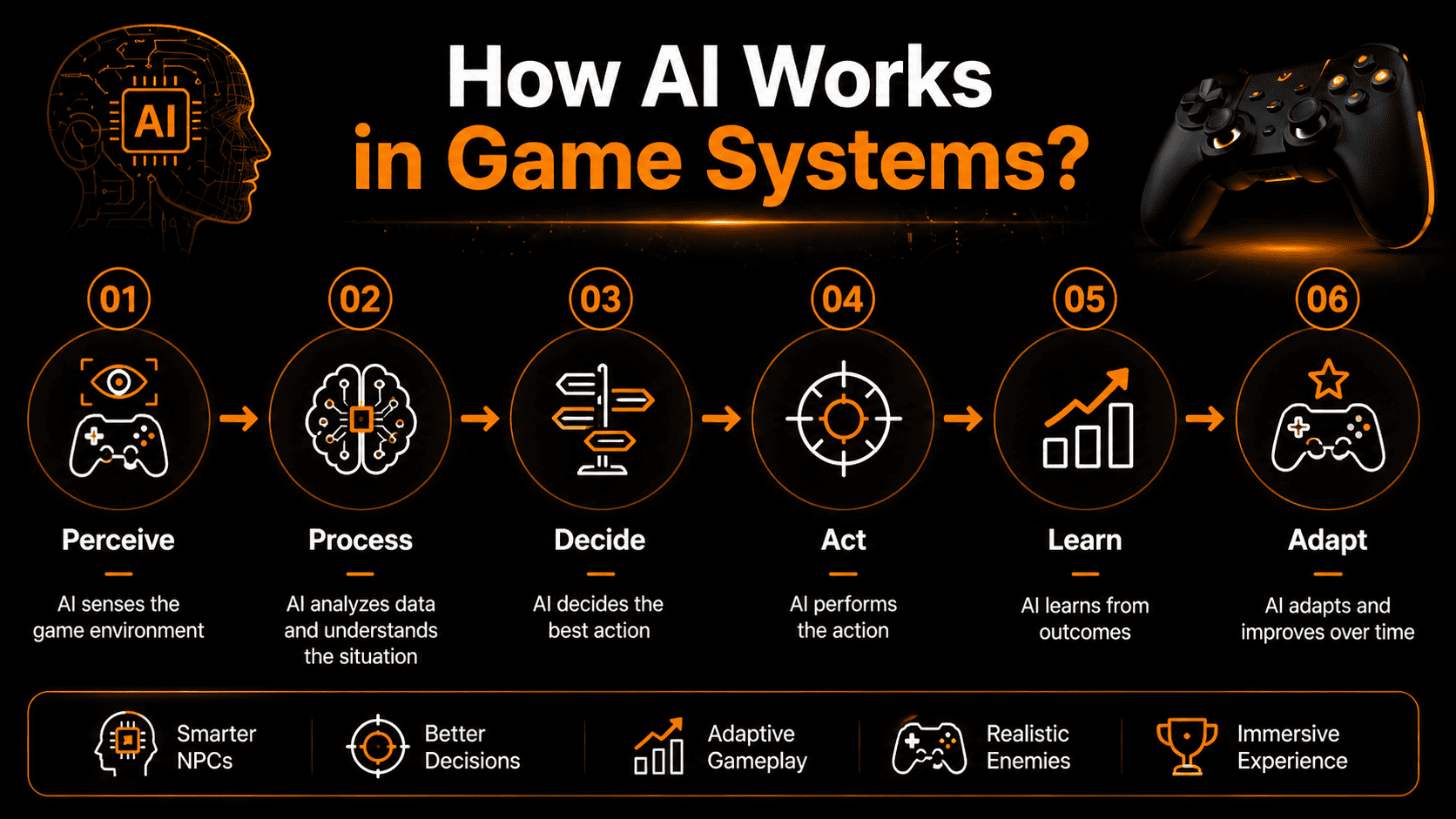
The system constantly watches player activity, interprets that data and then reacts using a combination of learned behaviour patterns and preprogrammed logic.
For instance, in AI in real time game mechanics, if a player regularly performs distant attacks in a shooting game, the system may alter the behavior of the adversary. Enemies will start to group together, use cover better, or try to get in close faster.
More refined systems can recognize patterns over longer periods of time and adjust across multiple gaming sessions. That keeps things balanced, but makes the experience less predictable and more responsive.
Types of AI Game Systems
Modern games do not use a single approach, but rather a set of artificial intelligence systems that work together.
The characters can use pathfinding tools to navigate around areas without getting stuck or behaving unrealistically. During combat , exploration or dialogue , the reactions of enemies and other characters are handled by decision algorithms . The best way is procedural generation using AI, which allows for the dynamic generation of game content, such as environments, levels, and maps, instead of designing it manually.
Another significant group is learning-based systems that use collected gaming data to improve behavior over time. These systems require strong machine learning pipelines to manage data flow, training cycles, and model updates efficiently across game environments, similar to how enterprise AI development frameworks are designed to operate at scale.
AI NPC Behavior Systems Explained
Some of the more obvious advancements in contemporary games are AI powered NPC behavior and decision algorithms. These adaptive NPC models are increasingly powered by real-time data pipelines similar to those used in AI agents simplifying healthcare workflows.
In older games non player characters had very simple patterns to follow, like patrolling set routes or attacking on sight. These acts were functional but soon became predictable.
Modern AI npc behavior and decision systems let characters respond in more complex ways. They can change their tactics, coordinate with other characters and change their aggression depending on how the player behaves, depending on the situation.
In some games, NPCs might even react differently depending on previous interactions with the player. This creates an illusion of memory and makes the game world feel more connected and believable.
Procedural Content Generation Using AI
Procedural generation using AI is changing how creators build game worlds.
Developers set rules, frameworks and limits, rather than creating every detail by hand, while artificial intelligence creates the actual content.
You can create maps, missions, geography and environmental features with this technique. The result is a world that feels bigger and more varied, without a lot of handwork.
It also increases the replay value, as players are less likely to run into the same layout, or the same sequence of events, over and over. And even within the same game, each session may play out a little bit differently. This approach is closely aligned with scalable content automation strategies discussed in procedural generation future of 3D game worlds.
Adaptive Gameplay Systems Using AI
Adaptive gameplay using machine learning is one of the biggest trends in gaming right now.
Instead of starting at a set difficulty level, the system adjusts itself based on player performance.
This idea is often called dynamic difficulty adjustment using AI. It allows for games to respond in subtle ways such as ramping up or down a game’s difficulty based on the performance of a player.
This can both lower the hostility of the opposition and improve the availability of resources for a struggling player. Stronger challenges might be introduced if a player is doing really well, so they don’t get bored.
The goal is to create a balanced experience that feels organic, not like something that’s being artificially managed. This approach aligns with IBM’s explanation of machine learning systems, which continuously improve outcomes based on data rather than fixed instructions.
AI in Multiplayer and Live Games
In the context of the internet today, AI systems in multiplayer games are essential.
They are used for matchmaking and balancing, tracking behavioral trends, detecting cheating, and improving communication security. Many studios now rely on enterprise AI assistants to monitor live data streams, automate moderation tasks, and support real-time decision-making across multiplayer environments.
These systems can also analyze engagement trends in the context of live gaming. If a player seems disinterested , the system might change rewards or suggest different modes to improve retention .
This will help build healthier and more stable gaming communities in the long run.
Benefits of AI-Powered Game Systems
AI-powered game systems improve both development workflows and the overall player experience. For developers, AI reduces repetitive tasks like manual testing and helps balance and scale complex game environments more efficiently.
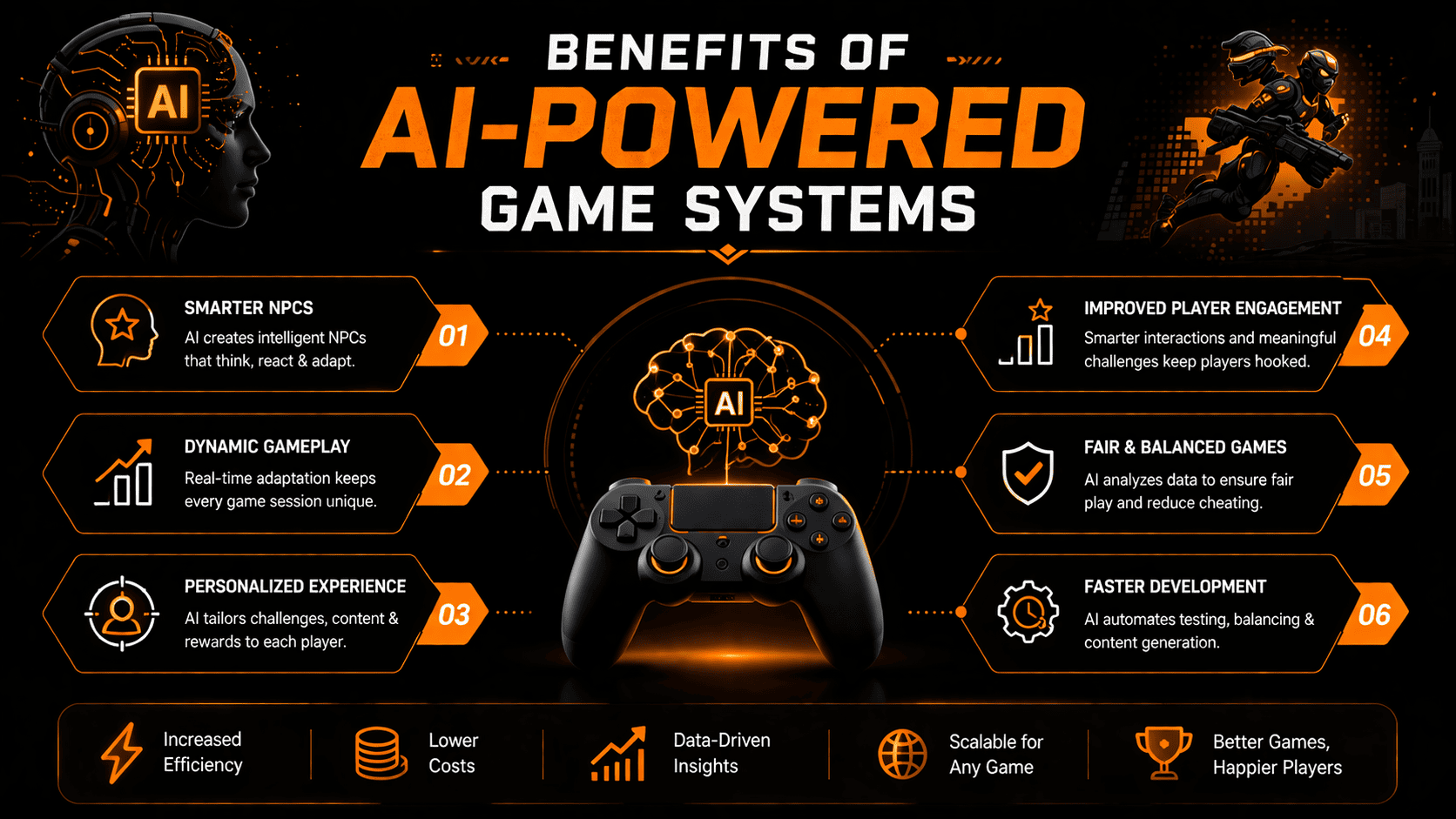
For players, AI creates games that feel responsive and alive. Worlds adapt to player behavior, gameplay stays fresh, and experiences feel more personal with every session. Studies highlighted by Forbes show that AI-driven gameplay experiences can increase player engagement and retention by up to 20%.
At the same time, industry analysts estimate that AI could reduce game development costs by up to 50%, unlocking nearly $22 billion in global industry value, through automation and efficiency gains.
Faster Game Development
AI tools speed up development by automating testing, reducing repetitive tasks, and helping teams focus more on creativity. These benefits are why many studios are investing in game development services by ChicMic Studios to scale AI-driven experiences.
Smarter Game Balancing
AI continuously analyzes gameplay data to fine-tune difficulty, pacing, and mechanics, creating smoother and more enjoyable player experiences.
Dynamic Game Worlds
AI enables worlds that change based on player actions, making environments feel alive, reactive, and different with every playthrough.
More Realistic Characters
AI-driven characters react naturally, learn from player behavior, and feel less scripted, adding depth and realism to gameplay.
Personalized Player Experience
AI adapts challenges, content, and interactions to individual players, making each game session feel tailored and more engaging.
Challenges of AI in Game Development
There are benefits to artificial intelligence in games, but there are downsides as well.
The biggest issue is the unpredictability. Traditional testing can’t properly assess dynamic behaviour, so AI for game testing and automation systems are often needed.
Additional concerns include significant computing demands and the necessity to balance fairness with creative control over generated content. AI has the potential to produce uneven or unbalanced experiences if not handled properly.
And developers have to carefully steer these mechanisms to make sure they add to the gameplay, not detract from it.
Addressing these challenges requires robust engineering practices similar to those outlined in blockchain development services complete guide.
AI vs Traditional Game Systems Comparison
Traditional game systems rely on fixed rules and scripted behavior. AI-powered systems adapt in real time, creating more dynamic gameplay and responsive player experiences.
The table below highlights the key differences between the two approaches.
| Feature |
Traditional Systems |
AI-Powered Systems |
| NPC Behavior |
Scripted and predictable |
Adaptive using AI NPC behavior and decision systems |
| Game Worlds |
Handcrafted levels |
Procedural generation using AI |
| Difficulty |
Fixed settings |
Dynamic difficulty adjustment using AI |
| Development |
Manual design |
Supported by AI game engine integration |
| Experience |
Repetitive gameplay |
Adaptive using machine learning |
Future of AI Game Systems
Artificial intelligence is leading us towards fully adaptive systems that behave more like living ecosystems than traditional software in game creation. This shift is already visible across the industry, with many leading studios actively integrating AI into their development pipelines. Several of these companies are highlighted in industry roundups such as the overview of game development studios adopting AI-driven approaches.
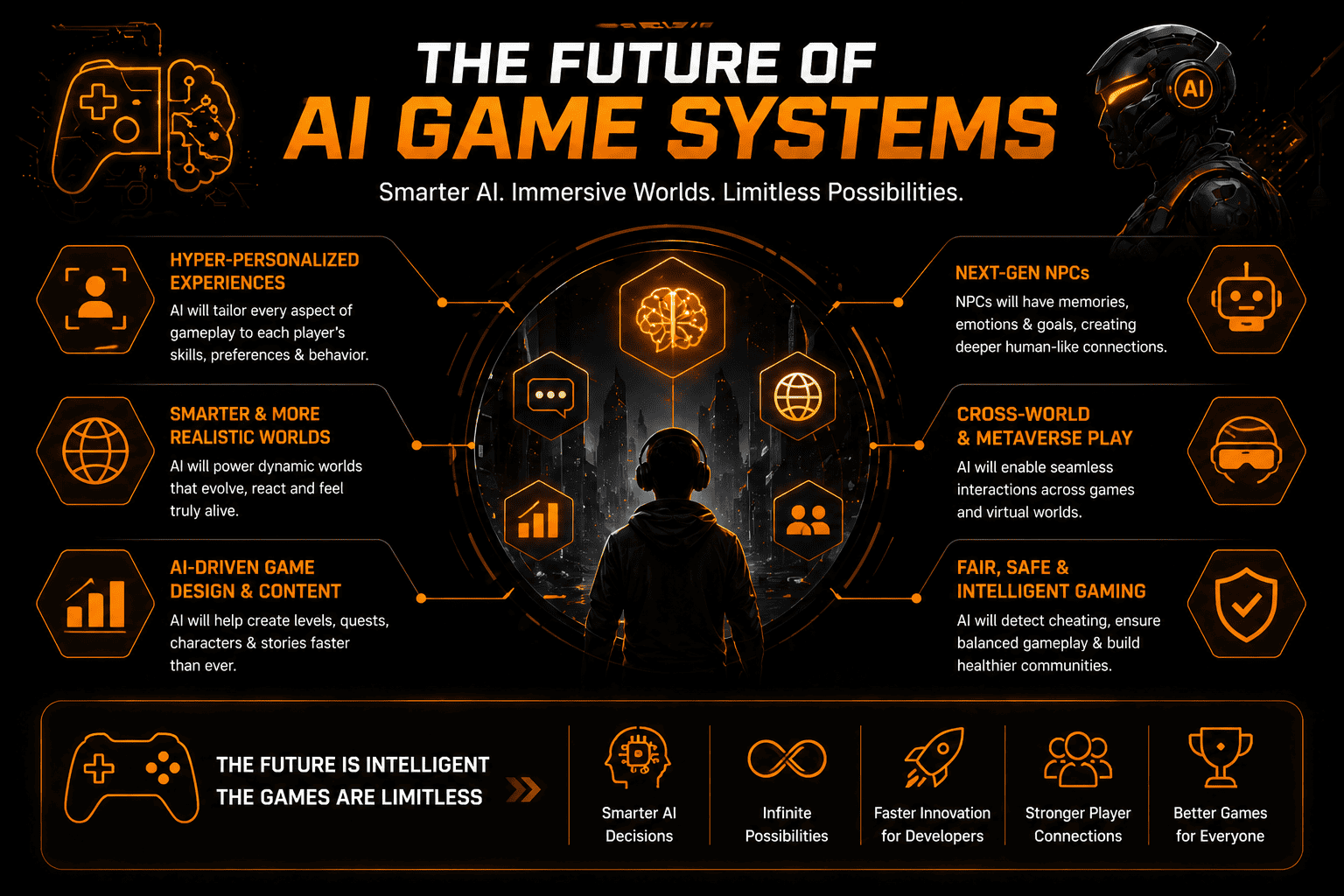
Games are expected to respond to not just individual players but whole communities. NPCs might develop longer memory systems . Surroundings might change in response to group behavior . Storylines might develop dynamically rather than follow a pre-determined trajectory .
In the future, a lot of the technical framework will be taken care of by AI based game design systems, allowing developers to spend more time on creativity, narrative and emotive design.
Final Thoughts
Game developers won’t be replaced by artificial intelligence. It’s changing the way they make games. Development is becoming intelligent, efficient and fast with AI game engine integration and AI for game testing and automation.
Games today are dynamic systems. They are dynamic experiences shaped by the behaviour of the players and by the technologies of AI based game design.
And this change is only the beginning.
Frequently Answered Questions
1. What are AI-powered game systems?
Artificial intelligence is used in AI gaming systems to affect gameplay. The game reacts to your choices and actions, rather than simply following a set of pre-determined rules. The gameplay feels less monotonous and more dynamic and responsive as a result.
2. How is AI used in game systems?
AI is commonly used to make gaming characters act more realistically and intelligently. Also, it allows for the automatic generation of environments, maps and material during gameplay. On top of that, AI can adjust difficulty on the fly to match a player ‘s skill level.
3. What are examples of AI in games?
In many games, AI is used to create enemies that change their approach based on how you play. Others deploy AI to generate environments that are new every time you start a new session. AI is also being used in multiplayer games to match players and detect unfair behaviour.
4. Why are AI systems important in games?
AI algorithms make games more engaging and immersive. They allow the game to react naturally to player decisions, rather than feel preordained. This gives it a better replay value and an all around more pleasurable experience.
5. What is procedural generation in AI games?
Procedural generation” is the use of AI to create game material automatically. You can include levels, maps, 3D environments and even missions in this category. It gives players more variety each time they play and lessens the amount of manual design work.
6. What is the future of AI in game systems?
AI in games has the major goals of more intelligent interactions and personalization in the future. Games will change storylines, challenges and characters based on a deeper understanding of player behavior. The world will be richer, more realistic, truly alive.