See Real Estate Tokenization in Action
Watch our live RWA tokenization platform demo to understand how real estate assets are tokenized, fractional ownership is managed, and rental distributions are processed through a blockchain-powered investment ecosystem.
Investor Returns: Understanding Yields
Returns in tokenized real estate come from two key sources; rental gains and capital gains. Appreciation is the long-term market growth driven by demand, location and macroeconomic conditions. Rental income is the income generated while tenants occupy the property.
Yields on rentals in Dubai fluctuate depending on the cycles of tourism, population growth, the inflow of foreign investment and the expansion of infrastructure. Thus, yields on Dubai property token yields vary significantly depending on the asset type and methodology.
The typical yield behavior is:
- 5%-8% stable annual returns on residential properties.
- Short term rents are between 7% and 12% depending on the occupancy.
- Commercial buildings with long-term stable tenants from 6%-10%
Downtown Dubai and Palm Jumeirah are popular travel destinations and tend to have strong short-term rental properties, especially during peak travel seasons. However, they may change from month to month. Commercial assets focus on predictability of the long term, residential properties are more stable.
Most tokenized real estate investments in the UAE generate 6 to 12 percent blended annual returns when combined with capital appreciation, with stronger assets sometimes beating that in high demand periods. Forbes reports that global prime real estate typically generates 4%–8% annual yields, making UAE tokenized assets competitive in comparison.
The transparency is a great benefit. Blockchain-based dashboards give investors real-time visibility into occupancy, rental income and asset performance, building confidence and closing information gaps.
ROI Comparison: Tokenized vs Traditional Real Estate
To understand the value of tokenization, it’s important to compare it with traditional real estate investment in the UAE. While both are backed by physical assets, their structure and investment experience differ significantly.
| Factor |
Tokenized Real Estate |
Traditional Real Estate |
| Entry Cost |
Low, fractional ownership |
High capital requirement |
| Diversification |
Easy across multiple assets |
Limited by budget |
| Liquidity |
Developing secondary markets |
Slow resale process |
| Management |
Platform-managed |
Owner-managed |
| Transparency |
Blockchain reporting |
Manual systems |
| ROI Structure |
Yield + appreciation mix |
Mostly appreciation-driven |
Tokenized real estate platforms often require Web3 dashboards, investor access layers, and decentralized transaction flows, where Web3 dApp Development becomes highly relevant.
The biggest advantage of tokenization is its flexibility. Investors can spread their money across multiple assets rather than spend a huge amount of money on one property. This allows for a better balanced portfolio strategy and risk management.
Therefore, real estate tokenized investments are becoming the preferred choice of modern investors who value global access, diversification and potential liquidity.
Risk & Reward Analysis
Tokenized real estate offers strong advantages, but it also comes with important risks that investors need to understand clearly. This enables investors to enjoy lower entry barriers, invest in high-end real estate in the UAE, earn passive rental income and diversify their portfolio with a range of assets. This will make it more attractive to foreign investors looking to gain exposure to Dubai property without the operational complexity.
But there are still risks. The platforms are all at different levels of maturity and their ecosystems are constantly evolving. Liquidity remains a work in progress, especially in secondary token markets where trading volumes are still modest. Secondary trading access is a major part of tokenized property liquidity, and Cryptocurrency Exchange Development can support marketplace-style trading for real estate-backed tokens.
Significant hazards include:
- Risk of operation and management of the platform.
- Changes in rules that affect compliance or structure.
- Illiquidity in the secondary market.
- Changes in rental incomes of assets created by tourism
But the UAE is aggressively building one of the world’s most structured regulatory environments for tokenized real estate, which is increasing institutional confidence and reducing long-term uncertainty.
Maximizing ROI on UAE Property Tokens
In tokenized real estate, the focus is more on strategy and allocation discipline than speculation when it comes to maximizing returns. Successful investors tend to focus on the quality, location and reinvestment behavior of their assets.
The demand in tourism and global appeal in prime areas such as Downtown Dubai, Dubai Marina and Palm Jumeirah continues to drive performance. Furthermore, these regions continue to have higher occupancy rates which directly affect the stability of rental income.
Successful tactics are:
- Investing in a range of commercial, residential and hospitality properties.
- Reinvesting rental income to compound growth.
- Matching stable-yield and high-yield attributes.
- Select properties with a history of occupancy and demand.
These tactics significantly improve property token profitability metrics over time, particularly when compounded over multiple years versus short holding periods.
Top UAE Platforms Offering Property Tokens
The UAE property token ecosystem is growing quickly, especially in Dubai, as regulatory clarity and fintech innovation are making it possible to invest in fractional real estate with clear ownership on the blockchain and automatic revenue distribution.
1. RealT UAE (Tokenized Real Estate Access Model)
RealT UAE uses blockchain tokens to provide investors with fractional ownership of income-generating properties. It has automatic rental payouts, clear asset backing and simple real estate investment with potential for passive income and worldwide access.
2. Prypco (Dubai Real Estate Token Platform)
Prypco offers a regulated digital platform for fractional investing in Dubai real estate. It simplifies property ownership by providing investors access to tokenized assets with transparent reporting, structured compliance and distribution of rental income.
3. SmartCrowd (Fractional Property Investment UAE)
SmartCrowd enables investors to buy shares in pre-screened Dubai homes and get rental income. The fully managed platform offers monthly dividends, easy entry into the UAE real estate markets and diversified real estate exposure.
4. Stake Properties (Global Access to Tokenized Property)
Stake Properties provides international investors with an entry into Dubai real estate through fractional ownership. It combines portfolio diversification, rental income distribution and blockchain transparency to increase the accessibility and digital efficiency of real estate investing.
Real-World Case Studies
Real-world performance gives realistic expectations for UAE property token returns. While tokenization helps increase access and transparency, location and demand cycles and asset fundamentals remain the determinants of real profits in Dubai’s real estate market.
1. Dubai Marina Residential Token Case
Steady mid-single-digit yields for Dubai Marina residential tokens are driven by demand for waterfront properties, long-term tenants, strong occupancy rates and ongoing investor interest in upscale, reputable residential real estate areas in Dubai.
2. Downtown Dubai Short-Term Rental Case
Short-term rental tokens for Downtown Dubai yield better monthly returns during increased tourism periods. It can be seasonal demand, international events, luxury travel cycles, and dynamic pricing in major city zones that will impact the results.
3. Business Bay Commercial Property Case
Commercial tokens in Business Bay, unlike residential and short-term rental property segments, provide stable income over the long term backed by corporate tenants, structured lease agreements, strong demand in the business district and lower volatility.
4. Palm Jumeirah Luxury Villa Case
The exclusivity of the beachfront, the need for luxury travel, seasonal variations in the cycles of high-end hospitality real estate, and ultra-wealthy international renters generate high rental income from Palm Jumeirah luxury villa tokens.
5. Dubai Silicon Oasis Emerging Market Case
Dubai Silicon Oasis tokens are seeing moderate yields, but with long term growth potential. Demand for affordable housing, growing infrastructure, a growing tenant base and popularity amongst young professionals and families are all contributing factors.
Why Investors Are Choosing Property Tokens?
Tokenized real estate is growing in popularity for structural reasons, not speculation. Availability of quality assets, the ability to diversify quickly and less cash required to access the UAE real estate markets are attracting more and more investors to the UAE real estate markets.
The leading reasons include:
- Lower barriers to entry than traditional property ownership.
- Ability to diversify across a large number of real estate holdings.
- Exposure to the highly in demand Dubai real estate markets.
- Automated rental distributions (Passive Income).
- Greater likelihood of liquidity in the future.
That’s why investor-friendly UAE property tokens are resonating with institutional and retail investors seeking efficient real estate exposure.
Future Outlook for UAE Property Token Investors
The future of tokenized real estate in the UAE is closely tied to legal progress and increased institutional adoption, with the help of Dubai Land Department (DLD) and the Virtual Assets Legal Authority (VARA), which are helping to formalize the ecosystem across property sectors. For UAE-focused property token projects, ChicMic’s Real-World Asset Tokenization in UAE guide explains how businesses can align tokenization models with regional market expectations.
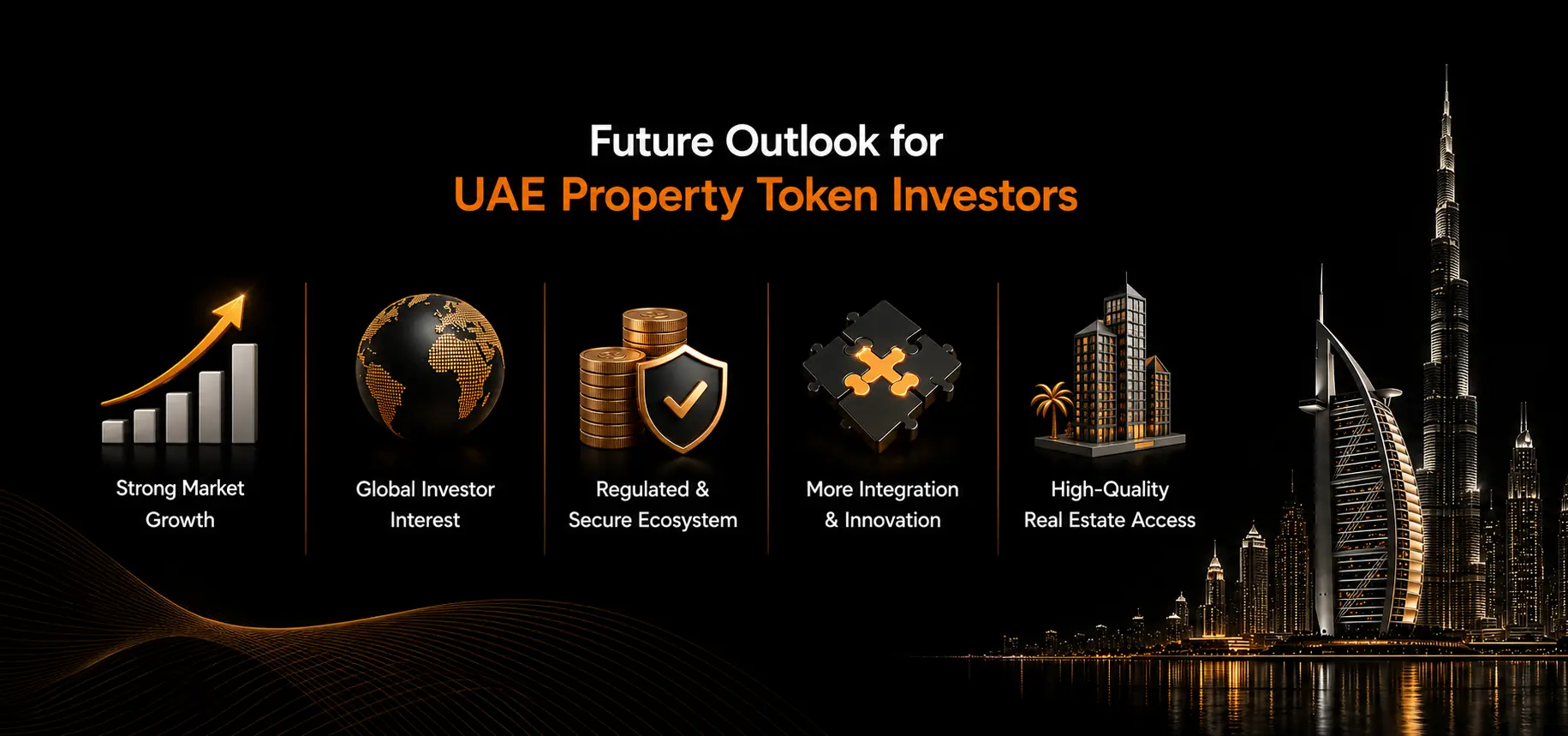
With the enhanced reporting requirements for yields and more secondary market liquidity the market is expected to evolve into institutional real estate portfolios, improving efficiency and transparency for investment and current holding.
As UAE property token returns become more widely known, international participation increases and tokenized real estate will gradually become a common investment structure in the UAE property market.
Wrapping Up
UAE property token returns are not just another asset class, they are a structural change in real estate investing. The UAE is developing one of the world’s most advanced regulated tokenized property ecosystems to offer investors greater accessibility, diversification and transparency. Tokenized real estate is expected to form a core component of the region’s modern real estate investment strategy as the market evolves. For founders planning a full property tokenization product, ChicMic’s Blockchain Development Services Guide explains the technical foundation behind secure blockchain-based business platforms.
Frequently Asked Questions
1. What are UAE property tokens?
UAE property tokens are digital tokens that represent fractional ownership in real estate assets. They allow investors to earn rental income and benefit from capital appreciation without having to own entire properties.
2. How much ROI can investors expect on property tokens?
Depending on the property type, location, occupancy rates and market conditions, most UAE property token investments yield 6%–12% annually.
3. Are property tokens safer than traditional real estate investment?
They have lower entry barriers, diversification and transparency but not without the risks of market volatility, regulation and platform reliability.
4. Can foreigners invest in UAE property tokens?
Yes, most of the UAE property token platforms do not require international investors to have local property ownership rights or UAE residency.
5. How are yields calculated for tokenized properties?
Yields are calculated on net rental income after expenses and distributed to token holders in proportion to their ownership stake.
6. What are the costs of investing in property tokens?
Depending on the platform, expenses could include platform fees, management fees, transaction costs and even exit or secondary market trading fees.
7. What platforms offer UAE property token investments?
Examples include popular platforms such as fractional investment companies SmartCrowd, Stake, Prypco and other regulated tokenized real estate platforms set up in the United Arab Emirates.
8. How liquid are UAE property tokens?
Some platforms offer secondary markets but liquidity remains in development. Depending on demand and structure of the platform, token sales can take some time.