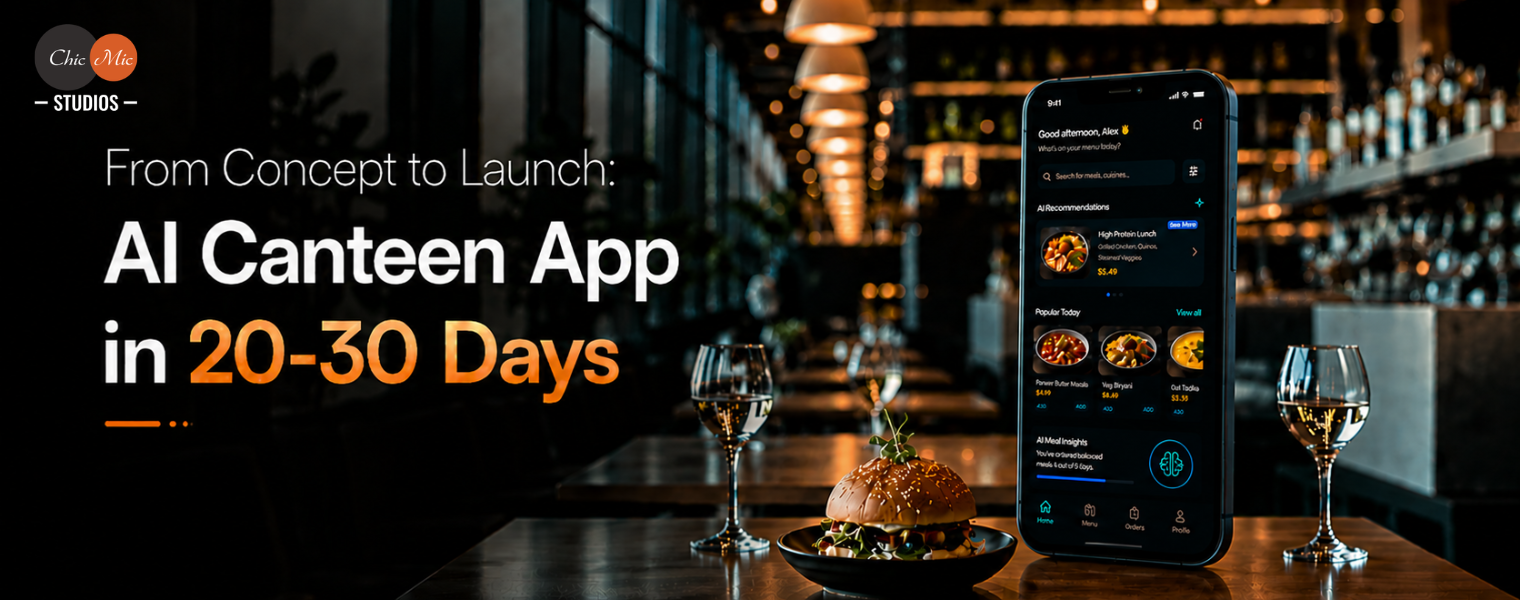
From Concept to Launch: AI Canteen App in 20‑30 Days
Key Takeaways:
- Core Impact: AI canteen apps turn workplace food systems into smart, automated platforms that improve ordering, operations, and employee dining using real-time data.
- Service stack: Includes smart ordering, AI recommendations, analytics, inventory control, and integration with HR and POS systems.
- Business Value: Reduces waste, improves efficiency, speeds up service, lowers costs, and enhances employee satisfaction.
- Industry Reach: Used in offices, factories, hospitals, universities, and large campuses for large-scale meal management.
- Future Trends: Generative AI, predictive procurement, nutrition tracking, and sustainability features will shape next-gen systems.
Introduction
Many workplaces quietly use artificial intelligence for meal ordering, offering customized menus based on employee preferences, streamlining kitchen operations, and making daily dining easier at corporate and enterprise locations. Learn more about our AI development services for enterprises that can help streamline business workflows and integrations.
Food at work is no longer just a supporting role. It has become an important part of employer branding, operational effectiveness, and employee experience. According to McKinsey & Company, AI adoption has accelerated significantly across enterprise operations, especially in workflow automation and decision intelligence, with nearly 70% of companies now using AI in at least one business function. This shift reflects how deeply AI is now embedded in modern business processes. Traditional cafeteria systems cannot keep pace with the growth of offices, the proliferation of teams, and rising employee expectations. That’s why companies in the US and elsewhere are closely watching the progress of AI canteen app development. For a deeper understanding of AI-powered automation in enterprise applications, check out our guide on How AI is Assisting and Transforming Mobile App Development to see real-world examples.
The speed at which such a system can be built takes many decision makers by surprise. With modern cloud infrastructure, pre-trained AI models, and a focused development approach it is possible to implement a fast app deployment 20-30 days from idea to live deployment. This blog explains how that process works, what makes it possible and why businesses are embracing intelligent food systems more than ever before.
What Is an AI Canteen App?
An AI canteen app is a centralized digital solution to manage end-to-end corporate food services. The whole process is controlled by a smart canteen ordering system that learns and improves with time, replacing printed menus, human tokens, spreadsheets or approximations.
The app is a simple mobile interface for employees to view menus, place orders, customize meals and receive real-time kitchen updates. It offers administrators and culinary teams insight into operational effectiveness, inventory consumption, and demand.
See our completed project in action: AI Canteen App Portfolio to understand how we implement intelligent workplace food systems.
The defining feature is intelligence, using a simple food application. Only orders are handled. AI-powered food ordering app scans user behavior. It looks at what workers order, when they order it, how demand changes over the week and which meals perform best in particular situations. This intelligence enables the system to automatically eliminate inefficiencies, predict demand and offer recommendations.
In large US corporate offices, AI canteen apps are often integrated with HR and wellness systems. AI-based canteen management is used by campuses and manufacturing facilities worldwide to cater to large amounts of meals without the need to employ additional staff or waste food. Discover how Web3 applications are transforming enterprise software and how they can integrate with smart canteen solutions.
Benefits of AI Canteen Apps for Businesses
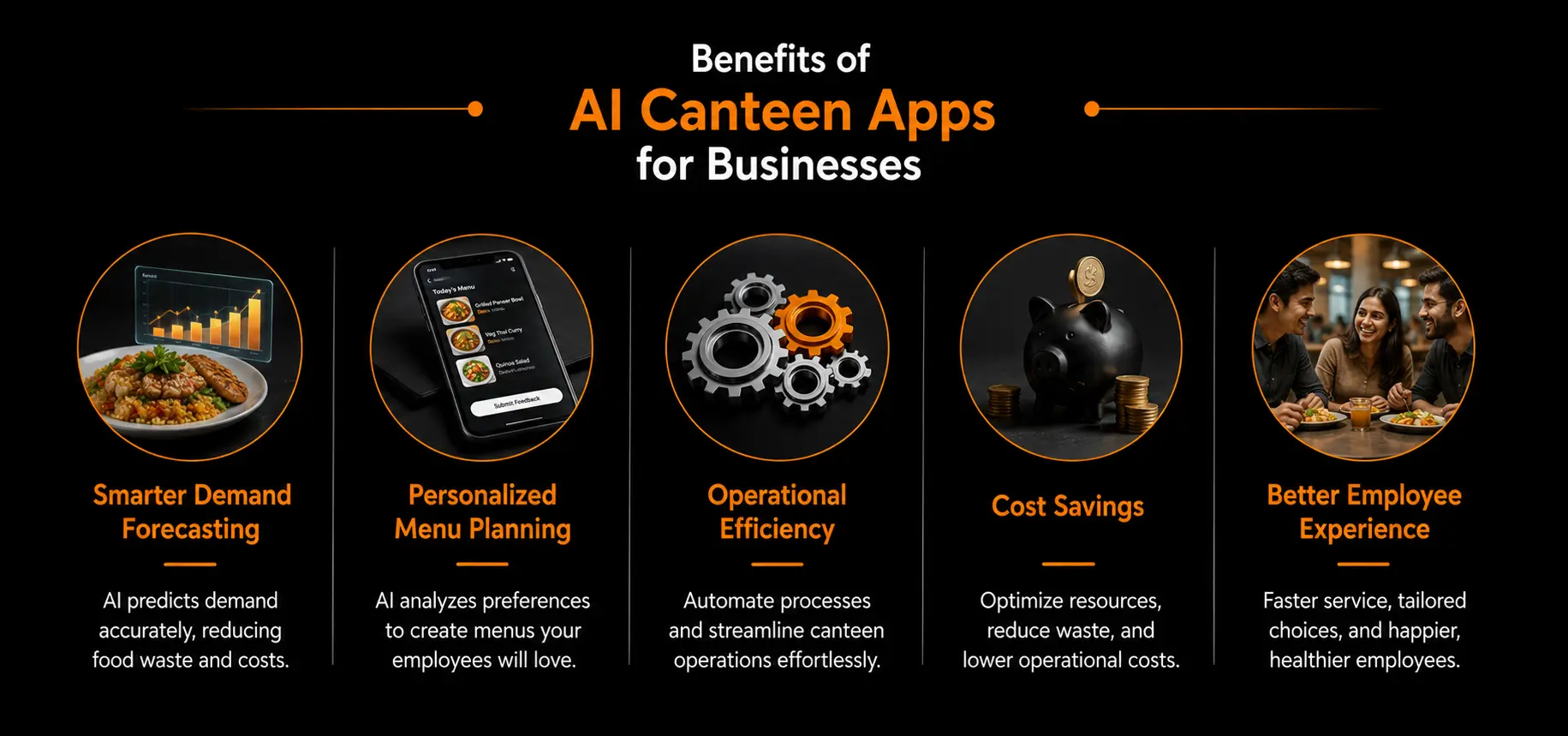
AI canteen apps are helping to enhance employee satisfaction, reduce overall food management inefficiencies in corporate settings, and address daily operational challenges, making them a staple of modern workplaces. They substitute manual canteen processes with more intelligent, data-driven solutions, cutting food waste, improving planning accuracy and making staff and kitchen cooperation easier. Faster, more personalized dining experiences for employees, and greater control over demand, timing and resource use for businesses. Over time this results in more effective workplace food ecosystems that scale easily across huge enterprises and different locations, plus smoother operations and cheaper costs.
- Reduced Food Wastage
AI can predict meal demand using historical and current data and help chefs make precise quantities, drastically reducing daily food waste.
- Improved Operational Efficiency
Automation makes for more efficient workflows and faster meal preparation cycles by minimizing the need for manual coordination between HR teams, vendors and kitchen staff.
- Faster Meal Service
Pre-ordering and AI-driven kitchen planning accelerate preparation and delivery during peak hours so that employees have shorter wait times.
- Enhanced Employee Experience
Personalized menus, real-time updates and simple ordering make workplace dining more convenient, predictable and pleasurable for employees.
- Better Cost Control
Predictive analytics supports companies in managing food costs by streamlining inventory, limiting waste, and improving the overall efficiency of kitchen resource planning and utilization.
Core Features of a Smart AI Canteen App
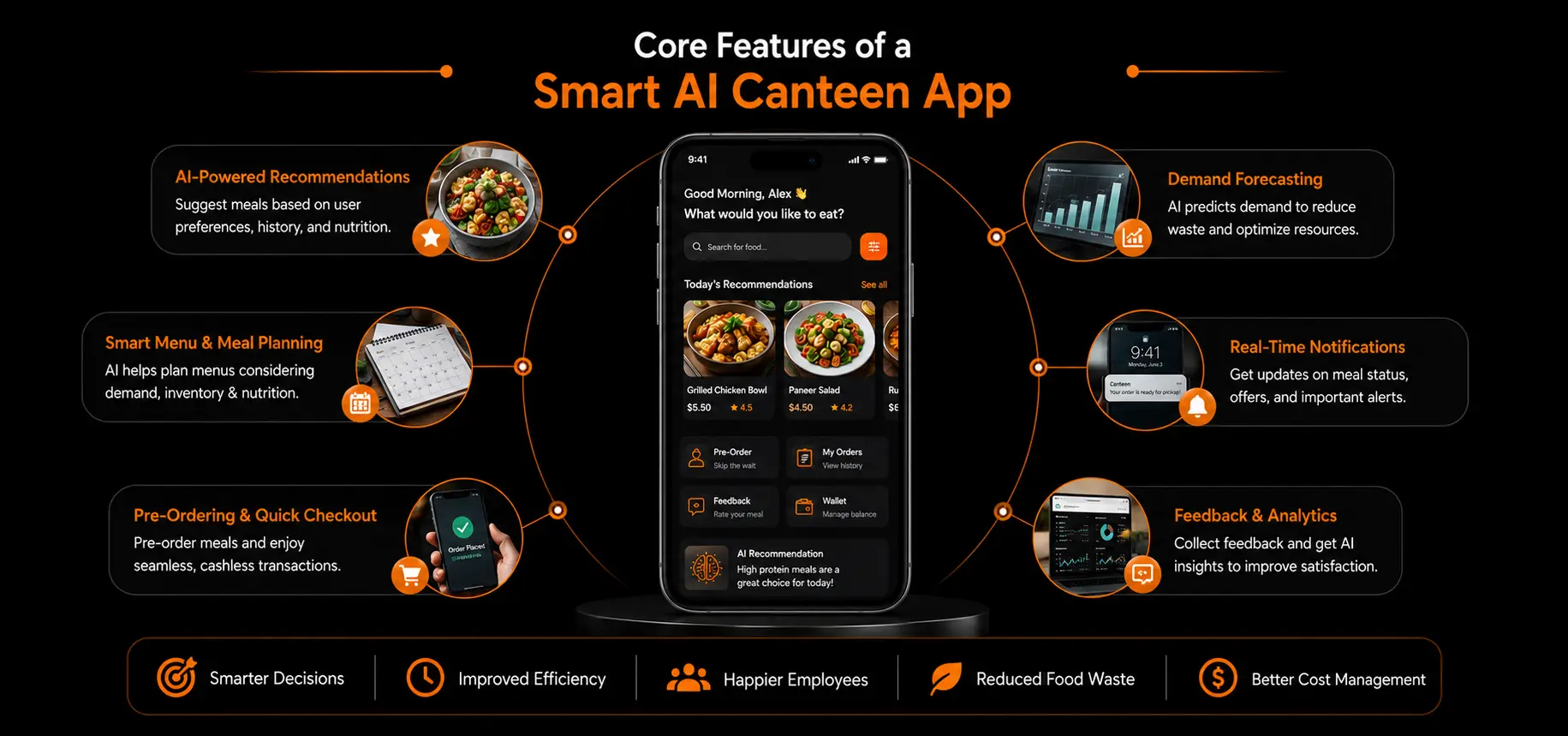
The goal of an intelligent AI canteen software is to simplify meals for staff while also providing administrators with insightful data to continuously improve operations. It’s a single, integrated system that combines ordering, personalization, analytics and automation and that gets smarter over time as it learns from usage trends. The platform relies on real-time and historical data to accelerate food planning, reduce waste, and improve service quality instead of using manual coordination or guesswork. The goal is to simplify the process of food choice and ordering for staff and, at the same time, improve decision-making for management and kitchen teams by providing accurate, data-driven insights that increase overall efficiency across the entire canteen ecosystem. For more on building enterprise-grade apps, check our mobile app development services that integrate AI, analytics, and user-friendly design.
- Simple Employee Experience
Via a quick, simple, user-friendly mobile interface, staff can browse menus, customize meals, place orders, set schedules, and receive notifications.
- AI Menu Recommendations
AI recommendation engines analyze user behavior, order history, preferences and time trends to deliver personalized meals that increase engagement and enjoyment.
- Admin Dashboard Insights
Dashboards that monitor demand trends, menu effectiveness, kitchen productivity, and consumption data can assist administrators in making informed decisions around planning and operations.
- Connected System Intelligence
Order data is continuously fed to AI models, which improves forecasts, optimizes menus, reduces waste and creates a self-learning canteen environment.
Technology Stack for Fast App Deployment
Today, with modern architecture, cloud systems, modular design and scalable technologies, apps can be delivered fast by 20 to 30 days fast. A thoughtful tech stack ensures all tiers are able to work in collaboration to allow speed without compromising scalability, security or performance.
This stack is designed for enterprise-level AI canteen systems where reliability and fast scaling are critical.
Core Technology Stack
| Layer |
Purpose |
Technologies Used |
| UI/UX Design |
Creating an intuitive and user-friendly interface for employees and admins |
Figma, Adobe |
| Mobile App Development |
Building a cross-platform app for Android and iOS |
Flutter (Dart), Android Studio, Xcode |
| Backend Development |
Managing core app functions like users, orders, and system logic |
Firebase |
| AI / Smart Features |
Powering recommendations, personalization, and demand insights |
Generative AI APIs, Python-based ML models |
| Quality Assurance |
Ensuring performance, stability, and bug-free experience |
Selenium, Manual Testing |
| Cloud & Hosting |
Supporting deployment, scalability, and real-time operations |
AWS |
| Integrations |
Connecting payments and enterprise systems |
Stripe / Razorpay |
| DevOps & Monitoring |
Automates deployment and monitors system health |
GitHub Actions / Jenkins |
Step by Step Development Timeline for 20-30 Days
In order to provide fast delivery, a clear and organized plan must be established for the whole process, and every step must be defined and done in parallel to save time without losing quality. The success of a 20–30 day development cycle depends on how well discovery, design, development, testing, and deployment are integrated, not managed separately. Working as a team with common objectives and constant communication makes it easier to avoid delays, reduce rework and keep consistency across the product. This systematic method ensures that every step leads directly to the final product. It is practical and dependable, and allows for fast delivery.
- Discovery and Planning
This phase’s main objectives are to understand company objectives, user workflows, legal constraints and to define the general scope of the AI canteen app.
- Design and Architecture
We create wireframes, map user-journeys and set the system architecture so that teams can develop smoothly in parallel.
- Development Phase
AI is trained and frontend, backend are developed in parallel. Core functionality like ordering and payments is more important than advanced intelligence features.
- Testing and Validation
Discussions are made on the accuracy, stability and performance of the system. The relevance and usefulness of AI output, e.g. menu suggestions, are discussed.
- Deployment and Launch
Finally deployment is done with cloud configuration and rollout preparation to kick off AI canteen app development smoothly in the next 20 to 30 days.
AI Algorithms for Menu Recommendations
The AI canteen system has an intelligence core, the AI menu recommendation engine, that constantly learns from the user’s behavior to offer highly customized and context-aware meal recommendations. It uses machine learning models to look at a variety of data signals, such as order history, ordering frequency, time of day, dietary preferences, and seasonal consumption patterns to predict what employees are most likely to select. Modern generative AI systems further enhance this capability by creating more adaptive and personalized recommendations based on real-time user behavior.
The tech is always changing recommendations in US business environments based on changing lunch hour habits, workplace occupancy changes and hybrid attendance trends. It also further adapts to regional cuisines, cultural dietary preferences, and varying shift schedules across different office settings globally to keep the recommendations locally relevant and applicable.
It becomes more precise and polished with every interaction. The more data you analyze , the better predictions get. This means inventory can be planned more intelligently and demand can be forecasted more accurately. This means less food waste as resources are allocated and prepared more accurately.
Testing and Quality Assurance Before Launch
Testing is a critical step that ensures the AI canteen application is safe, dependable, and ready for use in the real world. It guarantees the proper functioning of all the system components, under normal and extreme conditions, ensuring correctness, stability and a seamless user experience across the platform.
Functional testing makes sure that all the important workflows such as ordering, meal customization, payments, and order tracking are working properly so that the staff can use the system without any errors or interruptions. The performance testing simulates peak meal times and heavy traffic scenarios to assess the behavior of the system under high demand so that the platform is always fast, responsive and stable.
The validation testing of AI is focused on the system’s intelligence layer to ensure the menu suggestions are accurate, contextually relevant, and aligned with user preferences and company objectives.
Security testing is done in the following important areas: To protect sensitive information and system access:
- Safe payment processing
- User authentication and access control
- Data protection and privacy measures
- Vulnerability detection and blocking
Compliance testing is to ensure that the application is compliant with organizational and regulatory standards when integrated with corporate systems like HR systems, POS infrastructure, etc. Compliance testing is to ensure that the system is secure, scalable, and ready to be deployed into production.
Cost of Developing an AI Canteen App
The set of features, AI integration level, and deployment scale all influence AI canteen app design cost. A basic minimum viable product (MVP) with core features such as ordering, menu management, AI-based suggestions, etc., is fairly affordable compared to traditional enterprise food management systems.
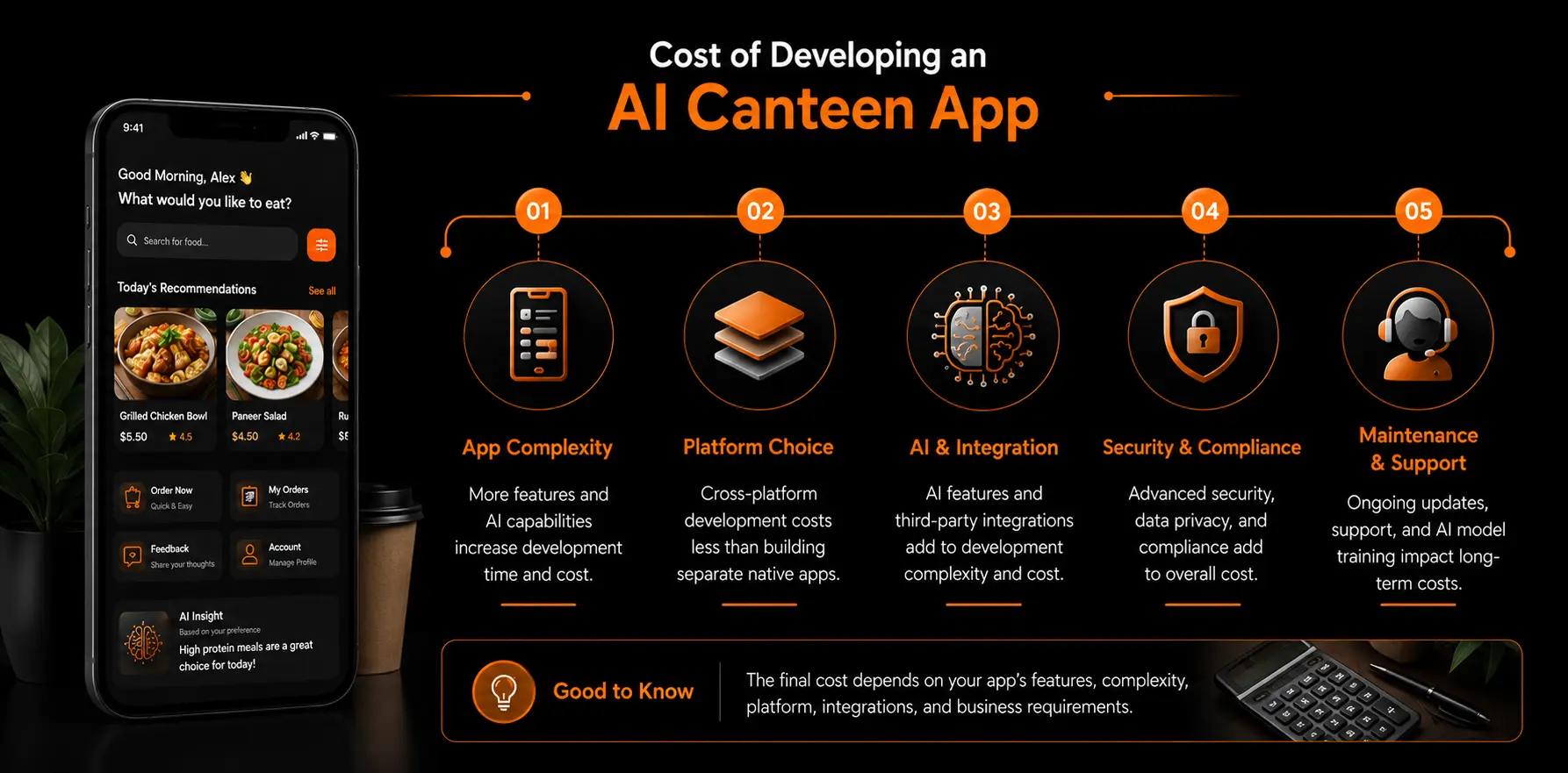
The costs increase as the system becomes more advanced and includes features such as real-time analytics, bespoke AI models, predictive demand forecasting, and multi-location support. Integration with external systems like payment gateway, POS systems and HR platforms can also add up to the total development effort and money. Total cost depends on:
- Complexity level and feature customization
- Data needs and complexity of AI models
- The magnitude or extent of the deployment
- 3rd party integrations (payments, POS, HR)
Despite the investment, most businesses see significant long-term profits. The solution is important financially and operationally as it decreases food waste, increases operational effectiveness and improves employee satisfaction in the long run.
Choosing the Right App Development Company
The long-term success of an AI canteen app depends on choosing the right development partner. The quality of the team directly affects the effectiveness of the development of the system, its scalability and its ability to accommodate changing needs. Besides performing the technical build, a competent development company also contributes to the overall system design, architectural decisions and product thinking. The right partner makes sure that the platform is built with scalability, security and real-world enterprise usage in mind from the get-go, cuts down on unnecessary complexity and helps align business objectives with the technology plan. This is where modern AI development capabilities play a crucial role in building scalable enterprise-grade applications.
- AI Expertise Required
Look for teams that have experience in integrating AI and machine learning to ensure accurate recommendations, smart automation, and continuous improvement of the system, as highlighted by IBM.
- Enterprise System Experience
Choose developers with a history of creating enterprise-grade applications to ensure scalability, reliability, and seamless integration with your business processes and IT infrastructure.
- Cloud Architecture Strength
Experience in cloud computing ensures scalable, high-performant and secure infrastructure, allowing for a smooth deployment at multiple sites for real-time operations.
- Scalable Product Design
The group needs to create a modular, flexible architecture that makes scaling, adding features, and maintaining the system over time easy without breaking or redesigning the system.
Find out why companies choose ChicMic Studios services for enterprise-grade AI, Web3, and mobile app solutions.
Post Launch Optimization and Analytics
The AI canteen app grows with real-world usage, when it’s out there. All those interactions like orders, preferences, timing patterns, they all become data. This data helps the system to better understand worker behavior, improve operational effectiveness and continuously improve performance. Analytics are essential to convert this raw data into useful insights that facilitate better decision making in food planning and management.
- Usage Analytics
Analytics can also be used by businesses to track menu performance, analyze user activity, identify the hours with the highest volume of orders, and improve overall kitchen efficiency, to optimize day-to-day operations and planning.
- Enhancing AI Models
AI models learn from new data all the time, improving demand forecasting, recommendation accuracy and the ability to adapt to changing employee preferences and workplace trends.
- Advanced Expansion Features
The platform can eventually be scaled to include more refined capabilities such as predictive procurement, sustainability measurement and nutrition analytics to create long-term value.
- Strategic Business Impact
This constant optimization and intelligence upgrade makes the AI canteen app more than just an ordering platform. It becomes a strategic tool that drives operational efficiency and enhances employee experience over time.
Conclusion
The AI Canteen App is a game-changer in the management of food services in today’s workplace combining automation, intelligence and real-time data to improve productivity and employee satisfaction. It makes cafeteria operations efficient and data-driven, with quicker meal delivery, less waste, and smarter planning. With the right tech approach, businesses can develop a scalable product that keeps getting better after launch, taking approximately 20 to 30 days to go from concept to launch.
Frequently Asked Questions
1. What is an AI canteen app?
An AI canteen app is a digital platform that uses artificial intelligence to manage end-to-end food ordering, improve efficiency, reduce waste, and enhance employee dining experience in workplaces.
2. How long does it take to build an AI canteen app?
It typically takes around 20 to 30 days to build an AI canteen app when using a structured development approach with cloud infrastructure, modular systems, and pre-trained AI models.
3. What are the key features of an AI canteen app?
Key features include smart ordering, AI-powered menu recommendations, real-time kitchen updates, employee customization options, and analytics dashboards that help improve food planning and operational efficiency over time.
4. How much does it cost to develop an AI canteen app?
The cost depends on features, AI complexity, and scale of deployment, but a basic MVP is affordable compared to traditional systems, with higher costs for advanced analytics and integrations.
5. Can AI canteen apps integrate with POS systems?
Yes, AI canteen apps can integrate with POS systems, HR tools, and enterprise software to ensure smooth data flow, automated billing, and efficient coordination between kitchens and management systems.
6. Who can use an AI canteen app?
AI canteen apps are suitable for corporate offices, manufacturing plants, hospitals, universities, and large campuses where large-scale meal management, efficiency, and employee satisfaction are important priorities.
7. Does it support custom meal requests?
Yes, the system supports custom meal requests by allowing users to modify ingredients, choose dietary preferences, and personalize meals according to health needs, taste, and workplace availability.
8. Can an AI canteen app support multiple locations?
Yes, it can manage multiple cafeterias from one system with centralized control, location-based customization, and unified analytics.