Key Takeaways:
- Core Value: Recently, developers have recognised that AI is becoming the core of how they create games. AI speeds up development, while enhancing realism.
- Comprehensive Services: Game development studios are applying AI to game development processes from asset creation & testing to NPC behavior.
- Business Benefits: Game studios focused on using AI, release higher quality games at a lower cost with enhanced player retention without excessive team expansion.
- Industry Use Cases: The best studios are applying AI in the areas of balancing game-play, creating adaptive behaviours for NPCs, creating better matchmaking systems after a live game release.
- Future Trends: AI is moving toward autonomous systems that provide continuous development of games post-release, enhancing long-term game-play.
What Is AI in Game Development?
In the context of game development, Artificial Intelligence (AI) refers to the application of various types of algorithms. If you’re new to the concept, you can explore what artificial intelligence is in detail from IBM. It also relates to the models of machine learning, and data-driven systems in many aspects of creating and operating games, not just NPC behaviour. It is current practice across all stages of game development in most gaming studios. For a broader perspective, you can also explore how AI vs blockchain in gaming is shaping the future of digital ecosystems.
The use of artificial intelligence in game design allows gaming studios to make better decisions and take better actions at larger scales. This is executed by using AI systems to analyse player data to manage the difficulty of games, predict who may stop playing, and optimise the in-game economies. Developers can also use AI game engines and AI toolsets used for game development to reduce manual workload, to speed up the creation of assets, and to automate the testing of a large number of gameplay scenarios. IBM reports that 42% of enterprise companies have already deployed AI in production, with many more actively scaling it across workflows such as automation, analytics, and decision-making
In addition, a number of game developers are turning to procedural generation instead of manually creating individual levels/environments. Procedural generation offers an efficient way to generate maps, quests and worlds while still feeling hand-crafted. This approach is widely used in modern 3D game development to create expansive and dynamic environments. Also, all of the realistic animations, facial expressions and dynamic dialogue systems within video games are built using neural networks. Now, however, AI is also being used to determine how non-player characters (NPCs), or computer-controlled characters, will behave. Thus allowing NPCs to learn from and adapt to player decisions instead of being restricted by a fixed script.
AI-assisted game development in 2026 will ultimately be used to enhance the creativity of game designers, rather than replace it. Repetitive tasks are handled by Autonomous game development systems, allowing game designers to focus on such important aspects, developing mechanics, and achieving an emotional connection with players. For mobile titles, AI-enabled game engines will enhance the development of game performance, monetization and retention of players more successfully than ever through the use of in-house tuning. Companies focusing on mobile platforms often leverage specialized mobile game development services to optimize performance and monetization.
In short, AI is rapidly becoming the hidden partner helping to produce many of the most popular games today.
Top 10 Game Companies Using AI in 2026
1. Electronic Arts
With a broad set of game title types (e.g. sports games and live-service games), Electronic Arts provides automated machine learning capabilities to create games that deliver a balanced and realistic experience.
AI uses real-world data on how players play games, as well as the characteristics of real-world sports, to model players movements, tactics and level of fatigue. AI-assisted game development can automate quality assurance testing, decreasing bugs prior to launch.
Key impact areas include:
- Real-time gameplay balancing
- Smarter AI-driven player behavior
- Faster content updates in live games
The result is consistency, realism, and faster iteration across massive franchises.
2. Ubisoft
Ubisoft has invested heavily in AI research, particularly around autonomous game development systems. Its open-world games use AI for NPC behavior that responds to time, environment, and player decisions.
Another way that Ubisoft can create vast game worlds without losing realism and quality is through procedural generation. Designers provide a framework with intent. AI then takes that input and creates new, unique options that appear to be completely hand-made.
This approach improves:
- World immersion
- Development efficiency
- Replay value
Ubisoft’s AI strategy is about depth, not shortcuts.
3. Epic Games
Epic Games shapes the industry through unreal engine, one of the most advanced AI game engines available. In 2026, Unreal supports AI-assisted animation, procedural environments, and intelligent NPC systems out of the box.
Epic also uses AI-driven player behavior insights to refine Fortnite’s live events and content cadence. Developers benefit from built-in game AI tools without needing large research teams.
Epic’s biggest impact is democratization. AI is no longer limited to AAA studios.
4. NVIDIA
NVIDIA plays a critical role in AI-powered gaming platforms.With technologies like NVIDIA ACE, developers can build NPCs that speak naturally, remember interactions, and respond emotionally using NVIDIA ACE AI NPC technology from NVIDIA.
These systems rely on advanced neural networks in gaming optimized for real-time performance. NVIDIA’s tools also support AI-assisted animation and voice synthesis.
For developers, this means:
- More believable characters
- Lower production overhead
- Higher immersion standards
5. Tencent Games
Tencent Games uses AI to manage scale. Its AI-driven player behavior systems personalize content, difficulty, and rewards across millions of users.
AI game engines for mobile games are central to Tencent’s strategy, optimizing monetization and retention automatically. Procedural generation in gaming enables rapid content expansion. Learn how AI adoption in business and analytics is evolving based on insights from McKinsey & Company.
Tencent’s strength lies in efficiency and global reach.
6. Activision Blizzard
Activision Blizzard uses AI to improve community health and maintain competitive balance. The use of machine learning models is very important in optimizing matchmaking, balancing weaponry, and creating an anti-cheat system.
Using AI to create more realistic NPCs also enhances both cooperative and enemy AI in our large-scale multiplayer modes.
The outcome of these uses of AI in gaming is fairness, stability and trust in competitive gaming or eSports.
7. Unity Technologies
Unity Technologies supports AI in gaming studios of all sizes. Its engine includes accessible AI-assisted game development tools for animation, navigation, and procedural generation.
Unity is especially strong in:
- AI game engines for mobile games
- Player behavior analytics
- Monetization optimization
This lowers the barrier to entry for smart game design.
8. Take-Two Interactive
Take-Two utilizes AI to improve both the realistic and narrative depth of games. NPCs follow a routine, recall previous actions, and will respond with emotions when using AI technology.
Procedural generation allows for the development of dense and believable environments and helps creators develop animation and user dialogue.
Creating an immersive experience is key to ensuring they do not lose the ability to tell a great story.
9. Sony Interactive Entertainment
SIE utilizes both AI technology in their hardware and AI tools at their first party studios. By using machine learning to improve video game design, they can provide better animations and facial expressions while ensuring they have proper levels of adaptive difficulty.
The use of AI for prototyping will speed up experimentation with ideas so that teams can more quickly improve upon these concepts.
SIE’s use of AI is focused on creating highly polished products that have an excellent cinematic experience.
10. NetEase Games
NetEase relies on AI-driven player behavior insights to evolve live-service games continuously. AI systems adjust content cadence and difficulty in real time.
Procedural generation in gaming supports rapid world expansion, especially for online titles.
NetEase excels at long-term engagement.
How AI Improves Game Development?
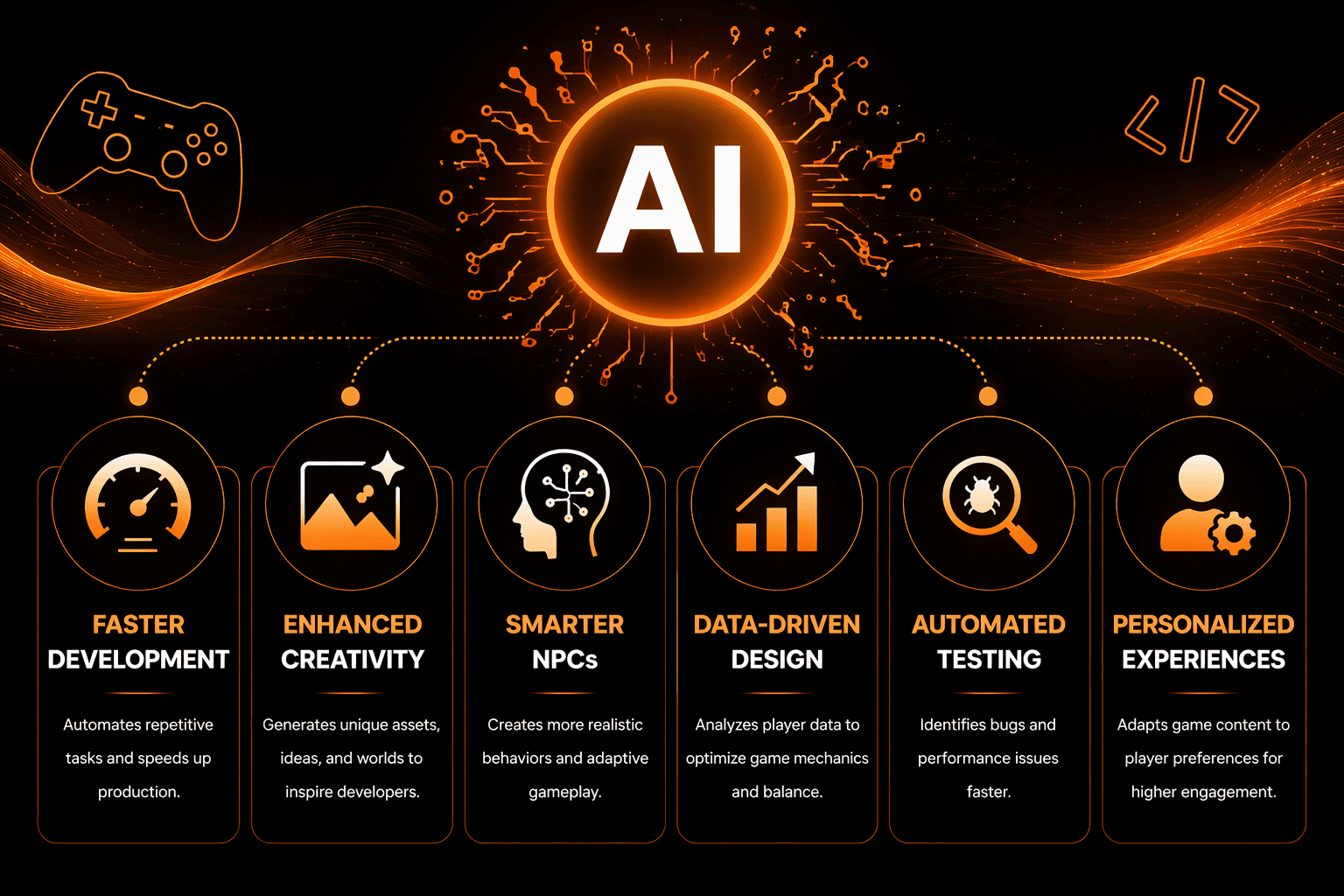
AI in game development decreases the time spent on tedious tasks in a gamer’s workflow. Gamers now use AI-enhanced game development to design, test, and produce prototypes much quicker than before.
Game developers create their assets automatically using AI game engines. They provide smooth transitions from one character to another through blending animations or create levels that have been tested through an AI engine. AI used for ML during the design process allows for the early detection of balance issues within video games, thus reducing the amount of money spent on fixing problems after launching. Many studios integrate these capabilities using advanced AI development services to build scalable solutions.
Some video games today use neural networks for their NPC’s behaviour to change, allowing them to adapt/react to what the player has done instead of being programmed to perform the same activities repeatedly.
Decision-making has been greatly improved by using AI to track player data via behaviour analytics, which provides game studios with an accurate picture of how players play video games, as opposed to conducting surveys that may or may not get the truth from the player.
Artificial Intelligence ultimately gives developers time to be creative, while complex systems can process and scale all data associated with game development. To explore how the industry is evolving, you can read more about how AI is shaping the future of game development.
Benefits of AI in Gaming
AI brings clear advantages to both developers and players, and those advantages go far beyond surface-level improvements. When used well, AI changes how games are built and how they feel to play.
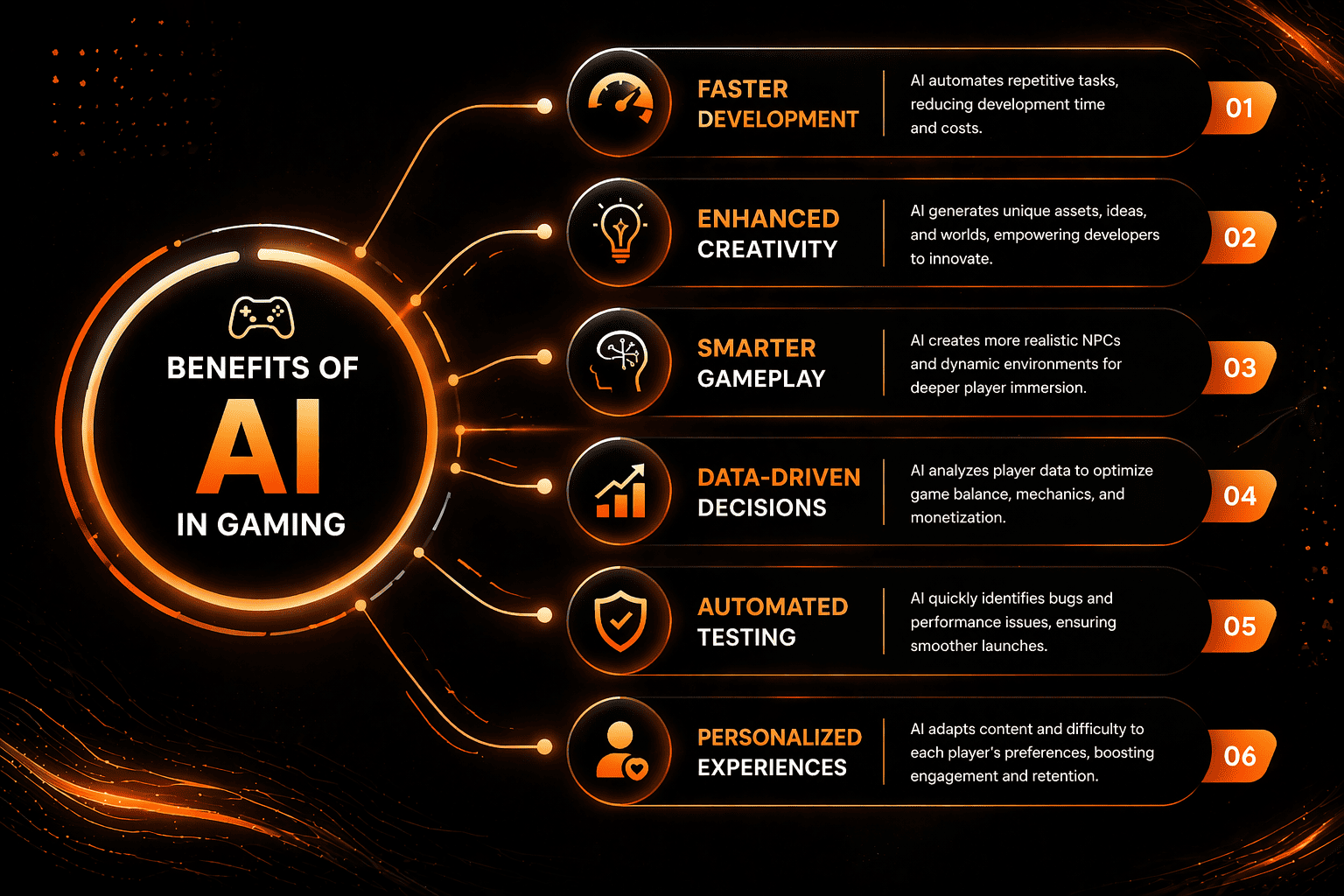
- Faster development cycles with fewer manual bottlenecks
AI-assisted game development automates repetitive tasks like testing, asset cleanup, and balance checks. This allows teams to move from idea to playable build faster, without burning out developers or cutting creative corners.
- Smarter NPCs and more immersive worlds
AI for NPC behavior enables characters to react, adapt, and learn from player actions instead of following rigid scripts. The result is game worlds that feel alive, unpredictable, and engaging over long play sessions.
- Personalized experiences driven by AI-driven player behavior
ML systems analyze how players explore, struggle, or succeed. Games can then adjust difficulty, content pacing, and rewards in real time, making experiences feel tailored rather than one-size-fits-all.
- Reduced costs through automation and procedural generation in gaming
AI tools reduce the need for large manual content teams. Studios can create expansive worlds, varied missions, and frequent updates without proportionally increasing budgets. Many studios adopt cross platform game development strategies to maximize reach while keeping costs optimized.
AI helps optimize processes, reduce repetitive tasks, and deliver smarter decision-making and efficiency gains across business operations. Over time, these gains stack up, making AI not just useful, but essential for staying competitive in 2026.
Conclusion
In 2026, AI no longer represents an experiment in gaming but, rather, it has completely transformed how many of the world’s top gaming studios build their businesses and compete. The leaders of the gaming industry are not chasing fads, these companies are beginning to innovate and build technologies that can learn, evolve and improve through player interactions.
The game development industry is changing the way video games are created and developed. Game studios creating techniques to implement AI into their production processes will be at the forefront of gaming innovation for the next ten years. On the other hand, companies that do not take advantage of the game-changing opportunity AI provides, could very easily find themselves obsolete in the rapidly developing gaming industry.
Moreover, AI will continue to be instrumental in the growth of gaming while serving as an actual partner in the future of gaming.
Frequently Asked Questions
What is AI in game development?
AI in game Development is the process of developing more intelligent, automated systems that provide enhanced gaming experiences.
Why is AI important for game development?
AI enables game studios to work effectively while cutting down on expenses, giving players experiences that are more realistic and enjoyable. AI also provides developers with more believable NPCs due to better behaviours as well as simpler assessment of potential problems.
Which game companies are using AI in 2026?
Right now, the top game development companies actively using AI in the design of their games include Electronic Arts, Ubisoft, Epic Games, Tencent, and Sony Interactive Entertainment.
What is NVIDIA ACE and how does it help game developers?
NI video games with NVIDIA’s ACE, gamers can play video games that contain characters that generate and respond to human conversations.
Is generative AI replacing game developers?
No, generative AI is assisting game developers by automating repetitive tasks. However, human input/skills continue to drive creative direction and story development.
What is the AI in games market size in 2026?
The total value of the video game industry is valued at approximately $269 Billion by 2026, with AI-driven tools growing rapidly as part of that value.
What AI tools do game studios use?
Game studios utilize AI game engines, procedural generation systems, machine learning analytics, and NPC behavior systems.
What are the benefits of AI in game design?
Greater immersion, more personalization for players, faster product development cycle times, improved player retention.
How is AI used in mobile game development?
Mobile games utilize AI to enhance performance, generate additional revenue through in-game purchases, scale difficulty according to the player, and allow for content updates across multiple players and platforms.
What is procedural content generation in gaming?
Procedural content generation (PCG) in video games refers to the application of AI to automatically generate various levels/environments/quests based on design criteria (rules).
Looking to integrate AI into your game?