
$30K – $60K
Basic DeFi dApp
6–12 weeks




















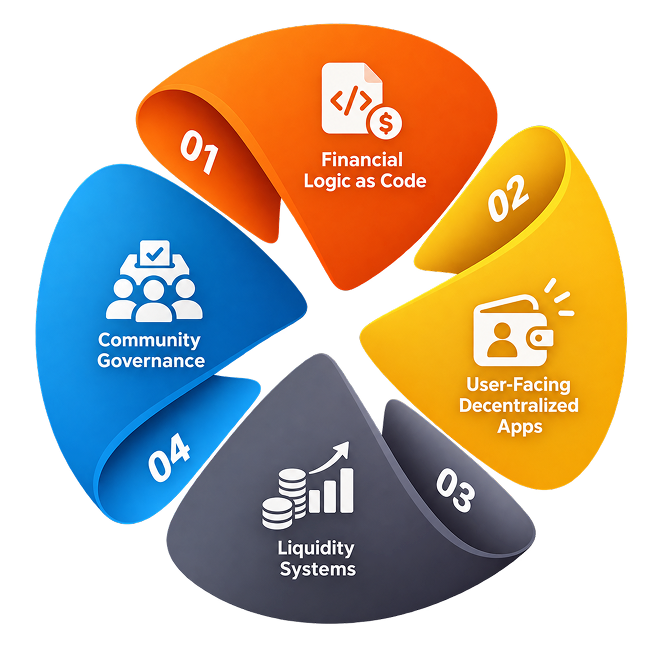
DeFi development means writing the software that replaces financial intermediaries with code. Instead of a bank deciding who can borrow, a broker executing your trade, or a custodian holding your assets, decentralized protocols handle these functions through smart contracts that anyone can inspect. Lending pools, trading venues, yield strategies, and stablecoin systems all run as open, auditable programs on blockchain networks. Building them demands more than ordinary software skills. Developers must master Solidity or Rust, squeeze every drop of efficiency out of gas consumption, wire protocols to reliable price feeds, and think like an attacker to find weaknesses before someone exploits them. Once deployed, these contracts guard real money and cannot be quietly fixed.
Our DeFi platform development services pair your product vision with senior engineers who have shipped protocols handling real capital.

We subject every contract to rigorous security testing before it touches mainnet, protecting your users and the liquidity they provide.

Launch on Ethereum, Arbitrum, Polygon, BSC, or Solana to meet users and capital wherever they already operate.

Our systems handle actual users, actual liquidity, and heavy transaction loads, not just controlled testnet environments.

Governance tokens, staking incentives, and fee structures are designed around your specific growth model and business objectives.

We monitor your protocol after launch to reduce gas costs, strengthen security, and keep it performing competitively.

The architecture, source code, and intellectual property belong to you. No lock-in, no licensing fees, no dependencies on us.
Conventional finance operates through stacked layers of intermediaries, paperwork-heavy processes, and systems that only select institutions can access. This arrangement benefits established players but imposes real costs: higher fees, slower movement of capital, and little room to try new ideas. On-chain finance attacks these problems directly. Every middleman in the chain adds expense, delay, and another place where things can break, and those penalties pile up across settlement, custody, and reporting. DeFi development replaces that entire stack with self-executing contracts that produce predictable results, finalize in moments, and publish their logic for anyone to verify. The business case is straightforward: lower costs to operate, quicker access to liquidity, and products that improve through code updates rather than contract renegotiations.
Legacy infrastructure cannot support programmable finance or composable products. Organizations are locked into slow rollouts. DeFi enables new financial models at the pace markets demand.
Idle collateral, locked reserves, and slow reconciliation immobilize working capital. DeFi's programmatic rails unlock these funds for growth or yield generation.
Every jurisdiction, custodian, and counterparty demands its own reporting. DeFi's unified on-chain records reduce administrative burden and accelerate cross-border activity.
Enterprises rely on the solvency and behavior of intermediaries they cannot audit. DeFi's trustless design removes this exposure to third-party failures.
Every layer of traditional finance, custody, clearing, settlement, and brokerage, takes its own cut. Each transaction an enterprise processes gets sliced by multiple parties. DeFi strips out these layers, dramatically reducing costs.
Geographic borders and regulatory hurdles shut out more than a billion people from basic financial services. DeFi protocols welcome anyone with an internet connection, creating new addressable markets for businesses.
Cross-border payments traditionally take days, tying up capital and introducing counterparty exposure. On-chain settlement compresses this to minutes, freeing funds for productive use.
Users cannot see how centralized institutions manage funds or whether rules are followed. DeFi's transparent, auditable contracts eliminate this opacity and simplify compliance.
As a DeFi dApp development company, ChicMic Studios delivers a broad range of decentralized applications, from trading venues and lending markets to governance systems.
AMM or order-book exchanges with liquidity pools and swap functionality, engineered for deep liquidity, low slippage, and secure, non-custodial trading.
Collateralized loan markets with automated interest rates and liquidations that maintain protocol solvency and protect both borrowers and lenders.
Reward distribution, auto-compounding, and liquidity mining strategies designed to attract capital and retain users through long-term incentive design.
On-chain futures, options, and perpetual contracts with oracle-based pricing, designed for precise settlement and stability in volatile markets.
Collateralized stablecoins and cross-border payment rails with clear reserve and redemption logic for fast, transparent value transfers.
Proposal systems, voting mechanisms, and treasury management that give token holders a transparent voice in protocol decisions and finances.

As a DeFi app development company, we bring the technical depth needed for every protocol to run on-chain safely, efficiently, and resiliently.
Proxy patterns let you fix bugs and add features without migrating, so your protocol can evolve while keeping user positions, liquidity, and contract addresses unchanged.
Accurate pricing, randomization, and external data from Chainlink and Pyth feeds ensure your protocol has reliable inputs for settlement, liquidation, and core logic.
Treasury operations always require agreed consent. Customizable approval thresholds ensure no single key can move protocol assets.
Efficient storage patterns and batch operations reduce user transaction costs, making your protocol more affordable and competitive at scale.
Real-time dashboards for TVL, volume, and protocol health give your team and community a clear view of platform performance.
Pause mechanisms, circuit breakers, and administrative functions support incident response so your team can resolve issues before they affect user funds.
The DeFi development process starts with economic design, progresses through contract engineering, auditing, and testnet validation, and concludes with a secure, monitored mainnet launch.

Define the economic model, smart contract structure, tokenomics, and integration requirements before development begins, so future decisions rest on a validated design.

Develop Solidity or Rust contracts that deliver core functionality while following OpenZeppelin standards, minimizing risk and ensuring security-critical code follows proven patterns.

Conduct unit tests, integration tests, and third-party audits to detect vulnerabilities before mainnet deployment and fix issues before they jeopardize funds.

Build wallet connection, transaction signing, and on-chain data display UIs that let users interact with the protocol easily and securely.

Deploy to testnet for community testing, bug identification, and performance validation under load, confirming the protocol behaves as designed before real funds are involved.

Launch on mainnet with monitoring dashboards, alerts, and ongoing gas and security optimization to ensure protocol resilience as usage and liquidity grow.
We provide DeFi development services for every phase of protocol delivery, including architecture, contracts, wallets, launch, and expert consulting.
As a DeFi platform development company, we build secure and scalable products for protocols, exchanges, tokenization platforms, gaming, fintech, and insurance.






Our DeFi development process moves from economic modeling through smart contract engineering, security auditing, and mainnet deployment, with clear checkpoints at every stage.
We define your protocol's economic logic, tokenomics, incentive structures, and success metrics before any code is written, ensuring technical decisions serve business goals.

We design the contract structure, upgrade patterns, access controls, and integration points, then document the architecture so it can be reviewed and audited.

We implement the core protocol logic in Solidity or Rust, following OpenZeppelin standards and optimizing for gas efficiency across all user-facing functions.

We build the user interface with wallet connectivity, real-time on-chain data, and integrations with oracles, bridges, and external protocols your application depends on.
We run unit, integration, and adversarial tests, then commission a third-party audit to identify vulnerabilities before any contract handles real capital.

We deploy to mainnet with staged liquidity, configure monitoring dashboards and alerts, and provide ongoing optimization for gas efficiency and security.


As a DeFi development company, ChicMic Studios pairs security-first engineering with production experience to deliver protocols built to perform in live markets.
DeFi development cost varies with protocol complexity, security requirements, and the number of chains and integrations involved. Every project is scoped individually, so the ranges below are guides rather than fixed quotes.
$30K – $60K
$50K – $90K
$80K – $150K
$100K – $180K
$120K – $200K+
$200K+


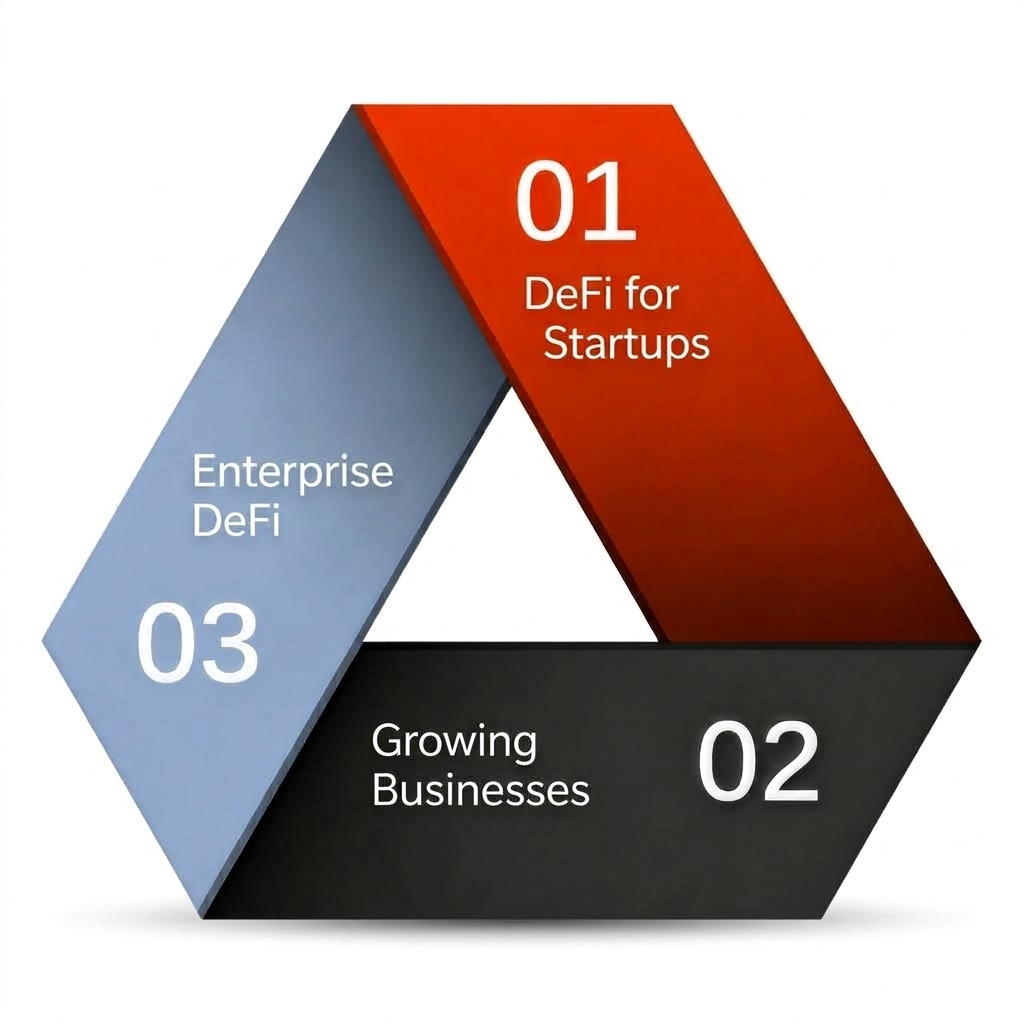
Whether you're launching a new DeFi protocol or adding decentralized finance to an established business, our development approach adapts to your stage and objectives.
Ready to create an impact?
The cost of development depends on the scope of the solution, the readiness of the data, the requirements for.

A DeFi development company designs, builds, and tests decentralized financial protocols on blockchains instead of relying on intermediaries. This includes smart contracts, user interfaces, and liquidity systems for lending, trading, staking, and governance.
A simple dApp starts around $30K, while advanced protocols with multiple audits and formal verification can exceed $500K. A custom protocol with two audits typically ranges from $200K to $500K, and fork-and-customize builds usually start around $80K.
Production-ready DeFi platforms typically take 4 to 12 months. A fork with customization takes 2–4 months, and a bespoke protocol with audits takes 4–8 months. Formal verification of novel mechanisms can extend to 12 months.
We build on Ethereum, Arbitrum, Polygon, BSC, and Solana. Ethereum remains the leading choice for blue-chip DeFi due to its deep liquidity. Solana is ideal for high-frequency, low-cost applications requiring fast finality.
Yes. All protocols we build are audited by third parties before mainnet deployment. Audit costs range from tens of thousands to several hundred thousand dollars depending on scale, and we treat security as a major budget line item.
Yes. We offer end-to-end development from economic modeling and tokenomics to smart contract engineering, frontend integration, and mainnet deployment. Forking is cheaper, but results in code you may not fully understand and must audit and rewrite more often.
A decentralized exchange (DEX) enables peer-to-peer asset swaps using liquidity pools or order books. A lending protocol lets users deposit collateral to borrow assets, with interest rates and liquidations determined by smart contract logic.
We follow OpenZeppelin standards, run extensive unit and integration tests, commission third-party audits, and implement emergency controls like pause mechanisms and circuit breakers. Security of deployed contracts is treated as an engineering discipline, not a checklist.
Yes. DeFi protocols can connect to oracles for pricing, bridges for cross-chain transfers, and external APIs for data. Integration complexity is a major cost driver, so we mitigate dependencies during architecture design.
Yes. Post-launch maintenance includes monitoring, gas optimization, security updates, and protocol upgrades. Active protocols typically require 15–20% of the original development cost annually for upkeep.
2026 © Copyright ChicMic Studios | Privacy Policy | Disclaimer