How to Choose a Blockchain Development Company in 2026
Key Takeaways
- Choosing a blockchain partner in 2026 is a strategic infrastructure decision, not a routine outsourcing exercise with short-term goals.
- The right blockchain company should first understand your business model and validate whether decentralization creates measurable operational value.
- Strong blockchain partners combine development with strategic consulting around tokenomics, governance design, compliance planning, and ecosystem scalability.
- Security must be embedded throughout the lifecycle through smart contract audits, formal verification, testing, and continuous post-launch monitoring.
- Cost evaluation should go beyond initial build estimates and include long-term ownership factors like gas optimization, maintenance, audits, and protocol upgrades.
- Multi-chain architecture expertise is increasingly essential, as modern blockchain products often require interoperability across networks for scale and flexibility.
- The best blockchain development companies act as long-term partners, supporting post-launch evolution, regulatory adaptation, and continuous platform improvement.
Introduction
The choice of a blockchain partner in 2026 is not your typical outsourcing decision of the past. This is a strategic move with high stakes that will decide the long-term survival of your digital infrastructure. The criteria you use today to evaluate blockchain development business will determine whether your platform stays secure, scalable and compliant; or becomes a liability forever written in an immutable ledger.
But to actually understand the essence of these systems you first need to understand what are smart contracts in blockchain and how they are powering decentralized applications. Meanwhile, the industry’s increasing adoption of nascent blockchain trends will continue to reframe how enterprises consider digital infrastructure.
Unlike traditional software, blockchain systems are unforgiving. Architectural issues remain after deployment. Choosing the right partner for blockchain development services is not a choice but a necessity.
Question 1: Do They Understand Your Business Model and Use Case?
One of the most important aspects to look at when assessing a blockchain development business is if they understand why you need blockchain in the first place. The biggest error enterprises will make in 2026 is adopting blockchain as a trend-driven technology, rather than a need. A good partner will challenge your assumptions, deconstruct your business model and decide whether decentralization can provide measurable benefit – or just unwanted complication.
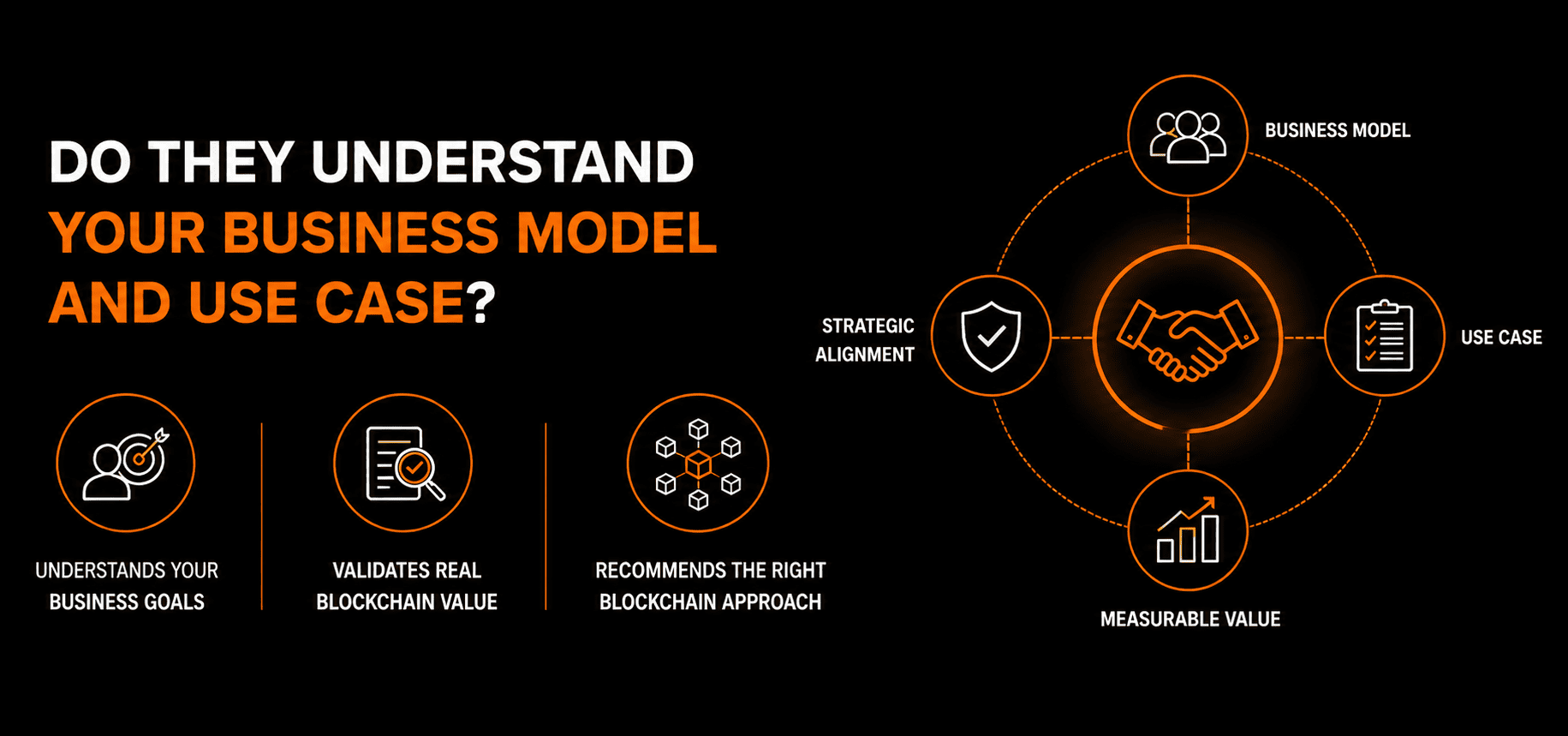
The difference between a vendor and a strategic partner becomes apparent in these initial discussions. A mature company offering blockchain development services will not always recommend a tech stack. Rather, they will look at issues such as trust boundaries, transparency of transactions, governance structures and interoperability. They will evaluate if a public blockchain, permissioned network or hybrid architecture will meet your operational objectives.
This consultative depth is increasingly backed by industrial expertise. According to Deloitte’s 2025 Global Blockchain Survey, over 75% of corporate blockchain initiatives fail owing to mismatch between technology design and business objectives. That stat shows the importance of hiring a partner who begins with strategy, not code.
Question 2: Do They Offer Strategic Consulting or Just Development?
By 2026 the border between consultation and development begins to blur. Blockchain solutions require architectural foresight, regulatory knowledge and ecosystem thought. There’s not just a need for a firm that creates code, without instruction on tokenomics, governance and compliance.
One of the main factors to consider when choosing a blockchain consulting service is that the company has the capacity to translate your idea into a sustainable ecosystem. This includes assessing economic incentives, the architecture of token flows, and the system’s adaptability to market changes. A great partner integrates consulting into development, rather than seeing it as an optional add-on.
Think about consulting capabilities on your hiring blockchain developers checklist. Do they help define roadmap milestones? Can they simulate network behavior before deployment? Are they familiar with cross chain interactions and evolving standards? Top companies blend engineering with web3 consulting solutions, helping organizations to confidently handle both technical and strategic difficulties.
Question 3: How Do They Approach Security and Smart Contract Audits?
Security is one of the most defining factors of any blockchain vendor selection process, especially when it comes to evaluating a smart contract development firm decision. Unlike traditional apps, blockchain vulnerabilities generally are not reversible. History has shown us time and again how a single exploit may cost millions of dollars in a matter of minutes.
A trusted partner will build security into every level of development, from architecture design to code implementation to monitoring after release. They should be aware of common attack vectors include reentrancy, front-running, integer overflows, and oracle manipulation. Most significantly, they must have a defined auditing procedure, internal review and external validation through specialized smart contract auditing services.
Platforms like Rekt News, which chronicle real world big DeFi exploit instances, underscore the significance of rigorous audits, showing how minor flaws can lead to catastrophic losses. Their security approach is mature because they comprehend the unchangeable nature of blockchain. In 2026, best-in-class firms will go beyond static audits with formal verification, fuzz testing and continuous monitoring technologies. They understand that security is not a milestone, but a permanent discipline that evolves with the protocol.
Question 4: What Is Their Pricing Model and Cost Transparency?
Blockchain budgeting in 2026 is a whole different ball game than web2 cost estimation. It’s not about development hours or UI complexity now. Instead, corporations are confronted with unpredictable gas costs, smart contract auditing costs, infrastructure dependencies, and the premium on highly skilled blockchain skills. The cost fluctuation of blockchain transactions is usually due to the network demand and gas pricing models, as stated in Ethereum’s official gas documentation. These features lead to a fluid cost structure, which is subject to change after implementation, making strategic budgeting essential, rather than a fixed estimate.
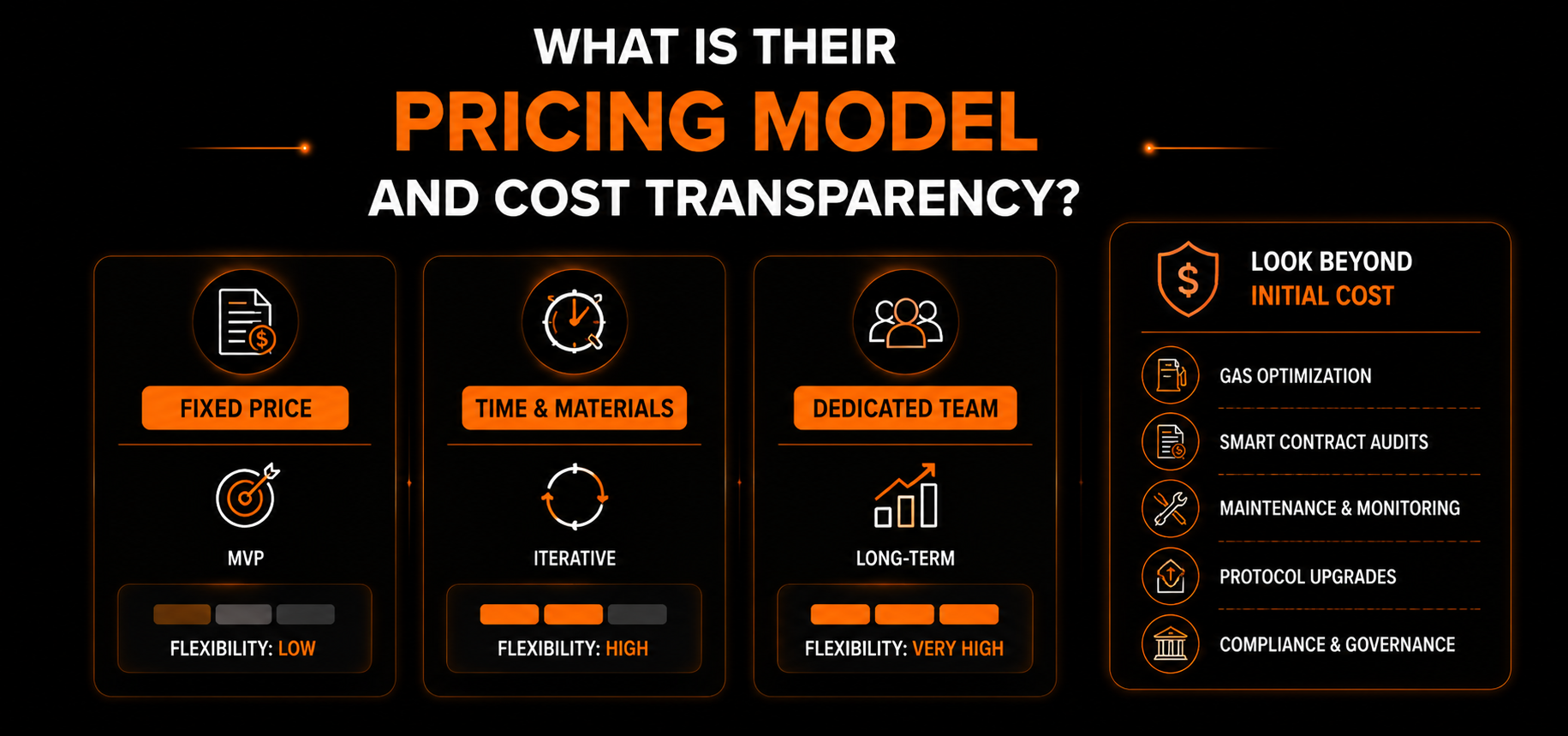
A seasoned partner will not just give you a number, but will guide you through a step-by-step process of estimating blockchain costs and help you understand how architectural choices directly impact both upfront and long term spending. This involves questions such as whether to use L1 or L2, how to optimize for gas usage, or how to implement cross-chain bridges, all of which can drastically alter financial results.
| Model |
Project Suitability |
Budget Range |
Flexibility |
Risk |
| Fixed Price |
Clearly defined MVPs with minimal scope change |
Low to Medium |
Low |
High (scope rigidity, change costs) |
| Time & Materials |
Iterative builds with evolving requirements |
Medium to High |
High |
Moderate (requires oversight) |
| Dedicated Team |
Long-term, scalable blockchain platforms |
High |
Very High |
Low (high alignment, continuous delivery) |
The table above offers a structural comparison but the real insight is to understand TCO, a word often missing in early stage planning. Blockchain systems have costs not only in their creation. These include smart contract monitoring, monthly security audits, gas-optimizing updates, frontend and wallet compatibility, and protocol changes. Additionally, there may be governance processes and compliance changes that will require ongoing input from engineers.
The practical value of cost estimating method is realized when companies take into account the lifecycle costs at the outset. Companies that only look at the initial development cost often underestimate the long-term investment required to support and expand a blockchain ecosystem. A good partner makes sure budgeting is not just what it takes to launch, but what it takes to last.
Question 5: How Deep Is Their Multi-Chain and Architecture Expertise?
Modern blockchain systems are rarely confined to a single network. Interoperability has become the standard, not the exception. Evaluating a firm’s architectural capabilities is therefore a critical step in any web3 development company comparison.
A technically proficient partner will demonstrate experience across ecosystems such as ethereum blockchain development and solana blockchain development. They should understand the nuances of consensus mechanisms, transaction throughput, and gas optimization. More importantly, they should be able to design systems that leverage the strengths of different chains while mitigating their limitations.
Understanding architectural decisions like public vs private blockchains, is critical when designing scalable and compliant systems. Poor design decisions can lead to scalability bottlenecks, excessive costs, and fragmented user experiences. The best companies approach architecture as a strategic discipline, balancing performance, security, and usability across the entire system.
Question 6: How Do They Compare to Other Web3 Development Companies?
When evaluating firms, it would be helpful to look for bigger industry standards like the top 10 casino game development companies. Or the top 10 game development companies in the USA in 2026. They are indicators of how companies differentiate themselves in highly competitive markets.
| Criteria |
Generalist IT Firm |
Crypto-Native Web3 Studio |
| Security Philosophy |
Reactive, compliance-driven |
Proactive, audit-first, adversarial mindset |
| Architecture Depth |
Moderate, system-level |
Deep, protocol-level understanding |
| Innovation Speed |
Slower, structured cycles |
Rapid, experimentation-driven |
| Legacy Integration |
Strong enterprise system integration |
Moderate, improving with time |
| Long-Term ROI |
Variable, depends on adaptation |
High when aligned with ecosystem trends |
Generalist companies are typically very good at integrating new systems with old ones, but may not have the know-how for more complex implementations such as blockchain. Crypto-native studios are, by contrast, deeply embedded in the ecosystem, which speeds up innovation and improves security.
This review should also employ frameworks such as Gartner’s blockchain maturity model. It shows how blockchain technology switches from being used for experiments to being used on a large scale by businesses. The right partner will meet you where you are today and help you become who you want to be tomorrow.
Question 7: Can They Act as a Long-Term Enterprise Partner?
There are more and more business uses for blockchain all the time, especially in areas that are backed by assets. For example, RWA tokenization services help businesses automate their control and get access to cash. As rules get stricter around the world, businesses need to make sure they follow guidelines like the OECD Blockchain Policy Framework. It tells big projects how to control, make sure they follow the rules, and handle risks.
The top RWA tokenization companies 2026 guide goes into more detail about this change, which shows how compliance and technical understanding can work together. A good partner is always willing to help, keep an eye on things, and give advice on how to move forward. That way, your system will stay useful over time because they will know about new rules, network updates, and new trends. This is when the built-in consulting choices from Web3 come in handy.
For example, a global supply chain network had to make sure that the privacy of deals between many parties was kept safe. The group had to use facts that no one knew about to keep things open and keep private information safe. To work with a company that was good at advanced security, they had to go through a tough selection process. In the end, they made a legal system that could be expanded and let people share info safely without other people seeing it. This is proof of how important it is to work with a person who is technically sound.
Question 8: Do They Follow Proven Development Standards and Practices?
A good guide to hire a blockchain project should highlight the industry rules compliance. Blockchain development is no longer an experiment; it is governed by protocols, frameworks, and best practices that have already been put in place.
A reliable partner will ensure their work aligns with the best practices of blockchain development. These include modular contracts, safe key storage and comprehensive testing tools. They should also show they know how to work with evolving standards like Ethereum’s official EIP standards that detail key aspects of how protocols function and can talk to each other.
Standards ensure that not only is something safe, but it also works with the rest of the environment. It makes it easy for wallets, exchanges and third-party services to work together, which is good news for both users and developers.
Question 9: What Does Their Hiring and Delivery Process Look Like?
You can tell a lot about a company’s reliability by how it builds its team and its delivery process. A project needs a clear workflow, open lines of contact and clear reporting to be successful.
Before you hire blockchain developers, look at the team structure. Are there specialized architects, security and DevOps engineers in them? Is there a guaranteed way to elevate problems? How frequently do they update you?
A strong approach will mitigate risks and keep the team on the same page. It also increases the responsibility of people as it allows you to track the work and make intelligent decisions throughout the development lifecycle.
Question 10: Do They Provide Post-Launch Support and Evolution Strategy?
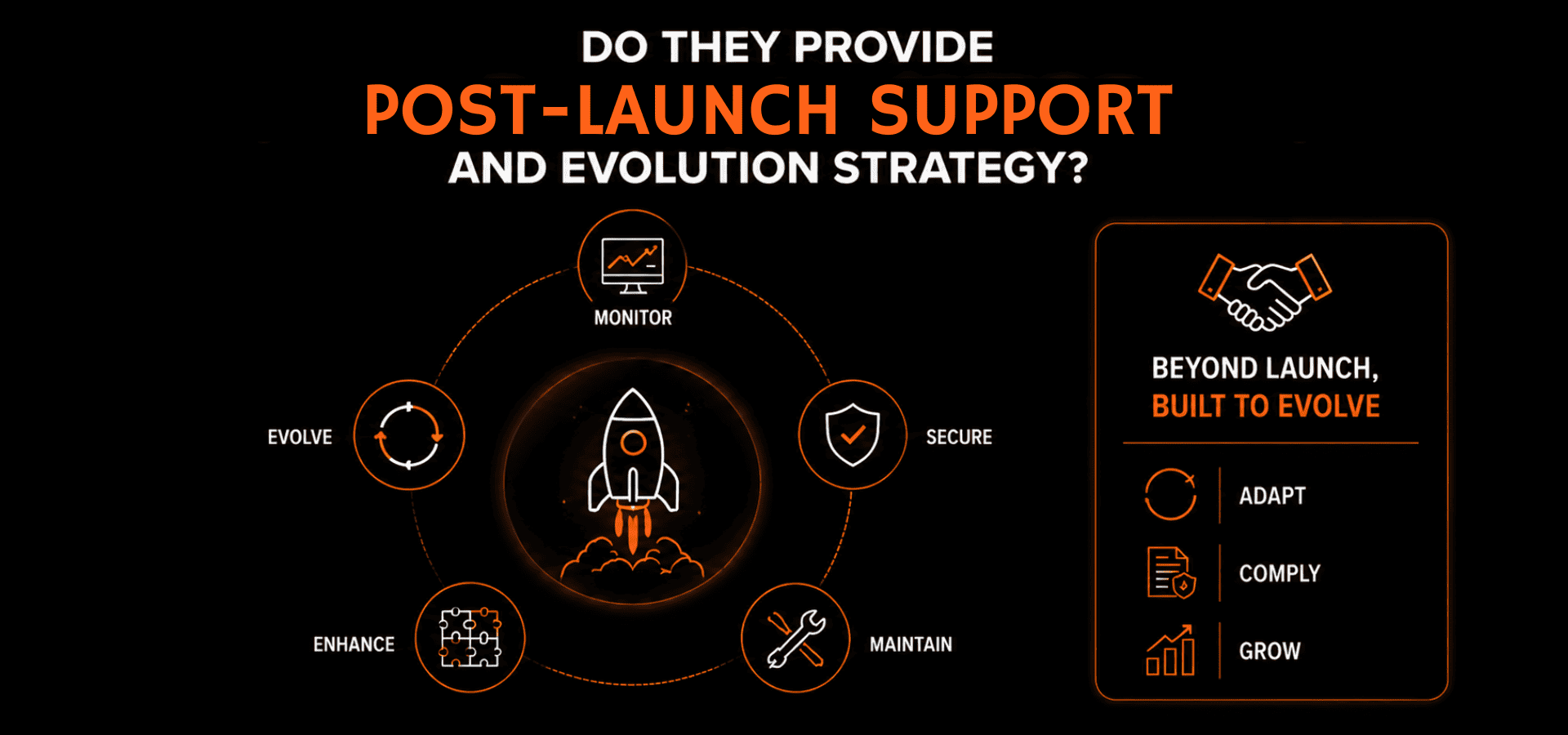
A Blockchain project does not end at deployment, it evolves over time. Networks need to be upgraded, controlled differently and continuously optimized. If your partner has left after the launch, you could be exposed to risks and lose opportunities.
Post launch support includes monitoring performance, fixing bugs and adding new features. It also means evolving with the times as the rules and the market are evolving. The best partners treat deployment as the beginning of a long-term relationship rather than the end of a project.
This perspective is even more important in 2026, when blockchain ecosystems grow more complex. Evolution is never-ending. Continuous evolution is not optional, it is a necessity of life.
Final Thoughts
Picking a blockchain software company in 2026 is a decision with lasting effects. Because blockchain is unchangeable, the effects of success or failure are magnified. This makes the selection procedure one of the most critical stages of your journey.
If you look at aspects like strategic alignment, technological knowledge, security procedures, and the prospect for a long-term relationship, you can make this tough decision with confidence. The proper partner will not only develop your system but will help it evolve and change over time, keeping it safe, scalable, and competitive in an ever-changing world.
For strategic alignment, check our asset tokenization services.
Frequently Asked Questions (FAQ)
1. Why is choosing a blockchain development company more critical than traditional software vendors?
Since blockchain systems are immutable and decentralized, faults could not be readily corrected once deployed. That means that the design and development process is significantly more crucial than for typical software projects. A bad decision might have long term financial and operational impact.
2. What is the most important factor when selecting a blockchain partner?
The most crucial thing is security. One weak connection and the entire system is at jeopardy. But security must be paired with the correct architecture and strategic alignment for long term success. Investopedia’s blockchain guide provides a wonderful primer to introduce you to the issue, if you want to acquire a grasp of the basics of blockchain. It’s a simple but complete explanation of how decentralised networks work.
3. How do I verify a company’s blockchain expertise?
Check their portfolio, audit reports and live installs. Contributions to open source projects and involvement in the blockchain community are considered. These metrics tell you how deep they are on the technical side and how reputable they are.
4. Should I prioritize cost or quality in blockchain development?
The most important thing is quality. Cost is crucial but cutting corners can be expensive. A good partner helps to get a greater ROI and reduce the risks in the long run.
5. What role does consulting play in blockchain development?
Consulting helps determine the course of the project and to be sure that it is consistent with the business goals and market conditions. It ties the technical implementation to the strategic aims.
6. How important is multi-chain expertise?
By 2026, multi-chain experience will be a prerequisite. It allows you to interoperate, scale and access different ecosystems making your platform more resilient and versatile.
7. What are common red flags when evaluating companies?
Red flags: unclear price, audit method, small portfolio etc. Technical decisions have no reasons. These are indicators of prospective hazards.
8. How long does it typically take to develop a blockchain project?
Complexity determines the timeline, ranging from a few months for basic apps to a year or more for huge systems. Good planning and good teams can substantially cut development time.
9. What happens after the blockchain solution is deployed?
Once you’ve deployed the solution, you’ll want to monitor it, update it with security patches and make feature enhancements. They need to be supported to continue working properly and being relevant.
10. Can blockchain solutions scale for enterprise use?
Yes, if the architecture is suitable. Layer 2 scalability, sharding, and cross-chain are solutions that can effectively satisfy the enterprise-level needs for blockchain systems.