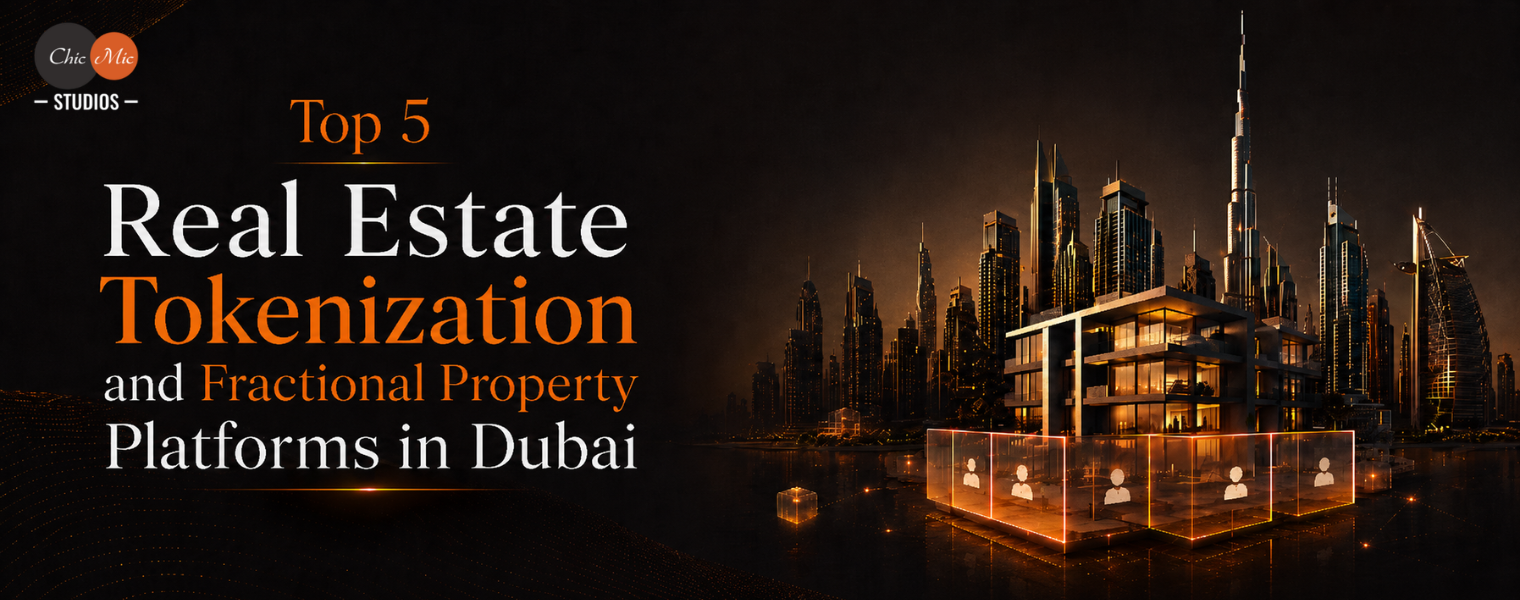
Top 5 Real Estate Tokenization Platforms in Dubai (2026 Guide)
Key Takeaways:
- Core Value: Fractional, compliant, and digitally structured real estate ownership.
- Comprehensive Services: End-to-end platforms covering issuance, custody, compliance, and investor access.
- Investor Impact: Lower capital entry and improved liquidity options.
- Market Adoption: Use across residential, commercial, and institutional assets.
- Growth Outlook: Rising regulation alignment and institutional participation.
Dubai’s Shift Toward Tokenized Real Estate
Dubai has never followed the norms of conventional real estate. The city has always kept pace with international real estate trends, from master planned neighbourhoods built at record speed to freehold ownership for foreigners. In 2026, that leadership is extending into a new frontier through real estate tokenization platforms Dubai investors are increasingly paying attention to.
Dubai real estate ownership is no longer a matter of large financial investments or long terms of ownership. Tokenization is changing the way assets are structured, how people enter the market, and how liquidity is generated. According to global consulting research, tokenized financial markets could reach nearly $2 trillion in total value by 2030, with opportunities to expand further as adoption grows across asset classes like real estate.
This guide explains how real estate tokenization works in the United Arab Emirates, why Dubai is taking the lead in the world, and which platforms are leading this transition in a sustainable and controlled way.
What Is Real Estate Tokenization?
Real estate tokenization is the process of representing ownership or economic rights in a property as digital tokens on a blockchain. Every token is a digitally recorded and legally structured part of a real asset.
Unlike speculative cryptocurrency assets, tokenized real estate is backed by real, income-generating properties. Tokens representing ownership or economic rights are issued using blockchain technology, while the underlying asset is typically held within a legally compliant structure such as a special purpose organization. This model follows broader asset tokenization frameworks, where physical assets are digitally represented on blockchain systems built for compliance, transparency, and long-term lifecycle management. These tokens can then be purchased, held, or transferred under clearly defined rules.
The solution allows digital property ownership via blockchain, while remaining compliant with current land laws and investment protections. Smart contracts reduce administrative burden and human error by automating distributions, ownership modifications, and compliance checks. Enterprise applications of blockchain are already delivering real world value, helping corporations tokenize assets and streamline processes such as fractional ownership and secure record keeping. For platforms that require automated investor payouts, ownership updates, and rule-based compliance, smart contract development becomes a core part of the tokenization stack.
In practical terms, tokenization maintains the stability of property ownership while allowing real estate to behave more like a financial asset.
Why Tokenization Matters in Dubai’s Property Market?
Dubai is well positioned for large-scale real estate tokenization for structural, not hypothetical, reasons.
One of the most important elements is government involvement. The Dubai Land Department already has blockchain-based projects for land registration and ownership verification. Dubai Land Department blockchain initiatives allow tokenized ownership models to exist alongside official registries, rather than outside of them.
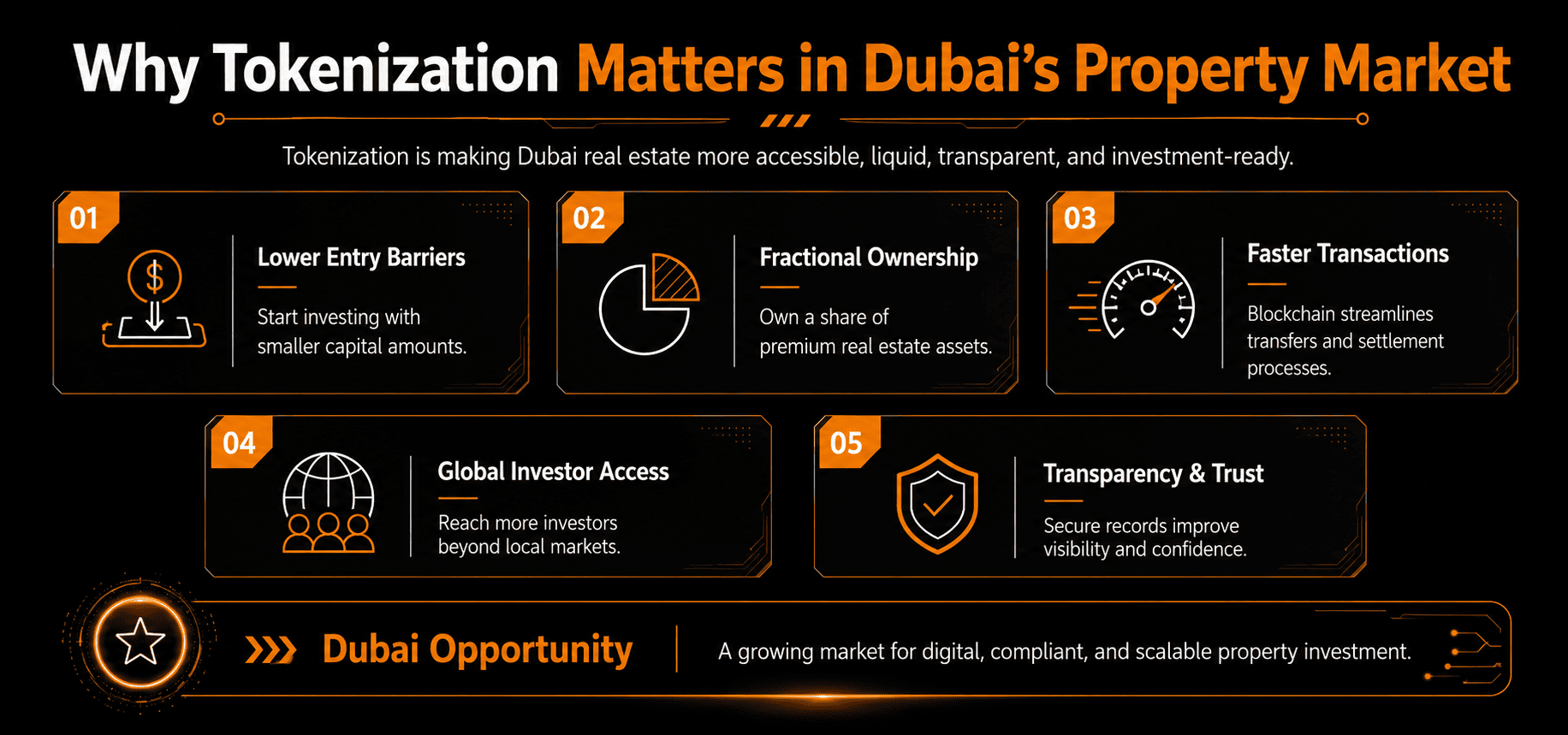
Another factor is the diversity of investors. Dubai’s property market draws buyers from Europe, Asia, Africa and the Middle East. Tokenization makes it easier for foreign investors to have access, while maintaining regulatory monitoring. This vastly expands investor access real estate tokens without sacrificing compliance.
A third driver is liquidity. Traditional real estate has long holding periods and high exit friction. Tokenization introduces structured liquidity mechanisms that allow for partial exits and secondary trading. One of the key reasons institutional investors are keen on tokenized real estate is the enhanced liquidity. Platforms planning regulated asset trading may also need crypto exchange development capabilities to support compliant secondary-market transactions.
Such factors combined with the legislation-friendly environment for innovation in Dubai are reasons why the pace of blockchain real estate tokenization UAE initiatives are increasing rather than decreasing.
Platform Selection Criteria
Not every platform that gives exposure to tokenized properties is structured the same way. Credibility in Dubai is built upon operational transparency, legal enforceability and regulatory coherence.
The primary requirement is adherence to the UAE’s tokenized property regulations. Platforms have to ensure that token holders have clear and enforceable rights in accordance with UAE law. This typically requires coordination with land registration authorities and cooperation with regulators such as the virtual assets regulatory authority.
Technology is important, but only when it strengthens compliance rather than bypassing it. Industry research shows that regulated blockchain solutions are far more likely to progress from pilot projects into real market infrastructure, gaining adoption among financial institutions and enterprises. Transparent ownership structures, audited smart contracts, and secure custody mechanisms are critical for long-term viability. Platforms that prioritize speed over structure may see early interest, but they often struggle to scale sustainably over time. A strong platform also requires reliable crypto wallet development capabilities to manage investor access, asset custody, and secure transaction flows.
There’s also market maturity. Platforms with operational track records, live assets and regular investor participation are far more reliable than those in pilot mode.
Top 5 Real Estate Tokenization Platforms in Dubai
As of 2026, these platforms represent the most important players shaping Dubai’s tokenized and fractional real estate investment market, from blockchain-native tokenization platforms to regulated crowdfunding and RWA infrastructure providers. Each one has a different approach to tokenization, catering to the interests of different issuers and investors.
- Prypco Mint
Prypco Mint is one of the most regulator-integrated real estate tokenization platforms currently available in Dubai. real estate tokenization platform available in Dubai at the moment.Prypco Mint is distinct in its direct synchronization with government processes. The technology doesn’t create a new layer of ownership but merges tokenized ownership with official land records. It removes legal uncertainty: ownership on the blockchain is what authorities record ownership as.Investors are given fractional access to regulated access without the operational complexity, with a focus on residential assets in Dubai. Prypco Mint is a benchmark for long-term investors who value legitimacy over speculative profits.
- Tokinvest
Tokinvest tokenizes real estate using capital markets and infrastructure approaches.
It is not just a marketplace, but also a platform where asset owners, developers and funds can tokenize real estate within a regulated digital securities framework. This makes it particularly relevant for institutional issuers and large projects.Tokinvest is focused on structured issuance strategies, cross-border onboarding of investors and regulatory certainty. It might not be attractive to retail investors, but it is important for the institutional-grade tokenization of the region.
- SmartCrowd
SmartCrowd is one of the first fractional property investing platforms in Dubai and continues to sit close to the tokenization trend through regulated fractional property ownership, although it should not be positioned as a fully blockchain-native platform.It started with traditional fractional ownership but its business model is very similar to tokenized real estate concepts. Investors receive rental distributions, buy shares in income-generating properties and monitor performance through digital tools.SmartCrowd is a bridge between fully blockchain native platforms and traditional fractional property investing methods in Dubai for many customers. Its strongest points are accessibility and investor familiarity.
- Stake
Stake is a sign fractional real estate is going mainstream. However, Stake is not a blockchain-native tokenization platform yet, but it is one of the most visible fractional real estate investment platforms in the UAE. Its scale, digital onboarding, and investor-access model make it relevant to the broader tokenization conversation. It’s not yet a blockchain platform, however, due to its size and regulatory status. Its ecosystem already has many of the structural components for tokenization.Stake will appeal to investors who like familiar investment structures now but are open to tokenized ownership methods in the future. The trend is a slow integration of blockchain infrastructure with traditional platforms.
- Mantra
Mantra is best understood as RWA tokenization infrastructure rather than a direct property investment platform. It is building a blockchain for real-world assets rather than focusing on individual properties. Its partnership with major developers such as DAMAC shows how large real estate firms are preparing for tokenized ownership at scale.Mantra is particularly well suited for institutional use cases where programmable compliance, custody integration and long-term scalability are more important than fast retail adoption.
Comparison Table: Feature Matrix
| Feature |
Prypco Mint |
Tokinvest |
SmartCrowd |
Stake |
MANTRA |
| Dubai Land Department alignment |
Yes |
Partial |
No |
No |
No |
| Blockchain native architecture |
Yes |
Yes |
Hybrid |
No |
Yes |
| Fractional ownership support |
Yes |
Yes |
Yes |
Yes |
Yes |
| Secondary market functionality |
Limited |
Planned |
Limited |
No |
Yes |
| Institutional suitability |
Medium |
High |
Low |
Low |
High |
| Retail investor accessibility |
Medium |
Low |
High |
High |
Low |
This tokenized real estate platforms comparison illustrates that each platform serves a different segment of the market rather than competing on identical terms.
How to Choose the Right Tokenization Platform?
It’s not about being popular, it’s about your role and your goals that will help you figure out which platform is best for you.
Retail investors usually care about easy onboarding, income visibility, and asset transparency. Key priorities for asset owners and developers include scalability, regulatory permission and issuance flexibility. Institutional investors need custody solutions, reporting requirements and regulated secondary liquidity. These requirements are closely tied to how real estate tokenization frameworks are designed and governed, making it important to understand the underlying structure before selecting a platform.
Companies building custom platforms should also assess whether they need Web3 wallet features for onboarding, investor verification, asset management, and transaction visibility.
When regulations change, platforms that provide integrated blockchain development services are often quicker to adapt. But some degree of trust is provided by platforms closely affiliated with governmental organizations that technology cannot. The most successful strategy is alignment, not acceleration.
Future of Real Estate Tokenization in UAE
By 2026, real estate tokenization in the UAE will undoubtedly be out of the trial phase. What started as small pilot projects is now becoming a structural part of the country’s financial system.
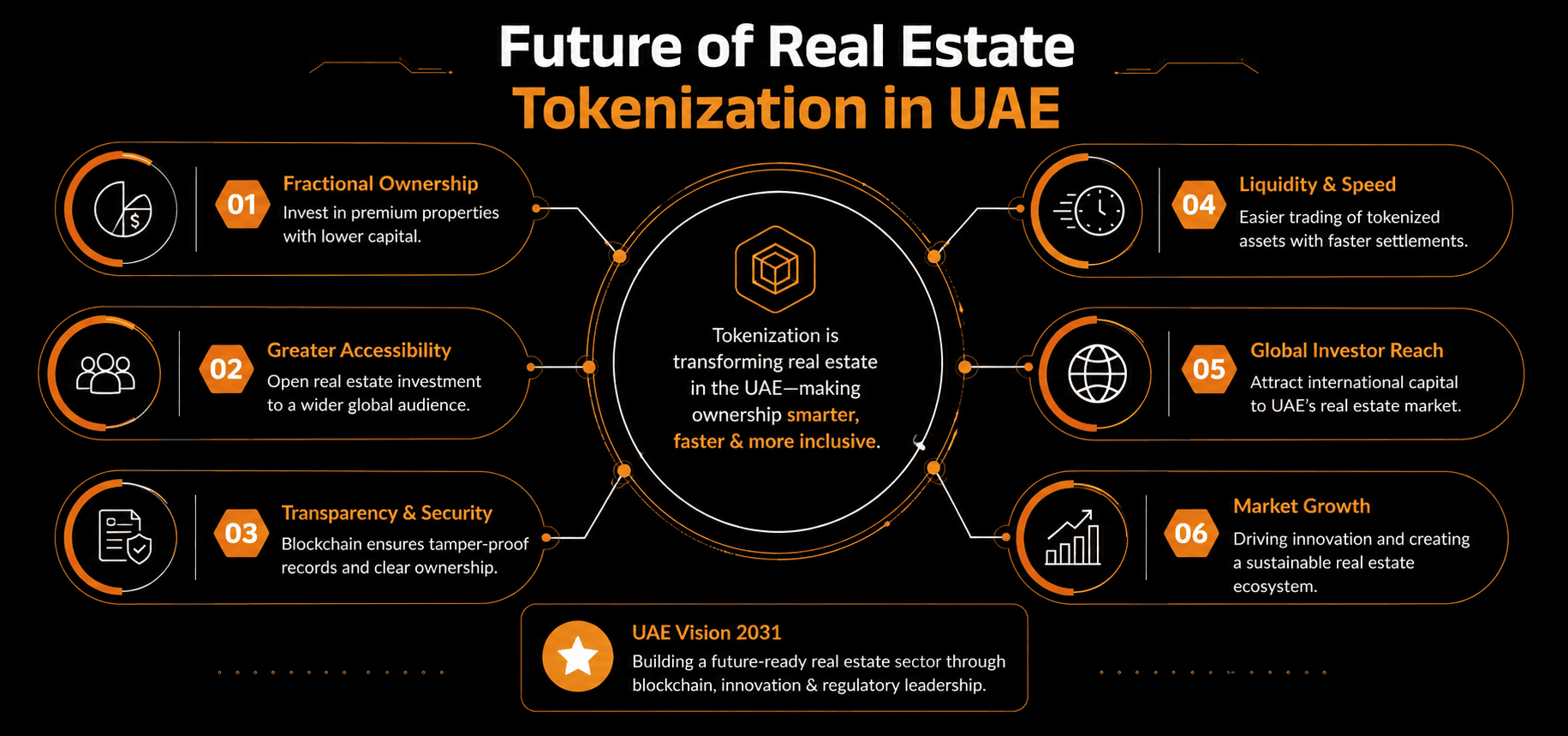
One big change is tokenized ownership, which is more in line with formal land registers. As government systems evolve, on-chain ownership records will likely be integrated more easily with conventional property paperwork. This reduces friction and builds trust for long-term investors.
At the same time regulated secondary trading venues are starting to develop. In the UAE, regulated venues are being built where slices of real estate are tokenized and traded with strict compliance rules, not open markets. This helps to keep the market stable and more liquid. Regulated platforms may also require cross-border distribution features to support international investors while following jurisdiction-specific rules.
Participation in institutions is also increasing. Banks, family offices and sovereign-related organisations are moving from observation to participation, raising the bar for custody, reporting and governance. Their arrival is a boost in the trust in tokenized property as a real asset class.
Physical real estate is not going anywhere. It’s ownership that’s evolving. With the expansion of blockchain technology into real estate transactions, ownership is becoming increasingly digital, programmable and accessible worldwide, in line with the long-term objectives of the UAE. While ownership structures are becoming more digital, the fundamentals of real estate development, asset management, and market expertise remain essential to building tokenized portfolios that are both compliant and commercially viable.
Final Thoughts
Dubai isn’t testing real estate tokenization. It is being built consciously, where innovation comes after regulation. This strategy has enabled the market to grow without the instability that is seen in less formal jurisdictions.
As technology evolves, regulations become clearer, and investor demand grows, tokenized real estate is transitioning from an alternate concept to a conventional ownership model. What was once exclusive to early adopters now attracts institutional capital and long-term investors that value accessibility, efficiency and transparency. Businesses planning custom platforms can also explore dApp development to build investor dashboards, ownership portals, and blockchain-based transaction systems.
It is now vital for all those who are serious about taking part in Dubai’s future real estate market to understand real estate tokenization. In the years ahead, the platforms that shape this shift now will determine how property is owned, transferred, and accessed.
Frequently Asked Questions
1. What is a real estate tokenization platform?
A real estate tokenization platform is a digital system that converts property ownership or income rights into blockchain based tokens. These tokens represent a defined share of a real world asset and are backed by legal structures, allowing investors to own, transfer, and track property interests digitally.
2. Can foreigners invest in tokenized real estate in Dubai?
Yes. Most tokenization platforms in Dubai allow foreign investors to participate, provided they complete identity verification and comply with UAE regulatory requirements. This makes tokenized property one of the most accessible ways for international investors to gain exposure to Dubai real estate.
3. How do tokenization platforms ensure security?
Security is ensured through a combination of audited smart contracts, regulated custody solutions, and immutable blockchain records. In addition, most platforms apply strict compliance checks and ongoing monitoring to protect both the assets and investors.
4. What are the benefits of tokenized property investment?
Tokenized property investment lowers the capital required to enter the real estate market, improves liquidity compared to traditional ownership, enables global investor access, and increases transparency across ownership, income distribution, and transactions.
5. How much does it cost to tokenize real estate?
The cost of tokenizing real estate depends on factors such as legal structuring, regulatory approvals, technology setup, and platform fees. Expenses can vary widely based on the size of the property and the complexity of the tokenization model.
6. Which blockchain standards are commonly used?
Most platforms use established ERC standards or purpose built real world asset protocols designed for compliance and transfer restrictions. These standards help ensure secure issuance, controlled transfers, and compatibility with regulated custody systems.
7. Are tokenized properties tradable?
Some platforms allow tokenized property interests to be traded on regulated secondary markets, while others limit transfers to approved investors. Tradability depends on regulatory approval and the platform’s liquidity framework.
8. Is property tokenization legal in Dubai?
Yes. Property tokenization is legal in Dubai when structured within approved UAE regulatory frameworks. Platforms must comply with financial regulations, land ownership laws, and digital asset guidelines to operate legally.
9. Do investors receive rental income?
In most cases, investors receive rental income automatically based on their token holdings. Smart contracts are commonly used to distribute income proportionally, providing transparency and reducing administrative delays.
10. Is tokenized real estate risky?
Like all investments, tokenized real estate carries risk, including market and regulatory factors. However, Dubai’s strong regulatory oversight and structured approach significantly reduce uncertainty compared to less regulated markets.