Unity vs Unreal Comparison: Pros, Cons & Key Differences
Key Takeaways:
- Core Value: Game engines impact how teams build, scale and manage interactive products over time.
- Development Capabilities: With modern engines, you can develop end-to-end for gaming, rendering, deployment, and live updates.
- Business Impact: The engine preference impacts costs, schedules, team composition, and the long term sustainability.
- Industry Use Cases: Gaming engines power simulations, XR experiences, and real-time visualization.
- Future Direction: The utilization of real-time engines is growing in different industries, corporations and immersive media applications.
Introduction
The Unity vs Unreal comparison has turned into much more than a superficial engine debate. When it comes to choosing between Unity and Unreal in 2026, it will affect not only how a game looks and works, but also teamwork. How fast features can be delivered, the scalability of the budget and the sustainability of the project. Developers no longer ask which engine is better in isolation. They want to know which engine fits their project scope, budget, platform strategy, and long-term technical roadmap. They want to know which engine best fits their long-term plan, business goals and technical reality.
Unity and Unreal are the most popular game engines for making games and real-time interactive experiences for mobile, PC, console, VR/AR, film, and business simulations. Both engines can deliver quality products but their approach to workflow, performance priorities, licensing and industry acceptance are all quite different.
This guide is written for developers, founders, and technical decision-makers who need a practical Unity vs Unreal comparison based on workflow, performance, cost, scalability, and production needs.
What Are Unity and Unreal Game Engines?
A lot of the difference between Unity and Unreal comes down to what they are meant for.
Unity Game Engine
Unity is developed by Unity Technologies and is quite popular for its flexibility and ease of use. It first gained traction with independent developers because it lowered the barrier of entry for game development. However, it has grown into a multi-purpose real-time platform that is now used for much more than just gaming. Unity is commonly used for mobile games, 2D, and stylized 3D games, as well as mixed-reality and augmented reality apps, educational products, and business simulations.
Unity’s design ideology is really about fast iteration and flexibility. Developers are not locked into rigid architectural patterns in the early stages. Teams are free to experiment and refine ideas without requiring major reorganization. This is why Unity is particularly appealing to startups and smaller teams that want to quickly test ideas before scaling up. For businesses planning scalable Unity-based products, ChicMic Studios offers Unity game development services for mobile, 2D, 3D, AR/VR, and cross-platform game projects.
Unreal Engine
When Epic Games developed the Unreal engine, their highest priorities were performance and visual fidelity. Unreal was built from the ground up for high-end productions where scalability, system management and rendering quality were paramount. As a result, it became the dominant engine for large-scale simulations, AAA console and PC games, and movies.
Unreal’s deep access to engine-level systems lets developers push the hardware to the limits. This power is complex and the projects generally call for more technical discipline and planning in advance, especially as teams get larger. Teams building cinematic, high-performance, or large-scale 3D experiences can explore Unreal game development services for advanced game production support.
Key Differences Between Unity and Unreal
The biggest thing to remember when comparing Unity and Unreal is that both engines are solving different problems.

Unity: Core Ideology and Approach
Flexibility and speed are the bedrock of unity. It enables developers to experiment with ideas easily, build systems incrementally and change direction without having to totally rethink the project architecture. Unity uses C# as the primary programming language which is easier to learn and enables quick development. Teams that are still iterating on gameplay, mechanics or business models can benefit from projects that start small and evolve naturally.
The reason Unity seems forgiving in prototyping and early production is because it does not impose strict structural constraints early on. This makes it great for teams that value flexibility and fast iteration over rigid system design.
Unreal: Core Ideology and Approach
Unreal is based on power and structure. This is a big set of integrated systems that are designed to work together at scale. Unreal was built with C++ for core systems and blueprint visual scripting for gameplay logic, enabling programmers and designers to make great contributions.
The first difficulty of unreal projects is good for big productions, which usually feel heavier at first. The engine architecture supports complex interactions, large scale environments and high performance rendering with increased predictability over time.
Unity vs Unreal Performance Comparison (2026)
Developers looking for Unity vs Unreal performance 2026 tend to want to know about real-world performance, stability, scalability, and cross-platform.
Unity Performance in Practice
Unity is great for XR apps, mobile environments, 2D game development, stylized 3D game development. Its improvements in memory management, rendering pipelines, and multithreading has really closed the speed gap with Unreal. Unity gives back to teams who are conservative with how they use their assets and scripting habits with reliable performance on all kinds of platforms.
Unity is not photorealistic out of the box, but gives you a lot of control over performance trade-offs, which is important for cross-platform and mobile projects.
Unreal Performance in Practice
Unreal still reigns supreme for clean performance for high-end scenarios. It is still the engine of choice for AAA console and PC games as it deals with deep geometry, complex lighting and expansive open environments better out of the box. Unreal employs rendering techniques that are made to be as realistic as possible. This also means they require more resources generally.
One key fact, often neglected, is that the power of Unreal must be carefully controlled. Without optimization projects can be hardware intensive, especially on mobile and lower end hardware. We have also covered common Unreal Engine performance struggles and how teams can fix them through better optimization planning.
From an enterprise and simulation standpoint, performance is closely tied to predictability and real-time accuracy. IBM explains that digital-twin and simulation systems depend on real-time rendering engines to continuously mirror physical environments and reinforces why engine-level performance decisions matter far beyond frame rates.
Industry experts provide guidance on performance optimization, team workflows, and engine selection in Game Developer insights.
Unity vs Unreal for Game Development Workflow
The difference in daily productivity between Unity vs Unreal development workflow is greater than most feature comparisons.
Unity Development Workflow
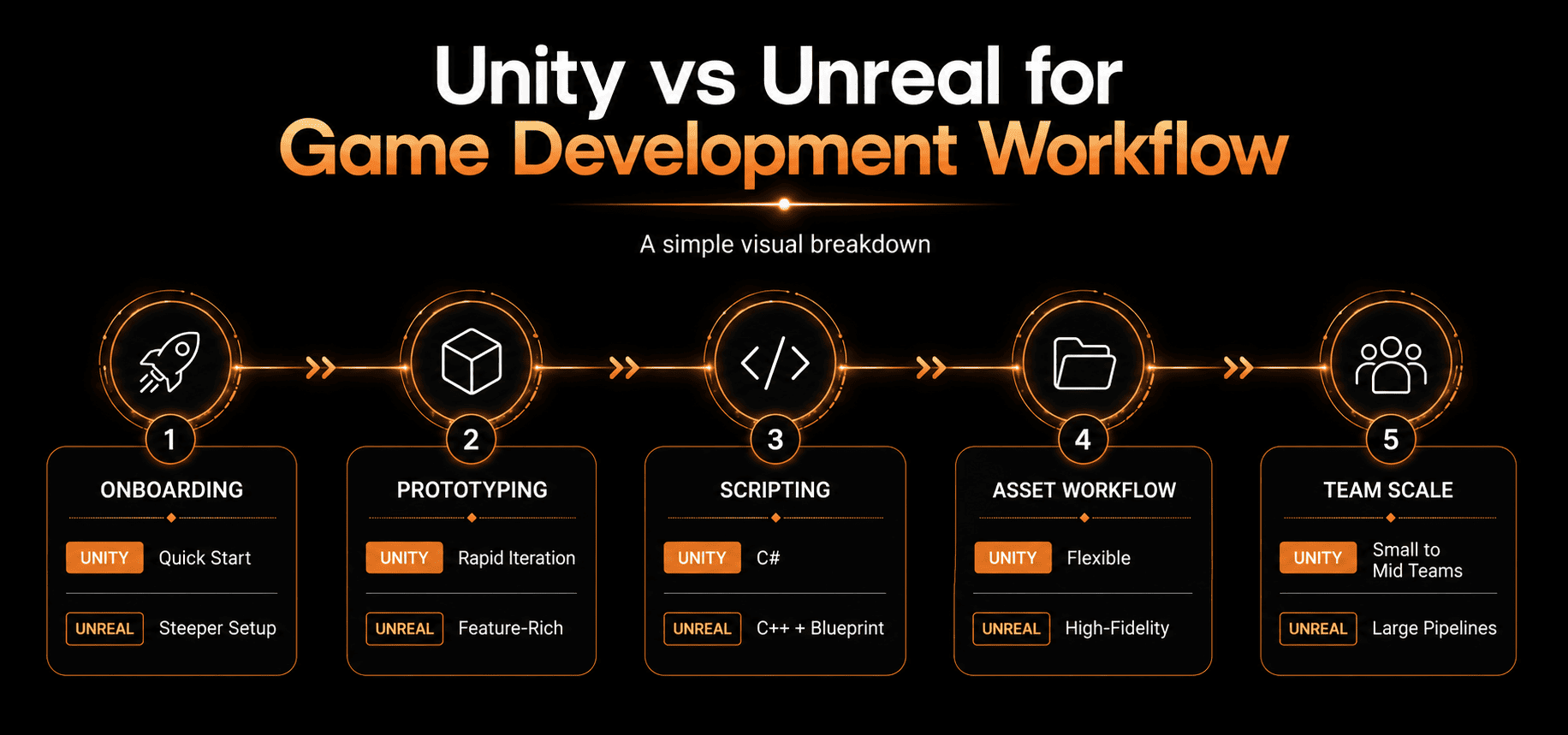
Unity’s approach is fast and editor focused. Developers can write scripts, hit play and test modifications in no time at all. Unity’s tight feedback loop promotes experimentation, enables rapid iteration and is ideal for gameplay-driven projects and frequent feature updates. Unity projects can feel developer-centric; teams can customize the architecture to fit their own coding style.
That flexibility is particularly useful for smaller teams where responsibilities overlap and decisions need to be made quickly.
Unreal Development Workflow
The Unreal process is more systematic and system centric. Blueprint visual scripting is a godsend for working in larger teams. It allows designers and non-programmers to create gameplay logic without ever touching C++ code. As projects mature, Unreal encourages moving performance critical systems into C++ to make the division of labor more clear.
Unreal workflows are great for large teams on complex projects with long development cycles, as they feel more like a production pipeline than a sandbox.
Unity vs Unreal Graphics Comparison
The visual quality debate between Unity and Unreal is often misunderstood.
Unity Graphics Capabilities
Unity is a master of mobile-friendly rendering, performance-conscious creative direction and styled visuals. Unity can produce realistic images but it requires more technical know-how and manual setup. This kind of flexibility is vital for mobile and independent projects, where developers are able to customize the visuals to meet platform limits.
What makes unity so powerful is that it allows you to express yourself artistically without making reality the default.
Unreal Graphics Capabilities
Unreal is the industry standard for photorealistic rendering. Its lighting systems, material tools and geometry handling make it easier to create cinematic graphics with less specialized equipment. Unreal’s rendering pipeline is especially suited for applications where visual fidelity is a key selling point.
Unreal offers a quicker, more dependable path to realism-driven experiences. For a more technical breakdown of Unreal’s rendering strengths, read our guide on Unreal Engine Nanite and Lumen.
Pricing and Licensing: Unity vs Unreal
Understanding Unity vs Unreal licensing is important for long-term financial planning.
Unity Licensing Model
Unity pricing is based on a subscription model with periodic fixed costs. No royalties on game revenue benefits long-term live service games and studios with stable revenue. This is a good technique for companies that want stability over changing costs.
Unreal Licensing Model
Unreal is free to use until you reach a revenue threshold, after which you pay a fee. This reduces the upfront risk for new ventures but can be expensive for more popular titles. Unreal’s business model is aimed at teams willing to sacrifice long-term revenue for early access to powerful technology.
Unity vs Unreal for Mobile Games
The industry is still pretty divided on Unity vs Unreal for mobile games.
Unity for Mobile Development
Industry leader in mobile game development, Unity is the industry leader in mobile game production, thanks to its better optimization, smaller build sizes and more advanced android and iOS tooling. This is the default choice for most mobile studios given its great integration with advertising, analytics and live-operations systems.
Unreal for Mobile Development
While Unreal can handle mobile games, it can overkill many mobile genres, and needs to be carefully optimized. This means Unity is still miles ahead of the competition in the mobile space.
Modern studios often enhance XR and AR applications with AI-driven interactive experiences to optimize gameplay, personalization, and adaptive behaviors.
Unity vs Unreal for VR/AR Development
Experience goals dictate whether to use unity or unreal for VR/AR.
Unity for VR and AR
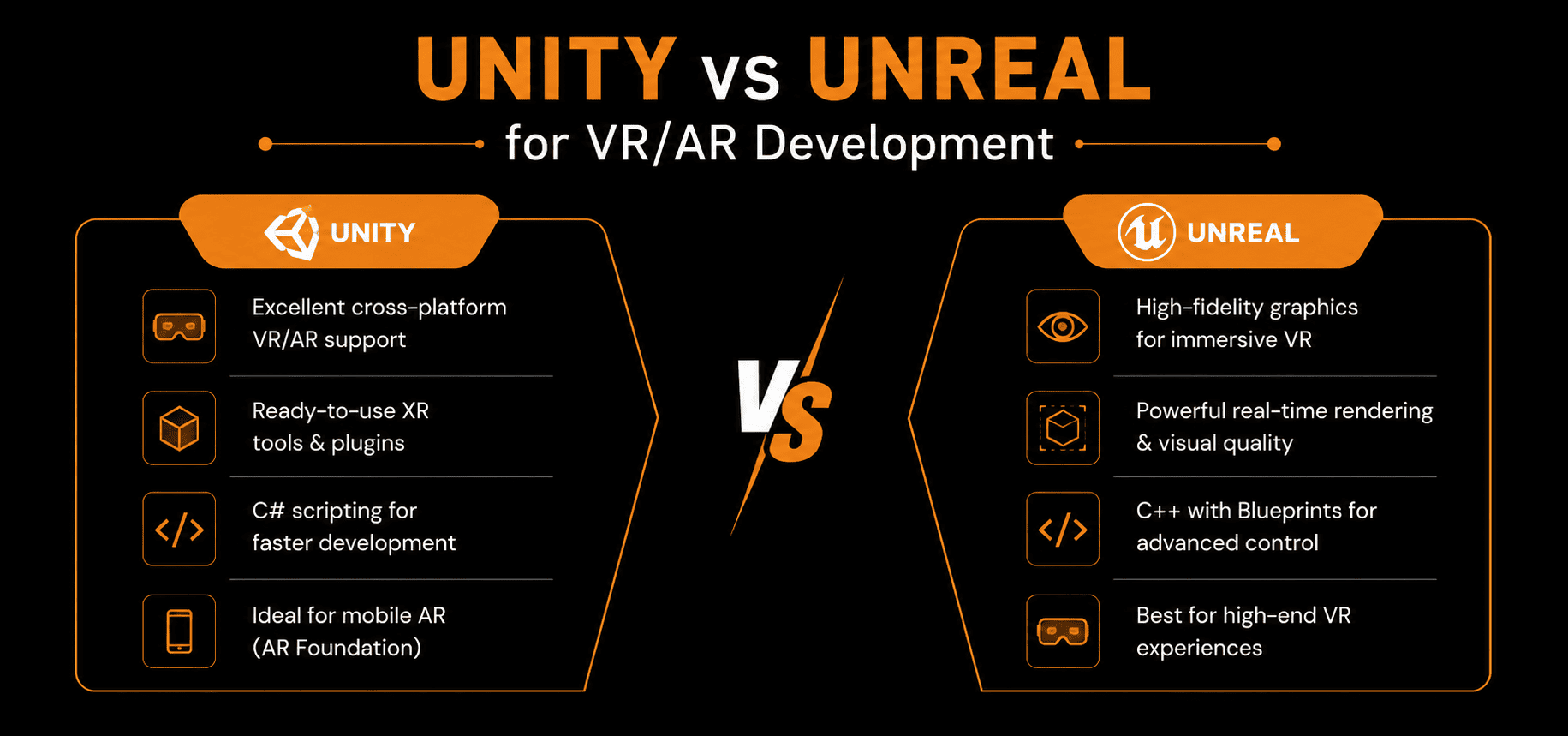
Heavy use of Unity is made by lightweight VR, mixed-reality and augmented reality apps. Its fast iteration cycle and strong platform compatibility make it well suited for consumer and enterprise XR solutions where flexibility and deployment speed matter.
Unreal for VR and AR
Unreal is great for high fidelity VR simulations, and immersive environments where presence and realism count. Unreal’s rendering power can be put to use for training simulations and VR cinematic experiences.
Unity is often preferred for lightweight AR and mixed-reality products, making it a strong fit for businesses exploring AR app development across training, retail, education, and interactive experiences.
Unity vs Unreal for Indie Developers
Independent developers are driven by cost, speed and flexibility. This comparison looks at Unity and Unreal in terms of how they support small teams to make games with fast iteration loops and limited resources.
Unity for Indie Developers
Unity is a popular choice for independent developers because it allows teams to work fast with low technical overhead. Rapid prototyping is essential for small teams testing concepts or tuning gameplay and the engine is lightweight and easy to set up. To its vast ecosystem of tutorials, assets, and plugins, along with its user-friendly C# scripting environment developers may avoid building everything from the ground up. Unity offers a good balance of flexibility, performance and development speed for indies facing tight deadlines and budgets.
But as initiatives grow, unity demands discipline. It can easily handle small and mid-sized games, but larger projects need careful architecture and optimization planning. Unity is still a solid choice for most indie games that want to be innovative, reach lots of platforms, and get out the door faster. For a deeper Unity-focused perspective, you can also read our guide on why Unity is the best game engine for flexible and fast-paced development teams.
Unreal for Indie Developers
Right now, Unreal engine appeals to independent developers looking for top-notch graphics and production-caliber tools. Its refined rendering, lighting and physics algorithms allow small teams to produce visually stunning games without the need for bespoke engines. While C++ is still available for more in-depth control when required, blueprint visual scripting reduces reliance on code and allows designers to quickly build complex systems.
But Unreal’s strength comes with added complexity. The engine expects a more structured development approach, projects are bigger and iteration can be slower. For independent filmmakers with a unique point of view and a strong visual sensibility, the effort may be worth it. It might look too demanding for smaller or experimental projects. To understand Unreal from a team-size perspective, explore our detailed post on Unreal Engine for indies vs AAA studios.
Detailed Comparison Table: Unity vs Unreal
| Aspect |
Unity |
Unreal Engine |
| Developed By |
Unity Technologies |
Epic Games |
| Best For |
Mobile, indie, 2D, AR/VR, cross-platform games |
AAA, console, PC, high-end 3D games |
| Programming |
C# (easy to learn, beginner-friendly) |
C++ with Blueprint visual scripting |
| Learning Curve |
Faster onboarding for beginners and small teams |
Steeper, more technical learning curve |
| Graphics Quality |
Scalable and efficient, great for stylized visuals |
Industry-leading realism and lighting |
| Performance (2026) |
Optimized for mobile and low-end devices |
Optimized for high-end hardware |
| Development Workflow |
Lightweight, flexible, rapid iteration |
Structured, suited for large teams |
| Asset Ecosystem |
Large asset store and plugin ecosystem |
Smaller but high-quality marketplace |
| Licensing Model |
Subscription-based pricing tiers |
Free upfront, royalty after revenue threshold |
| Industry Usage |
Dominant in mobile, indie, AR/VR sectors |
Strong presence in AAA and cinematic projects |
Conclusion: Unity or Unreal for Your Next Game Project?
The real lesson from this contrast of Unity vs Unreal is alignment not domination. If you want speed, flexibility, mobile reach and quick iterations, Unity is the better choice. Unreal is the finest choice for large-scale performance, cinematic visuals, and AAA-level control.
If you are considering Unity vs Unreal for a real project and need professional advice based on your goals, budget and plan, then schedule a consultation before you commit. Pick the right engine up front and save yourself money and months of rework. If you are still unsure whether Unity or Unreal fits your project, you can schedule a consultation with ChicMic Studios to review your game idea, platform goals, budget, and technical roadmap.
FAQs: Unity vs Unreal Comparison
1. What is the difference between Unity and Unreal?
Unity focuses on flexibility and fast iteration, making it ideal for prototyping and evolving projects. Unreal prioritizes performance, realism, and structured pipelines, which suits large, visually demanding productions.
2. Which engine is better for mobile games?
Unity is generally better for mobile games due to smaller build sizes, stronger android and iOS tooling, and easier integration with ads, analytics, and live-ops systems.
3. Which engine has better graphics?
Unreal offers stronger photorealistic graphics out of the box, especially for lighting and materials. Unity excels more in stylized visuals and performance-conscious art styles.
4. Which engine is easier to learn?
Unity is easier to learn, mainly because of its C# scripting and simpler workflow. Unreal has a steeper learning curve, though blueprint scripting helps beginners get started.
5. Can Unreal handle mobile games?
Yes, Unreal can run mobile games, but it usually requires more optimization. It’s better suited for visually ambitious mobile projects rather than lightweight or casual games.
6. How long does it take to learn Unity vs Unreal?
Unity basics can often be picked up within weeks. Unreal typically takes longer to master due to its deeper systems and performance-focused architecture.
7. How do Unity and Unreal compare for VR/AR development?
Unity is more popular for VR/AR because it’s easier to use, faster, and better for mobile and standalone headsets. Unreal engine is preferred for high-end VR with realistic graphics and advanced simulations.
8. Which engine is used more in the gaming industry?
Unity is used more overall, especially for mobile and indie games, while Unreal engine is more common in AAA and high-end console/PC games.