Why Ludo AI Game Development is Becoming a New Opportunity for Game Businesses
Key Takeaways
- AI opponents eliminate matchmaking gaps, allowing Ludo players to start games even during off-peak hours or in smaller regional markets.
- Ludo’s relatively simple rules and limited decision space make it well suited to reinforcement learning and configurable AI difficulty.
- Well-tuned AI can improve session continuity and tournament availability, but it cannot replace the engagement value of real multiplayer experiences.
- Player trust depends on transparent AI behavior, visible difficulty controls, and avoiding hidden difficulty adjustments that make opponents feel unfair.
- Ludo AI development can range from $15,000–$35,000 for a basic build to $50,000–$120,000 for a mid-core experience with tournaments, AI backfill, and live-ops support.
Introduction
Ludo boasts one of the largest built-in audiences of any board game on the planet, and mobile developers have spent a decade converting that audience into app downloads. But most Ludo apps have the same problem: at 2 AM or in a smaller regional language market, there aren’t enough real opponents online to fill a table and the app sits idle in a waiting room instead of in a match. This is exactly the gap that the studios that build ludo AI game projects are trying to fill.
Solo players are always matched against AI opponents that have been specially trained, so sessions can continue 24/7 without having to wait for matchmaking pools to fill up during peak hours. In this paper we discuss why Ludo is so well suited to AI, what the underlying technology can and cannot realistically fix, and how much a build like this costs a studio in time and money.
Ready to Build an AI-Powered Ludo Game?
Why Ludo Is Uniquely Suited to AI Opponents
Ludo is very simple. Four tokens, one die and a few capture and safe-square exceptions. That simplicity, in fact, makes it a good match for machine opponents. A model doesn’t have to reason over a huge state space like it would in a strategy game with a dozen kinds of units; it has to consider a small set of legal moves each round against risk, position, and a little bit of dice luck. This simplifies simulating the core Ludo game principles while retaining real strategic depth in decisions like when to break from safe square, or which token to move.
The combination of low complexity and real decision making in the real world has led to the wide interest in board game AI. Pachisi, the ancestral game of Ludo, was played in sixth-century India, which is why the mobile audience came to the game knowing the rules. For board and card game development studios with deep expertise in this area, the transition to Ludo AI is often a straightforward one, as they view the design of AI opponents as a tuning exercise rather than a research one, allowing for more realistic development schedules than AI development for more open-ended games.
What AI Actually Changes in Ludo Game Development
The biggest difference is the new ability to play solo. If a player opens the app on their way to work or after midnight, they don’t need a live matchmaking pool; the app can quickly match them against a bot. This is a direct response to Ludo filling in for gaps in smaller regional markets or off-peak hours, where waiting rooms have historically caused drop-offs before the session even began.
AI also suffers from enormous scaling challenges. Ludo AI difficulty levels can be set from a conservative beginning bot to an aggressive opponent that takes tokens when the dice allow it, offering new players a more gradual onboarding experience than throwing them into ranked human lobbies. That’s thanks to realistic AI behavior modeling – bots that bumble, miss shots or change pace come across more humans and prevent the experience from becoming too scripted. Studios that have studied how player feedback shapes retention are trying to get difficulty adjusting into the roadmap from day one, rather than tacking it on after the game launches.
The DeepMind AlphaZero research showed that training with self-play can lead to opponents that change their style within the rule system of a game. This idea is very applicable to simpler games such as Ludo. None of these on their own are a guarantee of retention – AI opponents solve availability but not all reasons for a player to leave.
Ludo Portfolio: 5 Million+ Downloads and Top Google Play Rankings
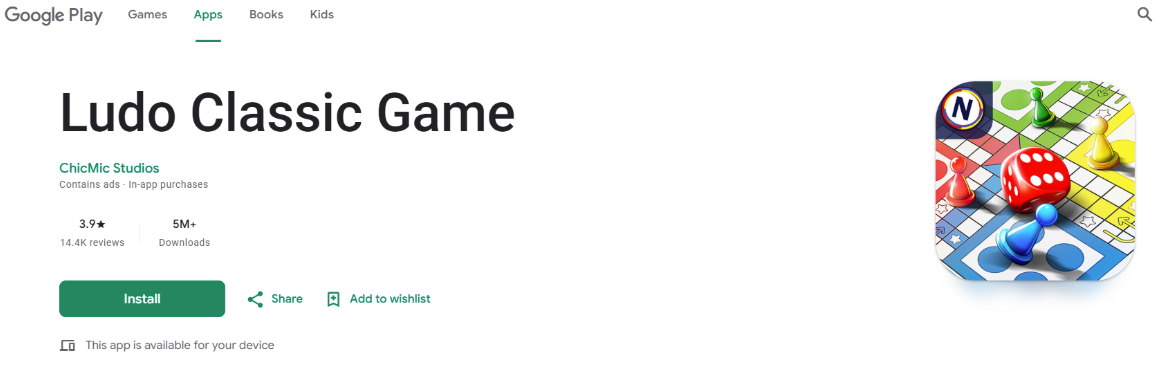
See how our Ludo development work translates into real player traction and store visibility. Our Ludo game development portfolio highlights a title built for Android with Unity & Nakama, and it has achieved:
- Built For: Android
- Technology: Unity & Nakama
- Industry: Games
- Installs: 5 Million+ Downloads
- Google Play Rankings: Ranked #1 in Trending, Ranked #1 in New + Updated Games, Ranked #2 in Top Free Games
- 9Apps: Top 3 Best Free Android Games of 2017
How AI Opponents Are Built: Reinforcement Learning and Beyond
Most production Ludo bots are trained with reinforcement learning game approaches. An agent is played many matches against itself or scripted rule-based opponents, receiving a reward signal for victories and token progress, and eventually adjusting its policy toward better play. A Ludo game finishes in a few rounds, allowing studios to run a huge number of simulated games cheaper than training bots for longer, open-ended titles. For teams new to the underlying methods, OpenAI’s introductory RL documentation is a good place to start.
The harder problem is not raw competence but AI opponent fairness. A bot optimized solely for winrate will crush casual players and hurt retention just as certainly as a dearth of opponents. The developers of the studios for Ludo skill-based gaming markets usually restrict bot aggression, add some randomization of decision timing, and use behavior based on logs of human play rather than release the best model by default. Unity’s ML Agents toolset, examined in our article on our breakdown of Unity’s AI game development approach, offers one of the most accessible entry points for teams new to training opponent models.
Business Case: Why Ludo AI Games Monetize Better
If tables are empty, session economics are affected immediately. Instant matches reduce the time between app launch and active play, thus increasing average session duration and, in turn, ad impression volume, which is a critical monetization lever for mobile Ludo. Less abandoned launches means studios see a more tangible benefit from AI opponents impacting the Ludo game economy as sessions no longer pause for a fourth player.
The tournament formats are good, too. Ludo tournament AI is able to backfill brackets when human registration drops below a bracket size, meaning entry-fee tournaments can run on schedule rather than being canceled or combined. The global mobile gaming market is expected to grow through 2027 and emerging markets will account for much of this growth, which should be taken into account in any monetization strategy for a Ludo release targeted to South Asian or Southeast Asian audiences. AI won’t replace a fun core loop, but it does remove a specific, well-documented reason for losing sessions.
Technical Considerations for Building Ludo AI
How a Ludo AI build is put together depends on the engine choice, where the inference takes place and the makeup of the team. Here’s how each option will affect the final result.
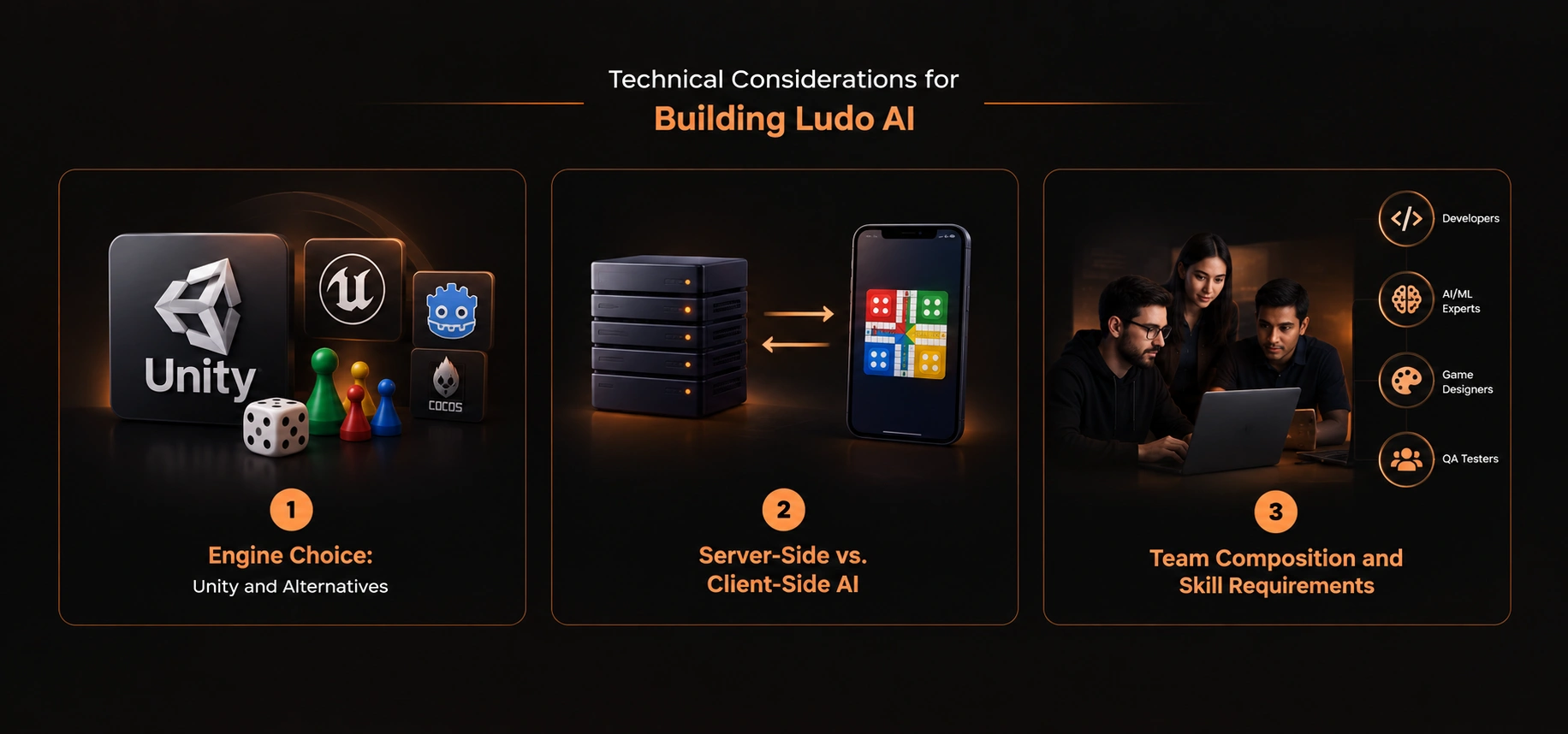
1. Engine Choice: Unity and Alternatives
Most studios creating Ludo games will choose Unity game development tools because of its proven success with 2D board-style games, the ability to export cross-platform to Android and iOS from a single codebase, and the large pool of developers out there that know the engine. One Unity case study mentions Ludo King, one of the most popular games built on Unity by Gametion, which reached over a billion downloads without a major engine upgrade.
2. Server-Side vs. Client-Side AI
The choice of engine matters less than where the AI logic lives. Server-side inference means the trained model is consistent across devices and makes it easier to change behavior without needing an app store update, but adds a network round-trip that could cause latency on weaker connections. Client-side inference avoids this lag, but requires that the model weights be stored inside the app, and loses centralized control over setting the difficulty.
3. Team Composition and Skill Requirements
Teams looking at this problem as part of larger mobile game development plans often prototype both ways before settling on one approach, since the right answer is very dependent on typical connection quality and average age of devices in target markets. Having a team that has specialist AI development experience, rather than just slapping AI on a generalist build team, really helps cut down on the review time.
UI, UX, and Player Trust in AI Ludo Games
The players that claim the AI opponent is cheating will be loud about it and the rubber-banding controversies in other genres show how quickly that opinion can spread. The game industry has long had commentary about adaptable AI opponents, noting that even well-tuned difficulty scaling can feel unfair if not communicated clearly to the player.
1. Transparency and Difficulty Selection
Ludo game UI UX choices such as displaying both difficulty levels in big letters or having a small “vs AI” sign during a match help to prevent this perception. I trust the former more than the latter. All I want is to pick the difficulty of my opponent before the match starts and not have it change under the hood.
2. Designing for Visible Player Control
But studios that do invest the time and money into UI UX design for this feature tend to treat difficulty selection as a visible, player-controlled parameter rather than a hidden backend variable. This strategy also plays into broader insights as to why user experience drives game retention, as players are far more forgiving of a difficult opponent they choose than one they feel is quietly engineered.
Cost and Timeline: What Ludo AI Development Actually Takes
The cost scales with how far a studio goes beyond a simple bot. A simple Ludo AI game development build: single-player mode, one or two difficulty tiers, basic reinforcement-learning-trained opponents. These usually cost $15,000 to $35,000 and takes 8 to 12 weeks with a small team. A mid-core construction including tournament modes, AI-backfilled brackets, tiered difficulty curves, and live-ops support for events typically costs between $50,000 and $120,000, with schedules ranging from four to six months depending on the amount of multiplayer infrastructure available.
- Basic single-player AI opponent with 2-3 difficulty levels.
- Mid-core design with tournament brackets and AI backfill.
- Full live-ops version, with seasonal events and analytics dashboards
1. Working With a Development Partner
These ranges presume that the studio is not developing a Ludo engine from the start. Working with an experienced game development partner who already provides Ludo-specific game development services and has a documented delivery procedure significantly reduces the estimation and prototyping phases while also avoiding the change-order surprises that come with a first-time Ludo build.
2. Sanity-Checking a Quoted Timeline
Reviewing a previous game portfolio for comparable board game titles is a sensible technique to double-check a quoted schedule before signing off, as not every generalist studio has released a title with real-money or skill-based tournament mechanisms. It’s also worth asking if the team may hire developers with prior game AI experience rather than general-purpose mobile engineers, as AI opponent tuning is a separate skill from fundamental gameplay engineering.
Calculate Your Ludo AI Game Development Cost Today
Hyper-Casual vs Mid-Core Ludo: Which Path Fits Your Business
Studios entering this market typically select between two product strategies. A hyper-casual vs. mid-core Ludo decision is typically based on monetization appetite: hyper-casual builds rely on ad revenue, minimal onboarding, and short iteration cycles, whereas mid-core builds invest in tournament economies, cosmetic purchases, and deeper AI difficulty ladders that reward longer engagement.
Teams with experience in hyper-casual game development can often launch a lightweight AI-opponent build quickly and test demand before committing to more extensive tournament infrastructure. Studios aiming for the mid-core approach, on the other hand, require stronger multiplayer-ready foundations from the start, as AI backfill works best when used in conjunction with a functional live matching system rather than replacing it entirely.
Concluding Note
Ludo’s simple rules, large installation base, and well-documented availability issue make it one of the most accessible starting points into AI-assisted board game development right now. AI opponents will not improve a poor core loop or replace actual multiplayer demand, but they will solve a specific, observable issue: empty tables at the wrong time. For studios that accurately scope the job: accurate difficulty tuning, transparent UX, and realistic budgets, a build ludo AI game initiative is a reasonable, well-understood gamble rather than a wild card.
Frequently Asked Questions
1. What is Ludo AI game development?
It’s the process of creating a Ludo game with trained AI opponents that can fill empty seats when human players are not available. The AI handles matchmaking holes, difficulty scaling and off-peak play, so a single player can jump into a match immediately at any time.
2. Why is Ludo a good fit for AI opponents?
Ludo’s rules are simple: four tokens, one die, and a few exceptions for capture and safe squares, so the model only looks at a limited number of allowable plays each turn. This makes the AI trainable, but still allows for real strategic complexity in judgments like whether to break from a safe square.
3. How much does it cost to build a Ludo AI game?
A basic one- or two-level difficulty build plus a single-player mode costs $15,000 to $35,000 and takes 8 to 12 weeks. A mid-core build with tournament modes, AI-backfilled brackets and live-ops support will cost $50,000-$120,000 and take 4-6 months to implement.
4. How are Ludo AI opponents trained?
Most production bots use reinforcement learning, where an agent plays thousands of simulated matches against itself, gets a reward signal for wins and token advancement, and gradually tunes its policy to play stronger. Ludo is less costly to train than longer, open-ended games, since matches are shorter.
5. Will strong AI opponents hurt player retention?
Yes, if the bot is trained only to win. A model that crushes casual players damages retention just as badly as empty tables. The studios should not have to release the strongest model by default, but rather limit the bot aggression, incorporate unpredictability into decision time and check against human play logs.
Build a Smarter Ludo Experience with AI