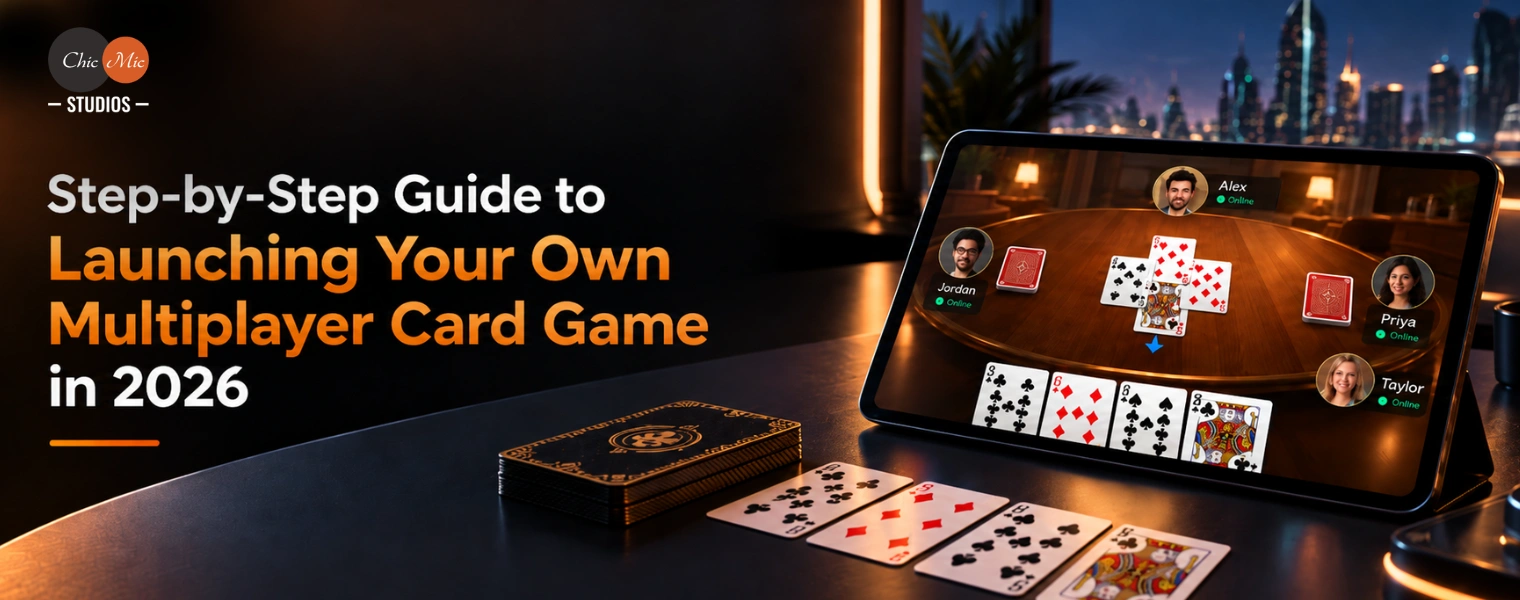
Step-by-Step Guide to Launching Your Own Multiplayer Card Development Solution in 2026
Key Takeaways
- Define the core gameplay loop, rules, player count, and unique game mechanics before starting full-scale development.
- Choose a technology stack based on your target platforms, gameplay complexity, and scalability requirements.
- Use an authoritative server architecture so the server validates player actions and controls the game’s state.
- Use real-time technologies such as WebSockets for synchronizing multiplayer gameplay.
Introduction
Multiplayer card game development has evolved far beyond physical decks and tabletop sessions. In 2026, players can compete in real time with friends or strangers across mobile devices, PCs, browsers, and connected platforms. From traditional games such as Rummy and Spades to competitive trading card games, multiplayer functionality has become a major part of the modern card gaming experience.
However, launching a successful multiplayer card game involves more than designing attractive cards and adding an online mode. Hire game developers to help with game rules, real-time communication, matchmaking, server authority, security, scalability, user experience, monetization, and post-launch operations.
This is where a structured approach to multiplayer card game development becomes important. Whether you are an independent creator, startup, publisher, or business looking for a reliable card game development company, the following steps can help you move from an initial concept to a production-ready multiplayer game.
Steps To Consider For Multiplayer Card Game Development
Step 1: Define Your Game Concept and Core Mechanics
Start by deciding what type of card game you want to build. Your concept could be based on a traditional game such as Rummy or Spades, or it could introduce completely new mechanics similar to modern digital trading card games.
You should define:
- Number of players
- Game modes
- Match duration
- Turn structure
- Win and loss conditions
- Card categories
- Resource systems
- Deck-building rules
These decisions influence almost every later stage of development.
A) Establish the Core Gameplay Loop
The core loop describes what players repeatedly do during a match. For example, a game could involve:
- Drawing cards
- Managing resources
- Playing cards
- Resolving abilities
- Attacking opponents
- Ending the turn
- Repeating until the win condition is reached
The loop should be simple enough to understand but provide enough strategic depth to encourage repeat play.
B) Identify Your Unique Hook
The multiplayer card game market is competitive, so your game needs a clear reason for players to choose it.
Your differentiator could be:
- A unique combat system
- Simultaneous turns
- Innovative card abilities
- Social mechanics
- A distinctive theme
- Shorter match durations
- Cooperative gameplay
A strong hook should be established before extensive development begins.
Have a Multiplayer Card Game Idea Ready for Development?
Step 2: Select the Right Technology Stack
A) Choose the Game Engine
The technology stack should match your target platforms and gameplay requirements. Unity engine can be a practical option for cross-platform card games because it supports 2D and 3D graphics, 3D animation, UI development, and deployment across multiple platforms. For browser-focused games, web technologies such as TypeScript, WebGL, and HTML5 may be more appropriate.
B) Select the Backend Architecture
A multiplayer card game requires a backend capable of handling authentication, player profiles, matchmaking, game sessions, and real-time communication.
A typical backend may include:
- API services
- Game servers
- WebSocket connections
- Database
- Cache/session storage
- Matchmaking service
- Analytics
- Monitoring
The architecture should be selected based on expected player concurrency and game complexity.
C) Plan for Cross-Platform Development
If you intend to release the game on iOS, Android, PC, and web, consider platform requirements from the beginning. UI layouts, input methods, performance, account management, and platform-specific integrations should be tested across target devices rather than added at the end.
Step 3: Build an Authoritative Multiplayer System
A) Keep the Server as the Source of Truth
One of the most important principles in card game development solution architecture is server authority. The client should send an action request, while the server determines whether the action is legal.
For example, when a player selects a card, the client can send a request to play that card. The server then checks whether:
- It is the player’s turn
- The player owns the card
- The card can legally be played
- The player has the required resources
- The current game state permits the action
- Only after validation should the server update the game state.
B) Use Real-Time Communication
WebSockets are well suited to multiplayer card games because they allow the server to push gameplay events to connected players without requiring constant polling.
They can be used for:
- Turn updates
- Card plays
- Game-state changes
- Player actions
- Match events
- Notifications
- Reconnection synchronization
HTTP APIs can still handle operations such as authentication, player profiles, purchases, and account management.
C) Protect Random Game Elements
Randomness is fundamental to card games. Deck shuffling, card distribution, random effects, and other outcomes should be controlled by the server rather than generated by the client. This prevents players from manipulating random outcomes and provides a more trustworthy competitive environment.
Step 4: Create and Test the MVP
A) Start With a Small Prototype
Do not begin by creating hundreds of cards and complex animations. Start with enough content to test whether the game is enjoyable.
An MVP might contain:
- Basic player accounts
- One game mode
- Limited card collection
- Lobby system
- Matchmaking
- Core game rules
- Turn management
- Win/loss handling
- Basic reconnection
B) Test the Game Before Full Production
Paper prototyping is still useful for card games. You can test card interactions, resource systems, balance, and turn structures without writing production code. Once the rules are stable, move the prototype into a digital environment for remote multiplayer testing.
C) Collect Real Player Feedback
Internal testing alone is not enough. External testers can identify:
- Confusing rules
- Unbalanced cards
- Boring turns
- Poor onboarding
- Long waiting periods
- Frustrating mechanics
Use this feedback to refine the game before investing heavily in content production.
Step 5: Design the UI, Art, and Player Experience
A) Make Cards Easy to Read
Card interfaces should communicate important information immediately. Players should be able to recognize:
- Card name
- Cost
- Type
- Ability
- Attack or defense
- Rarity
- Status effects
Avoid excessive visual effects that make important information difficult to understand.
B) Optimize for Mobile Screens
Small screens require careful UI planning. Buttons need appropriate touch targets, card text needs to remain readable, and the player’s hand should be easy to navigate. Responsive layouts are particularly important if the game will support multiple screen sizes.
C) Build a Consistent Art Pipeline
Create visual standards for:
- Card dimensions
- Typography
- Icons
- Colors
- Character art
- Animations
- Effects
A consistent pipeline makes future card and content production faster.
Need UI, Art & Multiplayer Engineering for Your Card Game?
Step 6: Add Progression and Monetization
A) Create Meaningful Progression
Players need reasons to continue playing after completing their first few matches. Potential progression systems include:
- Player levels
- Ranked modes
- Achievements
- Daily challenges
- Seasonal events
- Unlockable content
- Cosmetic rewards
Progression should reinforce the game’s core gameplay rather than create unnecessary complexity.
B) Select a Monetization Model
Common models include:
- Premium purchase
- Free-to-play
- Battle pass
- Cosmetic purchases
- Expansion content
- Optional in-game purchases
For competitive card games, be particularly careful with pay-to-win mechanics. Monetization should not undermine competitive fairness.
C) Implement Analytics
Analytics can help you understand how players actually use the game. Track metrics such as:
- Session duration
- Match completion
- Player retention
- Matchmaking time
- Disconnect rate
- Progression
- Purchases
- Churn
These insights can guide balancing, monetization, and future content decisions.
Step 7: Prepare the Backend for Scale
A) Plan for Concurrent Players
Your infrastructure needs to support more than individual players. It must handle simultaneous connections and active matches.
As the player base grows, you may need:
- Multiple game-server instances
- Load balancing
- Redis or similar caching
- Database optimization
- Automated deployments
- Cloud scaling
- Monitoring
An experienced game development company can help design infrastructure around expected concurrency rather than overbuilding the system from day one.
B) Implement Reconnection
Players will lose network connectivity. Your game should allow a disconnected player to return to an active match whenever possible. The server should retain enough game information to restore the player’s session and synchronize them with the current state.
C) Maintain Game History
Recording gameplay events can provide significant technical benefits. Game history can support:
- Match replays
- Debugging
- Dispute resolution
- Anti-cheat investigations
- Analytics
- Crash recovery
This becomes increasingly valuable as the multiplayer community grows.
Step 8: Implement Security and Anti-Cheat
A) Validate Every Important Action
Never trust gameplay information supplied by the client. Server-side validation should cover card ownership, turns, resources, card effects, game results, and other critical actions.
B) Secure Player Accounts
Implement appropriate authentication and session management. Sensitive communications should use encrypted connections, while APIs should validate requests and restrict suspicious activity.
C) Test Unusual Scenarios
Multiplayer testing should include more than normal gameplay. Test situations such as:
- Player disconnects during a turn
- Player reconnects after a delay
- Duplicate requests
- Simultaneous actions
- Invalid card actions
- Network latency
- Server restart
Step 9: Launch and Build Your Player Community
A) Start With a Closed Alpha
A controlled alpha lets you test the game with a limited audience before opening it to everyone.
Use this stage to evaluate:
- Gameplay balance
- Server stability
- Matchmaking
- Player onboarding
- Retention
- Bugs
B) Prepare Your Store Presence
Depending on your platforms, prepare your store listing, screenshots, trailer, descriptions, community links, and pre-registration or wishlist strategy. Your store page should communicate the game’s unique hook quickly.
C) Build the Community Before Launch
Community development should begin before the public release. Consider using:
- Discord
- Social media
- Developer updates
- Gameplay videos
- Creator previews
- Closed testing programs
Early players can become valuable sources of feedback as well as your first community advocates.
Step 10: Monitor and Improve After Launch
A) Track Technical Performance
After launch, monitor:
- Server performance
- Concurrent users
- Crash rates
- Network failures
- Matchmaking duration
- Database performance
- API response times
Technical monitoring allows your team to identify problems before they affect a large portion of the player base.
B) Continue Updating the Game
A multiplayer card game should be treated as an evolving product. Post-launch and quality assurance updates can introduce:
- New cards
- New game modes
- Balance changes
- Seasonal events
- Cosmetics
- Quality-of-life improvements
- New progression features
Player feedback and analytics should determine which updates receive priority.
Ready to Launch a Scalable Multiplayer Card Game?
Conclusion
Launching a multiplayer card game in 2026 with a card game development company requires a combination of strong game design and reliable engineering. The process should begin with a well-defined gameplay loop and move through prototyping, multiplayer development, UI/UX, progression, security, infrastructure, testing, and launch preparation.
The most important principle is to validate the game before scaling it. Build the core experience, test it with real players, strengthen the multiplayer architecture, and then expand the content and live-service systems.
Whether you are building a casual card app, competitive TCG, social multiplayer game, or cross-platform card gaming platform, choosing the right game development service and technical architecture at ChicMic Studios early can make the development process more predictable and scalable.
Frequently Asked Questions
1. How much does multiplayer card game development cost?
The cost depends on game complexity, number of platforms, multiplayer features, art requirements, backend architecture, and the amount of content. A simple card game MVP will generally require significantly less investment than a large competitive TCG with hundreds of cards and live-service features.
2. How long does it take to develop a multiplayer card game?
Development time varies according to the game’s scope. A basic MVP can take several months, while a feature-rich multiplayer card game can require a substantially longer development cycle involving design, engineering, art, testing, and backend infrastructure.
3. Which technology is best for card game app development?
There is no single best technology for every project. Unity can be suitable for cross-platform game development, while web technologies may be preferable for browser-first games. The backend should provide reliable real-time communication and authoritative game logic.
4. Do card games need multiplayer servers?
Competitive multiplayer card games should generally use server-side game logic. The server should validate player actions, manage game state, control random events, and determine game outcomes.
5. How can a multiplayer card game prevent cheating?
Use an authoritative server, server-side validation, secure randomization, authentication, rate limiting, encrypted communication, and gameplay event logging. Critical game decisions should never be controlled exclusively by the client.
6. Can a card game be launched on multiple platforms?
Yes. A properly planned architecture can support platforms such as iOS, Android, PC, and web. However, each platform has different requirements for UI/UX design, performance, input, authentication, and distribution.
7. Should I develop an MVP first?
Yes. An MVP development with a card game development company lets you validate the core gameplay and multiplayer experience before investing in a large content library. This can reduce development risk and reveal design problems early.
Turn Your Card Game Concept Into a Market-Ready Multiplayer Experience