How India’s Demat 2.0 Is Creating New Opportunities for Bond Tokenization Platform Development
Key Takeaways
- Demat 2.0 is opening a new chapter for Corporate Bond Tokenization in India, bringing regulated securities infrastructure and distributed-ledger technology together.
- Bond Tokenization Platform Development goes beyond token creation. Platforms need to support issuance, custody, compliance, settlement, reconciliation, reporting, and asset servicing.
- Secondary-market infrastructure represents a significant future opportunity, although tokenization itself does not automatically create liquidity.
- Demat 2.0 can influence the broader RWA Tokenization Development ecosystem, providing a model for building regulated digital representations of financial and real-world assets.
Introudction
India’s capital market is entering a new phase of digital transformation with the introduction of Demat 2.0 Tokenization for corporate bonds. In September 2026, SEBI announced the successful launch of the Demat 2.0 pilot for tokenised corporate bonds, opening a new direction for regulated digital securities infrastructure.
Unlike conventional crypto-based tokenization models, this approach connects tokenised securities with regulated market infrastructure and digital settlement mechanisms. This creates opportunities not only for issuers and investors but also for fintech companies developing institutional-grade Bond Tokenization Platform Development solutions.
As businesses explore digital asset infrastructure, coin and token development can also provide relevant technical foundations for designing tokenized assets and blockchain-based financial applications.
What Is India’s Demat 2.0?
Demat 2.0 is designed to represent corporate bonds as digital tokens on a permissioned distributed ledger infrastructure. The objective is not to replace the legal nature of a corporate bond with cryptocurrency. Instead, the technology can provide a digital representation of the security while preserving the regulatory, ownership and investor-protection framework surrounding corporate debt. This distinction is important for businesses entering Corporate Bond Tokenization. The opportunity is therefore less about creating another cryptocurrency and more about building compliant tokenization infrastructure for issuing, holding, transferring, settling and servicing regulated digital securities.
Why Bond Tokenization in India Is Gaining Attention
Corporate bonds already operate within a structured regulatory ecosystem. Tokenization introduces another technology layer that can potentially improve how different participants interact with these instruments. A conventional transaction can involve issuers, registrars, depositories, custodians, brokers, investors and settlement systems.
A tokenized architecture can connect these functions through programmable digital records and automated workflows.
Potential benefits include:
- Faster transaction processing
- Automated settlement workflows
- Reduced reconciliation requirements
- Programmable compliance controls
- Improved transaction traceability
- More efficient asset servicing
- Integration with digital settlement infrastructure
The key opportunity for developers is building the technology that connects these components without disrupting the underlying regulatory framework.
Key Opportunities in Bond Tokenization Platform Development
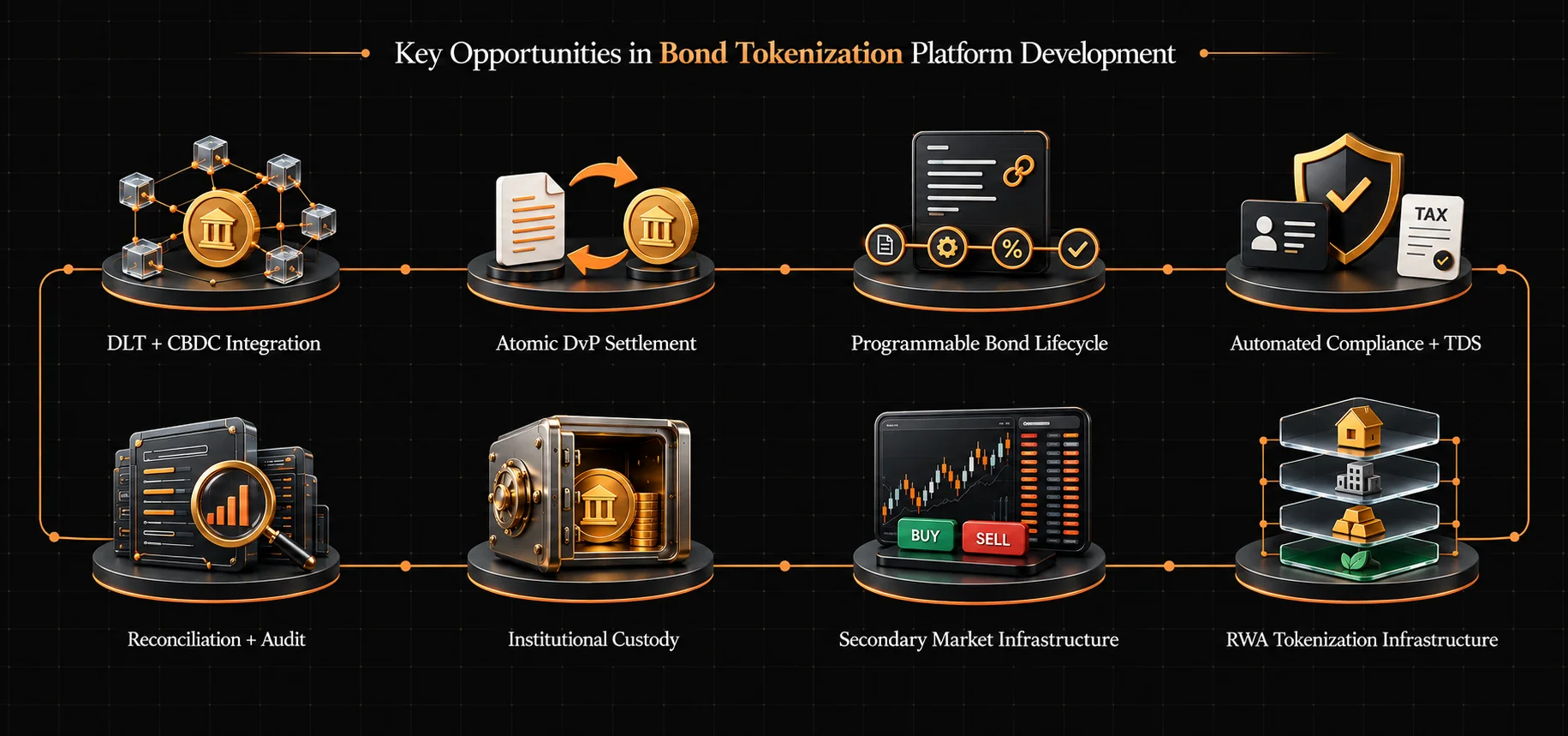
1. DLT and CBDC Integration
One of the most technically significant opportunities is creating an integration layer between permissioned distributed ledgers and regulated digital settlement infrastructure.
A Bond Tokenization Development platform can provide APIs for:
This type of infrastructure can allow financial institutions to interact with tokenized bonds through familiar APIs rather than managing blockchain infrastructure directly.
2. Atomic Delivery-versus-Payment
Settlement is one of the most important areas for tokenized securities. A tokenized bond platform can be designed around atomic Delivery-versus-Payment (DvP), where the transfer of the security and corresponding payment are coordinated within the same settlement process.
This can reduce counterparty and settlement risk while improving transaction visibility. For platform developers, the opportunity lies in building reliable transaction orchestration engines rather than simply deploying smart contracts.
3. Programmable Bond Lifecycle Management
A corporate bond has a lifecycle that extends well beyond issuance.
It may involve:
- Coupon payments
- Principal redemption
- Maturity
- Corporate actions
- Transfer restrictions
- Investor eligibility
- Covenants
- Tax processing
- Reporting
A tokenization platform can introduce a programmable lifecycle engine that connects these events with the tokenized security. For example, when a coupon becomes payable, the platform can identify eligible holders, calculate the applicable amount, initiate the payment workflow and update the transaction record. This creates an opportunity for developers to combine smart-contract logic with conventional financial application architecture.
4. Automated Compliance and TDS
Compliance is likely to be one of the most important components of institutional tokenization.
A production-grade platform could integrate:
- KYC and investor verification
- Eligibility checks
- Transfer restrictions
- Regulatory limits
- Tax rules
- TDS calculations
- Transaction monitoring
- Audit reporting
Instead of treating compliance as a separate manual process, rules can be incorporated into transaction workflows. However, developers should design these systems carefully. Smart-contract logic should automate deterministic processes while legal agreements, regulatory records and authorised financial institutions remain part of the overall control framework.
5. Reconciliation and Audit Infrastructure
Financial institutions often maintain records across multiple systems.
With tokenized securities, institutions may need to reconcile distributed-ledger records with custody, settlement, accounting and reporting systems. This creates an important opportunity for Bond Tokenization Development companies. Real-time dashboards could also provide compliance teams and auditors with transaction histories and digitally verifiable records.
6. Institutional Custody and Portfolio Integration
Tokenized bonds will still need to fit into institutional investment workflows.
Asset managers, banks, NBFCs, custodians and treasury departments may require integrations with:
- Accounting platforms
- Risk engines
- Treasury systems
- Custody platforms
- Regulatory reporting systems
- Portfolio management systems
This means a successful tokenization platform is unlikely to operate as an isolated blockchain application. Instead, it will need to function as an integration layer between traditional financial systems and tokenized assets.
7. Secondary Market Infrastructure
The next major opportunity is secondary trading. Tokenization can make securities digitally transferable, but technology alone does not create liquidity. A functioning secondary market still requires investors, market makers, compliant trading infrastructure, pricing mechanisms and regulatory oversight.
Future Bond Tokenization Platform Development may therefore include:
- Order management
- Liquidity management
- Transfer validation
- Settlement automation
- Market surveillance
- Trade reporting
- Portfolio management
- Institutional trading interfaces
SEBI’s broader corporate-bond initiatives also show continued regulatory attention toward online bond distribution and market infrastructure. The commercial opportunity will depend on how these future market functions develop.
8. Building RWA Tokenization Infrastructure
The Demat 2.0 model also provides a useful blueprint for the broade
RWA Tokenization development market. Corporate bonds are only one category of real-world assets that can potentially be represented digitally.
Future platforms may support:
- Bonds
- Private credit
- Fund units
- Receivables
- Real estate interests
- Infrastructure assets
- Other regulated financial instruments
For an RWA Tokenization Development company, the technical challenge is creating reusable infrastructure rather than building a separate blockchain application for every asset class.
A modular architecture can include tokenization, identity, compliance, custody, settlement, asset servicing and reporting as independent components.
Technology Stack for a Bond Tokenization Platform
A production-oriented platform may include several layers:
- User Layer: Institutional dashboards, issuer portals and investor interfaces
- API Layer: REST APIs, event-driven APIs and integration gateways
- Compliance Layer: KYC, AML, eligibility and transaction controls
- Tokenization Layer: Smart contracts and token lifecycle management
- Ledger Layer: Permissioned DLT infrastructure
- Settlement Layer: DvP and digital payment integration
- Data Layer: Transaction history, reporting and reconciliation
- Security Layer: Encryption, access control, key management and audit logging
This layered approach makes the platform easier to integrate with existing financial infrastructure.
Why Businesses Need Specialized RWA Tokenization Development Services
Building a tokenized bond platform requires more than blockchain development.
The development team needs to understand financial workflows, regulatory requirements, security architecture and institutional integrations.
Professional RWA Tokenization Development services can cover:
The goal should be to create infrastructure that financial institutions can actually integrate into their existing operations.
Challenges Developers Must Consider
The opportunity comes with significant technical and regulatory challenges.
Security is critical because tokenized securities can represent real financial value.
- Private-key management, access controls, transaction authorization and smart-contract security require institutional-grade architecture.
- Interoperability is another challenge. Platforms must communicate with existing financial systems rather than operating as isolated networks.
- Regulatory compliance is equally important. Tokenization does not remove securities laws or investor-protection requirements.
Finally, developers must avoid assuming that every future feature is already part of the current Demat 2.0 pilot. Secondary trading, retail access and broader programmability should be treated as future development areas unless specifically confirmed by regulators.
The Future of Bond Tokenization in India
India’s Demat 2.0 initiative represents an important shift in how regulated securities infrastructure can incorporate distributed-ledger technology. The opportunity extends beyond issuing a bond as a token.
The larger development ecosystem includes settlement engines, compliance platforms, custody integrations, asset-servicing systems, reconciliation tools and eventually secondary-market infrastructure.
For technology companies like ChicMic Studios, this creates a new category of financial infrastructure where blockchain technology operates alongside established market institutions rather than outside them.
Frequently Asked Questions
1. What is Demat 2.0 Tokenization?
Demat 2.0 is a SEBI-announced pilot for tokenised corporate bonds using distributed-ledger technology within regulated market infrastructure. SEBI announced the successful pilot launch on September 10, 2026.
2. What is Bond Tokenization Development?
Bond Tokenization Development involves creating technology that represents bonds as digital tokens and supports issuance, ownership, transfer, settlement, compliance and lifecycle management.
3. Is bond tokenization the same as cryptocurrency?
No. Tokenized bonds can remain regulated securities. The token is a technological representation of the underlying financial instrument, not necessarily a cryptocurrency.
4. Can tokenized bonds automatically pay coupons?
Technically, programmable infrastructure can automate parts of the coupon lifecycle. However, production implementations must account for legal terms, investor eligibility, taxation and regulated payment processes.
5. What does an RWA Tokenization Development company provide?
An RWA Tokenization Development company can provide tokenization architecture, smart contracts, compliance integrations, wallets, custody connectivity, settlement workflows, APIs and asset-management infrastructure.
6. Is Bond Tokenization in India ready for retail investors?
The current Demat 2.0 pilot should not be interpreted as a complete retail tokenized-bond market. Retail access and broader market functionality need to be assessed based on subsequent regulatory and infrastructure developments.