Cybersecurity Audit Checklist for Growing Companies
Key Takeaways
- A cybersecurity audit helps growing companies identify security gaps before they become costly incidents.
- Regular cyber risk assessments provide visibility into vulnerabilities across systems, applications, cloud environments, and business processes.
- For Canadian businesses, consider PIPEDA compliance, data protection Canada requirements, cloud security Canada considerations, and Canadian SaaS security.
- ChicMic Studios services include application security testing, API security testing, penetration testing, and code security review in the security lifecycle.
Introduction
Growth creates opportunities, but it also creates new cybersecurity trends and associated risks. As a company adds employees, customers, applications, cloud services, devices, vendors, and data, its attack surface expands. Security practices that were sufficient for a small team may no longer protect the business effectively.
This is where a cybersecurity audit becomes important. A cybersecurity audit gives growing companies a structured way to identify security gaps, evaluate existing controls, and understand whether their technology and processes can withstand current threats. It can also help leadership build a practical enterprise security strategy without slowing down business growth.
For startups, SMBs, and growing Canadian businesses, a regular security assessment can provide visibility into technical weaknesses, compliance requirements, and broader digital risks.
What Is a Cybersecurity Audit?
A cybersecurity audit is a systematic review of an organization’s technology, security controls, policies, processes, and data protection practices.
The objective is not simply to find vulnerabilities. A well-designed information security audit determines whether security controls are properly implemented, consistently followed, and appropriate for the company’s risk profile.
A typical audit may examine:
- Identity and access management
- Network security
- Endpoint protection
- Cloud infrastructure
- Application security
- Data protection
- Backup and disaster recovery
- Security monitoring
- Employee awareness
- Vendor and third-party risk
- Incident response
- Security governance
- Regulatory compliance
For growing organizations, an audit can become a foundation for a broader security maturity assessment.
Why Growing Companies Need Regular Security Assessments
Cybersecurity risks change as businesses grow. A startup may initially operate with a few employees, several SaaS applications, and a small cloud environment. A few years later, it may have hundreds of employees, multiple offices, customer-facing applications, APIs, remote workers, contractors, and sensitive customer information.
Every new system introduces potential risk. A cyber risk assessment helps identify these risks before they become security incidents.
It should answer practical questions such as:
- What systems and data are most important to the business?
- Who can access them?
- Are privileged accounts adequately protected?
- Which systems are exposed to the internet?
- Are critical vulnerabilities being fixed quickly?
- Are cloud environments securely configured?
- Can the company recover after ransomware or data loss?
- Are vendors introducing additional security risks?
The answers help organizations prioritize security investments according to business risk.
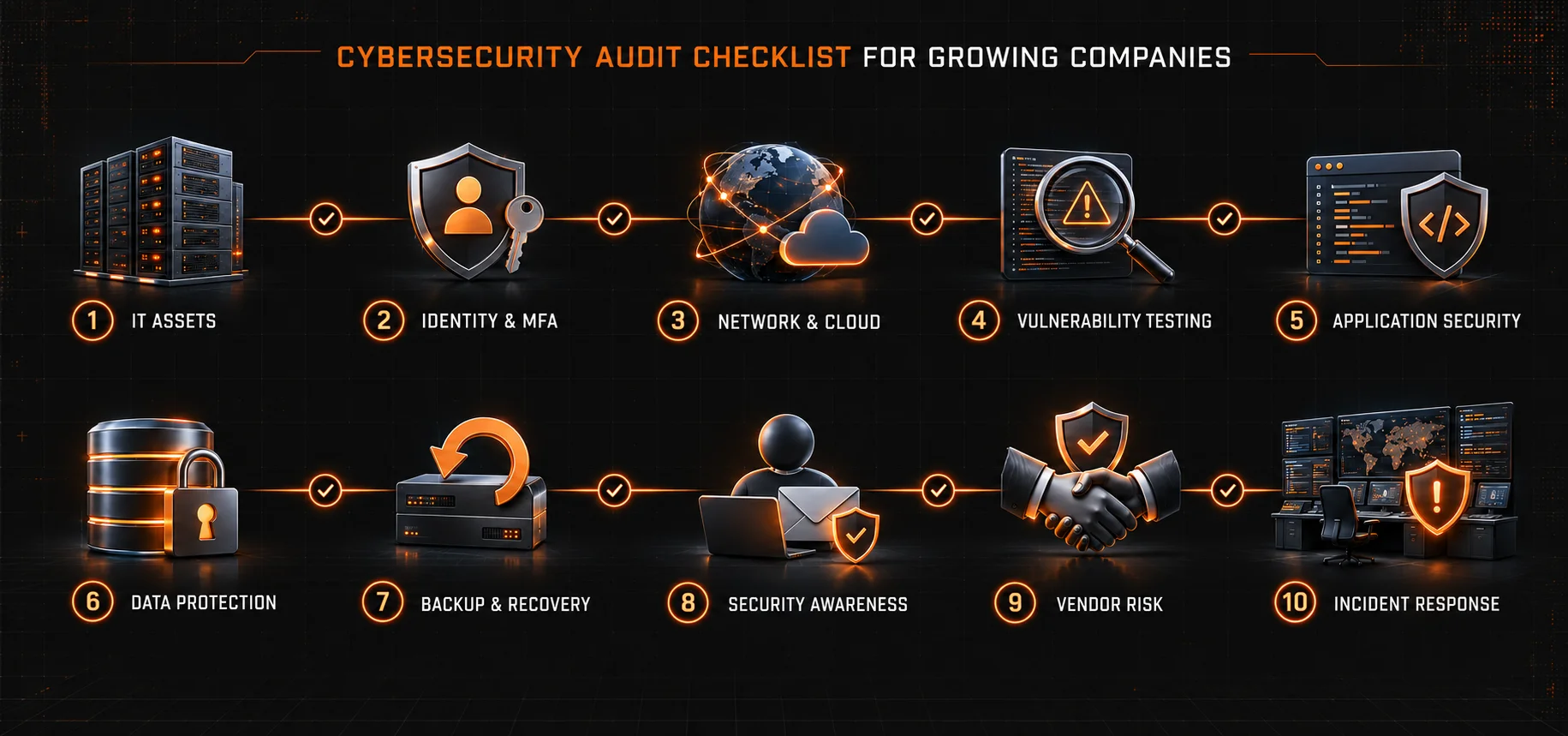
Cybersecurity Audit Checklist for Growing Companies
1. Review Your IT Assets and Attack Surface
You cannot secure assets that you do not know exist. Start by maintaining an accurate inventory of laptops, desktops, servers, mobile devices, network equipment, cloud infrastructure, applications, APIs, and SaaS platforms.
Identify internet-facing systems and services because they represent an important part of your external attack surface. Remove unused applications, inactive accounts, abandoned systems, and unnecessary services. A good asset inventory should identify the system owner, business purpose, data handled, criticality, and security controls associated with each important asset.
This is also an essential first step in any threat assessment or vulnerability assessment.
2. Strengthen Identity and Access Management
Identity is one of the most important security boundaries for modern businesses. Enable Multi-Factor Authentication (MFA) for email, cloud applications, administrative accounts, remote access, and other sensitive services. Review permissions using the principle of least privilege. Employees should receive only the access required to perform their jobs.
Pay particular attention to privileged accounts. A growing company should also have documented joiner, mover, and leaver processes so access is granted, changed, and removed promptly. Regular access reviews can identify dormant accounts, excessive permissions, shared accounts, and unnecessary administrative privileges.
3. Assess Network, Endpoint, and Cloud Security
Traditional perimeter security is no longer sufficient for organizations that rely heavily on cloud services and remote employees. Review firewall configurations, VPNs, wireless networks, endpoint protection, DNS security, and remote-access controls.
Endpoints should have appropriate protection, centralized management, encryption, and timely security updates. Cloud environments require their own controls.
A cloud security review should examine identity permissions, exposed storage, security groups, encryption, logging, secrets management, configuration changes, and administrative access. For Canadian organizations, cloud security Canada considerations should also account for where sensitive information is stored, contractual requirements, privacy obligations, and the organization’s data residency needs.
4. Perform Vulnerability Scanning and Penetration Testing
Regular vulnerability scanning can identify outdated software, insecure configurations, exposed services, and known vulnerabilities. However, scanning alone does not provide a complete picture. Organizations should consider penetration testing for important external systems, applications, APIs, and infrastructure.
Penetration testing attempts to validate whether identified weaknesses can actually be exploited and what an attacker could potentially reach after gaining access. A mature program combines automated scanning with targeted testing and remediation.
Critical findings should have clearly defined remediation timelines, responsible owners, and verification after fixes are implemented.
5. Include Application Security in the Audit
Applications often represent a direct path to customer data and business systems. A growing organization should include application security testing in its cybersecurity program. Depending on the technology stack, this can include:
- Web application security testing
- API security testing
- Mobile application security testing
- Source-code analysis
- Dependency scanning
- Authentication testing
- Authorization testing
- Configuration reviews
- Secrets detection
- Code security review
Security should also be integrated into the development lifecycle. Secure software development practices can include threat modelling, secure coding standards, peer reviews, automated security testing, dependency management, and security checks within CI/CD pipelines. This approach helps organizations identify weaknesses earlier rather than waiting until an application reaches production.
6. Protect Sensitive Business and Customer Data
Data protection should be evaluated from collection through deletion. Identify sensitive information such as customer records, financial information, credentials, employee information, intellectual property, and confidential business data.
Review whether sensitive data is encrypted both at rest and in transit. Access should be restricted according to business needs. Companies should also examine retention periods, secure deletion, data classification, backup protection, and data-sharing practices.
Canadian businesses should consider applicable privacy requirements, including PIPEDA compliance where relevant, along with provincial privacy obligations. For organizations operating across jurisdictions, privacy requirements may also include GDPR compliance. This makes data protection Canada considerations increasingly important for companies handling Canadian customer information.
7. Review Backup and Disaster Recovery
A cybersecurity audit should not stop at prevention. Ask what happens if an attacker successfully compromises the environment. Critical systems and data should have reliable backups protected against unauthorized modification or deletion. Where appropriate, organizations should maintain offline or otherwise isolated backup copies.
But having backups is not enough. Test restoration regularly. Document recovery priorities and establish recovery objectives such as Recovery Time Objective (RTO) and Recovery Point Objective (RPO). A ransomware incident can become a major business continuity event if systems cannot be restored quickly.
8. Assess Employee Security Awareness
Technology cannot eliminate every security risk. Employees remain an important part of the organization’s security environment. Security awareness programs should cover phishing, social engineering, password security, MFA, suspicious attachments, unsafe links, remote working, and incident reporting.
Organizations can conduct controlled phishing simulations to identify training gaps. Security policies should be reviewed periodically and updated as the organization introduces new technologies, applications, and working practices.
9. Evaluate Vendors and Third-Party Risk
Growing businesses rarely operate entirely on their own infrastructure. They depend on cloud providers, SaaS platforms, payment processors, consultants, managed service providers, software vendors, and other partners. Every external connection can introduce additional risk.
A vendor security assessment should consider:
- What information does the vendor access?
- Does it have privileged access?
- Where is the data stored?
- What security controls are implemented?
- How are incidents reported?
- How is access removed?
- Does the vendor subcontract critical services?
Canadian SaaS providers should pay particular attention to Canadian SaaS security, privacy requirements, cloud architecture, customer isolation, and third-party dependencies.
10. Establish Incident Response and Security Governance
Every growing company should know what it will do when something goes wrong. An incident-response plan should define responsibilities, escalation procedures, communication channels, containment steps, evidence preservation, recovery procedures, and post-incident review.
Security governance provides the structure around these activities. Organizations should define security ownership, policies, risk-management processes, control reviews, exceptions, and reporting. A cybersecurity framework can help organize these activities.
The NIST Cybersecurity Framework is commonly used to structure cybersecurity around identifying, protecting, detecting, responding, and recovering from cybersecurity risks. Organizations may also align controls with ISO 27001 compliance requirements, depending on their business and customer expectations. Other regulatory or contractual requirements may include SOC 2 compliance, HIPAA security requirements, GDPR, or applicable Canadian privacy obligations.
How Often Should a Growing Company Conduct a Cybersecurity Audit?
There is no single schedule that works for every organization. A formal audit may be performed annually, while higher-risk environments may require more frequent assessments. Certain activities should happen continuously or much more frequently.
For example:
- Vulnerability scanning can be performed regularly.
- Access permissions should be reviewed periodically.
- Security logs should be monitored continuously.
- Critical patches should be addressed according to risk.
- Incident-response plans should be tested periodically.
- Vendor risk should be reassessed when significant changes occur.
A practical approach is to combine an annual security assessment with continuous security monitoring and risk management.
Choosing a Cybersecurity Framework
A framework gives organizations a consistent structure for managing security. The NIST cybersecurity framework can help organizations understand and manage cybersecurity risk.
ISO 27001 provides a more formal information security management approach and can be particularly relevant when customers or partners require demonstrable security governance.
For organizations operating in Canada, framework selection should also account for applicable privacy laws and contractual requirements. The objective is not to collect certifications simply for the sake of certification. The objective is to establish controls that match the organization’s actual risks.
Building a Security Program That Supports Growth
Cybersecurity should not become an obstacle to business growth. The goal of secure business growth is to build security into the systems and processes that allow the company to scale.
ChicMic Studios has a very direct approach that is results driven and transparent. They start with the highest-risk assets and business processes. Prioritize vulnerabilities that expose sensitive information, critical systems, privileged accounts, or customer-facing applications. As the organization matures, expand security capabilities across cloud infrastructure, applications, identity, monitoring, third-party risk, and governance.
This turns cybersecurity from a reactive IT function into part of the organization’s broader digital risk management strategy. For Canadian organizations that lack internal security expertise, working with experienced cybersecurity companies Canada or specialized cybersecurity services Canada providers can help with security assessments, penetration testing, compliance readiness, cloud security, and ongoing monitoring.
Final Thoughts
A cybersecurity audit is not simply a compliance exercise or a checklist of technical controls. Regular cyber risk assessment, vulnerability testing, security monitoring, and governance can help organizations build resilience while continuing to innovate.
For a growing organization, it is a way to understand where the business is exposed and determine which improvements will and endpoint protection, application security, cloud security, data protection, vulnerability management, employee awareness, third-party risk management have the greatest impact.
Frequently Asked Questions
1. What is a cybersecurity audit?
A cybersecurity audit is a structured review of an organization’s security controls, technology, policies, processes, vulnerabilities, and risk-management practices.
2. How often should a company conduct a cybersecurity audit?
Many organizations perform a comprehensive audit annually while conducting vulnerability scanning, access reviews, monitoring, and other security activities throughout the year. Higher-risk organizations may require more frequent assessments.
3. What is the difference between a cybersecurity audit and penetration testing?
A cybersecurity audit evaluates whether security controls, policies, and processes are appropriately designed and implemented. Penetration testing attempts to identify and validate exploitable weaknesses in systems or applications. They complement each other but serve different purposes.
4. Is cybersecurity important for startups?
Yes. Cybersecurity for startups should begin early because security decisions made during the startup stage can affect infrastructure, applications, data protection, and compliance as the company grows.
5. What cybersecurity requirements apply to Canadian businesses?
Requirements depend on factors such as location, industry, type of information collected, and business activities. Organizations may need to consider PIPEDA, provincial privacy legislation, contractual requirements, and sector-specific obligations.
6. Does cloud computing make cybersecurity more difficult?
Cloud platforms can improve scalability and security capabilities, but they introduce configuration, identity, access, and third-party risks. A strong access controls, patching, endpoint protection, backups, employee awareness, vulnerability management, and an incident-response plan strong cloud security program should address these risks throughout the cloud environment.
7. What should an SMB prioritize first?
Cybersecurity for SMBs should generally begin with asset visibility, MFA, strong access controls, patching, endpoint protection, backups, employee awareness, vulnerability management, and an incident-response plan. Priorities should ultimately be based on the organization’s specific risk profile.