WhatsApp
microsoft-logo
pg-logo
samsung-logo
stanford-university-logo
systique hughes logo
cashback-logo
luxel-logo
Frugi logo
athleta-logo-1
Funko Logo
hzm logo
swiggy-logo
cardano-logo
animaca
RAG Development: Turning Retrieval Augmented Generation Into Enterprise-Ready Systems

RAG Development: Turning Retrieval Augmented Generation Into Enterprise-Ready Systems

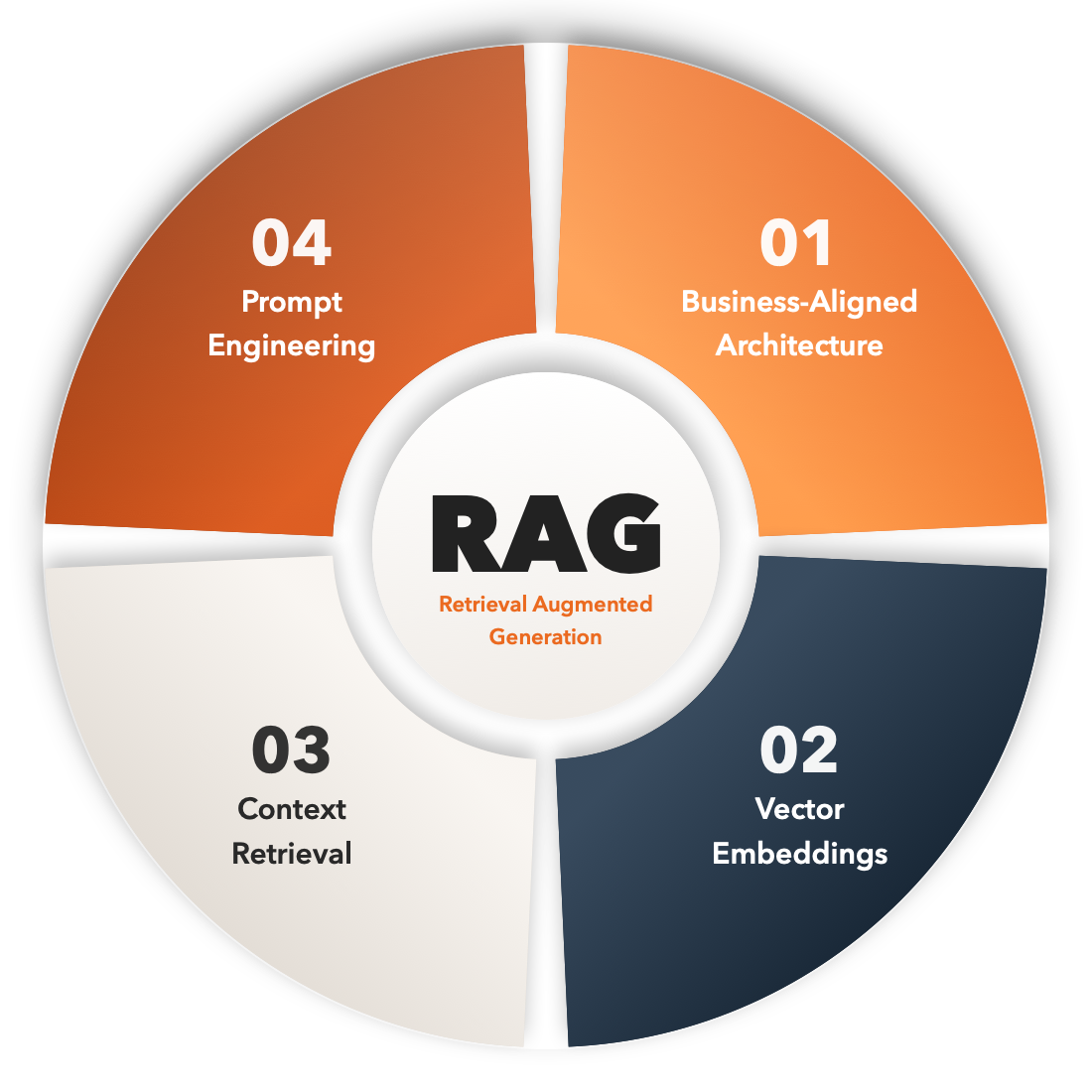
RAG development is the process of connecting large language models to your own data through vector embeddings, document retrieval and prompt engineering. Unlike a standalone chatbot, an enterprise RAG system retrieves the most recent context from authorized sources before generating each response. Effective RAG development is not only evaluation, monitoring and access control, but also ensuring that responses are reliable, accurate and traceable when used by real users and real decisions.

  • RAG Architecture Aligned With Business Objectives Build the RAG architecture based on your data sensitivity, cost, latency, and accuracy requirements.
  • Vector Database and Vector Embeddings The content is indexed with vector embeddings, and semantic search is used to identify relevant passages.
  • Document Retrieval and Context Retrieval Sort context and prioritize to make sure the model can answer using evidence.
  • Prompt Engineering and LLM Integration Combine structured prompts, natural language processing and the right model for the task.

Custom RAG Development Built Around Your Business

Most RAG initiatives begin with a business problem, not a preference for technology. At ChicMic Studios we start by examining the questions your teams ask, the documents they use and the systems they work with every day. Then we select the appropriate retrieval design, models and engineering: the end result is a RAG solution tailored to your organization that you can extend, govern, and evaluate rather than a failed-to-production prototype.

RAG Consulting Services

RAG Consulting Services

Develop a measurable roadmap, evaluate build-versus-buy options, and identify the high-impact use cases worth pursuing first.

RAG Readiness Assessment

RAG Readiness Assessment

Review the quality of the data, infrastructure, security requirements, and integrations before development starts.

Custom RAG Solutions

Custom RAG Solutions

Customize RAG applications around your specific workflows, domain vocabulary, and user roles from the start.

Enterprise RAG Development

Enterprise RAG Development

Scale retrieval across departments, data sources, and user groups with governance embedded from day one.

Private RAG Development

Private RAG Development

Run RAG in your cloud, VPC, or on-premises environment when data sensitivity demands tighter control.

RAG Development Services for Complex Business Requirements

Our RAG development services and RAG implementation services cover all the required layers from concept to a reliable production system.

Types of RAG Solutions We Develop

RAG can address a variety of needs, depending on an organization’s risk appetite, workflows and data. Usually, the best way to begin is with a single, well-defined use case with measurable results, such as fewer escalated support tickets or a faster document review.

Internal Knowledge Base RAG
Customer Service RAG
Document Intelligence RAG

Types of RAG Solutions We Develop

RAG can address a variety of needs, depending on an organization’s risk appetite, workflows and data. Usually, the best way to begin is with a single, well-defined use case with measurable results, such as fewer escalated support tickets or a faster document review.

Give employees answers from manuals, wikis and policies.

Give consumers and agents thoughtful and well-crafted answers and responses.

Extract, summarize, and compare information across contracts and reports.

Replace keyword lookup with search that understands intent across repositories.

Make institutional knowledge searchable as documents and teams change.

Assistance with legal, financial, medical or technical work requiring precise language.

Enterprise Semantic Search
Knowledge Management RAG
Domain-Specific Copilots
Internal Knowledge Base RAG Give employees answers from manuals, wikis and policies.
Customer Service RAG Give consumers and agents thoughtful and well-crafted answers and responses.
Document Intelligence RAG Extract, summarize, and compare information across contracts and reports.
Enterprise Semantic Search Replace keyword lookup with search that understands intent across repositories.
Knowledge Management RAG Make institutional knowledge searchable as documents and teams change.
Domain-Specific Copilots Assistance with legal, financial, medical or technical work requiring precise language.

Understanding The Benefits of RAG Development

The advantages of RAG are dependent on the use case, the quality of the data, and the uptake by the user. Linking RAG to measurable workflows instead of isolated experiments can improve the quality of answers and accelerate knowledge work.

Reduced AI Hallucinations

Reduced AI Hallucinations

Sourcing answers may help diminish the occurrence of unsupported assertions, but they can never be eliminated entirely.

Accurate, Domain-Specific AI Responses

Accurate, Domain-Specific AI Responses

Improve the accuracy of your LLM responses by supplying approved, terminology-correct content.

Real-Time, Up-to-Date Information Retrieval

Real-Time, Up-to-Date Information Retrieval

Update the knowledge base instead of retraining the model, so responses reflect your latest documents and information.

Personalized AI Responses

Personalized AI Responses

Adjust responses to the situation, permissions, and role of each user, so answers stay relevant and appropriate.

Enterprise Knowledge Management

Enterprise Knowledge Management

Turn scattered documents into AI-powered knowledge retrieval that teams can search, trust, and verify against original sources.

Better AI Search and Decision Making

Better AI Search and Decision Making

Surface relevant passages from approved sources to help teams reach faster, better-informed decisions with supporting evidence.

Secure, Scalable AI Applications

Secure, Scalable AI Applications

Scale across departments without sacrificing control over access, with audit trails that keep usage reviewable and accountable.

Enhanced Customer Experience

Enhanced Customer Experience

Deliver faster, more consistent support responses across channels, grounded in current policies, product details, and documentation.

Understanding How Does RAG Development Work?

The best way to implement the RAG development lifecycle is as a staged process, not a single build. Each stage reduces the uncertainty before you spend more money, and so your team can see real evidence on real data early on.

RAG Requirements Analysis and Use Case Identification

Identify the first set of use cases worth building, including the users, questions and success metrics.


Data Collection for RAG

Determine which documents, databases, and knowledge sources the system will use and who will own them.

Document Ingestion and Data Preprocessing

Clean, parse and standardize content from all sources, keeping metadata, structure and formatting.

Document Chunking

Divide the content into passages of suitable length, so that the context remains meaningful and related sections are readily available.

Embedding Generation and Vector Database Integration

Convert pieces to vector embeddings and store them in a vector database to allow for semantic search.

Retrieval Mechanism Development

Build semantic search, filtering, and ranking capabilities that return the most relevant context to each query.

LLM Integration and Prompt Engineering for RAG

Connect the language model and design prompts that use retrieved context faithfully and cite sources.

RAG Pipeline Implementation and Testing

Build the pipeline and benchmark the retrieval quality, accuracy, latency and hallucination rates on real data.

RAG Deployment

Connect the pipeline to the required systems and deploy it in the tested target environment.

RAG Monitoring, Optimization, and Maintenance

Use production metrics and user feedback to refine retrieval, prompts, and content as documents change.
How to Integrate RAG Into Existing Enterprise Systems

How to Integrate RAG Into Existing Enterprise Systems

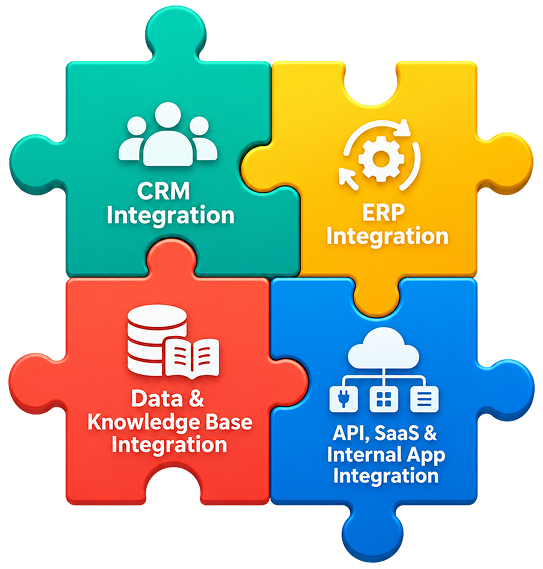
Integration planning begins during the discovery phase, not later in the project when changes are more expensive, to help uncover access requirements, data dependencies and testing requirements early.
  • CRM Integration Provide sales and service teams with customer information retrieval, drafted reply suggestions and grounded summaries from approved CRM records.
  • ERP Integration Integrate document retrieval and analysis in approved operational and financial processes such as procurement policies, purchase orders, and invoices.
  • Data Platform and Knowledge Base Integration Connect your RAG application to data warehouses, databases and document repositories with governed access that honors existing permissions.
  • API, SaaS, and Internal Application Integration Integrate RAG into your existing portals, dashboards, and internal tools without disrupting current workflows through APIs, middleware, and webhooks.
RAG Security, Governance, and Data Protection

RAG Security, Governance, and Data Protection

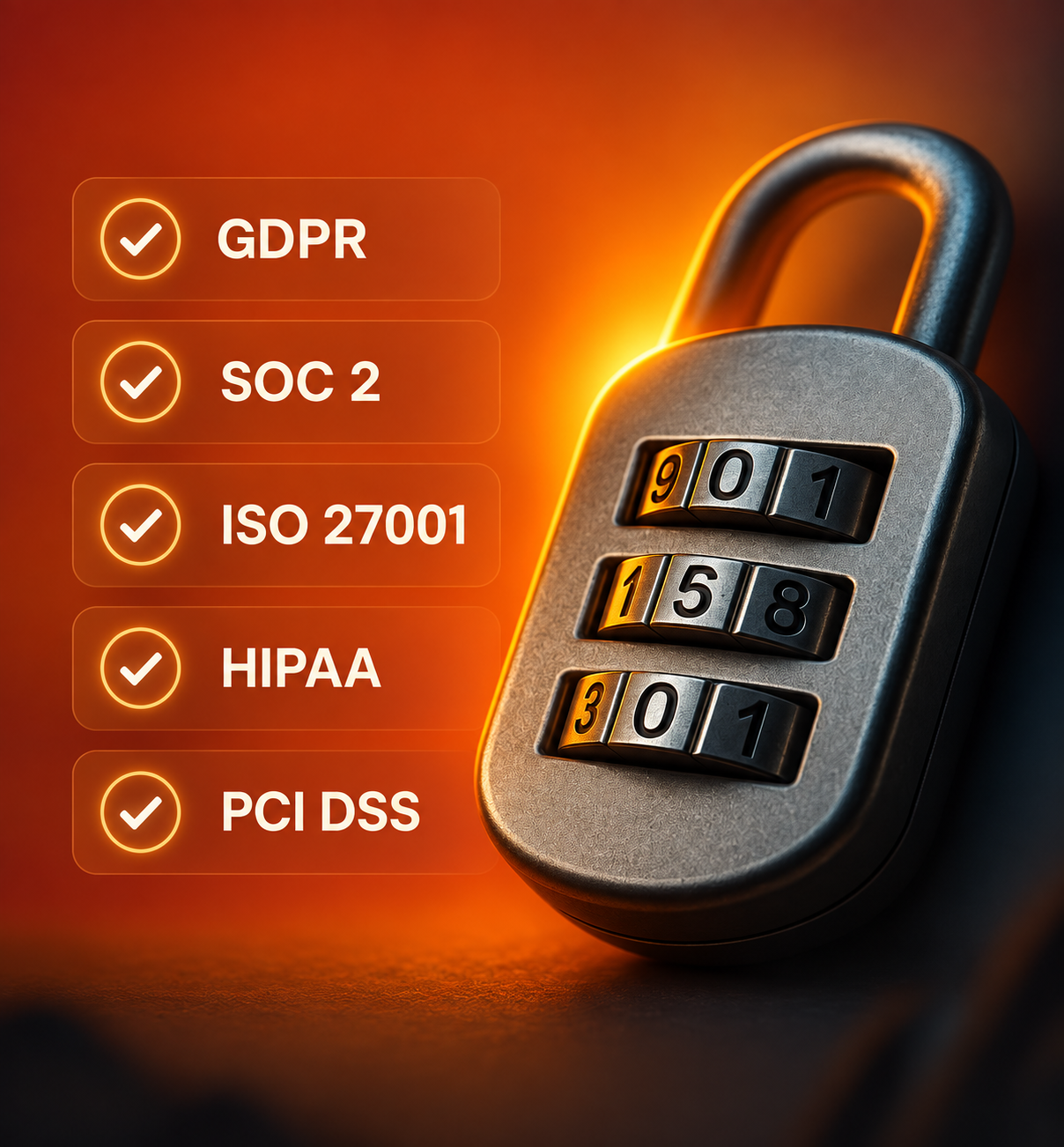
RAG applications frequently work with sensitive documents, customer data, intellectual property, or regulated data. Disregarding permissions may mean content is retrieved by the wrong person. Therefore, security and governance requirements are defined in the discovery phase and built into the architecture rather than added before launch. Depending on your data classification, regulatory environment and deployment model, our engineering approach can include the following controls.

  • Authentication and authorization
  • Role-based access controls
  • Permission-aware retrieval
  • Secure API integrations
  • Data encryption
  • Environment separation
  • Audit logging
  • Source citation
  • Output evaluation
  • Usage monitoring
  • Data retention planning
  • Human oversight

RAG Development Across Industries

RAG is applicable in any environment where organizations manage complex review processes, expertise, frequent questions or large amounts of documents. Given the wide variation in language, regulatory requirements and risk appetite, the right answer depends on the industry context.


Healthcare and Life Sciences
Finance and Banking
Fintech
Legal and Professional Services
eCommerce and Retail
Education and Training
Real Estate
Insurance
Manufacturing
Logistics and Supply Chain
Telecommunications
Energy and Utilities
Government and Public Sector
Travel and Hospitality
Technology and SaaS
01

Healthcare and Life Sciences

Healthcare RAG solutions help clinical and administrative teams retrieve guidelines, documentation, and research from approved sources, with answers that cite their origin. Healthcare RAG development assumes professional oversight for any output that informs patient care.

  • Clinical documentation
  • Research summaries
  • Patient assistance
02

Finance and Banking

Banking RAG development supports compliance, risk and operations teams in finding policies, regulations and internal procedures. This process provides traceable responses with source citations so reviewers can verify each response before it makes its way into a decision or customer communication.

  • Compliance review
  • Policy search
  • Customer support
03

Fintech

Fintech RAG solutions offer product, support and compliance teams firmly grounded answers about API documentation, partner terms and policy libraries. This allows fast-moving businesses to respond consistently while still maintaining the integrity of each answer by linking it to a reference that can be checked.

  • Developer documentation
  • Partner policies
  • Support automation
04

Legal and Professional Services

Legal RAG development assists with contract review, clause comparison and research by returning relevant passages with links to the sources. This allows lawyers and advisors to quickly review each output before relying on it in their client work.

  • Contract analysis
  • Legal research
  • Document review
05

eCommerce and Retail

eCommerce RAG development and retail RAG solutions enhance product discovery and customer support by providing answers to questions using the most current catalogs, policies, and order details. This means that service agents and shoppers get consistent and accurate answers as inventory changes.

  • Product discovery
  • Catalog search
  • Support automation
06

Education and Training

Education RAG development helps learners, instructors and administrators find answers in course materials, handbooks and institutional policies. This approach enables personalized study assistance, while letting educators control standards, accuracy and learning outcomes.

  • Course Q&A
  • Policy search
  • Content discovery
07

Real Estate

Real estate RAG development helps agents, property managers and buyers search listings, leases, inspection reports and transaction documents. This process speeds up the resolution of routine queries and preserves the integrity of the underlying document.

  • Lease analysis
  • Listing search
  • Contract review
08

Insurance

Insurance RAG development supports underwriters, claims teams and service agents by retrieving policy wording, coverage rules and claim histories. Quoted answers make this process easier by reducing the need to search manually and ensuring that decisions are consistent and can be audited.

  • Policy search
  • Claims support
  • Underwriting guidelines
09

Manufacturing

Manufacturing RAG solutions leverage equipment manuals, standard operating procedures and quality records as searchable guidance to help plant teams troubleshoot more efficiently and follow documented processes with answers that can be traced back to the source documents.

  • Maintenance manuals
  • Quality documentation
  • Safety procedures
10

Logistics and Supply Chain

Logistics RAG development gives operations teams the ability to query shipping records, carrier contracts, customs documentation and routing policies to get accurate answers that help resolve exceptions and make sure decisions are consistent with formal procedures and agreements.

  • Shipment records
  • Carrier contracts
  • Supply chain records
11

Telecommunications

Telecom RAG solutions support agents and network teams to find answers in technical documentation, troubleshooting guidelines and plan details, reducing the time to resolution and ensuring responses are consistent across channels and connected to approved sources.

  • Troubleshooting guides
  • Plan information
  • Technical documentation
12

Energy and Utilities

Teams in the energy sector use RAG to search technical manuals, regulatory filings, safety procedures and maintenance records. This supplies field and compliance staff with cited answers to support consistent, documented operations across sites and assets.

  • Maintenance records
  • Regulatory filings
  • Field support
13

Government and Public Sector

Public sector RAG development supports agencies and citizen service teams in the search for regulations, policies and case guidance. The result is source-linked responses that enhance consistency, while still keeping human review in the loop for decisions affecting residents.

  • Policy search
  • Citizen services
  • Regulatory guidance
14

Travel and Hospitality

Travel and hospitality RAG solutions can enable guest-service teams to answer questions about bookings, policies, amenities, and local information from current sources, providing consistent responses across channels and keeping details accurate as offerings change.

  • Guest support
  • Booking policies
  • Destination information
15

Technology and SaaS

RAG is used by tech companies to power product documentation search, developer assistants and customer support. It utilizes the latest release notes, knowledge bases and internal runbooks to help teams answer questions more quickly and consistently.

  • Documentation search
  • Developer assistants
  • Support automation

Our RAG Development Process Explained

We organize RAG initiatives around progressive validation, so you can confirm technical and business value before expanding scope. Each phase has defined outputs and clear decision points.

Discovery and Strategy

Define business goals, users, constraints, and success metrics so every later decision ties back to a measurable outcome.

01
02

Readiness and Prioritization

Assess data quality, infrastructure, and security needs, then rank use cases by business value and technical feasibility.

Proof of Concept

Validate the retrieval approach, model choice, and architecture on representative data before committing budget to a full production build.

03
04

MVP Development

Build the core RAG application, pipelines, and integrations, then test them with real users to gather practical feedback.

Production Engineering

Strengthen the solution with scalable architecture, security controls, evaluation, testing, and monitoring so it performs reliably under real workloads.

05
06

Deployment, Optimization, and Scale

Release into your cloud, hybrid, or on-premises environment, refine performance from usage data, and extend to additional teams.

Why Choose ChicMic Studios as Your RAG Development Company?

Why Choose ChicMic Studios as Your RAG Development Company?

Successful RAG efforts require strong software engineering and AI skills. ChicMic Studios approaches RAG development as a product and technical problem instead of a model selection problem. Our teams bring together AI, data engineering and application development to make sure your solution works with the systems and the people who will use it every day. This provides a connection between strategy, build and deployment. That’s the kind of results you can expect from our team RAG developers.

We analyze your workflows, users, and measurable objectives first, and only then select the technology that fits them.

Solutions can use proprietary APIs, open-source models, or a combination, chosen to match your accuracy, cost, and data requirements.

We base retrieval and prompt choices on benchmark results rather than assumptions, so every design decision has supporting evidence.

We build solutions around the systems your teams already use, including CRM, ERP, internal portals, and document repositories.

Work with us through project-based delivery, dedicated teams, or RAG consulting services, depending on your scope and needs.

We define access controls, audit logging, and governance requirements during discovery, so they shape the architecture from the beginning.

Build Your RAG Solution With ChicMic Studios

Move from experimentation to production-ready retrieval augmented generation with a development approach shaped by your data, systems, workflows, and governance requirements.

RAG Development Cost and Pricing

RAG development cost depends on the complexity and scope of the solution. A private multi-system platform, a RAG chatbot, an internal knowledge assistant and a readiness assessment all need different levels of infrastructure, data work and engineering complexity. After discovery, when data, integrations and deployment requirements are understood, a fixed estimate is confirmed. Use these ranges as a planning guide, not as a quote.

How Much Does RAG Development Cost?

01

$5K – $20K

RAG Strategy and Readiness Assessment

2–4 weeks

02

$15K – $40K

RAG Proof of Concept

4–8 weeks

03

$35K – $90K

RAG Chatbot / Assistant MVP

8–14 weeks

04

$80K – $180K

Enterprise RAG Application

14–24 weeks

05

$150K – $350K+

Private RAG Platform

20–36+ weeks

What Affects RAG Development Cost?

Data Preparation
Collection, cleaning, and ingestion add engineering effort.
Retrieval Complexity
Ranking, chunking and vector databases broaden the scope.
Model Strategy
Proprietary APIs and open-source models have different usage costs.
Integrations
CRM, ERP and legacy connections increase development and testing time.
Deployment Model
For on-premises hosting or VPC, additional infrastructure work is required.
Security and Compliance
Audits and controls on access improve design and testing.
Evaluation and Governance
Testing and documentation are extended with more stringent review requirements.
Ongoing Support
The lifecycle cost is influenced by optimization, revisions and monitoring.
  • Data Preparation
    Collection, cleaning, and ingestion add engineering effort.
  • Retrieval Complexity
    Ranking, chunking and vector databases broaden the scope.
  • Model Strategy
    Proprietary APIs and open-source models have different usage costs.
  • Integrations
    CRM, ERP and legacy connections increase development and testing time.
  • Deployment Model
    For on-premises hosting or VPC, additional infrastructure work is required.
  • Security and Compliance
    Audits and controls on access improve design and testing.
  • Evaluation and Governance
    Testing and documentation are extended with more stringent review requirements.
  • Ongoing Support
    The lifecycle cost is influenced by optimization, revisions and monitoring.

Ready to create an impact?

Let’s talk
about
your project

The cost of development depends on the scope of the solution, the readiness of the data, the requirements for.

username

email

mobile

security badge Your Idea is Fully Protected By Our Non Disclosure Agreement (NDA)
Requirement

Frequently Asked Questions

Find answers to your business inquiries in our comprehensive FAQ section.

RAG development builds systems that take relevant information from your own data and forward it to a large language model (LLM) so that the answers come from sources that are approved.

The system converts a query into a search, takes relevant passages out of a vector database, appends those to the prompt, and then the model answers from that context.

A RAG pipeline consists of ingestion, chunking, embedding, retrieval and generation. The RAG architecture describes how these components, including security and monitoring, are integrated.

Analyze requirements, prepare and ingest data, generate embeddings, build retrieval, integrate the LLM and prompts, and then test, deploy, and monitor.

RAG retrieves documents at question time and fine-tuning teaches the model how to behave. Neither is universally superior, and many solutions incorporate both.

There is no method to eliminate hallucinations altogether, but grounding answers in retrieved sources, validating outputs, and regular benchmarking can help reduce them.

Yes. RAG can be deployed on-premises, in the cloud or in a VPC, and access controls keep private content within your policies.

Yes. RAG often uses APIs to connect to proprietary or open-source models, letting teams keep their preferred model.

The cost depends on the complexity of retrieval, the readiness of the data, the integrations, the security and the deployment. A proof of concept can run tens of thousands of dollars, while a private platform can run a few hundred thousand dollars.

A proof of concept can take a few weeks, but production systems with complex data and integrations can take a few months.