Enterprise Generative AI Applications
Build applications for content generation, document analysis, summarization, knowledge retrieval, enterprise search, question answering, and AI-assisted workflows.
Enterprise AI development is the process of designing, building, integrating, and operating artificial intelligence solutions within complex business environments. Unlike standalone AI experiments, enterprise AI must work with existing applications, data platforms, business processes, security requirements, users, and operational systems.
Our enterprise AI development services cover the technology layers required to move from an AI opportunity to an operational solution.
Enterprise AI can support different business requirements depending on the organization's data, workflows, applications, and strategic objectives.
Build applications for content generation, document analysis, summarization, knowledge retrieval, enterprise search, question answering, and AI-assisted workflows.
Create employee-facing assistants that help users retrieve information, summarize documents, generate content, analyze data, and complete defined knowledge-work tasks.
Develop controlled AI agents capable of interacting with approved tools, systems, APIs, and knowledge sources to complete multi-step tasks.
Apply machine learning to forecasting, demand planning, risk analysis, anomaly detection, predictive maintenance, and other predictive workflows.
Use AI to extract, classify, summarize, validate, and route information from documents and other unstructured business content.
Personalize products, services, content, offers, search results, or experiences using relevant data and user behavior.
Apply visual intelligence to inspection, recognition, classification, document processing, quality control, and image-based workflows.
Develop AI-powered conversational experiences for customers, employees, support teams, service desks, and internal knowledge systems.
Develop scalable SaaS products with embedded AI functionality, intelligent workflows, personalization, analytics, or automation.
Automate repetitive business processes, coordinate cross-system workflows, and streamline tasks such as data entry, approvals, reporting, and operational handoffs using AI-driven decision-making and workflow orchestration.
The benefits of enterprise AI development depend on the use case, implementation quality, adoption, and the business process being improved. When AI is connected to measurable workflows, it can support a range of operational and strategic outcomes.
Validated solutions can be expanded to additional teams, workflows, applications, business units, or use cases based on organizational priorities.

We understand your business objectives, current systems, users, workflows, data environment, constraints, and AI opportunities.
We assess data availability, technical infrastructure, integrations, application architecture, security considerations, and organizational requirements.
Potential use cases are evaluated according to business relevance, technical feasibility, data availability, implementation complexity, and measurable outcomes.
A focused proof of concept can validate the selected technology, data approach, model behavior, integration strategy, and expected user experience.
The validated approach is translated into a production-oriented architecture covering applications, models, data, integrations, infrastructure, security, and monitoring.
We build the required applications, models, AI workflows, APIs, interfaces, data pipelines, integrations, and supporting components.
The solution is evaluated for functionality, AI output quality, performance, security, reliability, usability, and other requirements relevant to the application.
The solution is prepared for its target production environment and connected with the systems required for operational use.
After deployment, application metrics, AI performance, user feedback, costs, errors, and other relevant indicators can guide ongoing optimization.
Validated solutions can be expanded to additional teams, workflows, applications, business units, or use cases based on organizational priorities.

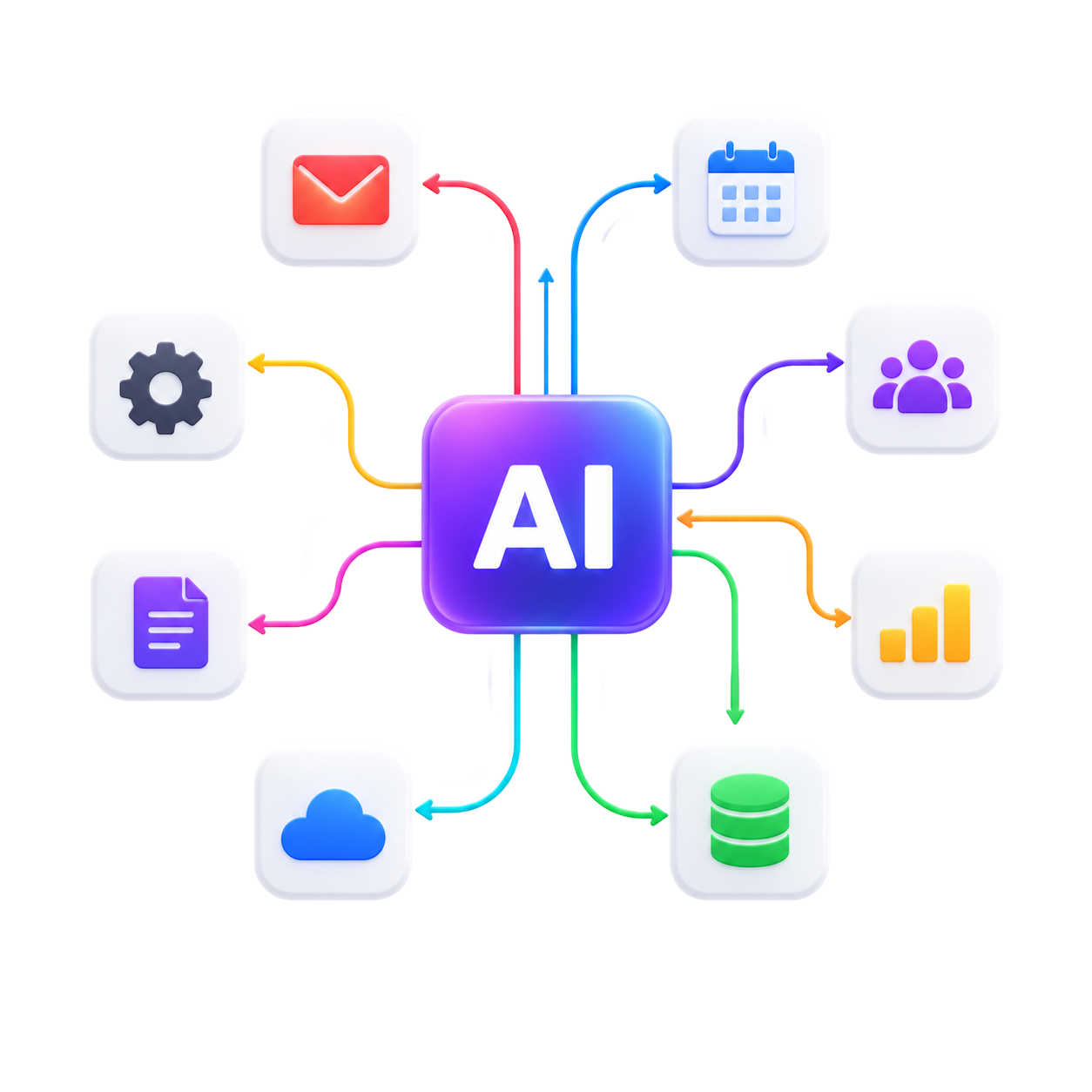
Enterprise AI rarely operates independently. The most practical implementations connect AI functionality with the software, data, and workflows an organization already depends on.
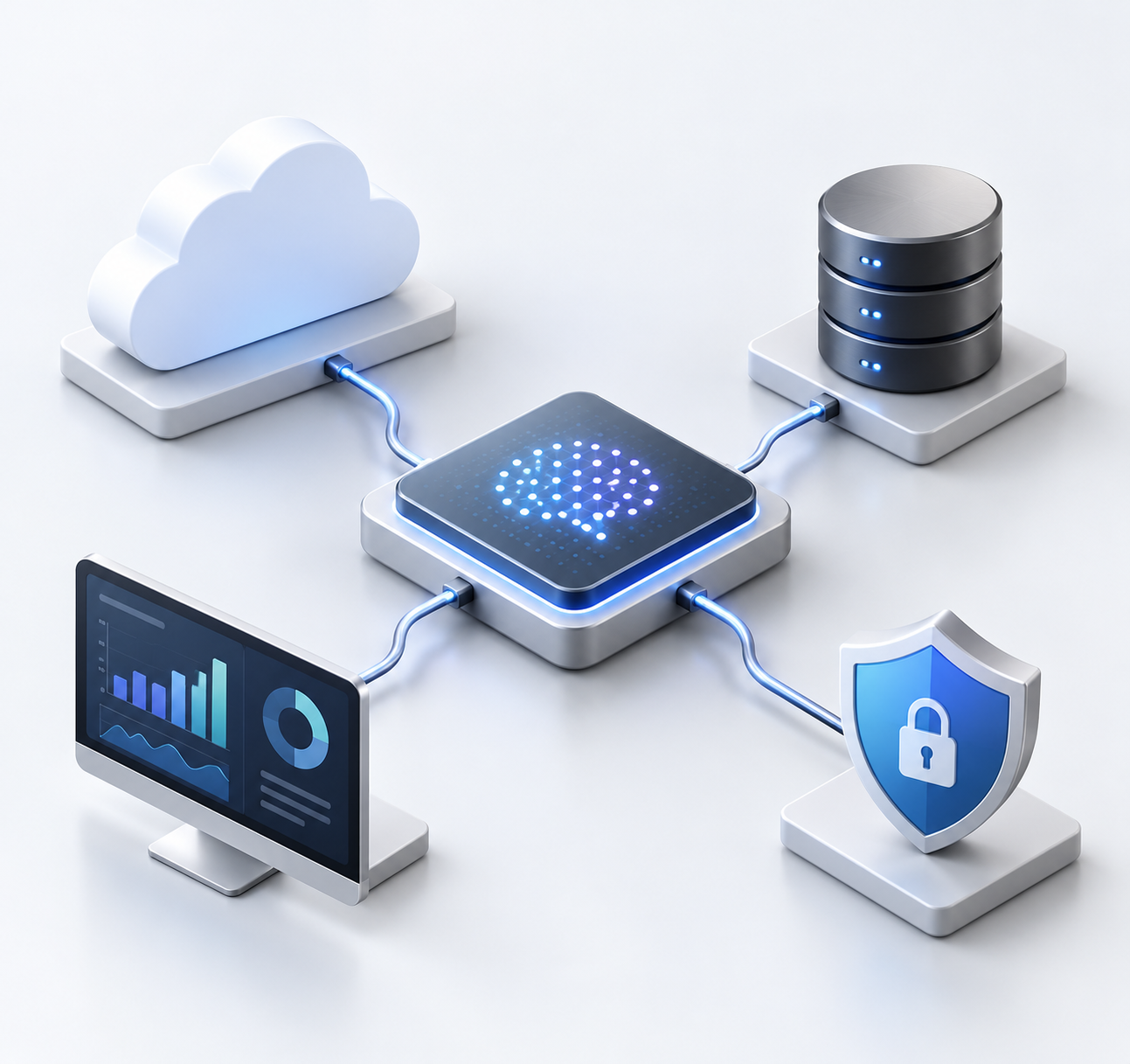
A production enterprise AI system may contain multiple interconnected layers.
Enterprise databases, data warehouses, data lakes, documents, knowledge bases, APIs, and other approved sources provide information for AI workflows.
This layer may include LLMs, machine learning models, predictive models, recommendation engines, NLP models, computer vision models, or specialized AI services.
RAG systems, embeddings, vector search, metadata, indexing, and retrieval mechanisms can connect AI applications with relevant enterprise knowledge.
Web applications, mobile applications, dashboards, portals, copilots, chat interfaces, and workflow applications provide access to AI capabilities.
APIs, middleware, event systems, connectors, and business services allow AI applications to interact with enterprise software.
Authentication, authorization, data access controls, encryption, logging, and other safeguards can be incorporated according to enterprise requirements.
Deployment pipelines, monitoring, evaluation, model versioning, observability, infrastructure management, and performance controls support the production lifecycle.
Enterprise AI introduces additional considerations because AI applications may process sensitive business information, employee data, customer information, intellectual property, or regulated information.
Our enterprise AI engineering approach can incorporate:
Enterprise AI can be applied across industries where organizations manage significant volumes of data, repetitive processes, customer interactions, complex decisions, or specialized workflows.
We organize enterprise AI initiatives around progressive validation so organizations can reduce technical uncertainty before committing to larger-scale implementation.
Define business objectives, identify AI opportunities, understand existing systems, and establish measurable goals.

Evaluate data, infrastructure, applications, integrations, security, and organizational readiness.

Identify the AI use cases that align with business objectives and technical feasibility.

Validate the proposed AI approach, data strategy, model behavior, and technical architecture.

Build the core AI application, integrations, interfaces, and workflows required to validate the solution with real users.

Strengthen the application with scalable architecture, testing, security, monitoring, deployment, and operational controls.

Deploy the solution into the required cloud, hybrid, or on-premises environment and connect it to enterprise systems.

Track application performance, AI quality, usage, infrastructure, and business metrics.

Extend validated AI capabilities to additional workflows, departments, applications, and business units.

Enterprise AI requires a combination of AI expertise and software engineering. ChicMic Studios approaches AI development as a product and technology challenge rather than treating the AI model as the complete solution.
We begin with the business problem, users, workflows, data, and measurable objectives before selecting the AI approach.
Our approach can cover strategy, UI/UX, application development, AI integration, backend engineering, data, APIs, testing, deployment, and ongoing maintenance.
Solutions can use existing AI APIs, foundation models, machine learning models, specialized models, or combinations of technologies depending on the requirements.
AI functionality can be connected with enterprise applications, APIs, databases, SaaS platforms, CRM, ERP, and other systems.
We consider scalability, security, performance, monitoring, deployment, and maintainability as part of the development lifecycle.
Organizations can work with ChicMic Studios through project-based development, dedicated development teams, consulting engagements, or end-to-end product development depending on the scope.
The enterprise AI development cost depends on the scope and complexity of the solution. An AI readiness assessment, an internal AI assistant, a predictive analytics platform, and a multi-system enterprise AI platform can require very different levels of engineering and infrastructure.
$5K – $20K
2–4 weeks
$15K – $40K
4–8 weeks
$40K – $100K
8–16 weeks
$75K – $180K
12–24 weeks
$150K – $350K+
20–36+ weeks
$250K – $500K+
6–12+ months
Enterprise AI development does not have to begin with a company-wide rollout. Organizations can start with a focused use case and expand after validating its business and technical value.
Ready to create an impact?
The cost of development depends on the scope of the solution, the readiness of the data, the requirements for.
Enterprise AI development is the process of designing, building, integrating, deploying, and maintaining artificial intelligence solutions for use within an organization’s business environment. It can include machine learning, generative AI, LLMs, NLP, computer vision, predictive analytics, recommendation systems, intelligent automation, and AI agents.
Enterprise AI development generally starts with business and technical discovery, followed by readiness assessment, use-case prioritization, proof of concept, architecture design, development, testing, deployment, monitoring, and continuous optimization.
An enterprise AI development company can provide AI strategy consulting, readiness assessment, custom AI development, model integration, data engineering, enterprise system integration, application development, deployment, MLOps, monitoring, maintenance, and AI modernization services.
Enterprise AI is designed to operate within complex organizational environments. In addition to AI capabilities, enterprise solutions typically need to address integration with existing systems, security, access controls, data governance, scalability, monitoring, deployment, and long-term maintenance.
Enterprise AI development cost depends on the AI functionality, application scope, data requirements, integrations, security, infrastructure, model strategy, and deployment requirements. A focused proof of concept may cost tens of thousands of dollars, while a large enterprise AI platform can require several hundred thousand dollars or more.
A focused enterprise AI proof of concept may take several weeks, while a production-grade solution involving multiple systems, complex data, advanced AI capabilities, and enterprise security can take several months. Larger AI transformation programs may be implemented incrementally over a longer period.
AI can integrate with enterprise systems through APIs, connectors, middleware, webhooks, data pipelines, backend services, and application integrations. This allows AI functionality to interact with systems such as ERP, CRM, databases, SaaS platforms, and internal applications.
Data requirements depend on the use case. Generative AI applications may use existing foundation models with enterprise documents and knowledge sources, while custom machine learning solutions may require historical datasets for training, validation, and evaluation.
Enterprise AI security can include authentication, authorization, role-based access, secure APIs, encryption, controlled data access, logging, environment separation, monitoring, and application security testing. The specific approach depends on the organization’s data and security requirements.
Yes. Depending on the AI technology and infrastructure requirements, enterprise AI solutions can be designed for cloud, hybrid, or on-premises environments. The deployment approach depends on factors such as data sensitivity, infrastructure, performance requirements, and organizational policies.
Benefits can include business automation, operational efficiency, decision support, workforce productivity, customer experience improvements, process optimization, personalization, business intelligence, and new AI-enabled product capabilities.
AI can connect with ERP and CRM platforms through APIs, connectors, middleware, webhooks, and data integrations. Depending on the use case, AI can support customer assistance, forecasting, document processing, recommendations, lead analysis, workflow automation, and information retrieval.
Enterprise AI ROI can be evaluated using metrics relevant to the business process, such as time saved, automation rate, cost per transaction, response time, productivity, forecast accuracy, customer satisfaction, conversion, error reduction, revenue impact, and operating costs.
Common challenges can include fragmented data, unclear use cases, integration complexity, security requirements, AI evaluation, infrastructure costs, user adoption, governance, model performance, and maintaining AI systems after deployment.
Organizations can begin with focused use cases, establish reusable architecture and governance patterns, standardize data and integration approaches, and expand validated AI capabilities to additional departments and workflows.
Enterprise model monitoring can track model performance, output quality, latency, errors, usage, data changes, infrastructure health, and other application-specific metrics. Monitoring requirements vary according to the AI model and business use case.
Enterprise AI can support financial services, healthcare, life sciences, retail, e-commerce, manufacturing, logistics, technology, SaaS, education, real estate, and other industries with data-intensive processes or opportunities for automation and intelligent decision support.
The choice depends on the use case. Pre-trained models can accelerate implementation when their capabilities meet requirements. Custom or specialized models may be considered when an application requires domain-specific behavior, proprietary data, specialized performance, or capabilities that existing models cannot provide effectively.
Yes. Existing LLMs can be integrated into enterprise applications for conversational interfaces, document analysis, summarization, knowledge retrieval, content generation, internal assistants, and other language-based workflows.
Enterprise AI modernization involves adding AI capabilities to existing applications, platforms, and workflows. Instead of replacing the complete technology stack, organizations can introduce intelligent functionality into selected parts of their existing software ecosystem.
An enterprise AI readiness assessment evaluates an organization’s data, infrastructure, applications, integrations, security environment, technical capabilities, and business processes to determine what is required for successful AI implementation.
Enterprise AI implementation services cover the activities required to move an AI solution from concept toward operational use, including architecture, development, integrations, data preparation, testing, deployment, security, monitoring, and ongoing optimization.
Yes. Enterprise AI agents can be developed to interact with approved tools, APIs, enterprise knowledge sources, and business systems. Agent workflows can be designed with defined permissions, validation, and monitoring appropriate to the use case.



Hiring enterprise AI developers can provide access to AI engineering, application development, data engineering, integrations, deployment, and software engineering capabilities required to build a complete enterprise AI solution rather than an isolated AI prototype.