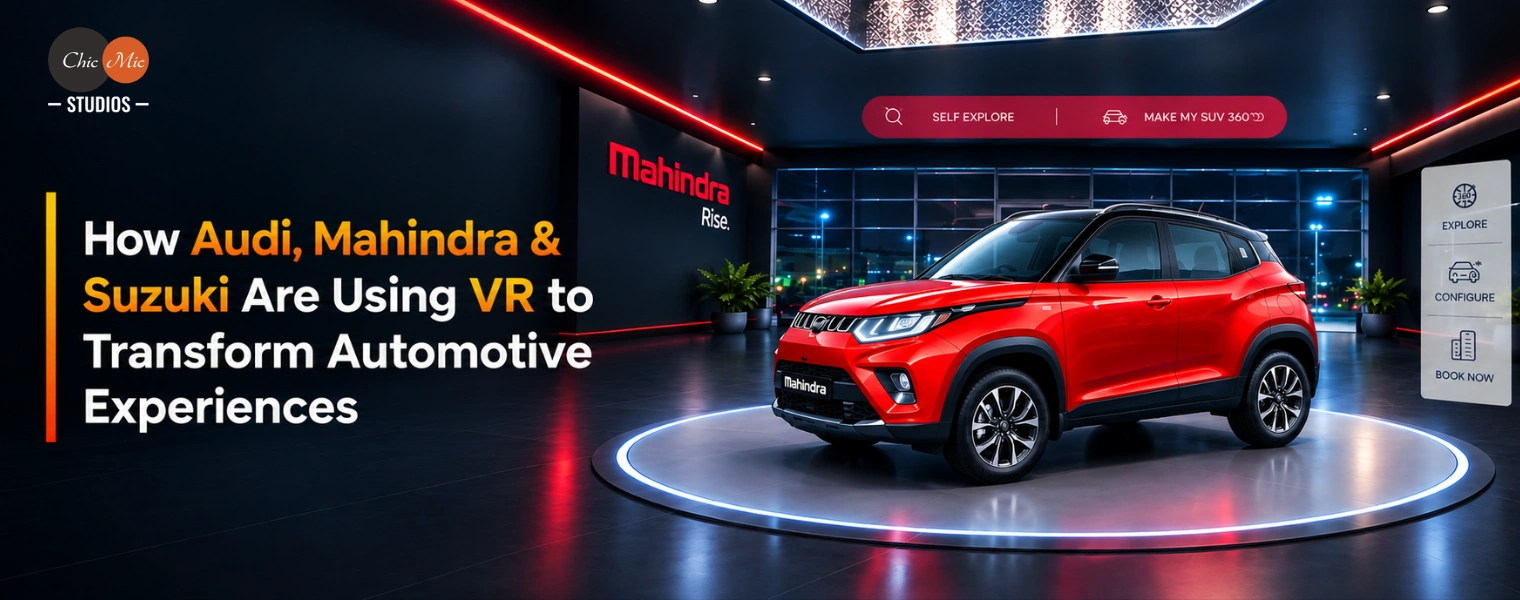
How Audi, Mahindra & Suzuki Are Using VR to Transform Automotive Experiences
Key Takeaways:
- VR is expanding across the automotive lifecycle, from vehicle design and prototyping to training, retail, and passenger experiences.
- Audi demonstrates how VR can become part of the in-car experience through motion-synchronized passenger entertainment and immersive vehicle visualization.
- Mahindra has used VR to support EV education and create immersive digital experiences that help customers understand electric mobility.
- Maruti Suzuki has explored virtual retail through ARENAVerse, allowing customers to digitally explore and configure vehicles.
Introduction
Virtual reality (VR) is particularly relevant because it allows automotive teams and customers to interact with three-dimensional vehicle environments before, or without, requiring a corresponding physical setup. This makes automotive virtual reality useful across product visualization, simulation, virtual showrooms, training, and immersive marketing.
Companies such as Audi, Mahindra, and Maruti Suzuki have already explored different applications of VR. These implementations illustrate how VR in the automotive industry is developing from an experimental technology into a practical layer for product and customer experiences.
For automotive companies evaluating VR app development for the automotive industry, the larger opportunity is not simply to put a vehicle inside a headset. It is to connect 3D assets, vehicle data, simulation, interaction design, and customer journeys into a useful digital experience.
See VR in Action: Immersive Automotive Experiences
VR becomes most valuable when it moves beyond a technology demonstration and solves a real automotive business or customer-experience challenge. At ChicMic Studios, we have worked on immersive VR solutions for leading automotive brands including Audi, Mahindra, and Suzuki, creating experiences that demonstrate how virtual reality can be applied across product visualization, customer engagement, and digital retail.
How VR Is Used in the Automotive Industry
Automotive VR has applications throughout the vehicle lifecycle. Engineering teams can use immersive environments for design reviews and simulations, while sales and marketing teams can use them for virtual showrooms and product demonstrations.
Common applications include:
- VR automotive design and visualization
- virtual vehicle prototyping
- automotive design simulation
- 3D vehicle visualization
- virtual showrooms
- interactive vehicle configurators
- virtual test drives
- VR training simulation
- safety training simulation
- digital twins and simulation environments
- immersive customer experiences
Bring Your Automotive VR Idea to Life
Innovations Across VR App Development for Automotive Industry
1. VR Automotive Design and Virtual Prototyping
Vehicle development traditionally involves physical prototypes, design reviews, CAD systems, clay models, engineering simulations, and extensive validation. VR does not eliminate these processes, but it can add an immersive review layer much earlier in the development cycle.
With VR automotive design, designers can enter a full-scale virtual representation of a vehicle and examine proportions, interiors, component placement, visibility, and ergonomics.
For example, instead of reviewing an interior exclusively through a monitor, a design team can inspect a virtual concept car experience at human scale. Multiple stakeholders can review the same digital model and discuss design decisions before committing to additional physical development.
Where virtual vehicle prototyping can help
- Reviewing vehicle proportions
- Examining interior layouts
- Evaluating driver and passenger ergonomics
- Comparing design alternatives
- Reviewing component placement
- Conducting collaborative design sessions
- Visualizing concepts before physical prototyping
This is where VR connects closely with automotive simulation software, CAD workflows, real-time 3D rendering, and digital asset pipelines.
2. Digital Twins and Automotive Simulation
A related development is the use of digital twin automotive technologies. A digital twin is more than a static 3D model. Depending on the implementation, it can represent a physical asset and incorporate operational, engineering, or sensor-related information. In an automotive context, a digital vehicle representation can become part of a larger simulation environment.
The distinction between VR and digital twins is important. VR is primarily an immersive interface and experience technology, while a digital twin represents a broader data-connected model of a physical system.
3. Virtual Showrooms and Customer Experiences
One of the most visible applications of automotive VR is the virtual showroom. A conventional showroom is constrained by physical space. A dealer can display only a limited number of vehicles, variants, colors, accessories, and configurations at a particular location. A digital environment can present those options differently.
Customers can potentially:
- explore vehicle exteriors and interiors
- change colors and configurations
- inspect features
- view accessories
- navigate digital environments
- interact with sales representatives
- experience virtual demonstrations
This creates a digital car showroom that complements the physical retail network. Maruti Suzuki’s ARENAVerse provides a documented example. Launched in January 2023, the platform was described as a metaverse platform for its Arena dealer network. Customers could interact with sales representatives digitally and configure cars across more than 700 Arena showrooms; a web version was also made available.
For businesses considering VR app development for the automotive industry, this type of application demonstrates how immersive technology can connect product visualization with digital retail.
4. Audi: From Passenger Entertainment to Immersive Vehicle Experiences
Audi provides one of the clearest examples of VR being connected directly to the vehicle experience. In 2022, Audi announced the integration of Holoride technology into selected vehicles. The system was designed for rear-seat passengers using a VR headset, with the virtual content taking vehicle movement into account. According to HT Auto’s report, acceleration, braking, and turning could correspond to movements within the VR environment.
Technically, this is different from a conventional VR showroom. That creates a form of motion-aware digital car experience in which the virtual environment responds to the physical vehicle. Audi’s example also demonstrates an important direction for automotive XR solutions: immersive content can become connected to real-world vehicle inputs rather than operating as an isolated application.
What Audi’s example demonstrates
The Audi VR experience illustrates how automotive VR can be used for:
- passenger entertainment
- immersive content
- real-time interaction
- vehicle-linked VR experiences
- future-oriented connected mobility concepts
The example was announced for selected Audi models and markets, so it should be understood as a specific implementation rather than evidence that every Audi vehicle uses VR.
5. Mahindra: Using VR to Explain Electric Mobility
Mahindra provides a different example of automotive VR. In January 2018, Mahindra Electric launched a VR-based drive experience for the all-electric e2oPlus. The company described the experience as a way to communicate the vehicle’s technical features and attributes through an immersive experience at selected dealerships. It also said the experience was delivered to customers before doorstep test drives.
This is particularly interesting from an automotive customer engagement perspective. Instead of using VR primarily for entertainment, Mahindra used it to communicate a relatively new product category electric mobility. The experience was also made available in a 2D, 360-degree format, while VR headsets provided the intended immersive version. This illustrates how a virtual test drive or immersive product demonstration can function as an educational layer before a conventional physical interaction.
6. Maruti Suzuki: Scaling the Virtual Showroom
Maruti Suzuki’s ARENAVerse demonstrates another approach to automotive VR: connecting an existing retail network to an immersive digital environment. The platform was designed around the Arena dealer network and allowed users to interact digitally with sales representatives and configure vehicles. Team-BHP reported that the platform could support configuration across more than 700 Arena showrooms.
This approach is relevant to automotive innovation India, where automotive retail networks can span large geographic areas. Rather than treating VR as a standalone marketing campaign, a manufacturer can integrate immersive experiences with:
- dealership systems
- vehicle configurators
- CRM platforms
- digital catalogs
- customer profiles
- lead-generation workflows
- analytics
7. VR Training and Simulation for Automotive Teams
Customer-facing applications are only one part of the opportunity. Automotive companies can also use VR training simulation for employees, technicians, manufacturing teams, and dealership staff. A simulated environment can reproduce procedures without requiring every training scenario to take place on a live vehicle or production floor.
Potential applications include:
1. Automotive Employee Training: Employees can learn procedures using interactive 3D environments.
2. Safety Training Simulation: Teams can practice potentially hazardous scenarios in a controlled digital environment.
3. Technician Training: Virtual components can be examined and manipulated before trainees work on physical equipment.
4. Dealership Training Solutions: Sales teams can learn product configurations, features, and customer interaction workflows.
5. Manufacturing Training: Workers can become familiar with equipment, production processes, and operational procedures through simulated environments.
VR does not automatically make training more effective; instructional design, hardware ergonomics, content quality, and assessment methods still matter. But the technology can provide a repeatable environment for immersive learning.
Build an Immersive VR Experience for Your Automotive Business
What Technologies Power Automotive VR?
Building an automotive VR application requires considerably more than a headset. A typical technical stack may include:
-
Unity VR Development
Unity can be used to build interactive 3D environments, vehicle configurators, simulations, and cross-platform VR applications.
-
3D Vehicle Visualization
High-quality vehicle models are central to automotive VR. Teams may work with CAD data, optimized meshes, materials, textures, lighting systems, and real-time rendering pipelines.
-
Hardware Integration
Applications may need to support enterprise or consumer headsets, controllers, hand tracking, spatial audio, and device-specific SDKs.
-
Cloud Infrastructure
Large-scale experiences can require cloud services for user accounts, content delivery, analytics, multiplayer functionality, and remote collaboration.
-
APIs and Enterprise Integration
A production-grade application may need to connect with CRM, ERP, dealership, inventory, vehicle configuration, or analytics systems.
This is why custom VR applications often require collaboration between 3D artists, UX designers, VR developers, backend engineers, and automotive-domain specialists.
Why Automotive Companies Are Investing in Immersive Technology
The business case varies by application, but several potential benefits are consistent.
| Application |
Potential value |
| VR automotive design |
Immersive design reviews |
| Virtual vehicle prototyping |
Earlier evaluation of concepts |
| Virtual showroom |
Expanded digital product exploration |
| Interactive vehicle configurator |
More engaging customization |
| VR training simulation |
Repeatable training environments |
| Virtual test drive |
Product demonstration without immediate physical driving |
| Digital twin |
Connected visualization and simulation |
| In-car VR |
New passenger experiences |
The key is to start with a business problem rather than the technology. A manufacturer should not ask, “Where can we use VR?” A better question is: “Which automotive experience is constrained by physical space, physical availability, visualization limitations, or training requirements and can immersive technology improve that workflow?”
Building VR App Development for the Automotive Industry
For an AR VR development company, automotive projects require a structured development process.
Step 1: Define the use case
Determine whether the application is intended for design, simulation, training, sales, marketing, or passenger experience.
Step 2: Design the experience
Map user journeys, interactions, environments, menus, navigation, and hardware requirements.
Step 3: Prepare 3D assets
Existing CAD models may need optimization for real-time rendering. Materials, textures, lighting, animations, and collision systems must also be prepared.
Step 4: Develop the application
Develop the application using technologies such as Unity or Unreal Engine and integrate required APIs and services.
Step 5: Test on target hardware
Performance, frame rate, interaction accuracy, tracking, comfort, and usability should be tested on the actual target devices.
Step 6: Deploy and maintain
Enterprise applications require ongoing content updates, device compatibility, analytics, security, and technical support.
For automotive brands, this process can support anything from a focused product demonstration to a full metaverse automotive solution involving multiple users, digital vehicles, sales representatives, and backend systems.
Build a Custom Automotive VR Experience
Automotive VR is moving beyond experimental demonstrations toward practical applications across design, retail, training, simulation, and passenger experiences.
Whether the requirement is a virtual showroom, interactive vehicle configurator, immersive training platform, or connected VR experience, the architecture should be designed around the actual business workflow.
The Future of Automotive VR
The next stage of automotive VR will likely involve greater convergence between VR, AI, real-time 3D, connected vehicles, digital twins, and mixed reality.
AI could make virtual environments more responsive and personalized. These developments align with broader global automotive technology trends, where software increasingly influences how vehicles are designed, sold, maintained, and experienced.
Audi’s motion-aware passenger experience, Mahindra’s immersive EV demonstration, and Maruti Suzuki’s ARENAVerse illustrate three different directions: in-car experience, product education, and digital retail. For car manufacturer VR solutions, the opportunity lies in connecting these experiences to measurable business and operational objectives rather than implementing immersive technology simply because it is new.
Conclusion
VR is becoming an increasingly flexible technology within the automotive ecosystem. Its applications range from VR automotive design and virtual vehicle prototyping to virtual showrooms, customer engagement, training simulations, and in-car entertainment. Audi, Mahindra, and Maruti Suzuki demonstrate how different automotive organizations can apply the same underlying technology to very different experiences.
For businesses exploring VR app development for the automotive industry, the strongest opportunity is to treat VR as part of a larger digital system. ChicMic Studios provide high-quality 3D assets, real-time rendering, interaction UI/UX design, vehicle data, simulation, analytics, and enterprise integrations that can work together to create useful immersive applications.
The result is not simply a virtual version of a car. It is a new digital interface for understanding, designing, selling, training with, and experiencing vehicles.
Frequently Asked Questions
1. How is VR used in the automotive industry?
VR is used for vehicle design reviews, virtual prototyping, simulation, employee and technician training, virtual showrooms, vehicle configuration, customer demonstrations, and in-car passenger experiences.
2. Why do car manufacturers use VR?
Manufacturers can use VR to visualize complex three-dimensional products, review digital concepts, create simulated training environments, expand customer experiences, and demonstrate vehicles or features digitally. The specific business value depends on how the application is integrated into the organization’s workflow.
3. What is VR app development for the automotive industry?
It involves designing and developing immersive applications specifically for automotive use cases. These may include vehicle configurators, virtual showrooms, training simulations, engineering visualization, digital vehicle experiences, and interactive product demonstrations.
4. What technologies are used to build automotive VR applications?
Common technologies include Unity, Unreal Engine, 3D modeling and CAD pipelines, real-time rendering technologies, VR hardware SDKs, cloud infrastructure, APIs, analytics platforms, and enterprise software integrations.
5. Can VR replace physical vehicle prototypes?
VR can reduce reliance on some physical prototypes during early design and review stages, but it does not eliminate the need for physical engineering validation, testing, manufacturing verification, and regulatory compliance.
6. What is a virtual showroom?
A virtual showroom is a digital environment where customers can explore vehicles and, depending on the implementation, configure features, inspect interiors, interact with sales representatives, or experience simulated demonstrations remotely.
7. What is the difference between VR and a digital twin?
VR is an immersive technology used to experience a digital environment. A digital twin is a digital representation of a physical asset or system that can incorporate data and operational relationships. A digital twin can be experienced through VR, but VR itself is not necessarily a digital twin.
8. How can VR improve automotive customer engagement?
VR can give customers interactive ways to explore vehicles, visualize configurations, understand features, and experience digital demonstrations. Audi, Mahindra, and Maruti Suzuki provide examples of different approaches to immersive automotive customer experiences.
9. What should companies consider before developing an automotive VR application?
Companies should define the business objective, target users, 3D asset requirements, interaction model, hardware, integrations, performance requirements, security, analytics, deployment environment, and long-term maintenance requirements before development begins.
10. Is VR the future of automotive technology?
VR is one component of the broader automotive technology landscape. Its future role will depend on how effectively it integrates with AI, digital twins, mixed reality, connected vehicles, simulation platforms, and enterprise systems.
Turn Your Automotive VR Concept Into a Real Product