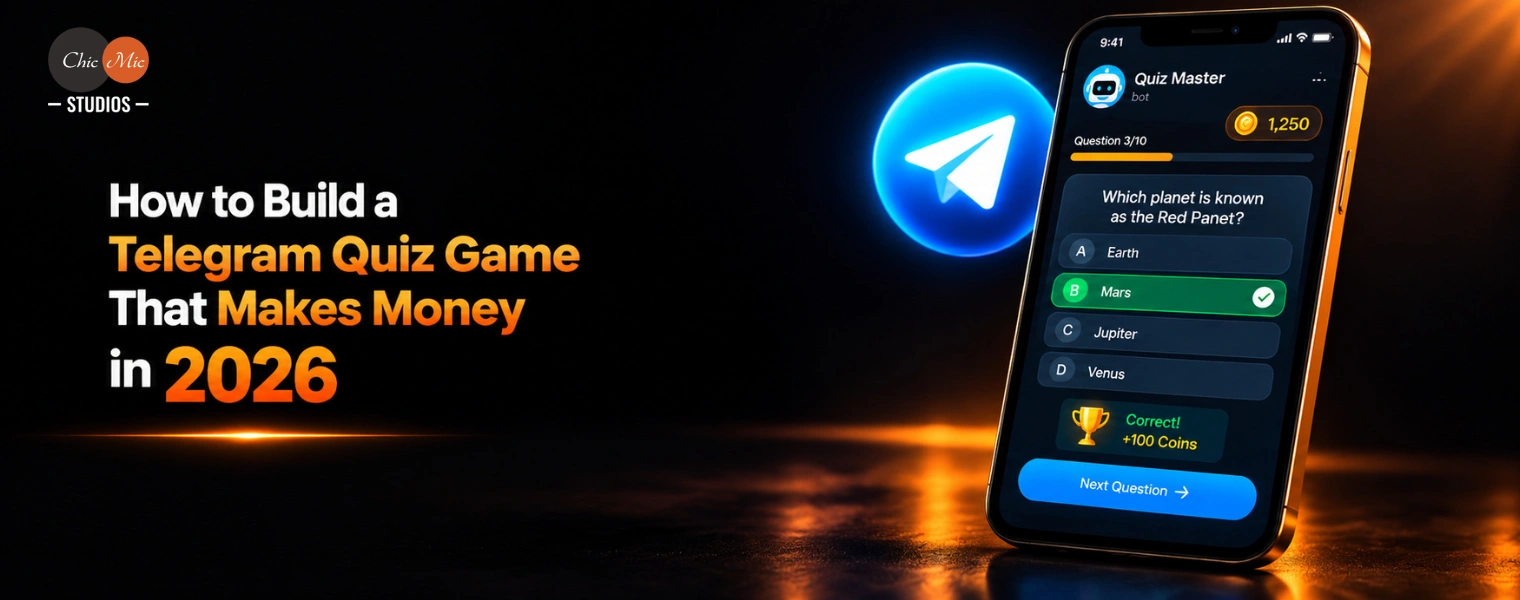
How to Create a Telegram Quiz Game: Development, Cost, Features & Monetization
Key Takeaways
- Create a Telegram quiz game using a Telegram Bot for communication and a Mini App for a richer, interactive gaming experience.
- Start with a focused MVP featuring quizzes, scoring, user profiles, leaderboards, and basic analytics before adding advanced functionality.
- Telegram quiz game development should include a secure backend and server-side scoring to protect results and prevent cheating.
- Add engagement features such as daily challenges, streaks, XP, badges, timers, and leaderboards to encourage repeat gameplay and generate revenue.
Introduction
Telegram has developed into more than a messaging platform. With Telegram Bots, Mini Apps, payments, communities, and interactive experiences, businesses can now create engaging products directly inside the Telegram ecosystem.
This makes Telegram an attractive platform for quiz games. A simple trivia bot can be created relatively quickly, while a custom Telegram Mini App can deliver a much more sophisticated gaming experience with timers, leaderboards, rewards, user profiles, analytics, and monetization.
If you are planning to build a Telegram quiz game in 2026, the most important consideration is not simply how to create questions and answers. You need to design the game mechanics, backend architecture, user experience, scoring system, security, analytics, and monetization strategy together.
This guide explains how to create a Telegram quiz game, the technology involved, essential features, monetization models, and the factors that determine Telegram quiz game cost.
What Is a Telegram Quiz Game?
A Telegram quiz game is an interactive trivia or knowledge-based game that users can access through Telegram. It can be implemented using Telegram’s native quiz functionality, a Telegram bot, or a custom Telegram Mini App.
A basic quiz can present questions with multiple-choice answers and calculate a final score. A more advanced product can introduce different categories, difficulty levels, timed questions, streaks, XP, achievements, tournaments, leaderboards, rewards, and personalized content.
The choice of architecture depends on the product’s objectives. A simple quiz may only require Telegram’s Bot API and basic server-side logic. A commercial quiz platform may require a Mini App frontend, backend APIs, database infrastructure, analytics, payment integration, and an administration system for managing questions and users.
Ready to Build Your Telegram Quiz Game?
How to Build a Telegram Quiz Game in 2026
Building a Telegram quiz game involves several technical and product-development stages. A structured development process can help reduce costs and prevent architectural limitations as the game grows.
1. Define the Telegram Quiz Game Concept
The first step is to define what users will actually play. Possible quiz formats include:
- General trivia
- Sports quizzes
- Movie and entertainment quizzes
- Educational quizzes
- Daily trivia challenges
- Brand-sponsored quizzes
- Competitive multiplayer quizzes
- Time-based challenges
- Tournament-style quizzes
You should also establish the primary gameplay loop. For example, players may receive a fixed number of questions, answer within a time limit, earn points for correct answers, and compete for leaderboard positions.
At this stage, define the target audience, quiz frequency, difficulty progression, reward system, and expected session length. A clear game concept makes subsequent Telegram quiz game development considerably easier because the technical requirements can be mapped to specific gameplay mechanics.
2. Choose Between a Telegram Bot and Mini App
One of the first technical decisions is determining whether the product should use a bot, Mini App, or both. A Telegram bot works well for lightweight quiz experiences. It can send questions, receive responses, provide feedback, and manage basic interactions.
A Telegram Mini App is more suitable when the game requires a custom interface. Developers can create a JavaScript-based web application that runs within Telegram and provides a richer experience. Telegram Mini Apps can support custom interfaces and game-oriented functionality.
For a commercial quiz product, a hybrid approach is often practical:
- The bot handles onboarding and notifications.
- The Mini App handles gameplay.
- The backend manages game logic, scores, users, and rewards.
This approach provides more flexibility than attempting to implement every feature through chat messages.
3. Create the Telegram Bot
To create a Telegram quiz game, developers first need to register a Telegram bot through BotFather. The bot becomes the communication layer between the game and its users. It can manage commands such as /start, send notifications, provide quiz invitations, and launch the Mini App.
The bot can also use deep links to direct users into particular game experiences or campaigns. Telegram provides the Bot API for developers to build bots and integrate functionality such as games, payments and Mini Apps. The bot token should be stored securely on the server and never exposed in frontend code.
4. Develop the Telegram Quiz Mini App
For a more sophisticated experience, the Mini App becomes the primary gameplay interface.
A custom Mini App can provide:
- Question cards
- Multiple-choice answers
- Countdown timers
- Progress indicators
- Animations
- Category selection
- Score displays
- Leaderboards
- User profiles
- Rewards
- Game history
The frontend can be developed using technologies such as React, Vue, Svelte, or standard JavaScript. The important consideration is not the specific frontend framework but the separation between the user interface and the backend game logic. The client should display the game state, while critical decisions such as scoring, reward eligibility, and tournament validation should be handled server-side.
5. Build the Quiz Engine and Backend
The quiz engine is the core of the application. It manages questions, answers, scoring rules, difficulty levels, time limits, attempts, and game sessions.
A typical backend needs to manage entities such as:
- Users
- Quizzes
- Categories
- Questions
- Answers
- Game sessions
- Attempts
- Scores
- Leaderboards
- Rewards
- Transactions
The backend can expose APIs for starting a quiz, submitting answers, retrieving questions, recording results, and updating leaderboards.
Server-side scoring is especially important for competitive games. The application should not simply accept a score submitted by the client because users could manipulate frontend requests.
6. Implement Scoring, Timers and Leaderboards
Scoring is one of the most important elements of a competitive quiz game. A simple scoring model can award a fixed number of points for each correct answer. More advanced systems can include time bonuses, difficulty multipliers, streak bonuses, and achievement points.
For example:
Final Score = Base Points + Time Bonus + Streak Bonus + Difficulty Bonus
The exact formula should be determined by the game’s economy and desired competitive balance.
Leaderboards can be separated into:
- Daily
- Weekly
- Monthly
- Global
- Category-specific
- Tournament-based
- Community-based
Redis or another caching system can be used to improve leaderboard performance when the number of concurrent players increases.
7. Add User Profiles and Progression
Persistent progression gives players a reason to return. Instead of treating every quiz attempt as an isolated session, the game can maintain:
- XP
- Levels
- Streaks
- Badges
- Achievements
- Quiz history
- Personal best scores
- Category performance
- Ranking history
This also creates additional opportunities for personalization. For example, a user who performs well in science but poorly in history could receive more science challenges while gradually being introduced to history content.
Essential Features for Telegram Quiz Game Development
A commercial Telegram quiz game can include a combination of gameplay, social, administrative, and monetization features.
1. Core Gameplay Features
- Multiple-choice questions
- Categories
- Difficulty levels
- Timed questions
- Randomized questions
- Randomized answer options
- Instant feedback
- Score calculation
- Quiz history
2. Engagement Features
- Daily challenges
- Streaks
- XP
- Levels
- Achievements
- Badges
- Leaderboards
- Personal rankings
3. Social Features
- Friend or community rankings
- Shareable results
- Referral systems
- Group challenges
- Competitive tournaments
4. Administrative Features
- Question management
- Quiz creation
- Category management
- User management
- Reward management
- Moderation
- Analytics dashboard
- Revenue reporting
Technology Stack for Telegram Quiz Game Development
The technology stack should be selected according to expected traffic, gameplay complexity, integrations, and development resources. For larger games, containerized deployment, load balancing, database replication, caching, monitoring, and automated deployment can be introduced as traffic increases.
| Component |
Recommended Technologies |
| Telegram integration |
Telegram Bot API |
| Mini App frontend |
React, Vue, Svelte, JavaScript |
| Backend |
Node.js, Python, Go, PHP |
| API |
REST or GraphQL |
| Database |
PostgreSQL or MySQL |
| Cache |
Redis |
| Cloud |
AWS, Google Cloud, Azure |
| Analytics |
Custom analytics + third-party platforms |
| Payments |
Telegram Stars |
How to Earn Money From a Telegram Quiz Game
The monetization model should be considered during product planning rather than after development. There are several ways to earn money from a Telegram quiz game.
1. Telegram Stars and Premium Content
Telegram supports Stars for digital goods and services sold through bots and Mini Apps. Developers can use Stars for eligible digital purchases within Telegram.
A quiz game could monetize through:
- Premium quiz packs
- Extra attempts
- Hints
- Special categories
- Premium challenges
- Advanced statistics
- Subscription-based access
This model allows the game to monetize engaged users without requiring a blockchain-based economy.
2. Sponsored Quiz Categories
Sponsorships can create a B2B revenue stream.
For example, a sports brand could sponsor a weekly sports trivia series, while an entertainment company could sponsor a movie quiz.
The sponsor could receive:
- Brand visibility
- Sponsored quiz placement
- Campaign-specific questions
- Results-page branding
- Audience engagement metrics
Sponsored quizzes can be particularly effective when the game has a well-defined audience.
3. Advertising
Advertising can be integrated into appropriate areas of the product, such as the home screen, category selection or results page.
However, advertisements should not interfere excessively with gameplay. Poorly implemented advertising can reduce session duration and player retention.
4. Subscriptions
A subscription model can provide access to premium functionality such as unlimited quizzes, exclusive categories, advanced statistics, ad-free gameplay, or special competitions.
Subscriptions can create predictable recurring revenue when the game has strong retention.
5. Optional Web3 Rewards
Blockchain can be introduced when there is a genuine business requirement for transferable digital assets.
Potential use cases include:
- Token rewards
- On-chain achievements
- NFTs
- Community incentives
However, Web3 is not required to make a Telegram quiz game profitable. Introducing tokens also creates additional requirements around wallet integration, smart-contract security, token economics, fraud prevention, compliance, and operational costs. For most new quiz products, conventional points, XP, badges and premium rewards are simpler options for an MVP.
Telegram Quiz Game Cost: What Determines the Price?
The Telegram quiz game cost depends heavily on functionality and technical complexity. A basic bot-based quiz may only require a question database, Telegram integration and simple scoring.
A custom Mini App can require significantly more development work because it introduces frontend development, backend APIs, user management, analytics and additional infrastructure.
Major cost factors include:
- UI/UX complexity
- Number of quiz modes
- Custom Mini App development
- Backend architecture
- Database design
- Leaderboards
- Real-time functionality
- Payment integration
- Admin dashboard
- Analytics
- Security
- Anti-cheating systems
- Third-party integrations
- Web3 functionality
- Cloud infrastructure
- Testing and maintenance
A useful way to estimate cost is to divide the project into three stages:
| Development Level |
Typical Scope |
| Basic |
Bot, questions, answers and scoring |
| Intermediate |
Custom Mini App, database, profiles and leaderboard |
| Advanced |
Multiplayer, tournaments, payments, analytics, rewards and scalable infrastructure |
Rather than choosing a development budget based solely on hourly rates, businesses should first define the feature scope and technical requirements.
Get an Accurate Telegram Quiz Game Development Cost Estimate
Development Timeline for a Telegram Quiz Game
Development time depends on the scope. A basic Telegram quiz bot can be developed significantly faster than a custom Mini App with multiplayer functionality.
A typical development process includes:
1. Discovery and Planning:
The team defines the gameplay, audience, monetization model, technical requirements and MVP scope.
2. UI/UX Design:
Designers create the UI/UX design as per Mini App interface, question screens, results pages, leaderboards and other user flows.
3. Development:
Frontend, backend, database, Telegram integrations and game mechanics are implemented.
4. Testing:
The team tests gameplay, scoring, payments, security, performance and different Telegram environments.
5. Deployment:
The application is deployed to production and connected to the Telegram bot.
6. Post-Launch Optimization
Analytics are reviewed to identify drop-off points, improve retention and introduce additional features.
How to Choose a Game Development Company for Your Telegram Quiz
Choosing the right Game development company is important because a Telegram quiz involves both game development and platform-specific engineering. A capable development partner should also be able to recommend an architecture based on the expected number of users instead of simply adding features to the scope. If you are building an MVP, an experienced team can help prioritize features and avoid unnecessary development costs.
Professional Game development services may cover the complete development lifecycle, including game design, UI/UX, frontend and backend development, testing, deployment, analytics integration, maintenance and future feature development.
Evaluate potential development partners based on their experience with:
- Telegram Bot API
- Telegram Mini Apps
- Game UI/UX
- Backend engineering
- Database architecture
- Cloud infrastructure
- Payment integration
- Real-time systems
- Security
- Analytics
- Post-launch maintenance
Conclusion
To successfully build a Telegram quiz game in 2026, focus on the complete product rather than the quiz questions alone. A strong technical foundation should combine Telegram Bot integration, a Mini App when necessary, a secure backend, a structured quiz engine, server-side scoring, a scalable database, analytics and appropriate security controls.
Start with a focused MVP and validate the gameplay before adding complex features. Once users demonstrate repeat engagement, introduce streaks, leaderboards, premium content, sponsorships, subscriptions or Telegram Stars. Web3 can be added later if the business model requires tokens or blockchain-based rewards, but it should not be considered mandatory.
Whether you want to create a Telegram quiz game as a lightweight MVP or develop a large-scale competitive platform, working with an experienced Game development company like ChicMic Studios can help you select the appropriate architecture, control the Telegram quiz game cost, and build a product that can scale as its user base grows.
Frequently Asked Questions
1. How do I build a Telegram quiz game?
To build a Telegram quiz game, you need to define the gameplay, create a Telegram bot, develop the quiz engine, implement scoring, connect a database, and optionally build a Telegram Mini App for a richer user experience.
2. Can I create a Telegram quiz game without coding?
Simple quizzes can be created using Telegram’s native functionality and available bot tools. However, a custom commercial quiz game typically requires frontend, backend, database, security and analytics development.
3. How much does a Telegram quiz game cost?
The Telegram quiz game cost depends on the complexity of the game. A basic bot requires fewer resources, while a Mini App with leaderboards, payments, analytics, multiplayer functionality and rewards requires a larger development budget.
4. How can I earn money from a Telegram quiz game?
You can earn money from a Telegram quiz game through premium quiz content, subscriptions, Telegram Stars, sponsorships and advertising. Web3 rewards can also be considered for products that have a suitable blockchain business model.
5. Should I build a Telegram bot or Mini App?
A bot is suitable for simple quiz interactions. A Mini App is preferable when the game needs a custom interface, animations, timers, advanced leaderboards, user profiles or more complex gameplay.
6. Do I need blockchain for a Telegram quiz game?
No. Blockchain is optional. Traditional points, XP, badges, premium content, subscriptions and sponsorships can all be used without cryptocurrency or NFTs.
7. Can Telegram quiz games have leaderboards?
Yes. Leaderboards can be implemented through a backend database and server-side scoring. They can support daily, weekly, global, category-based or tournament-specific rankings.
8. Can I monetize a Telegram quiz game with Telegram Stars?
Telegram supports Stars for eligible digital goods and services sold through bots and Mini Apps. Developers need to implement Telegram’s payment requirements correctly.
Build Your Telegram Quiz Game With a Clear Development Roadmap