Multiplayer Co-Op Game Development: Cost, Process & Timeline (2026 Guide)
Key Takeaways
- Development Cost: The cost of building a multiplayer co-op game depends on gameplay complexity, backend infrastructure, supported platforms, and ongoing updates.
- Development Process: Successful co-op games require careful planning, multiplayer architecture, gameplay balancing, extensive testing, and continuous post-launch support.
- Essential Features: Matchmaking, synchronized gameplay, communication tools, progression systems, and secure servers are fundamental to a great co-op experience.
- Business Value: Multiplayer games encourage longer player retention, stronger communities, and recurring monetization opportunities.
- Future Outlook: Cross-platform gaming, AI-powered experiences, and cloud-based multiplayer services will continue shaping co-op games in 2026.
Introduction
The capacity to team up, achieve goals, and experience things together has made multiplayer cooperative games one of the most engrossing aspects of the gaming business. From puzzle games to survival adventures to mission-based role-playing games, cooperative gaming is still popular among players who would rather prefer teamwork than compete. With the growing demand for multiplayer cooperative experiences, companies and developers are more and more curious about the multiplayer co-op game development cost before embarking on a new project. The total cost depends on a number of variables like game complexity, platforms supported, multiplayer infrastructure, art style, long-term maintenance needs, etc.
It takes a lot more than just getting people to connect online to make a great co-op game. Good game mechanics, reliable networking, balanced game systems, and a scalable backend to support a growing player base are all required. If you’re an indie developer with a new idea, or a studio putting together a commercial multiplayer game, knowing the development process, the costs involved and reasonable timeframes will help you make better decisions. In this blog, we’ll cover multiplayer co-op games development process, important features that players expect in 2026, and key costs. Businesses often rely on professional game development services to streamline multiplayer projects from planning to launch.
What Is Multiplayer Co-Op Game Development?
The purpose of designing multiplayer co-operative games is to create games in which the players work together to achieve common goals, rather than playing against each other. Inherently, the gameplay experiences are team-based. Players explore open worlds, solve puzzles, survive enemy waves, or complete story-based missions. Co-op games encourage teamwork, communication and progression as a group, which makes them more fun and rewarding than competitive multiplayer games, where you win based on how you perform compared to other players.
Co-op gameplay is now a popular feature in many genres of games, including strategy games, casual mobile experiences, dungeon crawlers, survival games and action role-playing games. Developers are embracing co-op features because they foster social connections and encourage long-term player engagement. You can see this trend in many platforms from complex PC and console games developed using complex engines like Unity and Unreal Engine to Roblox co-op game development projects for communal gaming.
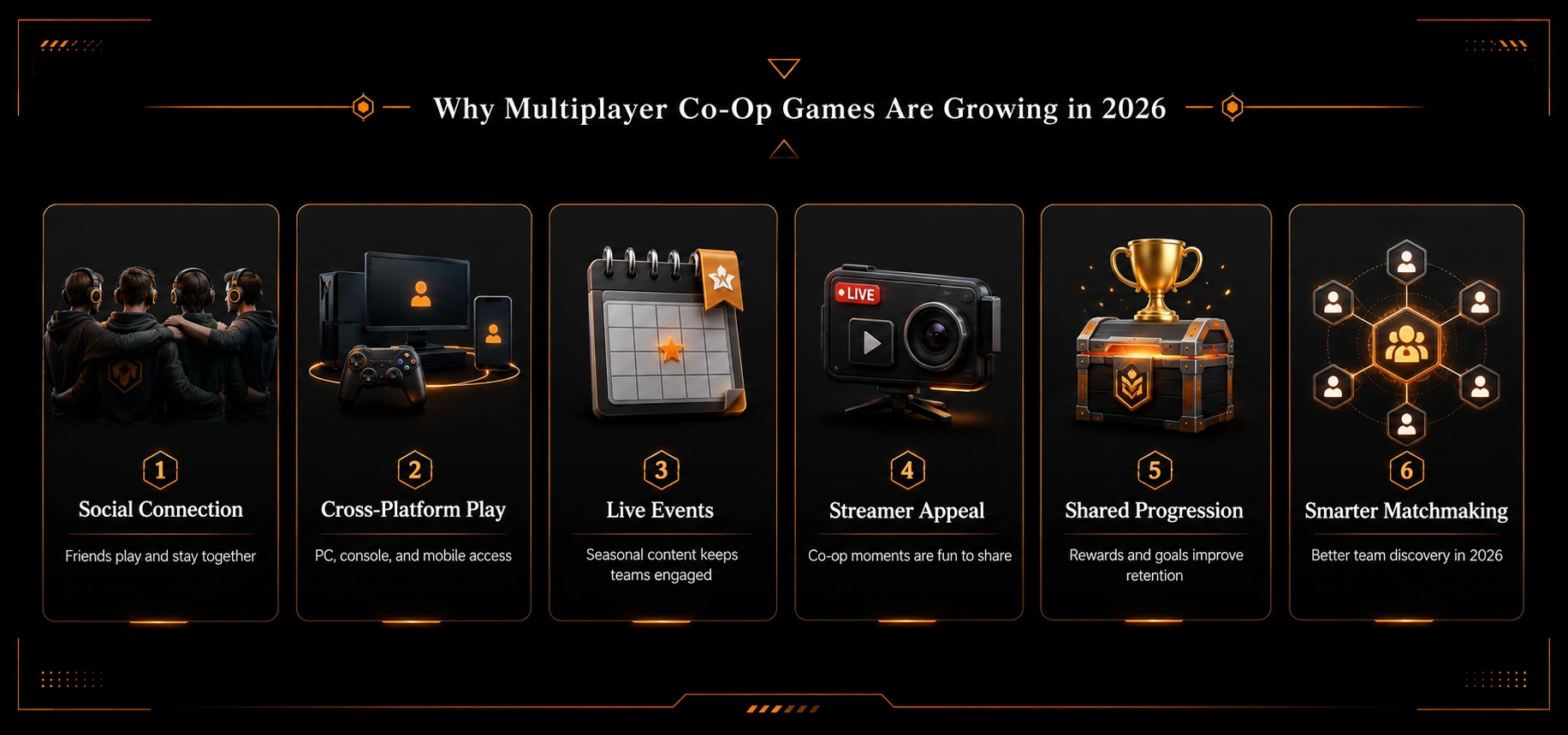
Multiplayer co-op games are becoming one of the fastest-growing divisions of the gaming business as players opt for shared experiences over traditional solo gameplay. By 2026, technological advancement, better online connectivity and changing player expectations are pushing developers to create games that focus on teamwork, social interaction and long-term engagement.
Several factors are driving the growth of multiplayer co-op experiences:
- Growing demand for social gaming
- Cross-platform gaming support
- Expansion of live-service games
- Higher player retention rates
- Increased monetization opportunities
- Growth of online gaming communities
- Advancements in multiplayer technology
The increasing popularity of co-op gaming is creating new opportunities for developers and businesses. Multiplayer titles can build higher player loyalty and longer-term success by focusing on engaging gameplay, community building, and continual updates.
Ready to Turn Your Co-Op Game Idea Into a Development Plan?
Multiplayer Game Development Process
Building a multiplayer game requires a mix of technical expertise, creative planning, and continuous optimization. Each step of the development is important to create a reliable and interesting gaming experience.
1. Planning and Game Design
Developers set out platform requirements, monetization strategy, gaming mechanics, target audience, and game concept before production begins.
2. Prototyping Core Gameplay
Early prototypes help test key mechanics, identify design flaws, and improve cooperative gameplay elements prior to full-scale development.
3. Multiplayer Backend Development
Developers create servers, databases, networking systems, matchmaking, and synchronization tools to enable smooth real-time multiplayer interactions. Robust multiplayer systems also depend on efficient database development for handling player data and game progress.
4. Gameplay Development
Teams develop cooperative, combat, progression, AI, inventory, and crafting systems while ensuring player experiences are balanced and coordinated.
5. Testing and Optimization
Testing at scale to ensure smooth gameplay across all platforms and devices, find bugs, improve performance, and reduce latency problems. Comprehensive quality assurance helps identify multiplayer issues before launch.
6. Launch and Ongoing Support
The game’s lifecycle is prolonged and player engagement is sustained through post-launch upgrades, new content, bug fixes and community improvements.
Types of Multiplayer Co-Op Games
The formula for co-op games is different. Different genres require different multiplayer architectures, progression systems and gameplay mechanisms, impacting the complexity and cost of development.
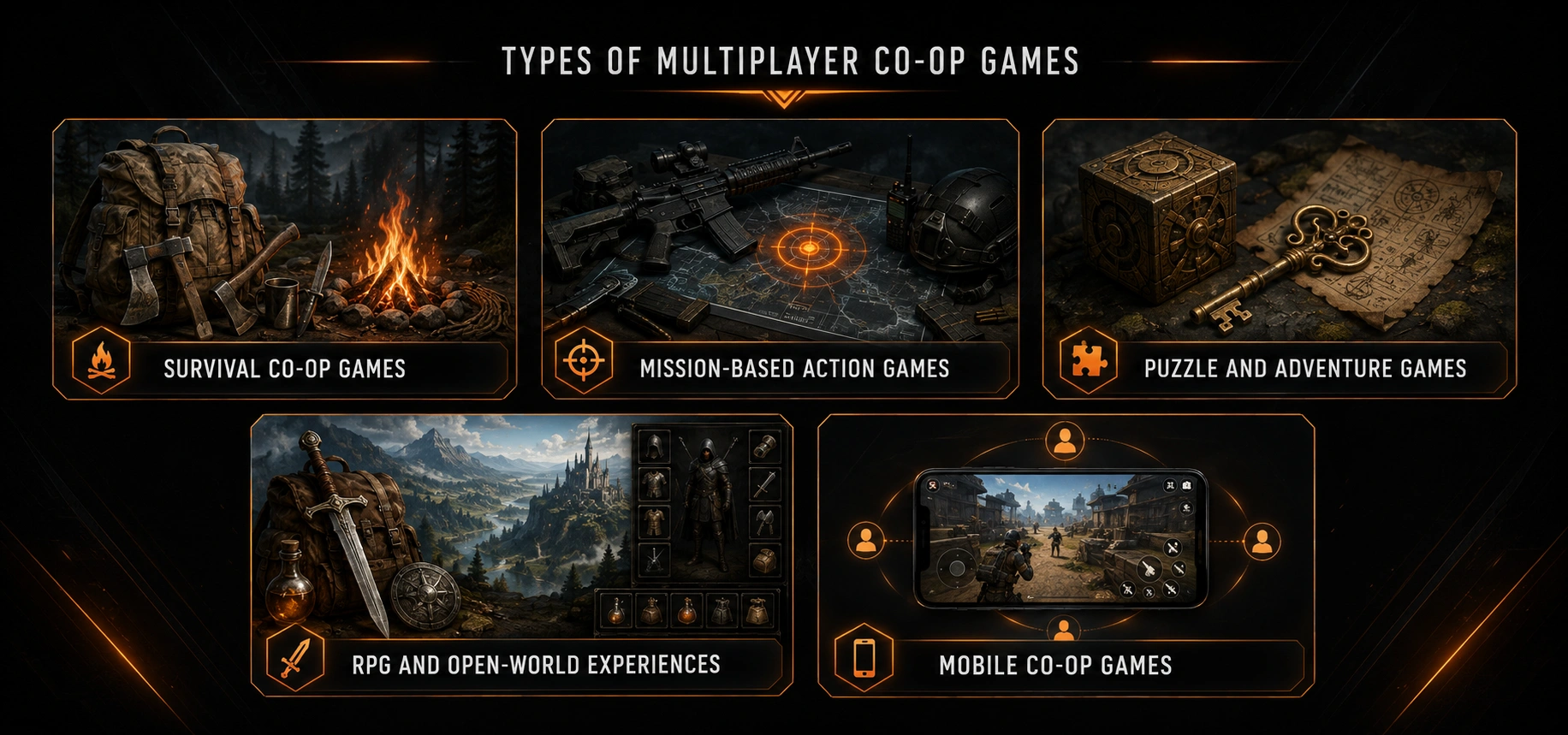
1. Survival Co-Op Games
Players gather resources, craft equipment, build shelters, and survive challenges together while using teamwork and strategy to overcome threats.
2. Mission-Based Action Games
Players use special abilities, roles, and coordinated team tactics to achieve objectives, defeat enemies, and progress through levels.
3. Puzzle and Adventure Games
These games are about solving problems and communicating, with players joining forces to overcome challenges and move forward together as a team, drawing on a broad spectrum of abilities.
4. RPG and Open-World Experiences
Players explore vast worlds, complete quests, customize their avatars and engage in collaborative journeys through levelling up mechanics and multiplayer gameplay. These experiences are typically built using advanced 3D game development techniques. For expansive cooperative worlds, 3D environment design services can help create detailed, exploration-friendly spaces that support quests and team-based gameplay.
5. Mobile Co-Op Games
Mobile co-op games offer accessible multiplayer experiences but require matchmaking, cloud saves, synchronization, and backend support for seamless gameplay. Teams targeting smartphones can also use mobile game development services to plan controls, performance, and multiplayer systems for mobile-first co-op experiences.
Essential Features of a Successful Co-Op Game
Multiplayer co-op games are not just graphics. What draws players back in is how easily they can work together, talk, and move forward as a team. Whether you’re building a big cross-platform experience or a fun mobile game, these characteristics directly impact player satisfaction and long-term retention.
1. Reliable Matchmaking
Fast matchmaking quickly connects with players that are best suited for you to create a more seamless multiplayer experience. Balanced games and shorter wait times.
2. Real-Time Synchronization
Real-time synchronization guarantees a uniform gaming experience for all players, with movements, combat, and mission progress perfectly synchronized across devices.
3. Shared Progression
Shared growth fosters teamwork by helping participants to complete missions, achieve goals, earn rewards, and develop together.
4. In-Game Communication
Voice chat, text messaging and ping systems can help teams to coordinate strategy and have more enjoyment during multiplayer sessions. Clear communication menus, team indicators, and accessible HUD elements also benefit from professional UI/UX design.
5. Cross-Platform Compatibility
Cross-platform support enables players on PCs, consoles, and mobile devices to enjoy the same multiplayer experience without restrictions. Large-scale releases often require specialized PC game development expertise alongside mobile optimization.
6. Secure Multiplayer Infrastructure
Anti-cheat software, secure servers and player authentication protect user information and the integrity of gameplay and multiplayer gaming experience as a whole.
Factors That Affect Multiplayer Co-Op Game Development Cost
The cost of developing multiplayer co-op games varies from project to project, because each game has unique technological, creative and commercial needs. Knowing these challenges helps companies determine the most important features and provide more precise budget estimates.
1. Game Scope and Complexity
Larger worlds, complex gameplay systems, unique dynamics and interactive settings require more development resources, which increases production costs and time.
2. Platform Selection
Developing for multiple platforms is more expensive than a single platform because you have to optimize, test and make compatible with each system.
3. Multiplayer Infrastructure
The costs of multiplayer backend development, as well as long-term scalability, are significantly impacted by dedicated servers, matchmaking, cloud hosting, authentication and real-time networking. Modern multiplayer infrastructure is frequently powered by scalable Node.js development solutions.
4. Art Style and Game Assets
Custom characters, environments, animations, visual effects and high quality assets instead of simpler or pre-built resources require more production effort. Projects that need distinctive heroes, enemies, or companions can also benefit from 3D character design and 3D animation services.
5. Game Engine
The engine you choose will affect the development efficiency, networking capabilities, platform support, and overall cost of developing multiplayer gaming systems. Projects with high-end graphics may also benefit from Unreal game development solutions. For cross-platform projects that prioritize rapid iteration and broad device support, dedicated Unity game development expertise can also be a strong fit.
6. Post-Launch Support
Regular upgrades, server maintenance, security enhancements, new content, bug patches, etc. These kinds of things are necessary to keep players engaged and the game running long term.
Common Development Challenges
The technical and gameplay challenges of creating a multiplayer co-op game directly impact performance, scalability, and player satisfaction. With early detection of such problems, the risk of development is reduced and the multiplayer experience is improved.
1. Maintaining Low Latency
Performance optimization of the network reduces delays to ensure responsive controls, smooth gameplay and coordinated player interaction across different devices and geographic locations.
2. Preventing Cheating
Server-side validation, secure authentication and anti-cheat measures make sure gameplay is always fair and player accounts and in-game economies are never exploited.
3. Balancing Cooperative Gameplay
Good balance mechanics ensure that all player roles stay relevant, promote team work and keep the game fair and fun.
4. Scaling Multiplayer Systems
Cloud infrastructure and scalable servers help to keep up with expanding player communities, while keeping up performance during peak gameplay and more concurrent users. Effective DevOps practices also help maintain server stability and continuous deployment.
5. Keeping Players Engaged
Regular updates, seasonal events, new content and community-driven improvements all bring players back, extending the game’s long-term lifecycle and success.
Multiplayer Co-Op Game Development Cost & Timeline in 2026
The cost and timeline of creating multiplayer co-op games depends on many factors, such as the complexity of the gameplay, multiplayer infrastructure, platforms it supports, backend architecture, custom assets and support after launch. The more ambitious cross-platform experiences require higher investment and longer development times due to the complexity of networking, extensive QA and live-service elements, but smaller co-operative games can be developed on a low budget and short timeframe.
Estimated Multiplayer Co-Op Game Development Cost & Timeline
| Development Level |
Estimated Cost |
Estimated Timeline |
| Basic Co-Op Mobile Game |
$15,000 – $35,000 |
3–5 Months |
| Mid-Level Multiplayer Game |
$35,000 – $90,000 |
6–9 Months |
| Advanced Cross-Platform Game |
$90,000 – $250,000+ |
9–15 Months |
Note: The approximations are used as a general benchmark. Actual costs and timelines will be impacted by project scope, complexity of the multiplayer, backend infrastructure, platforms supported, custom assets, testing requirements, and ongoing maintenance after launch.
Know Your Multiplayer Game Scope, Timeline, and Budget Before Development
Should You Build In-House or Outsource?
The optimal development approach depends on your budget, technical expertise, project timeline, and long-term business goals. While both can be used to make a successful multiplayer game, it’s easy to pick the approach that best suits your project if you know the differences between the two options.
| Factor |
In-House Development |
Outsourcing Development |
| Initial Cost |
Higher due to hiring and infrastructure |
Lower with an established development team |
| Time to Start |
Longer recruitment and onboarding process |
Faster project kickoff |
| Technical Expertise |
Built internally over time |
Immediate access to experienced specialists |
| Project Control |
Complete in-house control |
Collaborative development with regular updates |
| Development Speed |
Depends on team availability |
Faster with proven workflows |
| Best For |
Companies with long-term in-house game teams |
Businesses looking for faster, cost-effective development |
Before choosing a development partner, review a studio’s multiplayer capabilities, shipped work, and production quality. You can explore our game development portfolio to see the range of experiences delivered by our team.
Future Trends
The future of multiplayer co-op gaming is all about building more connected, dynamic and engaging experiences. As technology evolves, players want more intelligent games, smooth multiplayer interactions and the ability to play with friends across different devices without any interruptions. Browser-based multiplayer experiences are also driving demand for modern web game development solutions.
The next generation of co-op games will be shaped by artificial intelligence, cloud-powered infrastructure, procedural content creation and live-service upgrades in 2026 and beyond. Businesses that adopt these technologies early will be better equipped to create games that will keep players engaged, create lasting communities, and stay ahead of the curve in an increasingly competitive gaming industry.
Conclusion
Multiplayer co-op games are still one of the fastest growing categories in the gaming industry and offer exciting opportunities for businesses, startups and game studios. The development of multiplayer co-op games is much better understood in terms of cost, development process, timetable and critical elements that impact the success of a project. Armed with this information, businesses can better plan and make well-informed investment decisions. As player expectations continue to change in 2026, working with a skilled development team can help transform creative concepts into scalable, feature-rich multiplayer games that provide long-term player engagement and company success. If you’re planning a multiplayer project, contact our team to discuss your development requirements.
Frequently Asked Questions
1. What is multiplayer co-op game development?
It is the process of creating games where players work together to complete shared objectives through online or local multiplayer gameplay.
2. How much does multiplayer co-op game development cost?
Development costs typically range from $15,000 to over $250,000, depending on project scope, multiplayer infrastructure, supported platforms, and post-launch requirements.
3. How long does it take to develop a multiplayer co-op game?
Most projects take 6 to 12 months, although larger cross-platform games may require additional development time.
4. What factors affect multiplayer game development costs?
Major factors include game complexity, backend infrastructure, supported platforms, multiplayer functionality, custom assets, testing, and ongoing maintenance.
5. Is Unity a good choice for multiplayer game development?
Yes, Unity offers flexible networking solutions and cross-platform support, making it a popular choice for many multiplayer and cooperative games.
6. How much does it cost to develop a co-op mobile game?
A basic co-op mobile game generally starts around $15,000, while feature-rich multiplayer titles can require significantly larger budgets.
7. Can Roblox be used for multiplayer co-op games?
Yes, Roblox provides built-in multiplayer capabilities that make it suitable for developing cooperative games with social gameplay and monetization features.
8. Why do businesses outsource multiplayer game development?
Outsourcing gives businesses access to experienced developers, reduces hiring costs, shortens development timelines, and provides ongoing technical support.
9. What technologies are used for multiplayer backend development?
Developers commonly use dedicated servers, cloud infrastructure, matchmaking systems, databases, authentication services, and real-time networking frameworks.
10. How do I choose the right co-op game development company?
Look for a company with proven multiplayer experience, a strong development portfolio, transparent communication, scalable development processes, and reliable post-launch support.
Book a Free 30-Minute Consultation with a Game Expert.