AI Fitness App Development: What Actually Changes When You Add AI
Key Takeaways
- Gyms, Canadian health-tech startups, healthcare organizations and corporate wellness providers can use AI to develop personalized digital fitness and wellness solutions.
- The future is moving from AI features to intelligent fitness platforms. Predictive analytics, voice assistants, connected devices and AI agents could make fitness experiences increasingly adaptive and proactive.
- AI changes fitness apps from tracking platforms into adaptive fitness systems. Instead of simply recording workouts, AI can analyze user data and continuously personalize recommendations.
- AI workout personalization is the core transformation. Machine learning can use goals, workout history, performance, preferences and relevant wearable data to create more adaptive workout experiences.
Introduction
Fitness apps have moved beyond basic workout tracking. Users now expect digital fitness platforms to understand their goals, recognize changes in their performance, and provide recommendations that are relevant to their individual needs. This is where AI fitness app development is changing the way fitness products are designed.
A traditional fitness application may store workout history, display exercise videos, track calories, and send scheduled reminders. An AI powered fitness app, however, can analyze user behavior and fitness data to deliver more personalized experiences. Machine learning models can identify patterns, recommendation engines can generate AI exercise recommendations, and conversational AI can support users through an AI personal trainer or voice fitness assistant.
The change is therefore bigger than adding an AI chatbot. Artificial intelligence in fitness introduces a new intelligence layer between the application’s data and its user experience.
For businesses, this creates opportunities to develop intelligent fitness platforms that continuously improve their recommendations as more user data becomes available. For gyms, wellness companies, and Canadian health-tech startups, AI can also create scalable digital coaching and engagement solutions.
Traditional Fitness Apps vs. AI-Powered Fitness Apps
The biggest difference between a traditional fitness application and an AI-powered platform is how the application uses data.
A conventional workout tracking app primarily records information and presents it to the user. An AI-powered system can use the same information to generate recommendations, identify behavioral patterns, and modify the user’s experience.
| Capability |
Traditional Fitness App |
AI-Powered Fitness App |
| Workout plans |
Predefined programs |
Adaptive workout plans |
| Recommendations |
Rule-based or generic |
AI exercise recommendations |
| Tracking |
Manual or semi-automatic |
Automated data analysis |
| Personalization |
Primarily based on onboarding |
Continuous AI workout personalization |
| Progress |
Historical charts |
Predictive and personalized insights |
| Coaching |
Videos and instructions |
AI personal trainer and conversational coaching |
| Exercise analysis |
Limited |
Computer vision workout tracking |
| Notifications |
Scheduled reminders |
Behavior-based recommendations |
| Wearable data |
Displayed as metrics |
Used as an input for AI models |
| User interaction |
Forms and menus |
Chat and voice fitness assistant |
From Tracking to Adaptation
Traditional workout tracking app development often follows a predictable model: collect user information, select a suitable workout from a database, track completion, and display progress. This is the foundation of machine learning fitness apps, where historical user data can be analyzed to improve future recommendations.
For example, a user may initially receive a strength-training plan based on their fitness level and goals. After several sessions, the application can analyze workout completion, performance and available data to determine whether future sessions should be modified.
Build an AI-Powered Fitness Platform for the Future
This is the foundation of AI workout personalization. The goal is not necessarily to make every workout harder. The goal is to make the recommendation more relevant to the user’s current circumstances.
What Actually Changes When You Add AI to a Fitness App?
Adding AI to a fitness application changes more than its visible features. It can introduce new data pipelines, machine learning models, recommendation engines, computer vision systems and conversational interfaces.
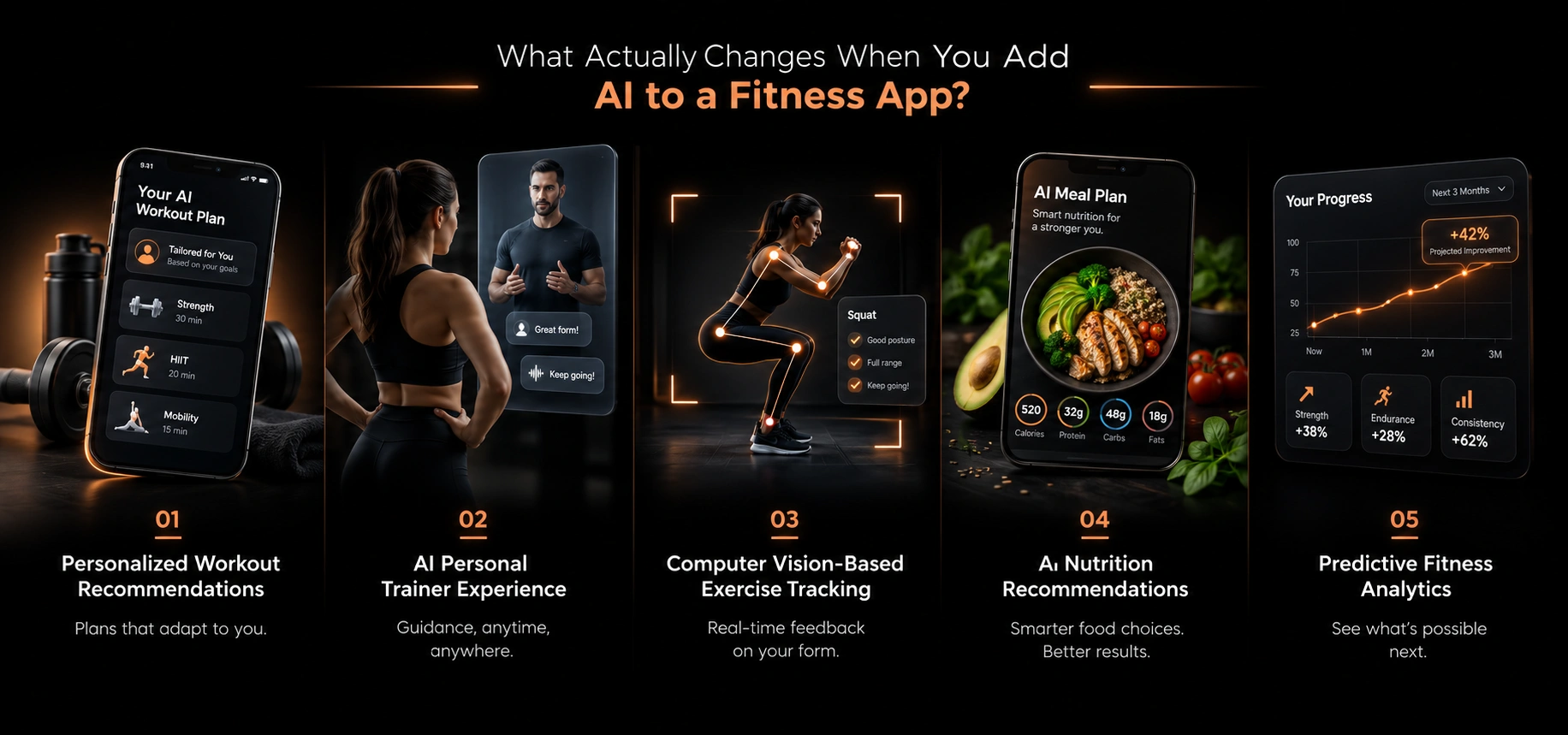
The most important changes occur in five areas.
1. Personalized Workout Recommendations
One of the primary benefits of AI fitness app development is the ability to move from static workout programs toward adaptive recommendations.
An AI workout engine can consider multiple inputs, including:
- Fitness goals
- Current fitness level
- Workout history
- Previous performance
- Exercise preferences
- Available equipment
- Workout duration
- Activity patterns
- Relevant recovery information
- Permitted wearable data
These inputs can be converted into structured features and passed to a recommendation or machine learning model. The model can then rank or generate suitable exercises and training sessions.
As the user completes more sessions, the system receives additional feedback. This allows the personalization layer to refine future recommendations. The result is an adaptive workout plan rather than a fixed program.
2. AI Personal Trainer Experience
The second major change is the introduction of an AI personal trainer. A conversational AI system can allow users to interact with the application using natural language instead of navigating through multiple screens.
For example, users could ask:
- What workout should I do today?
- Can I replace this exercise?
- Why did my workout change?
- I only have 20 minutes. What should I do?
- How am I progressing?
Technically, this can combine a large language model with structured application data, user profiles, fitness rules and a controlled knowledge base.
This distinction is important because an LLM alone does not automatically create reliable fitness intelligence. The conversational model should be connected to verified application data and appropriate safety controls.
For more interactive products, businesses can also implement a voice fitness assistant, allowing users to receive instructions or interact with the app without repeatedly touching the screen.
3. Computer Vision-Based Exercise Tracking
AI also changes how fitness applications can interpret physical movement. With computer vision workout tracking, a smartphone or connected camera can capture movement and use computer vision and pose-estimation models to identify body landmarks and movement patterns.
Potential applications include:
- Repetition counting
- Exercise identification
- Range-of-motion analysis
- Movement tracking
- Tempo analysis
- Form-related feedback
- Posture correction AI
For example, instead of requiring users to manually count repetitions, the application could use pose estimation to identify movement cycles.
However, computer vision is technically challenging. Camera angle, lighting, body occlusion, exercise variations and model accuracy can all influence results. Therefore, posture correction AI should be tested extensively before being positioned as a safety-critical capability.
4. AI Nutrition Recommendations
AI can also connect exercise and nutrition rather than treating them as completely separate features. An intelligent fitness platform can potentially use fitness goals, activity patterns, food preferences and permitted user information to provide personalized nutrition guidance.
Potential functionality includes:
- Meal recommendations
- Food logging
- Calorie tracking
- Macronutrient guidance
- Goal-based nutrition suggestions
- Workout-related nutrition recommendations
This supports the broader movement toward AI wellness technology, where fitness, nutrition and recovery become interconnected components of one digital experience.
Nutrition features should still have appropriate safety boundaries and should not present general AI-generated guidance as a substitute for professional medical or dietary advice.
5. Predictive Fitness Analytics
Traditional analytics mainly explain what already happened. For example: “You completed 16 workouts this month.” Predictive fitness analytics attempts to identify patterns and estimate what may happen next.
Potential use cases include:
- Progress forecasting
- Goal tracking
- Adherence analysis
- Recovery trends
- Performance trends
- Engagement prediction
- Churn-risk signals
An AI-powered application can use historical data and machine learning models to identify patterns that may not be obvious from basic dashboards. Predictions should be presented as estimates rather than guarantees, particularly when they relate to health, performance or recovery.
Key AI Features for Modern Fitness Apps
Not every fitness product needs every AI capability. The right feature set depends on the target users, business model, available data and technical requirements.
1. AI Workout Generator
An AI workout generator can create exercise sessions according to the user’s goals, fitness level, available equipment and time constraints. More advanced systems can continuously modify the generated plan using performance feedback.
2. Virtual Fitness Coach
A virtual coach can guide users through workouts, explain exercises, answer questions and provide personalized feedback. It can serve as the conversational layer between the user and the rest of the fitness platform.
3. AI Chat Assistant
An AI chat assistant allows users to interact with fitness software using natural language. This can reduce friction when users need quick answers about workouts, exercises, goals or application features.
4. Wearable Integration
Wearable integrations can provide additional data for personalization. Depending on the platform and user permissions, this can include:
- Activity
- Heart rate
- Sleep
- Workout history
- Other fitness-related measurements
The important point is that wearable data should not simply be displayed. The AI layer can potentially use relevant data as an input for recommendations.
5. Progress Prediction
Progress prediction can turn historical fitness data into forward-looking insights. Instead of simply showing completed workouts, an AI system can analyze trends and help users understand whether their current behavior is aligned with their selected goals.
6. Recovery Intelligence
Recovery-related features can combine appropriate activity, sleep and performance information to provide training guidance. The objective is to help users understand when they may want to maintain intensity, modify a session or prioritize recovery.
7. Computer Vision Workout Tracking
Camera-based movement analysis can automate repetition counting and provide exercise-related movement feedback. This can be particularly valuable for home fitness and remote coaching products.
8. Behavioral Personalization
AI can learn how users interact with the application. For example, one user may respond well to achievement-based notifications, while another may prefer simple reminders for medications.
Build Your AI Fitness App With a Clear Budget Plan
How AI Fitness Apps Improve User Engagement
AI does not automatically make a fitness app engaging. Its value comes from making the experience more relevant to the individual user. A traditional application might send the same reminder to thousands of users.
An AI-enabled application can potentially use behavioral data to determine who needs a reminder, when it should be sent, and what type of message may be most relevant.
AI can support engagement through:
- Personalized workout recommendations
- Adaptive goals
- Progress insights
- Contextual notifications
- Conversational coaching
- Personalized motivation
- Recovery guidance
- Re-engagement recommendations
For gyms, wellness providers and businesses exploring fitness app development Canada, this can also create new opportunities for member engagement beyond the physical facility. A gym app, for example, could combine membership information, workout programs, progress tracking and AI coaching into a single digital experience.
For Canadian health-tech startups, wellness companies and other businesses exploring AI wellness solutions Canada, the same architecture can support more specialized products. The broader opportunity is to build AI wellness platforms that connect exercise, coaching, behavior and relevant health data while maintaining appropriate privacy, security and safety controls. Ultimately, the biggest change when AI is added to fitness software is not the presence of an AI button.
Technology Stack Behind AI Fitness Applications
A modern AI powered fitness app combines mobile development, AI/ML, backend infrastructure, data storage and third-party integrations. For fitness mobile app development, businesses can choose native technologies such as Swift and Kotlin or cross-platform frameworks such as Flutter and React Native. The exact stack depends on the product’s requirements, but the following architecture covers most AI fitness app development use cases.
Opportunities for Fitness Businesses in Canada
The digital fitness market in Canada is creating opportunities for gyms, wellness providers, health-tech companies and corporate wellness organizations to build personalized digital experiences. For businesses exploring AI fitness app development Canada, AI can transform a conventional fitness product into an intelligent platform for coaching, personalization and engagement.
1. Gym Chains
For gym chains, gym app development can go beyond membership management, class schedules and workout tracking by incorporating AI personal trainers, adaptive workout plans and personalized member engagement.
Potential applications include:
- AI personal trainer functionality
- Personalized workout plans
- Member progress tracking
- AI exercise recommendations
- Retention analytics
- Automated member engagement
- Digital coaching between gym visits
2. Canadian Health-Tech Startups
Canadian health-tech startups can also use AI to develop custom wellness applications for fitness coaching, nutrition, recovery, employee wellness and lifestyle management.
Potential products include:
- AI coaching platforms
- Digital fitness applications
- Nutrition and wellness applications
- Recovery platforms
- Exercise adherence tools
- Corporate wellness solutions
3. Healthcare Technology
Companies working in healthcare technology Canada can explore AI-enabled wellness and physical-activity applications for appropriate use cases. However, there is an important distinction between a consumer wellness application and a clinical healthcare product.
If an application begins providing diagnosis, treatment recommendations or clinical decision support, it may require substantially different validation, regulatory and privacy considerations.
4. Corporate Wellness
Corporate wellness providers can use AI to personalize employee fitness programs. Instead of giving every employee the same challenge, an intelligent platform can potentially adapt recommendations based on individual goals, preferences, activity and engagement.
This creates opportunities for AI wellness solutions Canada that combine fitness tracking, personalized coaching and organizational wellness programs.
5. Global Opportunities
The real impact of AI on healthcare targeting the US, Australia, UK and UAE business market is resulting in bigger opportunities. For organizations building digital fitness solutions North America or international AI wellness platforms, localization should be considered at the architecture level. Data governance, health-platform availability, language, user expectations and regulatory requirements can vary by market.
Challenges in Building AI Fitness Apps
AI introduces significant opportunities, but it also creates technical challenges that traditional fitness app development may not encounter.
1. Data Quality and Availability
AI models depend on reliable data. Incomplete workout histories, inconsistent exercise names, missing wearable data or inaccurate user inputs can reduce recommendation quality.
2. Privacy and Security
Fitness applications can process highly sensitive information, particularly when they combine activity, sleep, biometric and health-related data.
Businesses should consider:
- Encryption
- Authentication
- Access controls
- Consent management
- Data minimization
- Secure API communication
- Data retention
- Third-party data sharing
Applications targeting Canada, the USA, UK, Australia and UAE should also account for applicable regional privacy requirements.
3. AI Accuracy and Reliability
AI-generated recommendations should be tested before they are exposed to users at scale. This is particularly important when recommendations influence workout intensity, nutrition or recovery.
AI systems should include appropriate rules, validation and fallback mechanisms rather than relying entirely on model output.
4. LLM Hallucinations
Generative AI can produce responses that sound authoritative but are incorrect. An AI fitness assistant should therefore use techniques such as:
- Retrieval-augmented generation where appropriate
- Structured fitness data
- Controlled prompts
- Output validation
- Safety rules
- Human review for high-risk workflows
The LLM should be treated as one component of the application, not the entire intelligence layer.
5. Computer Vision Limitations
Computer vision workout tracking is highly dependent on real-world conditions. Performance can be affected by:
- Camera positioning
- Lighting
- Body occlusion
- Clothing
- Exercise variations
- Camera resolution
- Movement speed
Testing should therefore include diverse real-world environments rather than only controlled demonstrations.
6. Wearable Fragmentation
Supporting multiple wearable platforms can increase both development and maintenance complexity.
A business should prioritize integrations according to its target users rather than attempting to support every device at launch.
7. Cold-Start Problem
AI workout personalization becomes more difficult when a user has no historical data. A new user may provide only basic onboarding information.
One approach is to combine initial profile information with general model patterns and then gradually personalize recommendations as more behavioral data becomes available.
How Businesses Can Build an AI Fitness App
A successful AI fitness application should start with a clearly defined business and user problem rather than a list of technologies.
Step 1: Define the Fitness Use Case
Identify:
- Who will use the application?
- What problem does it solve?
- What information does the AI need?
- What decision should AI improve?
For example, “personalize workouts for gym members based on previous performance” is a clearer use case than simply deciding to “add AI.”
Step 2: Choose AI Features
An MVP might only require AI workout personalization and conversational coaching. Advanced features such as computer vision and predictive analytics can be introduced later.
Step 3: Design the Data Architecture
Determine what data the application needs and where it will come from. Possible sources include:
- User profiles
- Workout history
- Mobile activity
- Wearables
- Health platforms
- Nutrition data
- User feedback
Then define how that data will be stored, normalized and processed.
Step 4: Develop AI Models
Depending on the use case, development may involve:
- Recommendation models
- Machine learning models
- LLM integrations
- Computer vision
- Predictive analytics
Businesses do not always need to train AI models from scratch. Existing models and APIs can accelerate development, while custom business logic and domain-specific models can provide differentiation.
Step 5: Integrate Devices and Platforms
Connect relevant health platforms, wearables and third-party services. Prioritize integrations based on the target audience and the data required for the AI use case.
Step 6: Launch, Measure and Optimize
After launch, monitor both product and AI performance. Important metrics can include:
- User activation
- Workout completion
- Retention
- Recommendation acceptance
- AI interaction frequency
- User satisfaction
- Goal progression
- Model accuracy
AI fitness software development is an iterative process. As new user data becomes available, businesses can improve recommendation logic, refine models and optimize the overall experience.
Future of AI Fitness Apps with Emerging Companies like ChicMic Studios
Healthcare app development at ChicMic Studios offers an array of features that provide top-notch healthcare services that are AI-driven. Our strong portfolio of healthcare apps also highlight the use cases across industries.
1. From Tracking to AI Coaching
Future AI fitness technology will move beyond recording workouts toward understanding user behavior and recommending what to do next. This will turn traditional workout tracking apps into more intelligent, personalized digital coaching platforms.
AI wellness platforms will increasingly connect workouts, nutrition, activity, sleep and recovery into a unified user profile. This can enable more contextual AI health coaching instead of isolated fitness recommendations.
3. From Reactive to Predictive
Instead of responding only after a workout or missed session, AI can identify behavioral and performance patterns earlier. Predictive analytics can support personalized interventions, progress forecasting and smarter AI exercise recommendations.
4. Computer Vision-Powered Fitness
Computer vision will make computer vision workout tracking more accessible through smartphone cameras and connected devices. Pose estimation can support repetition counting, movement analysis and increasingly sophisticated posture correction AI.
5. Voice-Based Fitness Assistance
Voice interfaces can make fitness applications more convenient during workouts when users cannot easily interact with a screen. A voice fitness assistant can provide exercise instructions, answer questions and support hands-free AI health coaching.
6. AI Agents in Fitness
AI agents could move fitness applications from answering user questions to completing defined tasks within approved boundaries. They may coordinate workouts, reminders, wearable insights, recommendations and simplify workings of healthcare as part of an intelligent fitness platform.
7. Hyper-Personalized Fitness
Future AI workout personalization will increasingly use multiple data points rather than relying only on goals and workout history. This can create adaptive workout plans that respond more closely to individual behavior, preferences and performance trends.
8. Connected Smart Fitness Technology
Fitness apps will increasingly connect smartphones, wearables, smart equipment and health platforms into a single ecosystem. This connected smart fitness technology can provide AI systems with richer contextual data for personalization and analytics.
9. AI Fitness Apps Across Global Markets
The opportunity extends from fitness app development Canada to the USA, UK, Australia and UAE as businesses adopt digital fitness solutions. AI wellness technology can support gyms, startups, healthcare organizations and corporate wellness providers across these markets.
Frequently Asked Questions
1. What is an AI fitness app?
An AI fitness app uses artificial intelligence to provide personalized workouts, intelligent coaching, movement analysis, progress insights and adaptive fitness recommendations.
2. How does AI improve fitness apps?
AI can analyze user data and behavior to create personalized recommendations, adaptive workout plans, intelligent coaching and predictive insights.
3. How much does AI fitness app development cost?
The cost depends on the application’s features, platforms, AI complexity, computer vision requirements, wearable integrations, backend architecture and ongoing infrastructure costs.
4. What AI features should a fitness app have?
Common features include AI workout personalization, adaptive workout plans, an AI personal trainer, conversational assistants, wearable integration, computer vision workout tracking and predictive analytics.
5. Can AI replace human personal trainers?
AI can automate and support many coaching tasks, but it does not completely replace human trainers. Human professionals can provide judgment, accountability and expertise that software cannot universally replicate.
6. How does computer vision work in fitness apps?
Computer vision can process camera input using pose estimation and movement-analysis models to identify exercises, count repetitions and provide movement-related feedback.
7. Can AI fitness apps integrate with wearables?
Yes. AI fitness applications can integrate with supported wearable and health platforms to use permitted activity, sleep, heart-rate and other fitness-related data.
8. Why should fitness companies invest in AI apps?
AI can help fitness companies deliver more personalized experiences, automate parts of coaching and engagement, analyze user behavior and create scalable fitness technology solutions.
Turn Your Fitness App Idea Into an AI-Powered Product