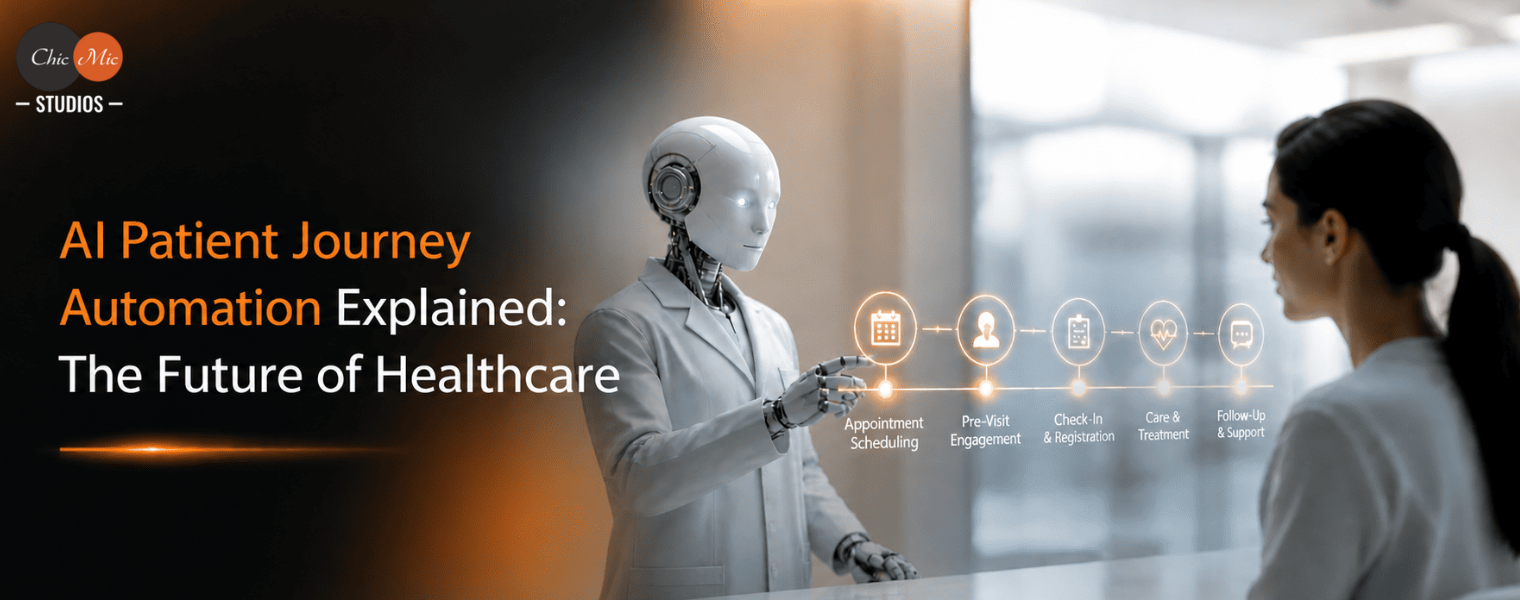
AI Patient Journey Automation Explained: The Future of Healthcare
Key Takeaways:
- Core Value: AI patient journey automation unifies fragmented healthcare processes into a seamless, intelligent care experience.
- Extensive Abilities: It combines autonomous agents, generative AI, workflow automation, and human oversight to manage the full patient lifecycle.
- Business Benefits: Organizations reduce administrative burden, improve efficiency, and deliver better patient outcomes at scale.
- Industry Use Cases: Hospitals, telehealth providers, and chronic care programs use AI to automate intake, coordination, monitoring, and follow-ups.
- Future Trends: Agentic AI will enable continuous, proactive care by managing entire patient journeys in real time.
AI Patient Journey Automation Explained: The Rise of Autonomous Healthcare Agents
The automated patient journey powered by AI is no longer a trial or a pledge for the future. It is beginning to set the stage for the large-scale operations of modern health care systems. Patients today expect healthcare to be as easy as ordering a meal or booking a trip. Unfortunately, traditional healthcare systems were never built for this level of coordination and customization.According to industry research from sources like Deloitte and McKinsey, healthcare systems are rapidly adopting AI to improve operational efficiency and patient outcomes, as highlighted in recent insights on generative AI adoption in healthcare.
Instruments are still not integrated in clinics and hospitals. Scheduling is done on a single system. One is where medical records live. Billing is off-site. Follow-ups are often inconsistent and manual. This leads to patient frustration and provider burnout.
This is where AI patient journey automation makes the difference, powered by advanced AI Development Services that unify fragmented healthcare systems into a seamless experience. AI ensures patients feel supported and healthcare staff are back in control of their workflows by seamlessly merging all care touchpoints into a single continuous experience. The answer is not by installing more software. The goal is to finally bring healthcare into one system.
What Is AI Patient Journey Automation?
The path of healthcare is seldom a straight line. Patients go from check-up to test to prescription to appointment. Traditional solutions create gaps and delays because they address each phase individually.
AI patient journey automation is the use of artificial intelligence to manage and optimize the entire patient lifecycle – from onboarding and diagnosis to treatment and follow-up – ensuring seamless, proactive, and personalized healthcare experiences.
AI patient journey automation adds intelligence to this chaos. Enterprise studies show that 85% of healthcare organizations have already adopted or are actively exploring AI, with most focusing on patient coordination, workflow automation, and care continuity. It enables healthcare organizations to manage the whole patient experience as a seamless flow, rather than a series of isolated events.
AI patient journey mapping tools inform the system where the patient is in their care cycle and what should happen next. If a test result is delayed, AI modifies the schedule. When a patient shows signs of disengagement, AI triggers personalized outreach. The technology automatically escalates a follow-up if it is deemed to be vital.
The objective is simple. Nothing was missed. No context is lost. No loitering.
The way in which care is delivered is radically changed by this approach, as decisions are no longer made on a reactive basis. They’re proactive and personalized.
What Are Autonomous Patient Journey Agents?
Intelligent healthcare automation through autonomous patient journey agents are not just rule-based scripts or chatbots. These sophisticated AI systems monitor, assess, decide and act throughout healthcare operations.
These agents can work across electronic health records scheduling platforms, diagnostic billing systems, and engagement tools due to their autonomous healthcare agent architecture. They learn context, and adapt to clinical data and patient behavior. Much of this adaptability comes from advances in generative AI that enable systems to reason, personalize interactions, and evolve with patient data over time.
For example, an agent can schedule follow-up appointments, track lab results, alert clinicians and book appointments without human intervention. The technology kicks in human-in-the-loop healthcare AI when there’s risk or ambiguity, maintaining clinicians at the helm when judgment matters most.
They strike a balance between oversight and autonomy, making them safe, reliable, and scalable.
How AI Automates the Patient Lifecycle?
Patient lifecycle management using AI covers the entire patient journey from first interaction to ongoing engagement. Recent healthcare surveys show that 70% of healthcare organizations are actively using AI today, with nearly 69% leveraging generative AI and large language models to automate onboarding, triage, and follow-up processes.
AI guides questions and filters intent for discovery to help patients find the right care faster. Onboarding forms auto-filled, insurance verified, appointments booked seamlessly.
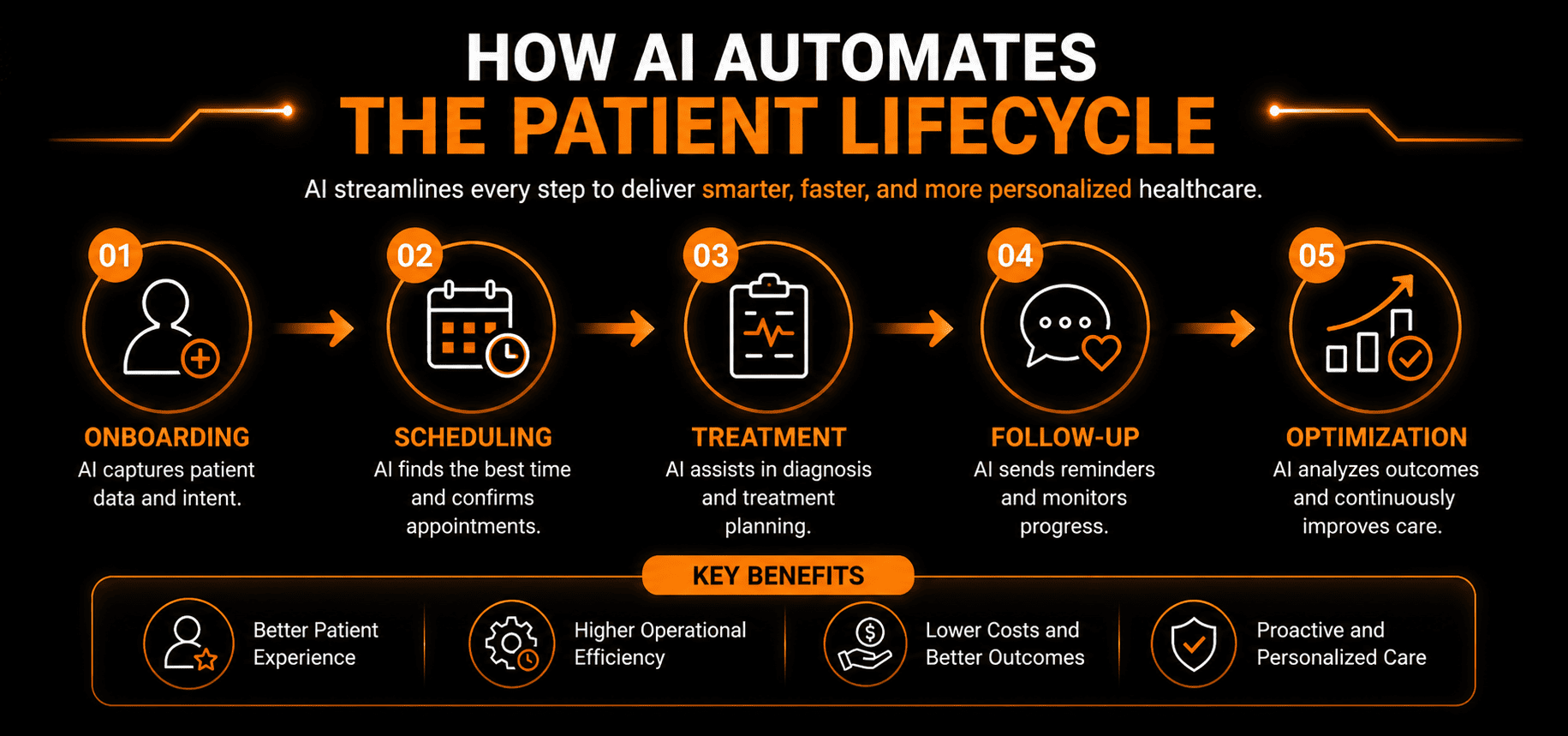
AI clinical workflow optimization in the clinical setting alleviates administrative burden by automating documentation, prioritizing cases, and organizing care teams. Many healthcare organizations are now investing in scalable AI Agent Development Solution to automate patient lifecycle operations efficiently. AI aids in making sure follow-up medication reminders and monitoring of recovery take place on time post-treatment.
Long term engagement becomes smarter. AI driven patient engagement platforms use specific schedules based on patient results, adherence and risk rather than generic schedules.
This lifecycle approach to continuity of care improves patient happiness and outcomes immediately.
AI Healthcare Workflow Automation Explained
Healthcare workflows have traditionally been hard pathways. Unexpected situations that require manual intervention from staff slow down operations.
AI healthcare workflow automation systems are vigorous. And they do improve over time adapting themselves to real world situations. They decide based on patterns in data and results, not hard rules.
Healthcare automation using AI agents can help organizations coordinate complex operations across departments without adding to the workload. Behind this level of coordination is strong AI development that brings together data pipelines, model orchestration, and system integrations to ensure automation works reliably in real healthcare environments.
Automation at this level reduces errors, increases productivity and allows medical staff to focus on patient care rather than paperwork. Industry data indicates that organizations using AI-driven workflow automation report up to 30–40% reductions in administrative workload, freeing clinicians to focus more time on direct patient care.
Key Features of Autonomous Healthcare Agents
Autonomous healthcare agents are where clinical accountability meets data intelligence automation. Unlike traditional healthcare software, they are designed to sense situations through complicated variables and make informed decisions while collaborating with humans. The following features describe the basic skills that enable these agents to operate safely and successfully within modern healthcare ecosystems.
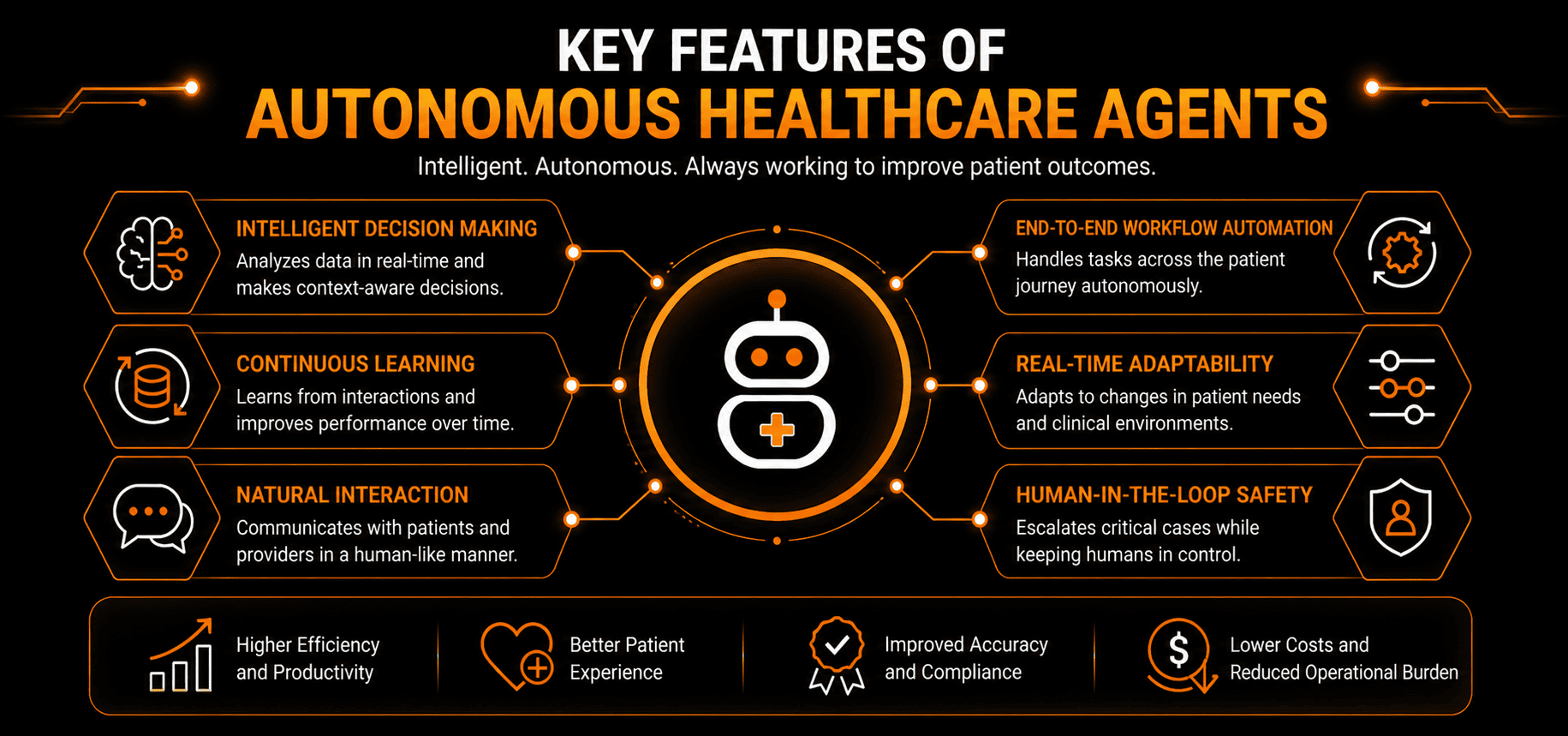
- Context-Aware Intelligence
Autonomous healthcare agents need to combine clinical operational and behavioral data to make meaningful decisions, not just discrete rule-based
actions.
- Autonomous Decision-Making
Autonomous agents are not the same as automation in the traditional sense in their ability to make free choices, act and coordinate their operations.
- Seamless System Integration
Integration is not an optional element, it is an essential element, because healthcare environments are dependent on EHRs, hospital management systems devices, and legacy tools.
- Continual Learning Improvement
Autonomous agents can evolve using input from outcomes and real-world data to improve performance without constant reprogramming.
- The Human Loop
Safety, trust, and regulatory compliance all require human monitoring, so human-in-the-loop healthcare AI is a necessary feature, not a bug.
Benefits of AI Patient Journey Automation
The value of AI patient journey automation is visible across the entire healthcare ecosystem.
Patients experience smoother journeys, fewer delays and clearer communication. Providers spend less time coordinating care and more time treating patients. Healthcare organizations reduce costs while improving outcomes. Business and healthcare leaders report that AI delivers an average return of over $3 for every $1 invested, making patient journey automation both a clinical and financial advantage.
| Area |
Traditional Systems |
AI Patient Journey Automation |
| Workflow Coordination |
Manual |
Intelligent and automated |
| Patient Engagement |
Reactive |
Proactive and personalized |
| Clinical Efficiency |
Fragmented |
AI clinical workflow optimization |
| Operational Scale |
Limited |
High without added staff |
| Error Handling |
Human dependent |
Automated with escalation |
This transformation is not theoretical. It is already happening.
Real-World Use Cases of AI in Patient Journey
AI-based hospital management systems are used by hospitals to predict patient flow, manage bed availability and optimize staffing. These technologies analyze admissions, discharges, and real-time clinical data to alleviate congestion and improve productivity. AI can help emergency rooms by triage, which can identify important cases and reduce waiting time. For a deeper look at healthcare-focused apps, explore our blog on The Growing Impact of Healthcare Mobile App Development.
AI improves scheduling and coordination of patient onboarding for outpatient and specialty care. By synthesizing patient histories, lab results, and imaging into actionable insights at the point of care, intelligent systems help doctors and reduce no-shows.
Autonomous agents are used in chronic care programs to monitor data from wearable and remote devices. Early identification of risk allows timely interventions, better long-term outcomes and fewer avoidable hospital admissions.
Telehealth services use AI to automate follow-up, intake routing paperwork. That removes some of the administrative burden and allows doctors to spend more time with their patients.
Integrated with secure data infrastructure like Blockchain Development Services, these technologies provide privacy, traceability, and trusted data sharing.
AI Agents vs Traditional Healthcare Systems
The difference between AI agents and traditional healthcare systems is not only technological but structural. Traditional platforms are built to support documentation and compliance whereas AI agents are designed to support decision making and action. This change affects how care is delivered, how resources are managed and how quickly healthcare organizations can respond to patient needs. The comparison below highlights how this shift transforms healthcare operations from static workflows into intelligent adaptive systems. This evolution is closely aligned with the rise of AI-first enterprises, as explained in our guide on What Is an AI-First Company and Why It Outperforms Traditional Businesses.
| Capability |
Traditional Systems |
AI Agents |
| Decision Making |
Manual or rule based |
Autonomous and learning |
| Adaptability |
Low |
High |
| Patient View |
Fragmented |
End to end |
| Data Usage |
Historical |
Real time and predictive |
| Human Role |
Constant |
Strategic via human in the loop healthcare AI |
This shift enables healthcare to operate as a living system rather than static software.
Challenges in AI Healthcare Automation
AI healthcare automation has assurance, but there are a number of hurdles that need to be carefully weighed. The quality of data is a key factor, as AI systems need accurate and consistent data to generate reliable outcomes. Integration with legacy systems might be difficult especially in settings built on old technology not designed for real time intelligence. Leveraging scalable Web Development Services can help modernize legacy healthcare infrastructure and enable smooth AI integration.
Clinician trust is another key factor. Transparency and explainability are essential for healthcare professionals to understand and feel secure in AI-supported judgments. Security, privacy and regulatory compliance must remain a key focus given the sensitivity of healthcare data.
These difficulties notwithstanding, they can be managed quite successfully through careful system architecture, strong data governance, and a phased rollout approach.
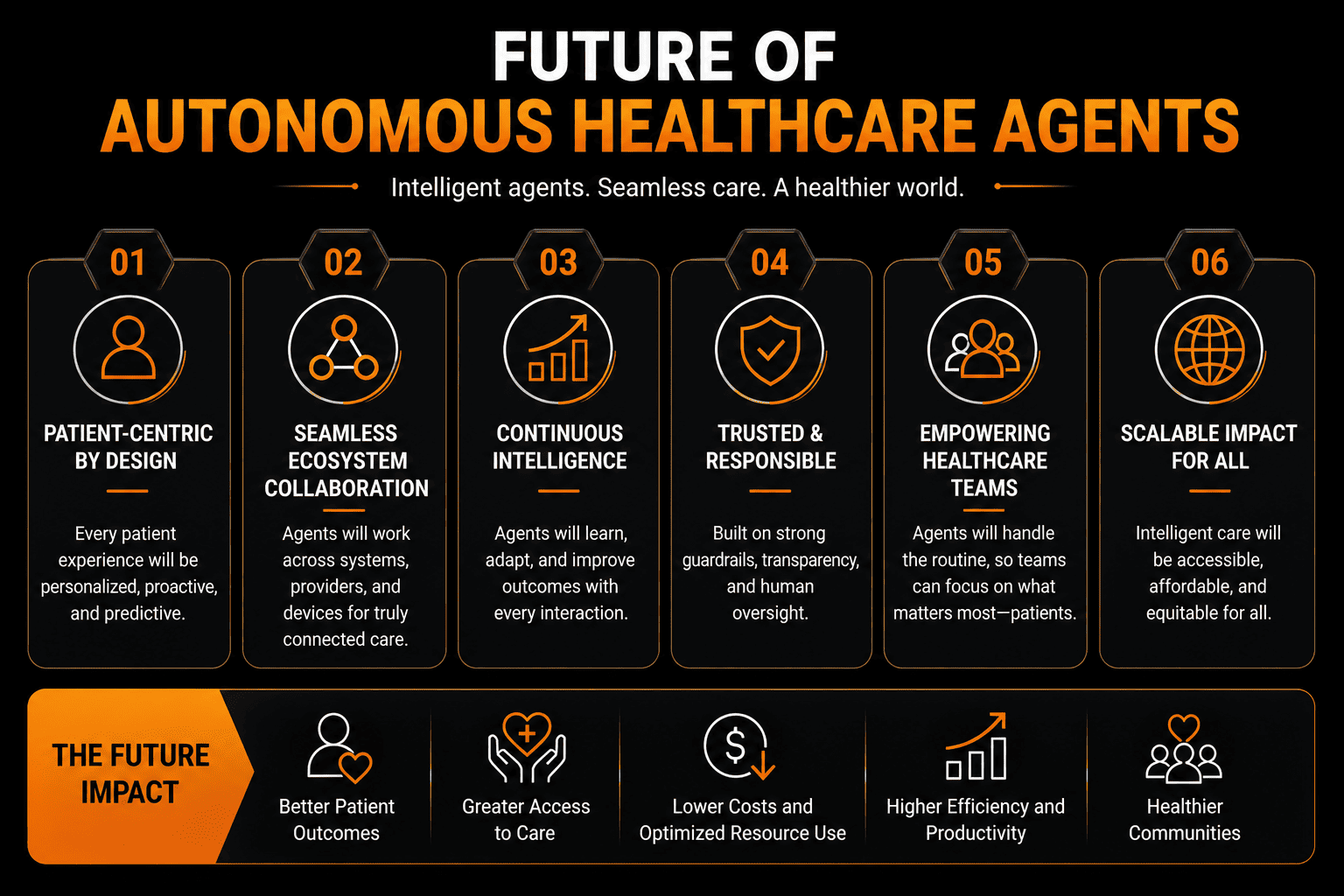
Future of Autonomous Healthcare Agents
The future of agentic AI in healthcare will be defined by continuous adaptive care, not isolated automation. Autonomous healthcare agents will become more prevalent across the patient journey, combining clinical judgments, operational procedures and patient engagement into one intelligent system. This shift is part of a larger movement toward intelligent, agent-driven AI systems that are transforming how organizations design, deploy, and scale automation across sectors.
Learn more about this transformation in our detailed guide on Agentic AI vs Generative AI
As these agents develop, they will manage complete care pathways, predict risks in advance and provide immediate treatments. As AI continues to improve personnel infrastructure and care delivery in response to real-time demand, resource utilization will become more dynamic.
The episodic treatment paradigms of healthcare will be replaced by ongoing intelligent assistance where patients will be proactively advised rather than reactively cared for. Investing in AI patient journey automation now will enable organizations to lead the next wave of innovative, scalable and patient-centric healthcare.
Conclusion
The changes in healthcare are practical, not theoretical. Systems can’t work in silos anymore, teams feel the pressure, and patients want more seamless experiences. AI patient journey automation offers structure and intelligence to the entire care flow to help solve these problems.
Human in the-loop healthcare AI keeps clinicians in the loop where judgment and empathy matter, while autonomous healthcare agents handle coordination, follow-ups and workflow choices at scale. This means that everyone involved feels that the care is more reliable, reactive and well-organized.
This change is about resilience-building for healthcare organizations. By investing now, you’re helping to build AI healthcare workflow automation systems that can ultimately adapt, improve and deliver better patient outcomes. Early adopters will be better positioned for the future of healthcare.
Frequently Asked Questions
1. What is AI patient journey automation?
AI patient journey automation” is the application of AI to manage and improve each step of the patient care journey, from the initial contact through to post-treatment follow-up. It allows for more connected and consistent appointment scheduling, communication about clinical workflows, and engagement with healthcare systems.
2. What are autonomous patient journey agents?
Autonomous patient journey agents are AI-powered systems that proactively monitor care workflows across healthcare platforms. They react to live data and to patient actions, and they orchestrate the scheduling of clinical tasks, of documentation and of patient communication.
3. How does AI improve patient experience?
AI improves patient experience by reducing waiting times, minimizing manual processes and ensuring timely follow ups. Patients receive clearer communication, more personalized care plans and fewer disruptions throughout their healthcare journey.
4. What are the benefits of AI in healthcare workflows?
The main benefits include improved efficiency, reduced administrative burden, fewer errors and better care coordination. Through AI healthcare workflow automation systems providers can focus more on patient care while operations run more smoothly in the background.
5. Is AI patient journey automation secure?
Yes when implemented correctly AI patient journey automation follows strict healthcare compliance standards. Data encryption access controls and secure infrastructure including blockchain services help protect patient information and maintain trust.
6. What is the future of AI in healthcare automation?
The future is more about self-sufficient and flexible solutions that allow for ongoing care. The future of agentic AI in healthcare will allow us to anticipate risks earlier, optimize resources and deliver more personalized patient experiences.