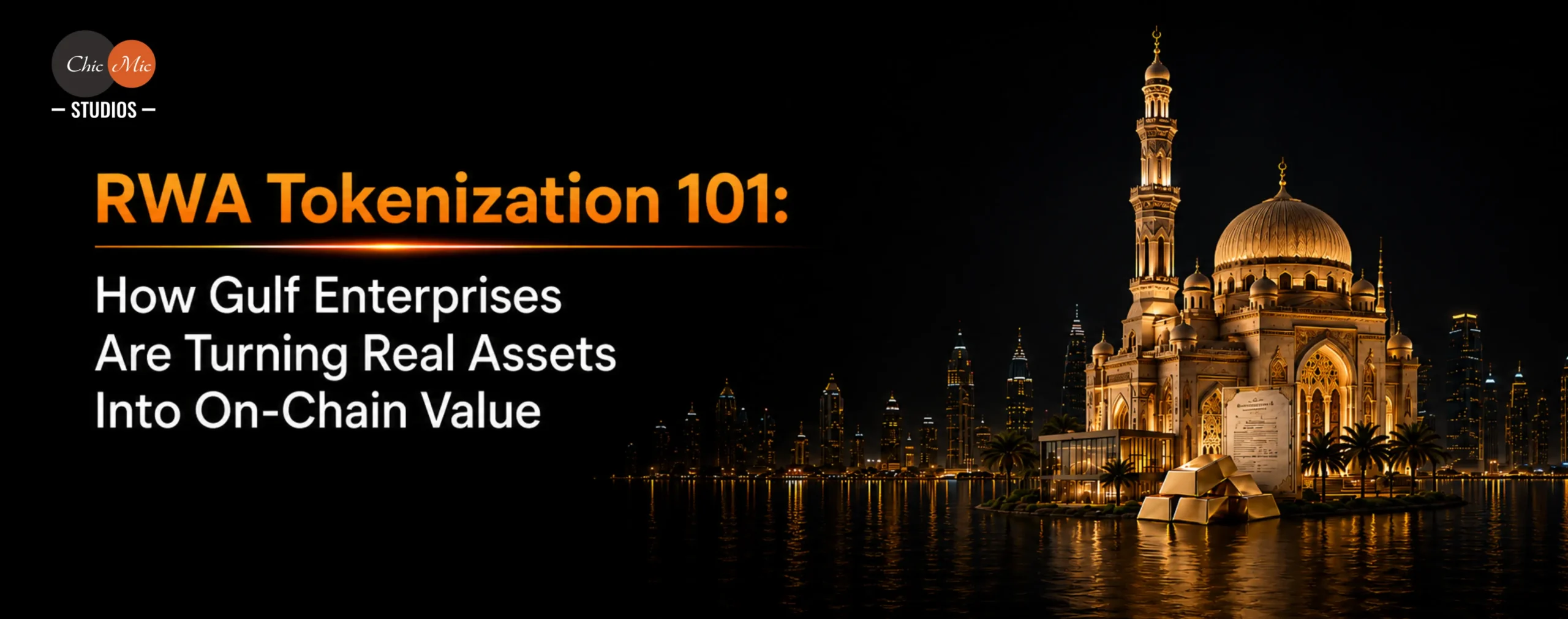
RWA Tokenization 101: How Gulf Enterprises Are Turning Real Assets Into On-Chain Value
Key Takeaways
-
- Digital Ownership: RWA tokenization enables businesses to represent physical assets on blockchain, creating secure digital ownership, improving transparency, and opening new investment opportunities.
- Key Assets: Real estate, gold, infrastructure, investment funds, renewable energy projects, and private equity are among the leading asset classes being tokenized in the Gulf.
- Business Value: Tokenization enables fractional ownership, improves transparency, streamlines operations, and creates new fundraising and investment opportunities for enterprises and investors.
- Future Growth: Supportive regulations, enterprise blockchain adoption, and increasing institutional interest are positioning the Gulf as a growing hub for RWA tokenization.
Introduction
The Gulf is shifting its focus from cryptocurrency speculation to RWA tokenization, which has actual business value. Businesses in the UAE, Saudi Arabia, and the larger GCC are investigating the possibility of converting physical assets such as infrastructure, commodities, and real estate into digital tokens on blockchain networks. This strategy is increasing liquidity, opening new opportunities for Gulf digital asset investment, and facilitating ownership for investors and businesses.
RWA tokenization is emerging as a viable approach for businesses seeking to modernize their operations as governments continue to invest in enterprise innovation and digital transformation. Growing enterprise blockchain adoption, changing regulations, and interest in Sharia-compliant tokenization UAE solutions are shaping a stronger foundation for tokenized assets throughout the region. Businesses exploring blockchain adoption often begin with a well-defined asset tokenization strategy.
What Is RWA Tokenization?
Real World Asset (RWA) tokenization is the process of converting ownership rights of a physical or traditional financial asset into digital tokens on a blockchain. Each token represents a verified stake or ownership interest in the underlying asset. Instead of relying only on paper records or databases owned by one company, ownership is securely stored on the blockchain. This allows assets to be transferred, managed, and tracked. Smart contracts for RWA can automate many processes, improving accuracy, efficiency, and transparency.
There are many assets that can be tokenized, including commercial and residential real estate, corporate bonds, investment funds, infrastructure projects, private equity, renewable energy assets, fine art, and collectibles. Fractionalized asset investment enables multiple investors to own smaller shares of the same asset, making high-value investments more accessible. Many organizations rely on blockchain development services to build secure tokenization solutions. For a broader foundation, explore this real-world asset tokenization guide.
Get Expert Guidance for RWA Tokenization
Why Are Gulf Enterprises Adopting Tokenization?
The Gulf is rapidly becoming a global hub for blockchain development. Strong government support, evolving regulations, and growing investor confidence are enabling businesses in the GCC to use RWA tokenization to modernize asset ownership, enhance fundraising, and generate new investment opportunities.
1. Unlocking New Investment Opportunities
Tokenization allows valuable assets to be divided into smaller units of ownership, making it possible for more investors to participate and for companies to raise capital more efficiently.
2. Increasing Liquidity
Digital ownership allows qualifying assets to be transferred more quickly and efficiently, supporting greater liquidity and more active secondary markets.
3. Supporting Enterprise Digital Transformation
With the rise of enterprise blockchain adoption, businesses are integrating tokenization into existing digital initiatives to improve operational efficiency, automation, and transparency. Businesses are also combining blockchain with AI development to automate enterprise workflows.
4. Attracting Global Capital
Tokenized assets provide secure and transparent ownership structures that enable Gulf businesses to access cross-border investment opportunities.
Sharia Compliance in RWA Tokenization
As RWA tokenization gains momentum across the Gulf, businesses must ensure their digital asset offerings align with Islamic finance principles. Combining blockchain innovation with Sharia compliance helps build trust, supports regulatory expectations, and encourages wider investor participation across the GCC. Teams should also review the UAE crypto regulation guide before planning a regional launch.
1. Importance of Sharia Compliance
Sharia-compliant tokenization is based on Islamic finance principles that emphasize true asset ownership, transparency, ethical investments, and responsible financial practices throughout the investment lifecycle.
2. Building Investor Trust
A Sharia-compliant tokenization framework in the UAE, Saudi Arabia, and the wider GCC can boost investor confidence, attract institutional and individual investors, and encourage long-term engagement.
3. Role of Smart Contracts
Well-designed smart contracts for RWA increase transparency, reduce human error, and automate ownership transfers, compliance checks, and profit distributions. Businesses can also review how smart contracts work in blockchain before defining platform logic.
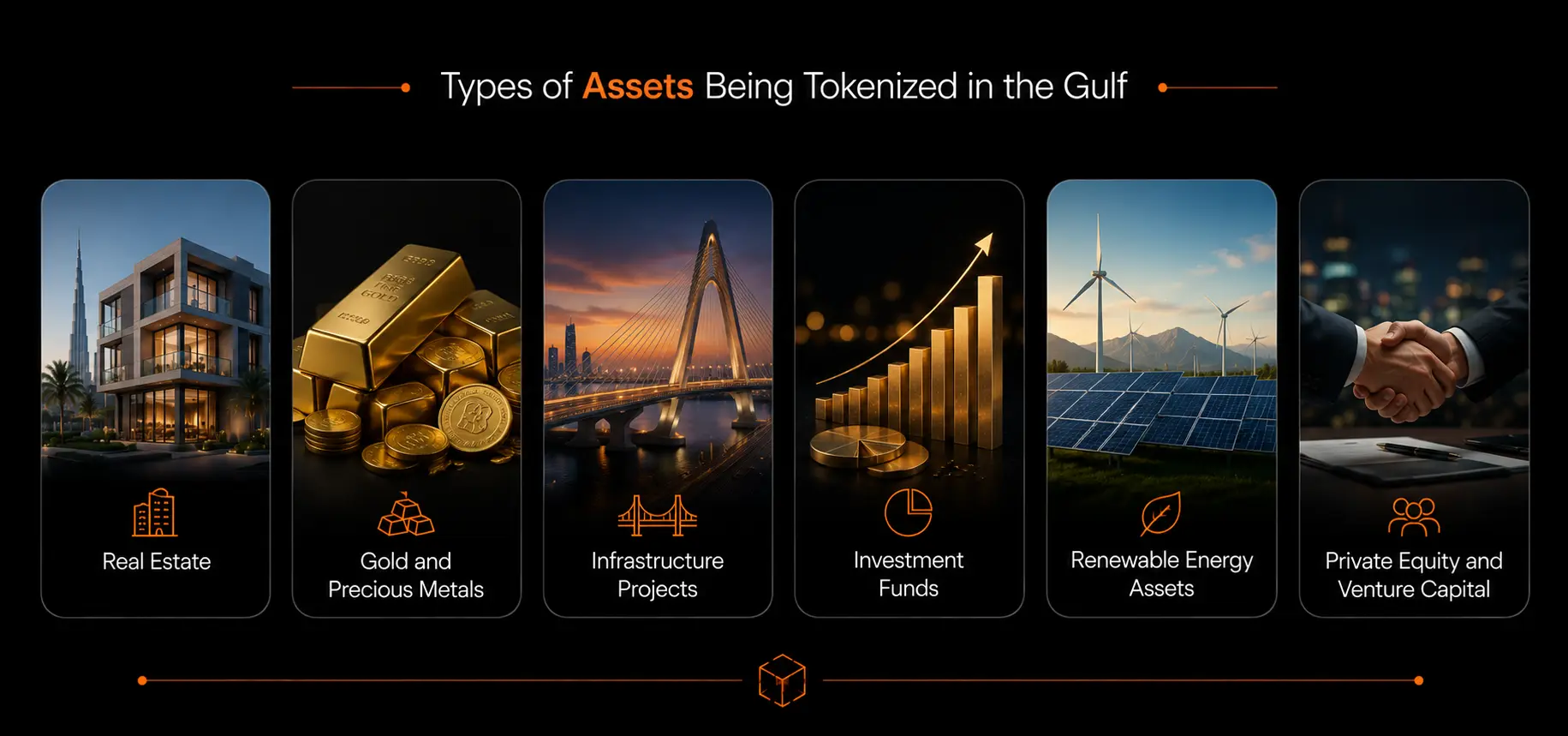
Types of Assets Being Tokenized in the Gulf
The financial industry is not the only sector undergoing transformation through RWA tokenization. Businesses in the GCC are placing a range of tangible and financial assets on-chain to boost liquidity, attract investors, and simplify ownership.
1. Real Estate
One of the fastest-growing Gulf use cases is real estate on-chain tokenization. It allows property developers to divide residential and commercial assets into digital units of ownership, create new funding sources, and give investors access to prime real estate with less capital. Decision-makers can compare leading models in this guide to real estate tokenization platforms in Dubai.
2. Gold and Precious Metals
Gold continues to be one of the region’s preferred stores of value. Businesses can tokenize vaults of physical gold using blockchain technology to support fractional ownership, increase transparency, and simplify the purchase, sale, and transfer of ownership.
3. Infrastructure Projects
Major infrastructure projects often require significant capital. Tokenization allows companies to access a broader investor base and fund initiatives across smart cities, transportation, logistics, and renewable infrastructure.
4. Investment Funds
Asset managers are increasingly exploring tokenized investment funds to accelerate investor onboarding, improve ownership tracking, reduce administrative work, and strengthen transparency throughout the investment lifecycle.
5. Renewable Energy Assets
Tokenization is opening new investment opportunities in solar farms, wind projects, and other sustainable infrastructure by making long-term assets more accessible to investors.
6. Private Equity and Venture Capital
Institutional investors have historically dominated private markets. Fractionalized asset investment can expand access to selected venture capital and private equity opportunities while keeping participation within regulatory guidelines.
Build a Compliance-Ready RWA Tokenization Platform
Choosing the Right RWA Tokenization Platform in 2026
As RWA tokenization becomes a viable Gulf business strategy, choosing the right platform is just as important as choosing the right asset. Modern RWA blockchain platforms support compliance management, process automation, enterprise integration, and long-term growth. Reviewing the top RWA tokenization companies can help enterprises compare technical and compliance capabilities.
1. Regulatory Compliance
A trustworthy platform should adapt to changing laws in the UAE, Saudi Arabia, and the GCC. Audit trails, transaction tracking, permission controls, and identity verification help companies meet regulatory mandates and build investor confidence.
2. Smart Contract Automation
Modern platforms use smart contracts to automate profit distributions, ownership changes, and compliance checks. This improves asset management, reduces manual effort, and increases accuracy.
3. Enterprise Integration
The best tokenization platforms integrate with ERP software, CRM systems, banking infrastructure, and digital identity services. This allows firms to implement blockchain without disrupting current business operations.
4. Scalability and Security
As tokenized assets grow, businesses need platforms that can process higher transaction volumes without sacrificing security. Strong encryption, governance controls, secure infrastructure, and disaster recovery are essential. Secure investor access may also require dedicated crypto wallet development services.
5. Flexibility for Future Growth
Businesses should choose platforms that can accommodate new asset classes, evolving regulations, and expanding investor networks without requiring a complete technology rebuild.
Benefits for Investors and Enterprises
RWA tokenization creates value beyond asset digitization. It helps businesses raise capital more efficiently and gives investors better access, transparency, and flexibility. These blockchain tokenization benefits are driving adoption in the UAE, Saudi Arabia, and the wider GCC.
- Improved Liquidity: Tokenized assets can be transferred more efficiently than many traditional assets, creating better opportunities for qualified buyers and sellers.
- Fractional Ownership: Investors can access smaller portions of high-value assets, while businesses can reach a broader investor base.
- Greater Transparency: Blockchain records transactions on an immutable ledger, improving ownership visibility, record keeping, and auditing.
- Faster Transactions: Digital ownership and automated workflows reduce paperwork and manual approvals for eligible transfers.
- Lower Operational Costs: Smart contract automation reduces repetitive administrative work and improves operational efficiency.
- Access to Global Investors: Tokenization helps businesses reach eligible investors across multiple markets and attract foreign capital.
- Better Portfolio Diversification: Investors can access real estate, infrastructure, renewable energy, and private-market opportunities.
Some tokenized-asset ecosystems may also connect with DeFi development solutions to support programmable financial services, subject to applicable regulations.
Challenges & Considerations
RWA tokenization presents valuable opportunities and important responsibilities. Businesses should assess operational, technical, and regulatory factors before deploying real-world assets on blockchain.
| Challenge |
Why It Matters |
| Regulatory Compliance |
Digital asset regulations are evolving across the UAE, Saudi Arabia, and the wider GCC. Involving legal experts early can help businesses reduce compliance risks. |
| Asset Valuation |
Every tokenized asset needs a transparent ownership structure, accurate valuation, and reliable documentation to build investor confidence. |
| Cybersecurity |
Businesses must protect wallets, applications, APIs, and identity systems from cyber threats. Structured quality assurance services help identify critical platform issues before launch. |
| Investor Awareness |
Clear communication and educational resources are important for building trust and encouraging informed participation. |
| Technology Integration |
The platform should integrate smoothly with financial systems, ERP software, compliance tools, and reporting processes. |
Future Outlook for RWA Tokenization in the Gulf
RWA tokenization is expected to play a major role in the Gulf’s digital economy. Growing interest in stablecoin development is also expected to strengthen tokenized asset ecosystems across the region. Increasing institutional interest, evolving blockchain rules, and digital transformation investments are setting the stage for wider adoption.
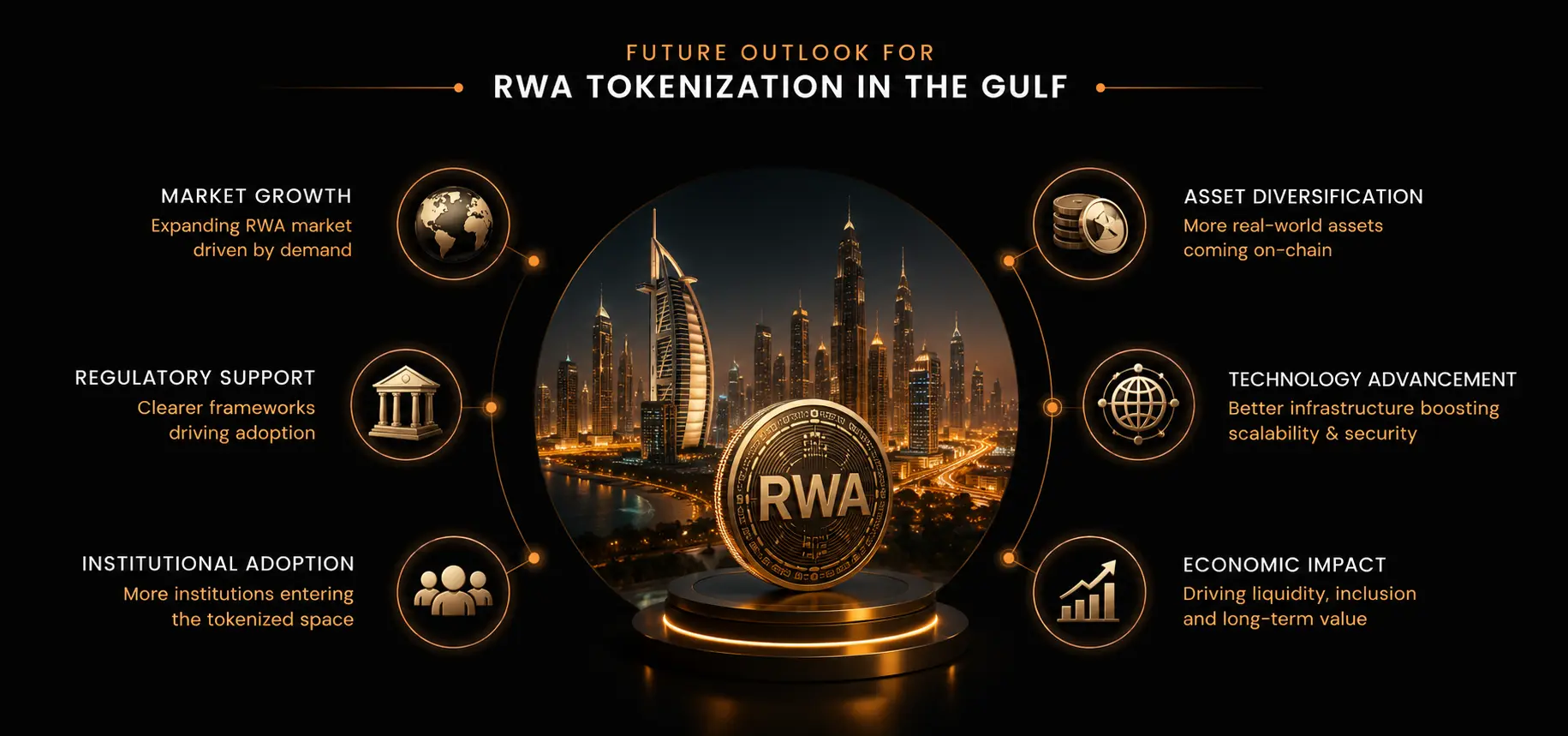
More collaboration between regulators, financial institutions, and technology providers will support the region’s digital asset ecosystem. This can give businesses more opportunities to raise capital and investors easier access to a wider range of investment opportunities. Property-focused investors can also study the returns and yields on UAE property tokens.
Conclusion: Why Gulf Enterprises Should Consider RWA Tokenization
RWA tokenization is transforming how businesses in the UAE, Saudi Arabia, and the wider GCC manage and invest in real-world assets. Companies are using blockchain to improve transparency, create new funding avenues, and increase operational efficiency. With enterprise adoption rising and regulations evolving, organizations that invest in secure, scalable, and compliance-ready platforms will be better positioned for long-term growth in the Gulf’s digital asset economy.
Frequently Asked Questions
1. What is RWA tokenization?
RWA tokenization is the process of converting ownership rights in real-world assets such as real estate, gold, or investment funds into digital tokens recorded on a blockchain.
2. Why are Gulf enterprises adopting RWA tokenization?
Businesses across the Gulf are adopting tokenization to improve liquidity, attract investors, streamline asset management, and support digital transformation.
3. Is Sharia compliance important for RWA tokenization in the Gulf?
Yes. Many investors and institutions in the UAE and GCC prioritize investments that align with Islamic finance principles. Sharia-compliant structures can improve trust and expand market participation.
4. Which assets are commonly tokenized in the Gulf?
Real estate, precious metals, infrastructure projects, investment funds, renewable energy assets, private equity, and digital securities are among the most commonly explored asset classes.
5. What are the benefits of RWA tokenization?
Key benefits include improved liquidity, fractional ownership, greater transparency, faster transactions, lower administrative costs, and access to a broader investor base.
6. Are there platforms for RWA tokenization in the UAE?
Yes. Blockchain technology providers and regulated digital asset platforms are developing enterprise-grade solutions for tokenizing real-world assets in the UAE.
7. What are common challenges in tokenizing assets?
Common challenges include regulatory compliance, cybersecurity, legal structuring, technology integration, asset valuation, and investor education.
8. How can investors participate in RWA tokenization?
Investors typically participate through regulated digital asset platforms that offer tokenized investment opportunities, subject to eligibility and compliance requirements.
9. How do smart contracts support RWA tokenization?
Smart contracts automate ownership transfers, compliance checks, revenue distribution, and transaction execution, reducing manual work and improving transparency.
10. Is RWA tokenization only for large enterprises?
No. Startups, property developers, investment firms, and SMEs can also explore tokenization based on their business model and regulatory requirements.
Launch Your Secure RWA Platform