WhatsApp
microsoft-logo
pg-logo
samsung-logo
stanford-university-logo
systique hughes logo
cashback-logo
luxel-logo
Frugi logo
athleta-logo-1
Funko Logo
hzm logo
swiggy-logo
cardano-logo
animaca
LLM Development: Turning Large Language Models Into Enterprise-Ready Systems

LLM Development: Turning Large Language Models Into Enterprise-Ready Systems

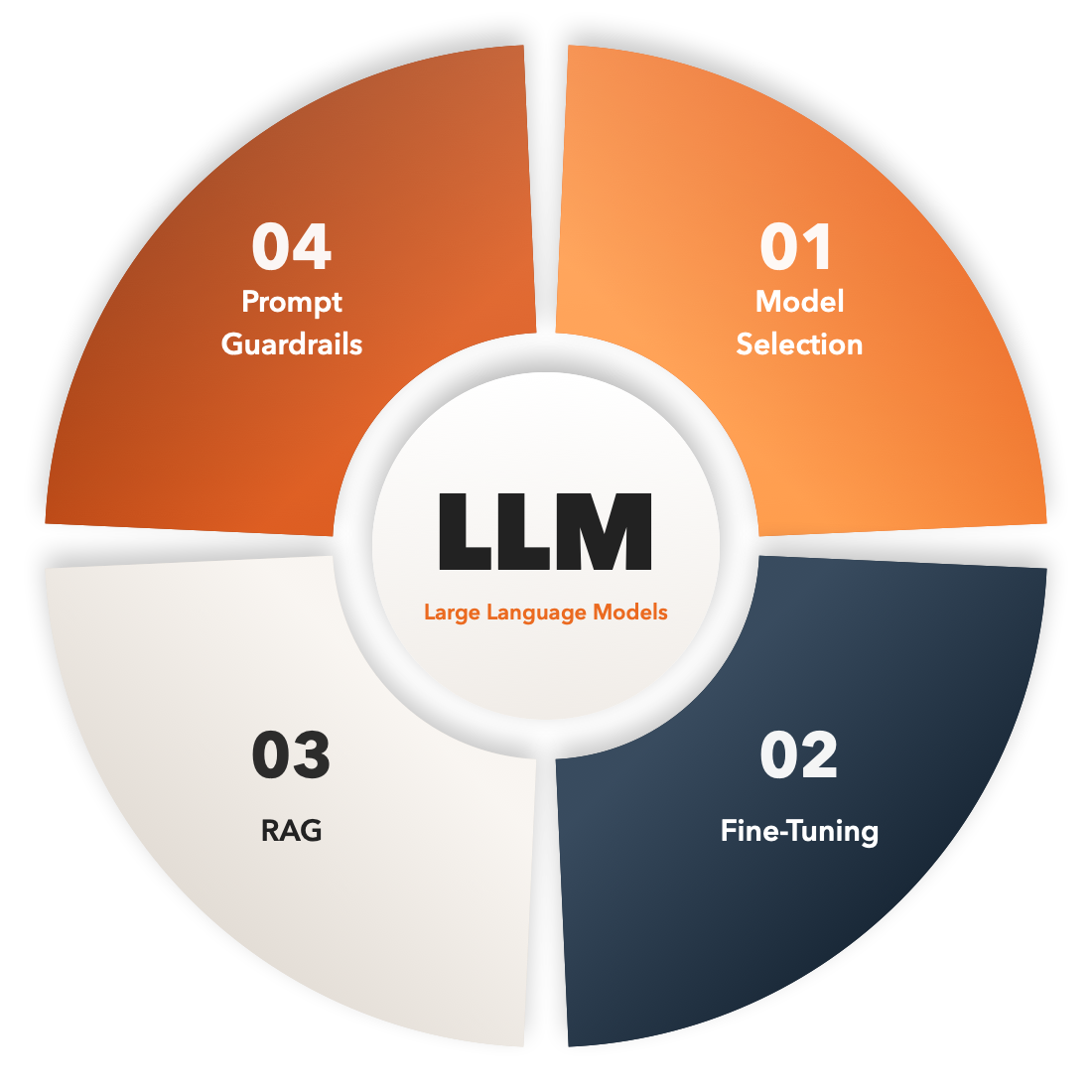
Large language model development is the process of selecting, adapting, integrating and running foundation models in real-world business settings. An enterprise LLM is not a chatbot demo. It has to work with existing applications, control of access, review standards, and proprietary data. Evaluation, monitoring and cost management are also important, along with robust LLM development to ensure outputs are reliable, auditable and accurate when relied on by real users and real decisions.

  • Foundation Model Selection Aligned With Business Goals Evaluate the accuracy, latency, cost, and data-sensitivity requirements of proprietary and open-source foundation models.
  • LLM Fine-Tuning and Adaptation Where appropriate, use LoRA or full fine-tuning to tailor transformer models to your terminology, formats and rules.
  • Retrieval Augmented Generation Respond with your documents. Each response must be traceable back to an approved source.
  • Prompt Engineering and Guardrails Structure prompts, validate outputs and enforce policy controls to maintain consistent behavior of users and applications.

Custom LLM Development Built Around Your Business

Most LLM initiatives start with a business problem, not a model preference. At ChicMic Studios, we develop custom complex language models based on the workflows, users and data your teams already use. Then we find the right combination of engineering, retrieval and models. You are not building a prototype that is unfit for production. You are building a solution that your organization can evaluate, control, and scale.

LLM Strategy Consulting

LLM Strategy Consulting

Consider build vs buy options, identify high value use cases and create a roadmap that ties to measurable outcomes.

LLM Readiness Assessment

LLM Readiness Assessment

Before development begins, review data quality, infrastructure, security requirements and integrations to identify gaps early.

Custom LLM Solutions

Custom LLM Solutions

Create language-model applications tailored to your own workflows, domain vocabulary and user roles, right out of the box.

Enterprise LLM Development

Enterprise LLM Development

Build governance from the start to scale language capabilities across departments, data sources and user groups.

Private LLM Development

Private LLM Development

Run models in your own cloud, VPC or on-prem environment where data sensitivity requires tighter control.

Ready to Build an LLM Solution Around Your Data?

Why LLM Development Requires More Than a Model

A large language model can write text, summarize documents, and answer questions, but it doesn’t know your policies, systems or risk limits. The enterprise assistant may still have to authenticate the employee, retrieve approved documents, apply policy rules, generate a cited response, log the interaction, and be observable after launch. That’s why the development of LLM software is focused on the entire environment around the model, not the model itself.

  • Data Reliable results are based on relevant, well structured and regulated data sources.
  • Applications The language capabilities should be compatible with the instruments that are currently used by employees and customers.
  • Integrations LLMs often exchange data with CRM, ERP, ticketing and document systems.
  • Security Authentication, authorization, and data protection are baked in from the start.
  • Operations Production LLMs require evaluation, monitoring, logging, cost tracking and regular maintenance.
Why LLM Development Requires More Than a Model

LLM Development Services for Complex Business Requirements

From LLM development services to LLM application development services, we cover every layer needed to take an idea to a reliable production system. We adapt the scope of our services to the current state of your organization and its future requirements.

Types of LLM Solutions We Develop

LLMs support very different requirements depending on an organization’s data, workflows, and risk tolerance. The most effective starting point is usually one well-defined use case with measurable outcomes, such as faster document review or fewer escalated support tickets.

Enterprise Chatbots and Assistants
Document Processing and Analysis

Deliver internal and customer-facing assistants that answer within defined guardrails.

Extract, summarize, classify, and structure information from contracts, reports, and unstructured content.

Assist with ticket triage, response drafting, and escalation, with human review where outcomes carry risk.

Assist legal, financial, medical, or technical work that depends on precise vocabulary.

Customer Service Automation
Domain-Specific Copilots
Enterprise Chatbots and Assistants Deliver internal and customer-facing assistants that answer within defined guardrails.
Document Processing and Analysis Extract, summarize, classify, and structure information from contracts, reports, and unstructured content.
Customer Service Automation Assist with ticket triage, response drafting, and escalation, with human review where outcomes carry risk.
Domain-Specific Copilots Assist legal, financial, medical, or technical work that depends on precise vocabulary.

Benefits of Custom LLM Development

The business benefits of LLMs are dependent on the use case, quality of the implementation and user adoption. Instead of isolated experiments, models related to measurable workflows can deliver operational and strategic outcomes.

Enterprise AI Automation

Enterprise AI Automation

Reduce manual effort required for defined repetitive language based tasks in the support and operations teams.

Improved Business Efficiency

Improved Business Efficiency

Help employees to effectively search, summarize, draft and analyze information in their daily work.

Personalized AI Solutions

Personalized AI Solutions

Tailor tone, format, and knowledge to your brand, users, and roles through fine-tuning.

Intelligent Automation

Intelligent Automation

Combine APIs, business rules, and language understanding to streamline everyday workflows.

Enhanced Customer Experience

Enhanced Customer Experience

Provide faster, more consistent, contextual responses across support and service interactions.

Scalable AI Solutions

Scalable AI Solutions

Extend the capabilities of well-established teams via reusable architecture and evaluation approaches.

Secure Enterprise AI

Secure Enterprise AI

Ensure the security of sensitive data through access policies, private deployment, and audit logging.

Reduced Operational Costs

Reduced Operational Costs

Control costs with routing, caching, usage monitoring and model selection.

How Does LLM Development Work?

The LLM development lifecycle is most effective as a staged procedure rather than a single build. Each stage reduces uncertainty before more money is committed, so your team and stakeholders will get early proof points of real data.

LLM Requirements Analysis

Define the risk limits, success metrics, workflows and the users that the solution must fulfill.


LLM Architecture Design

Build the security, retrieval, integration and model layers around your environment.

Data Collection and Preparation

Collect, order, scrub and tag the data that the model will learn from or pull.

LLM Model Selection

Evaluate the accuracy, latency, cost, and deployment limitations of foundation models.

LLM Pre-Training and Fine-Tuning

Pre-train only if necessary, then adapt the model with LoRA or full fine-tuning.

Prompt Engineering

Design structured prompts and output validation that keep behavior consistent.

RAG Implementation

Connect the model to your documents with vector search, embeddings and citation tracking.

LLM Testing and Evaluation

Benchmark accuracy, latency, cost, and hallucination behavior, then tune.

LLM Deployment

Connect the systems you need and deploy the software into your on-prem, hybrid or cloud environment.

LLM Monitoring and Optimization

Use production metrics and user feedback to help manage costs, make rapid updates and retrain.
How to Integrate LLMs Into Existing Enterprise Systems

How to Integrate LLMs Into Existing Enterprise Systems

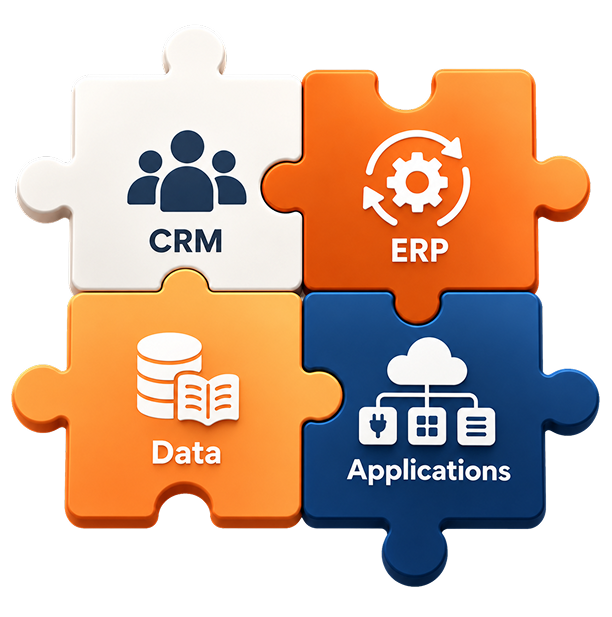
LLM integration services add language capabilities to the software, data and workflows your organization already uses so employees don’t have to buy or learn a separate tool.
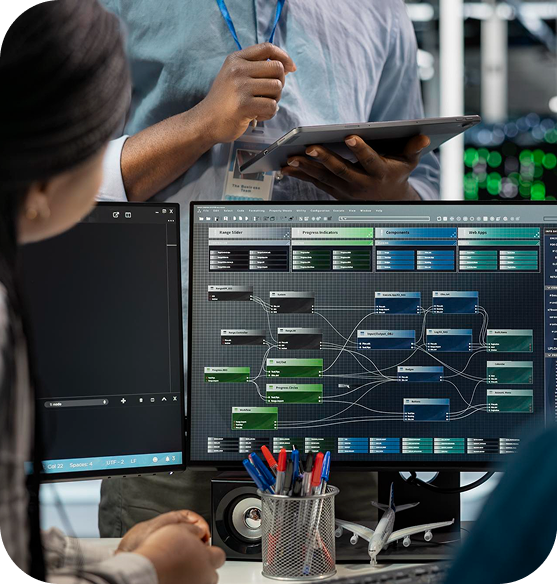
  • CRM Integration Support sales and service teams with summaries, drafted responses and customer information from approved CRM records.
  • ERP Integration Implement document processing and analysis in accordance with approved operational and financial procedures, e.g., purchase orders and invoices.
  • Data Platform Integration LLM applications connect to warehouses, databases, and document repositories with governed, permission-aware access.
  • API, SaaS, and Internal Application Integration Leverage APIs, middleware, and webhooks to incorporate language capabilities into existing portals, dashboards, and internal tools.
LLM Architecture: From Data to Intelligent Applications

LLM Architecture: From Data to Intelligent Applications

An LLM production system is generally a multi-layered system, with each layer having its own design, testing, and ownership. It also allows future modifications to the system, because individual components can be replaced without having to redesign the entire system.
  • Data Layer Databases, documents, knowledge bases, and APIs supply the information LLM workflows rely on.
  • Model Layer Depending on the task specifications, transformer models (either proprietary, open-source or fine-tuned) are selected and combined.
  • Retrieval and Knowledge Layer Embeddings, indexing, and vector search connect responses to relevant source content.
  • Application and Integration Layer Interfaces, APIs, and connectors provide users and systems with access to LLM capabilities.
  • Security and Operations Layer Access control, logging, evaluation and monitoring, enabling safe and manageable production use.
LLM Security, Governance, and Data Protection

LLM Security, Governance, and Data Protection

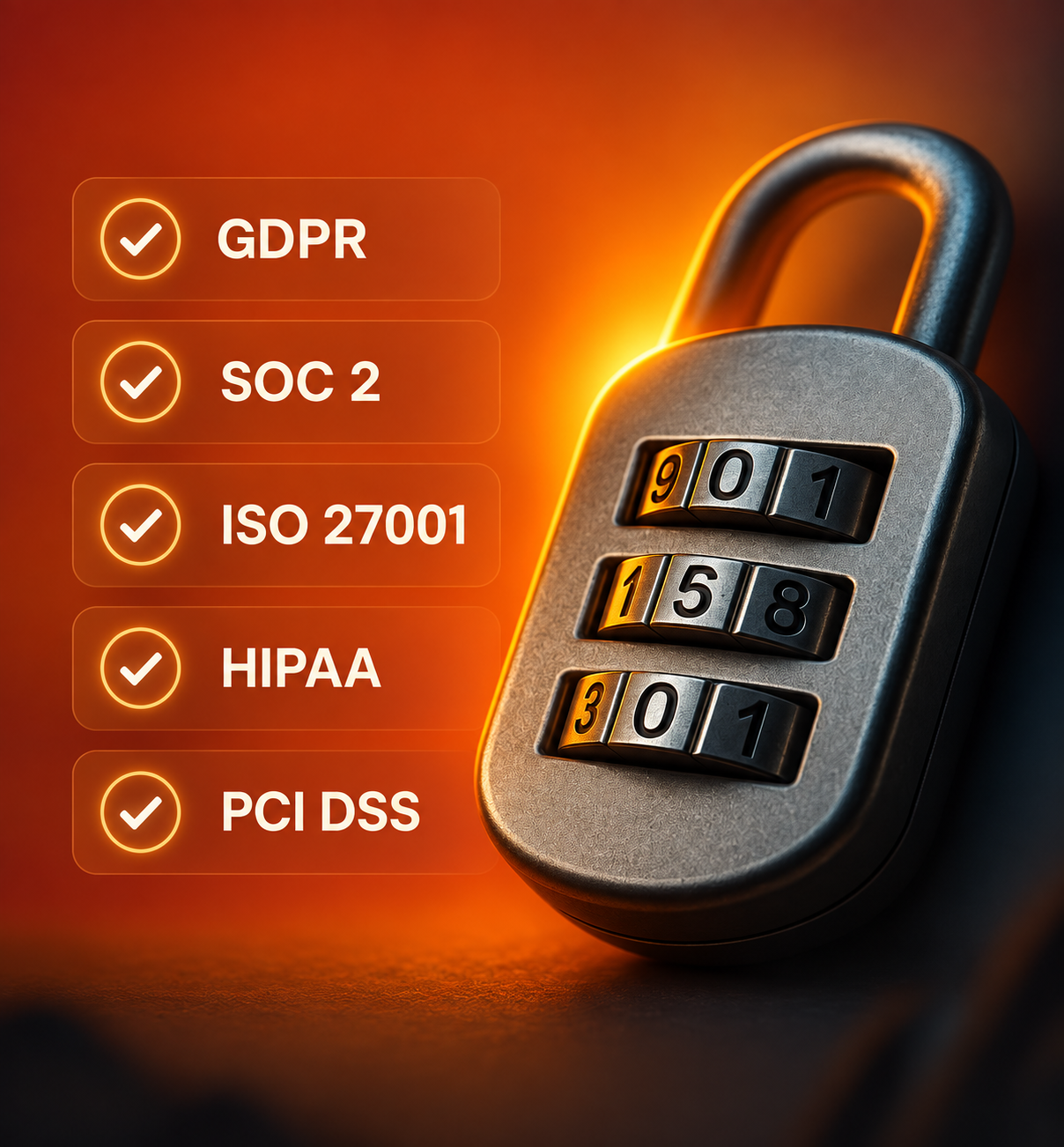
LLM applications may process confidential business information, customer records, intellectual property, or regulated data. Security and governance requirements are therefore defined during discovery and built into the architecture rather than added before launch.

  • Authentication and authorization
  • Role-based access controls
  • Controlled data access
  • Secure API integrations
  • Data encryption
  • Environment separation
  • Audit logging
  • Output evaluation
  • Usage monitoring
  • Secure deployment practices
  • Data retention planning
  • Human oversight

LLM Development Across Industries

LLMs apply wherever organizations manage large volumes of documents, repetitive communication, specialized knowledge, or complex review processes.


Healthcare and Life Sciences
Finance and Banking
eCommerce and Retail
Education
Legal
Real Estate and Insurance
Manufacturing and Logistics
Customer Service
01

Healthcare and Life Sciences

Healthcare LLM development supports clinical and administrative teams with drafting documentation, summarizing research and retrieving information from approved sources. These outputs are reviewed by qualified professionals before they are used to make decisions about patient care.

  • Clinical documentation
  • Research summaries
  • Patient assistance
02

Finance and Banking

Finance LLM development and banking LLM development are being developed to help compliance, risk and service teams review policies, regulations and customer queries. These LLMs generate traceable outputs that reviewers can verify before affecting a decision or customer communication.

  • Compliance review
  • Document intelligence
  • Customer support
03

eCommerce and Retail

eCommerce LLM development and retail LLM development enhance product discovery and customer support by answering questions based on current catalogs, policies, and order data. This guaranties uniform responses for service agents and shoppers as inventory and offers evolve.

  • Product discovery
  • Catalog search
  • Support automation
04

Education

Education LLM development helps students, teachers and administrators find answers in course content, manuals and school policies. This facilitates the creation of content and study aids, allowing educators to retain control over standards, accuracy, and learning outcomes.

  • Course Q&A
  • Policy search
  • Content generation
05

Legal

Legal LLM development speeds up contract review, clause comparison and research by highlighting relevant passages and linking to sources, and gives lawyers and advisors the ability to quickly verify each output before relying on it in client work.

  • Contract analysis
  • Legal research
  • Document review
06

Real Estate and Insurance

Insurance LLM development and Real Estate LLM Development helps teams sift through policies, leases, inspection reports and claims documents, so they can respond to routine inquiries more quickly, while still remaining connected to the underlying record for review.

  • Lease analysis
  • Policy search
  • Claims support
07

Manufacturing and Logistics

Manufacturing LLM development and logistics LLM development turn equipment manuals, quality records, shipping documents and operating procedures into searchable guidance, helping plant and operations teams get faster responses to questions with answers that can be traced back to the source documents.

  • Maintenance manuals
  • Quality documentation
  • Shipment records
08

Customer Service

The customer service LLM under development will help agents respond faster and more consistently by supporting ticket triage, drafted responses, and escalation routing. Human review continues to be used for sensitive, high-value or high-risk customer interactions.

  • Ticket triage
  • Response drafting
  • Agent assistance
Why Choose ChicMic Studios as Your LLM Development Partner?

Why Choose ChicMic Studios as Your LLM Development Partner?

ChicMic Studios treats LLM development as a tech and product problem, not a model selection problem. Our teams combine AI, data engineering and application development to make sure your solution integrates well with the systems and people that will use it every day.

We analyze your workflows, users and quantifiable objectives before deciding on the right technology.

Based on what you need, solutions can be built on your own proprietary APIs, open source models, or a mix of both.

Instead of making assumptions, we use benchmark results to inform our model and prompt decisions.

Our solutions are designed around the systems that your teams are using today, such as internal portals, ERP & CRM.

Partner with us through consulting engagements, dedicated teams or project-based delivery.

Build Your LLM Solution With ChicMic Studios

Move from experimentation to production-ready language AI with a development approach shaped by your data, systems, workflows, and governance requirements.

LLM Development Cost and Pricing

LLM development cost depends on the complexity and the scale of the solution. The infrastructure, the data work, and the engineering to support a readiness assessment, an internal knowledge helper, a fine-tuned domain model, and a private multi-system platform are not the same.

How Much Does LLM Development Cost?

01

$5K – $20K

LLM Strategy and Readiness Assessment

2–4 weeks

02

$15K – $40K

LLM Proof of Concept

4–8 weeks

03

$35K – $90K

RAG Assistant / LLM MVP

8–14 weeks

04

$50K – $120K

Fine-Tuned Model Solution

10–18 weeks

05

$80K – $180K

Enterprise LLM Application

14–24 weeks

06

$150K – $350K+

Private LLM Platform

20–36+ weeks

What Affects LLM Development Cost?

Model Strategy
The cost of the usage and development of proprietary APIs and open source models differs.
Fine-Tuning Scope
LoRA is less computationally expensive than full fine tuning.
Data Preparation
The engineering effort is augmented by cleaning, structuring and labeling of data.
Integrations
CRM, ERP and legacy connections increase development and testing time.
Deployment Model
VPC or on-premises hosting requires additional infrastructure work.
Evaluation and Governance
Testing and documentation are subjected to more rigorous review requirements.
Ongoing Support
The cost of the lifecycle is affected by revisions, retraining, and monitoring.
  • Model Strategy
    The cost of the usage and development of proprietary APIs and open source models differs.
  • Fine-Tuning Scope
    LoRA is less computationally expensive than full fine tuning.
  • Data Preparation
    The engineering effort is augmented by cleaning, structuring and labeling of data.
  • Integrations
    CRM, ERP and legacy connections increase development and testing time.
  • Deployment Model
    VPC or on-premises hosting requires additional infrastructure work.
  • Evaluation and Governance
    Testing and documentation are subjected to more rigorous review requirements.
  • Ongoing Support
    The cost of the lifecycle is affected by revisions, retraining, and monitoring.

Ready to create an impact?

Let’s talk
about
your project

The cost of development depends on the scope of the solution, the readiness of the data, the requirements for.

username

email

mobile

security badge Your Idea is Fully Protected By Our Non Disclosure Agreement (NDA)
Requirement

Frequently Asked Questions

Find answers to your business inquiries in our comprehensive FAQ section.

LLM development is the practice of selecting, customizing, combining, evaluating, and deploying large language models for business applications (e.g., fine-tuning, RAG, prompt engineering, monitoring, etc.).

It is performed by means of a series of steps like requirements, architecture, data preparation, model selection, adaptation, testing, deployment and monitoring. Evidence is collected at each step.

Custom LLM development involves fine-tuning, retrieving and designing prompts for a foundation model to match your data, terminology and business rules.

Fine-tuning is the continuation of training a pretrained model on domain data. LoRA has a lower computational cost, while full fine-tuning can adapt more widely at a higher cost.

Retrieval augmented generation connects a model to your documents at query time, so you can cite up-to-date sources for the answers without retraining.

There is no cookie cutter model. We evaluate the options in terms of accuracy, latency, cost, data sensitivity and deployment constraints before making a recommendation.

Yes. Fine-tune, RAG, guardrails and prompt engineer to adapt output format, tone, knowledge and rules to your workflows.

The cost will depend on the scope, the readiness of the data, the fine-tuning, the integrations and the deployment. A private platform might run several hundred thousand dollars, and a proof of concept could run tens of thousands of dollars.

A proof of concept can take a few weeks but production systems with complex data and integrations can take a few months.

Look for engineering depth beyond prompts, evidence-based evaluation, integration capability and a phased approach that shows value early.