AI Automation in Saudi Energy: Oil & Gas 2026
Key Takeaways:
- Core Value: AI automation is already delivering measurable improvements in efficiency, safety, cost control, and sustainability across Saudi oil and gas operations.
- Business Impact: Predictive maintenance, real-time monitoring, and intelligent optimization are reducing downtime, lowering operating costs, and improving asset reliability.
- Use Cases: AI is actively used across exploration, drilling, production, refining, logistics, and maintenance to enhance visibility, accuracy, and decision-making.
- Sustainability Gains: AI supports energy efficiency, emissions reduction, water optimization, and waste minimization while maintaining production performance targets.
- Future Direction: Beyond 2026, AI will move toward autonomous operations, integrated digital twins, and real-time optimization across entire energy networks.
AI in Saudi Oil & Gas: From Concept to Operational Reality
AI in Saudi oil & gas automation is no longer a futuristic concept. It already affects Saudi Arabia’s exploration, production, refinement and management of energy. With its digital transformation speeding up under Saudi Vision 2030, AI automation is emerging as one of the most valuable technologies to enhance productivity, safety, and sustainability in the energy industry. Many Saudi energy operators now rely on AI development expertise to operationalize predictive analytics at scale.
A lot of the first stage of AI adoption was related to data visibility. The trend will be towards intelligence at scale by 2026. Machine learning oilfield operations, autonomous decision support and real-time monitoring AI systems are now a direct part of oilfield operations, refineries and energy infrastructure throughout Saudi Arabia. Advanced machine learning models play a key role in analyzing seismic, drilling, and production datasets. This article discusses AI automation, its current state, usage in Saudi oil and gas operations and its prospects after 2026. Modern machine learning solutions help energy companies identify hidden operational patterns and improve predictive decision-making across large-scale oilfield data.
Introduction: AI Meets Energy in Saudi Arabia
Saudi Arabia has always worked at a scale where small improvements in efficiency generate huge value. This is an ideal application for AI in Saudi oil & gas automation. The sector generates vast amounts of data from pipelines, refineries, drilling systems, and sensors. Real-time monitoring AI systems often integrate tightly with IoT app development frameworks across oilfield assets. Thanks to AI, that data can now be used in real time.
Energy operators are moving from reactive to predictive and autonomous technologies, rather than responding to problems as they occur. The difference is clear, from digital twins in upstream oil to AI predictive analytics in energy. The intelligence is closing in on the real operation. In addition, the shift is in line with national objectives of workforce modernization, emissions reduction and energy optimization.
Why AI Matters for Oil & Gas Automation?
Oil and gas industry operations are complex, expensive, and very prone to downtime. Traditional automation provided for improved operational control, but is still reactive by nature. With AI, you gain foresight. It learns continuously from your operational data, identifies patterns at a scale humans can’t compete with, and makes better decisions in real time. Autonomous decision support systems are frequently built using scalable python development environments. This change has made AI a necessity for Saudi Arabia’s modern-day energy operations, instead of a luxury. Integrating AI with IoT application development enables continuous monitoring of connected equipment, pipelines, and industrial sensors in real time.
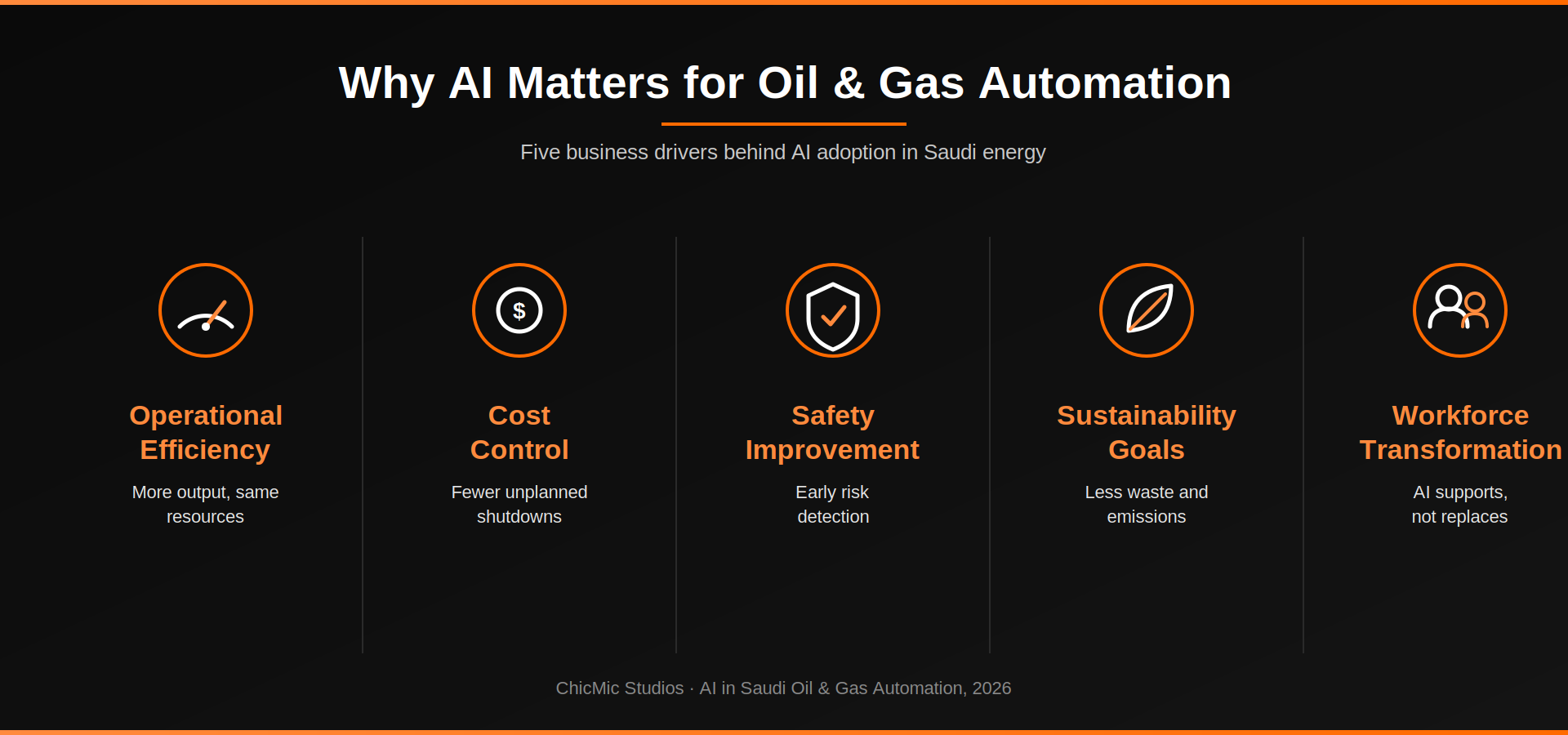
Key Business Drivers Behind AI Adoption
| Driver |
Why it matters in KSA energy |
| Operational efficiency |
AI optimizes production without increasing resource input |
| Cost control |
Predictive maintenance reduces unplanned shutdowns |
| Safety improvement |
Real-time monitoring AI systems identify risks early |
| Sustainability goals |
AI helps reduce waste, emissions, and energy loss |
| Workforce transformation |
AI supports engineers rather than replacing them |
Energy industry AI optimization is now directly tied to competitiveness, not experimentation.
AI Use Cases in Saudi Oil & Gas
AI is used in Saudi Arabia’s energy sector not to experiment with the theoretical, but because it’s operationally necessary. Most deployments are focused on improving existing workflows by increasing visibility, accuracy and responsiveness. AI-driven asset visibility depends on secure and optimized database development foundations. This allows operators to enhance performance, reliability and safety without replacing proven technology or interrupting critical production processes.
Common AI Use Cases Across the Value Chain
| Area |
AI application |
| Exploration |
Machine learning oilfield operations analyze seismic data |
| Drilling |
Autonomous drilling and sensor AI improve accuracy |
| Production |
Digital twin in upstream oil simulates field behavior |
| Refining |
Smart automation for oil & gas refineries improves yield |
| Logistics |
AI forecasting optimizes storage and transportation |
| Maintenance |
AI oilfield maintenance solutions predict failures |
These use cases are being rolled out incrementally, often starting with high-impact assets. Many organizations also leverage AR application development to visualize digital twins and support maintenance teams with interactive field inspections.
Predictive Maintenance: Minimizing Downtime and Cost
In the oil and gas sector, predictive maintenance is often the first clear ROI for AI. Equipment failures can result in production losses, emergency repair costs and safety hazards. AI predictive analytics in the energy sector uses past and present data to detect early signs of failure, allowing teams to act before malfunctions occur and costs increase. Predictive maintenance platforms are commonly deployed alongside enterprise-grade DevOps pipelines for faster updates.
Benefits of AI-Driven Predictive Maintenance
- Fewer unplanned shutdowns and production losses
- Lower maintenance costs by avoiding emergency repairs
- Longer equipment life and delayed capital replacements
- Improved safety through early risk detection
- Smarter spare parts planning and inventory control
AI oilfield maintenance solutions are now considered core infrastructure rather than experimental tools. Some enterprises also integrate intelligent AI chatbots to help engineers instantly retrieve maintenance records, equipment status, and troubleshooting recommendations.
AI for Sustainability and Energy Efficiency
Sustainability has become a priority. It is included in the operational KPIs for all Saudi energy projects. AI improves energy efficiency in plants, cuts flaring and optimizes fuel use. Digital twins in upstream oil models are used to simulate environmental impacts of any changes in operations.
How AI Supports Sustainability Goals
- Energy Consumption Optimization: AI looks at how the plant is running, and finds ways to reduce wasted energy, balance the loads and use less fuel, all without reducing output levels.
- Emissions Monitoring and Reduction: AI monitors emissions data, detects unusual trends, helps reduce flaring and allows for timely corrective actions across facility operations in a safe way.
- Water Usage Optimization: AI supports water usage by tracking usage, detecting leakages, improving recycling processes and helping appropriate water management decision-making across assets.
- Waste Minimization: AI reduces operational waste by increasing process efficiency, forecasting the amount of material lost and promoting cleaner, more sustainable operations across sites.
- Smarter Asset Lifecycle Management: AI extends the life of assets through simplified maintenance plans, preventing early replacements and improving the reliability of equipment on energy assets for the long term.
These capabilities directly support Saudi Vision 2030 digital energy objectives without compromising production performance.
Challenges in Implementing AI Automation in Energy
The oil and gas industry is slowly adopting AI in Saudi Arabia but there are still some people reluctant to apply it. The problems are with organizational readiness, legacy environments, and governance needs that need to change with the rollout of AI, not the technology itself.
Key Challenges
- Data Quality Gaps: Many assets were not created for AI-driven analytics, so inconsistent, incomplete or improperly formatted data limits the accuracy of the model.
- Legacy System Integration: Integrating today’s AI platforms with legacy control systems, sensors and infrastructure requires time, customization and deliberate operational planning.
- Talent and Expertise Shortage: In addition to data science skills, effective AI systems require domain knowledge, technical supervision, and operational understanding.
- Change Management: Transitioning from reactive operations to decision-making enabled by AI requires cultural buy-in and trust in data-driven insights.
- Cybersecurity Risks: As AI systems connect more resources and data sources, securing models, data pipelines and operational networks becomes more important.
The success of AI in the energy sector depends on tackling these issues at the same time as implementation. Early investment in data foundations, people and governance makes a big difference to businesses chances of getting scalable and reliable results from AI automation.
Future Outlook: AI and Energy in Saudi Arabia Beyond 2026
Post 2026, AI automation will shift towards autonomous activities. Human oversight will be secondary to decision execution (rather than decision support).
You can expect to see greater use of fully integrated digital twin environments, autonomous drilling and sensor AI, and real-time optimization across whole energy networks. Saudi Arabia has the benefit of size. As AI models are trained on larger and more varied datasets over time, they become more valuable and accurate.
Conclusion: The Road Ahead for AI in Energy
Artificial intelligence is definitely past the point of adoption in Saudi oil and gas automation. Many enterprises validate AI maturity by reviewing relevant AI portfolio implementations across industries. It is also delivering measurable gains in sustainability, cost control, safety and efficiency, in addition to preparing the industry for future more autonomous operations. As Saudi Arabia progresses its energy transition under Vision 2030, organizations that connect AI strategy with operational priorities, compliance requirements, and workforce readiness will be best positioned to shape the next wave of intelligent, resilient energy systems.
Frequently Asked Questions
1. What is AI automation in oil and gas?
AI automation in oil and gas refers to using machine learning, predictive analytics, and real-time monitoring systems to improve exploration, drilling, production, refining, maintenance, and logistics by making operations more predictive, efficient, and reliable.
2. How does AI help energy companies in Saudi Arabia?
AI helps energy companies in Saudi Arabia optimize production, reduce downtime, improve safety, lower operating costs, support sustainability goals, and make faster, data-driven operational decisions across the energy value chain.
3. What real AI use cases exist in Saudi energy?
Real AI use cases include seismic data analysis in exploration, autonomous drilling systems, digital twins for production optimization, smart automation in refineries, AI-based logistics forecasting, and predictive maintenance for critical equipment.
4. Is AI in oil & gas costly to implement?
Initial AI deployment requires investment in data infrastructure and integration, but most projects focus on high-impact assets. Cost savings from reduced downtime, lower maintenance spend, and efficiency gains often outweigh implementation costs.
5. How does AI improve safety in energy operations?
AI improves safety by monitoring equipment and environments in real time, identifying early warning signs of failure or hazardous conditions, and enabling proactive intervention before incidents or accidents occur.
6. What’s next for AI in Saudi energy?
Beyond 2026, AI is expected to move toward more autonomous operations, including self-optimizing production systems, advanced digital twins, autonomous drilling, and real-time optimization across entire energy networks.
7. Does AI replace human workers in oil and gas?
No, AI supports engineers and operators by handling complex data analysis and repetitive monitoring tasks, allowing human teams to focus on decision-making, oversight, and strategic planning.
8. How does AI support sustainability goals in energy?
AI helps reduce emissions, cut flaring, optimize fuel and energy use, manage water consumption, and minimize waste, supporting sustainability targets without compromising production performance.
9. What challenges do companies face when adopting AI in energy?
Common challenges include data quality issues, integrating legacy systems, talent availability, and ensuring governance, cybersecurity, and explainability alongside AI deployment.
10. When should energy companies start adopting AI automation?
Energy companies should adopt AI when operational complexity, downtime risk, cost pressures, or sustainability targets require better visibility and predictive decision-making at scale.