AI Application Architecture

Design application architectures that connect AI models with APIs, databases, backend services, user interfaces, and supporting infrastructure.



















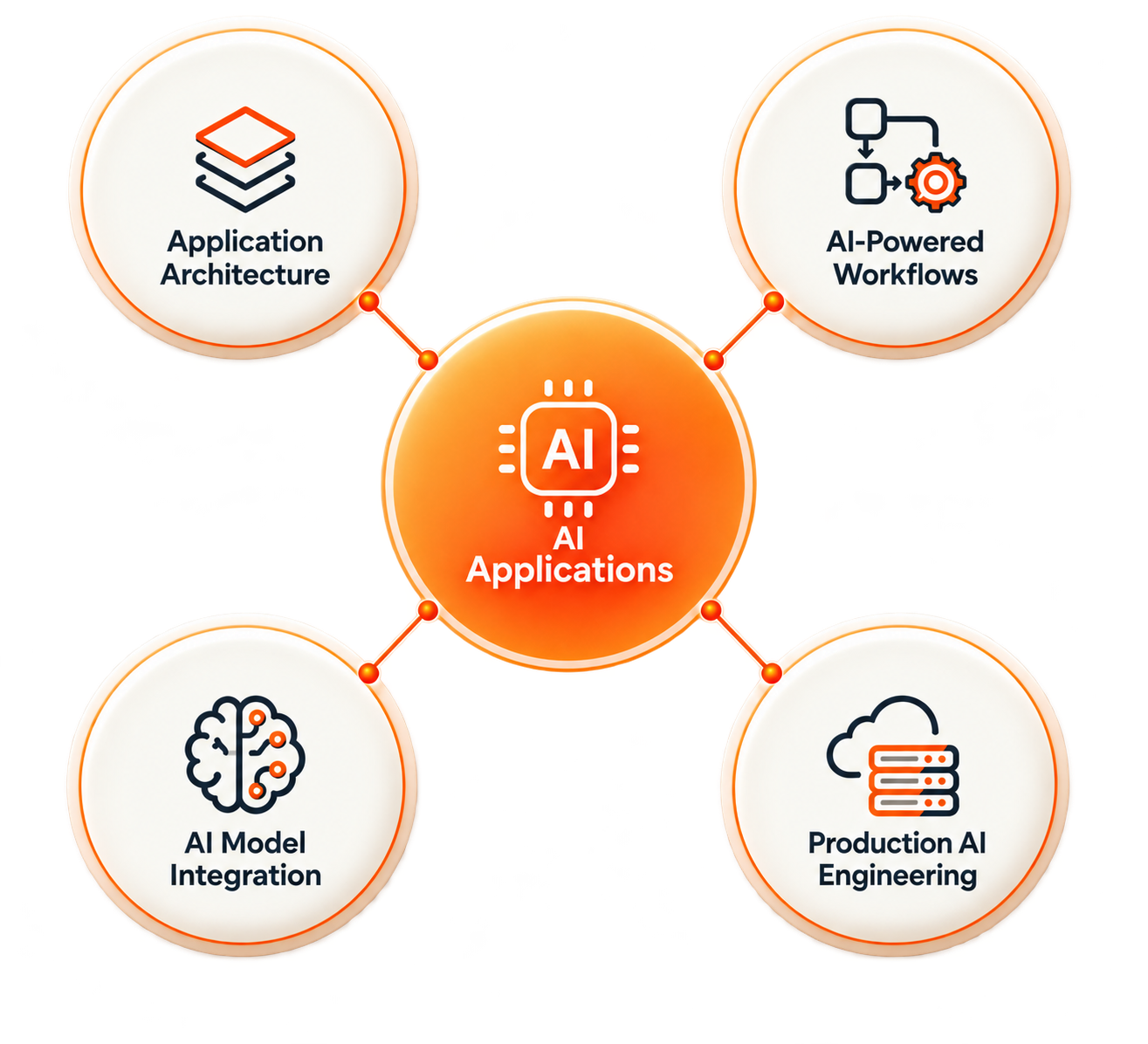
AI application development transforms artificial intelligence technologies into usable software products that solve specific business and customer problems. Instead of treating an AI model as a standalone component, effective AI applications combine models with application logic, data, APIs, interfaces, business workflows, and security controls.
At ChicMic Studios, we combine AI capabilities with application engineering to develop solutions that can move from an initial concept or AI MVP toward production deployment.

We develop AI applications around real product requirements, user workflows, integrations, performance expectations, and deployment environments rather than limiting development to an isolated AI demonstration.

Applications can be designed around existing AI APIs, foundation models, machine learning models, or combinations of AI technologies depending on the functionality required.

We connect AI capabilities to practical business use cases such as automation, personalization, intelligent search, customer support, recommendations, content generation, and data analysis.

AI functionality is developed alongside the application architecture so the product can evolve as users, data, functionality, and business requirements grow.

AI capabilities can be incorporated into existing mobile or web applications instead of requiring organizations to replace an entire product.

AI applications can be evaluated after launch using user feedback, application metrics, AI performance, and changing business requirements to identify opportunities for improvement.
AI applications can bring intelligence directly into the software employees and customers already use. The potential value comes from applying AI to specific workflows and measurable business activities rather than deploying AI simply as a technology layer.
AI applications can automate repetitive activities such as information extraction, document processing, classification, customer queries, and routine workflow operations.
Intelligent applications can reduce manual processes, accelerate information handling, and help teams complete defined workflows more efficiently.
AI can analyze relevant user behavior and preferences to support personalized recommendations, content, search results, and interactions.
AI-powered applications can process large amounts of structured and unstructured information to identify patterns, summarize information, and provide relevant insights.
Conversational AI, virtual assistants, recommendation systems, and intelligent support features can create more contextual digital experiences.
Automation and intelligent workflows can reduce repetitive manual effort and help organizations optimize selected operational processes.
AI copilots and assistants can help employees search information, summarize documents, generate content, and complete routine knowledge-work tasks.
AI capabilities can introduce new features, experiences, and business models that would be difficult to deliver through conventional application logic alone.
We build AI-powered applications across generative AI, machine learning, conversational AI, intelligent automation, predictive analytics, and AI-enabled business software.
Build applications that use generative AI for content creation, summarization, question answering, document analysis, ideation, translation, and other language or content-driven workflows.
Develop conversational applications that can answer questions, guide users, retrieve information, and support customer or employee workflows.
Create AI-powered agents capable of handling defined tasks, interacting with approved tools, retrieving information, and progressing through multi-step workflows.
Develop recommendation engines that personalize products, services, content, or other digital experiences based on relevant data and user behavior.
Use machine learning to support forecasting, classification, anomaly detection, risk analysis, demand prediction, and other data-driven use cases.
Develop applications that use image and video intelligence for recognition, analysis, inspection, classification, and visual search.
Build scalable AI SaaS products with intelligent functionality integrated into subscription-based digital experiences.
Create voice-enabled applications using speech recognition, voice processing, natural language understanding, and conversational interfaces.
Design application architectures that connect AI models with APIs, databases, backend services, user interfaces, and supporting infrastructure.

Prepare, transform, structure, and connect relevant data so applications can use business information effectively.

Connect AI applications with approved knowledge sources through retrieval systems, embeddings, vector search, metadata, and contextual information.

Integrate large language models into applications for conversational interfaces, content generation, summarization, reasoning-assisted workflows, and knowledge applications.

Coordinate AI agents, tools, APIs, and workflows for applications that require multi-step task execution.

Connect AI applications with existing APIs, databases, SaaS platforms, CRM systems, ERP platforms, and other business software.

Implement appropriate authentication, authorization, access controls, and application-level safeguards based on the solution's requirements.

Track application performance, AI behavior, usage, errors, latency, and other relevant metrics to identify opportunities for improvement.
Our services cover the complete AI application lifecycle, from initial consulting and product definition through development, integration, deployment, and optimization.
AI application development can support industries that work with large amounts of information, repetitive processes, customer interactions, complex decisions, or specialized workflows.






We organize AI projects around clear development stages so businesses can validate the technology and product direction before scaling the application.
We identify the business challenge, users, AI opportunity, available information, technical dependencies, and measurable objectives.
A focused proof of concept can validate the technical approach, selected AI technology, data requirements, and expected application behavior.
The validated concept is converted into a usable MVP containing the core AI functionality, interfaces, integrations, and workflows required to test the product with users.
The application is strengthened with appropriate architecture, security, testing, performance optimization, monitoring, and integration capabilities.
The AI application is deployed into the intended environment and connected to the systems and services required for operational use.
Application performance, AI output quality, usage, user feedback, and business results can be evaluated to guide future improvements and feature development.

We approach AI application development as a combination of artificial intelligence and software engineering rather than treating the AI model as the complete product.
Our approach combines AI functionality with application interfaces, backend systems, APIs, databases, and supporting software engineering.
Applications can use existing AI services, foundation models, machine learning models, or multiple technologies depending on the specific use case.
AI functionality can be connected with existing applications, APIs, business systems, and workflows to make intelligence part of the broader product ecosystem.
Our AI application development approach can cover consultation, product planning, UI/UX, development, AI integration, testing, deployment, and ongoing improvements.
The AI application development cost depends on the type of application, AI functionality, data requirements, integrations, platform, complexity, security requirements, and ongoing infrastructure.
$3k–$10k
1–3 weeks
$10k–$30k
3–6 weeks
$25k–$60k
6–12 weeks
$50k–$120k
12–20 weeks
$100k–$250k+
16–28+ weeks
$200k–$500k+
24–40+ weeks



Whether you're validating a new AI product or adding intelligence to an established software ecosystem, the development approach can be adapted to your stage and objectives.
Ready to create an impact?
The cost of development depends on the scope of the solution, the readiness of the data, the requirements for.

AI application development is the process of creating software that incorporates artificial intelligence capabilities such as machine learning, generative AI, natural language processing, computer vision, recommendation systems, or predictive analytics.
AI application development generally involves identifying the use case, defining requirements, selecting the appropriate AI technology, designing the application architecture, developing the software, integrating AI functionality, testing the application, deploying it, and continuously improving it.
Traditional applications primarily rely on predefined programming logic, while AI applications incorporate models or AI services that can analyze information, generate outputs, recognize patterns, understand language, make predictions, or support intelligent interactions.
The AI application development cost depends on the application’s complexity, AI capabilities, data requirements, integrations, platforms, security requirements, infrastructure, and development timeline. An AI MVP will generally require a different investment from a large enterprise AI application.
Development timelines vary according to scope. A focused AI proof of concept may take several weeks, while a production-grade AI application with multiple integrations and advanced functionality may require several months.
Data requirements depend on the AI use case. Applications built around existing foundation models may primarily require relevant business data for retrieval or contextualization, while custom machine learning solutions may require larger datasets for training and evaluation.
Yes. AI can be incorporated into existing mobile applications, web applications, SaaS platforms, and business software through APIs, model integrations, backend services, and other technical approaches.
AI application development can involve large language models, generative AI, machine learning, natural language processing, computer vision, speech technologies, recommendation systems, AI APIs, cloud services, databases, and application development frameworks.
Yes. Existing large language models can be integrated into applications for conversational AI, content generation, summarization, knowledge retrieval, document analysis, and other language-based use cases.
The decision depends on the use case. Pre-trained models can accelerate development when their capabilities match the application’s requirements. A customized or specialized model may be considered when the application requires domain-specific behavior, proprietary data, or specialized performance characteristics.
AI applications can be evaluated using representative datasets, predefined evaluation criteria, functional testing, AI output assessment, performance testing, security testing, and human review where appropriate.
Yes. AI applications can connect with ERP, CRM, databases, SaaS platforms, and other business systems through APIs, connectors, middleware, webhooks, and other integration approaches.
ChicMic can develop AI-powered mobile and web applications, generative AI applications, chatbots, conversational applications, recommendation systems, machine learning solutions, AI-enabled SaaS products, and applications that integrate AI into existing software.
AI application security can involve authentication, authorization, controlled data access, secure API integrations, encryption, application security testing, monitoring, and appropriate access controls based on the application’s requirements.
Post-launch activities can include application monitoring, performance optimization, AI output evaluation, infrastructure management, feature enhancements, maintenance, and model or integration updates when required.
An experienced AI application development company can combine AI expertise with product engineering, UI/UX, backend development, integrations, testing, deployment, and ongoing maintenance to create a complete application rather than an isolated AI model.
2026 © Copyright ChicMic Studios | Privacy Policy | Disclaimer